



Volleyballexercises for seniors
Last update: january 2026
Starting Formation
- Each player receives a number.
- Swiss ball in the centre.
- Players stand in a circle around the Swiss ball.
- Players move around the ball, sideways or backward-forward.
- When a number is called, the player responds, takes the ball, and throws it at the retreating players.
- Add-on: The player who is hit takes the Swiss ball and tries to hit another player.
- Move around the circle.
- Respond to changes in direction.
- Improve movement, enhance focus.
Setup
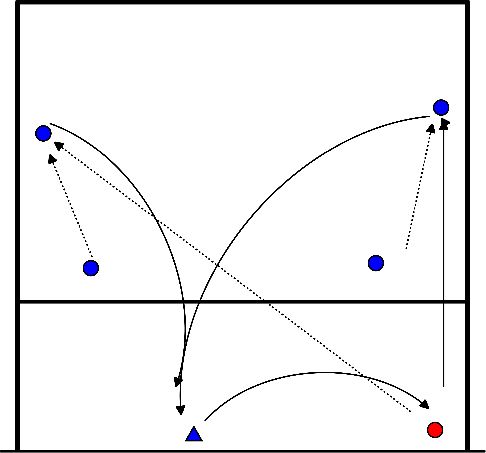
- One half of the court with 3 players:
- 1 setter
- 1 attacker in position 4
- 1 defender in position 5
- Start with a technical attack in position 5 using topspin and an extended arm.
- The defender moves from the first tempo backwards to the third tempo.
- Move backwards only after the setter has made contact with the ball.
- Defensive movement: right, left, right.
- Defence must occur along the line.
- No scoring is allowed along the line.
- Defence must be performed while stationary.
- Repeat with a technical attack in position 1 using topspin and an extended arm.
Objective
- Put pressure on the opponent with service and attack.
- Handle easy balls and quickly set up an attack.
- The coach throws the ball to the team of six players.
- The team of six builds an attack and must score from the rally pass.
- The team of four tries to prevent this by blocking and defending.
- Teams switch when the team of six scores 5 points.
- Each score by the team of six: 1 point.
- Each ball defended or blocked by the team of four: 1 point deduction.
- Each incorrect rally pass: 2 points deduction.
- Take responsibility.
- Get under the ball and play precisely.
- Make the pass, then move for the attack.
- Recognise and seize opportunities.
Execution
- The setter is ready with a ball cart.
- The setter is instructed to set the ball for themselves up to a maximum of 5 times.
- The attackers do not know how many times this will happen and can only start their approach after the set-up.
- The attackers must approach more aggressively and build more speed and height with a good braking step.
- If this goes well, the trainer can place the setter closer to the attackers to shorten the distance of the set-up.
Execution
- Divide the group into pairs. One person from each pair starts at the net, the other on the baseline.
- The players on the baseline have a ball, possibly with a reserve ball.
- The players at the net perform a block jump.
- After the block jump, they immediately turn around and defend a ball from the baseline player.
- The ball can be tapped, hit, or played in a fast manner.
- Note: turn around immediately after the block and assess the situation. Do not step in too quickly due to a potentially hit ball.
- Let the players at the net defend 10 balls, then switch roles.
Part 1
- 30 step-ups (step up and down from a bench)
- 15 push-ups (feet on the bench)
- 30 step-ups
- 15 Spiderman push-ups (pull one leg up like a frog while doing push-ups)
- 30 east-west step-ups (right foot on the bench, left foot next to it, then left foot on the bench, right foot next to it)
- 10 squat jumps (bend knees and jump as high as possible when extending)
- 30 east-west step-ups
- 10 squat jumps
- 20 lateral shuffles over 4 meters
- 10 split-squat jumps (jump and bend one knee, alternating knees each time)
- 20 forward and backward sprints over 4 meters
- 10 squat jumps
- After each part, take a short rest and then continue.
Setup
- 2 teams of 6, 8, 10, or 12 players.
- 1 player on the court, the rest stand behind the end line in the waiting area.
- The trainer introduces the ball into play to court A or B.
- Players may only play the ball underhand.
- After playing the ball, the player steps out and someone from the waiting area takes their place.
- In case of an error, the player ensures ball safety and encourages the team.
- If all players from one team are played out, the other team earns a point.
Exercise 1
- Each group of three has two balls.
- Two players stand at the net, a few meters apart.
- The third player stands in the backcourt.
- Players at the net alternately throw the ball at a fast pace.
- The player in the backcourt returns the ball underhand.
- The first ball is thrown deep.
- The second ball is thrown short.
- Throwers stand further apart.
- The player on the sideline throws deep, the other player throws short.
- After a certain number of balls or time, players switch positions.
Execution
- A serves to B.
- B passes the ball to the setter.
- The setter plays a high ball into the backcourt.
- B defends this ball back to the setter.
- The setter provides a setup for A.
- A attacks on this setup.
- After the attack, A takes B's position and B becomes a substitute.
- The setter remains in position.
- The outside hitters use the left half of the court with one setter.
- The middle hitters and opposite hitters use the right half with another setter.
- After the service, A picks up a second ball.
- After B's attack, A throws this ball into the court.
- B plays this ball to the setter.
- The setter provides a setup.
- B attacks once more.
Execution
- Form groups of three and give each group one ball.
- The player in the middle continuously runs a figure eight.
- Each time the player in the middle arrives back, a ball is thrown.
- Player A throws or plays the ball overhead to Player B in the middle.
- Player B plays the ball back underhand to Player A and then runs a loop around Player A until they are back in the middle.
- Meanwhile, Player A plays the ball overhead to Player C.
- Player C plays the ball overhead back to Player B.
- Player B plays the ball back underhand to Player C and then runs a loop around Player C until they are back in the middle.
- Repeat this cycle.
- After 2-3 minutes, switch the player in the middle.
- To make it easier, Players A and C can also throw the ball instead of playing it overhead.
- Both underhand and overhead throwing and catching are allowed.
- To practice standing still while playing or throwing, Player B can throw and catch underhand.
Working in pairs:
- throw up left/right
- throwing over from the neck, with and without bounce
- over smashing with bounce
- over smash with defense
- 1x own and then play
- 1x own and then smash
- try underhand crossover play:
- group 1. plays up and down and group 2/3. plays crossed
- group 3 plays up and down and group 1/2. plays crossed
- group 2 plays up and down and group 1/3. plays crossed
3 vs 3 game 2-touch.
- must play 2x
- underhand, overhand, no smash
- not in the 3 meter.
On the ball and without the ball.
2-pairs:
2-pairs:
- throw over 2 hands
- throw over 1 hand left/right alternately
- throw over with bounce
- smash with bounce
- smash with bounce, do not catch but play 1 x OH
- overtake underhand, pay attention to position
- play underhand, touch ground, stay low
- one player smashed, other plays OH back, after the play touch the ground and return low.
- one player smashed, other defends and plays to himself, the smasher taps ground and goes back low to defend
On the ball and without the ball.
2-pairs:
2-pairs:
- throw over 2 hands
- throw over 1 hand left/right alternately
- throw over with bounce
- smash with bounce
- smash with bounce, do not catch but play 1 x OH
- overtake underhand, pay attention to position
- play underhand, touch ground, stay low
- one player smashed, other plays OH back, after the play touch the ground and return low.
- one player smashed, other defends and plays to himself, the smasher taps ground and goes back low to defend
2-pairs:
- throw up 2 hands
- throw over 1 hand left and right alternately
- throw over with bounce
- smash with bounce
- smash with bounce, do not catch but play OH once
- OH pass, pay attention to position
- OH pass, touch ground, stay low
- one player throws on, other plays OH back, after playing touch pawn and return low
- One player touches hard
- OH overplay after player plays the ball, touch pawn, return low
Play in pairs from approx. 3m line to 7m line.
Net player always plays up 1x for himself, then back again.
Back player plays back in 1x and then does for himself successively:
- 5x Turn around on own spot.
- 5x To the back line, tap with 1 hand and return to 7m.
- 5x Sit on your buttocks and stand up again.
If the ball goes wrong: Start again at the last unsuccessful series of 5.
Change after 15x.
First round overhead, 2nd round underhand.
Trainer starts rally.
- Players must handle ball and rally.
Everything:
- defend
- moving along
- attack
- blocks
- conditionally
Move to a setter (at position 2)
- setter must take a defensive position immediately after the set
- is the attack outside, then the 2 other players must join immediately
- is the attack in the middle, apply the same.
Everything at high tempo and high quality
Pairs divide among the four squares in the field and play the following warm-up exercises in sequence:
- Balls are thrown the way it is caught. The one who throws the ball over the net goes to tap the wall at the back and returns. Foul or point is passed. Possibly with point scoring;
- Same, but now the ball is played back in one go with a volleyball technique;
- Ditto, only now the attack is made from behind the three-meter line and not tapped inside the three-meter zone;
- Ditto, anything goes and the box from which scores represent the number of points that can be earned.
- Two teams, whose players line up randomly in the field.
- Ball is caught and thrown back the same way.
- When the ball is thrown, the one who threw it goes to tap a wall.
- The other players turn in the meantime.
- Making a mistake means running around the field and rejoining the team.
- After a while, players play instead of throw.
- The one who played goes to tap the net and comes back.
- There is still a run through and a run around in case of a foul.
- Scoring can only be done between the three-meter line and the back line.
Organization:
- Make two teams of 5.
- Positions 2 (2x), 4, 5 and 1.
- Ball on P2.
Execution:
- Start by throwing ball with 2 hands from neck from 2 to 4.
- Catch at 4 and throw with 1 hand to 1.
- Catch and throw with 2 hands underhand on 3/6.
- Walking from 2 to 4: sidestep.
- From 4 to 5: backwards: shuffle.
- From 5 to 3/6 and through to 1: fast walk.
- From 1 to 2: fast walk.
Next:
- Bra from 2 to 4.
- Tight to 2 and there passes to 3/6.
- Bra from 3/6 to 2 and resume.
Organization:
- Triplets with 2 balls.
- Player without ball is the runner.
- Distance player with ball approximately 5 meters.
Execution:
- Player starts next to a player with ball.
- Then runs around the other player with ball and at that point throws.
- The first player has the ball. Catch and throw back.
- Then run around the first player with ball and 2nd player now throws the ball.
- Catch and throw back.
Extension:
1. Have balls BH play
2. Only one ball. Pace now increases (start with shortened distance)
1. Have balls BH play
2. Only one ball. Pace now increases (start with shortened distance)
Guusje game
2-team replay (net/backfield)
2-team replay (net/backfield)
- OH-OH
- OH 1x own sideline
- player 1 throws/smashes the ball, player 2 defends
- ditto, player immediately gives a short ball, player 2 defends 2x
Trailing diagonally from 2 to 5
- OH-OH
- 4-2 pairs on one half of play.
- Group 1 throws balls towards group 2, and catches balls.
- Group 2 on one half of play. These defend all balls toward group 1.
- Groups 3 and 4 keep the field of play safe.
- After 20 balls turn immediately.
- Same but with smash.
- Variation smash/short/long
- Pairs: the one at the net has the ball, the other player starts on the three-meter line.
- Ball is bounced on the ground and then thrown immediately towards 6 meters.
- On the bounce, the person who is going to pass may move.
- Move quickly, get behind the ball and deliver good pass.
- Again the pairs: the one at the net has the ball, the other player starts on the three-meter line.
- The ball is thrown with a bounce.
- As a result, the ball can also come left or right, so it must be moved not only backwards, but also sideways.
- Again the pairs: the one at the net has the ball, the other player starts on the three-meter line.
- Now the ball is thrown up and bounced, so it must be defended.
- When the ball is thrown up, it may be moved.
- Both hitting and poking are allowed.
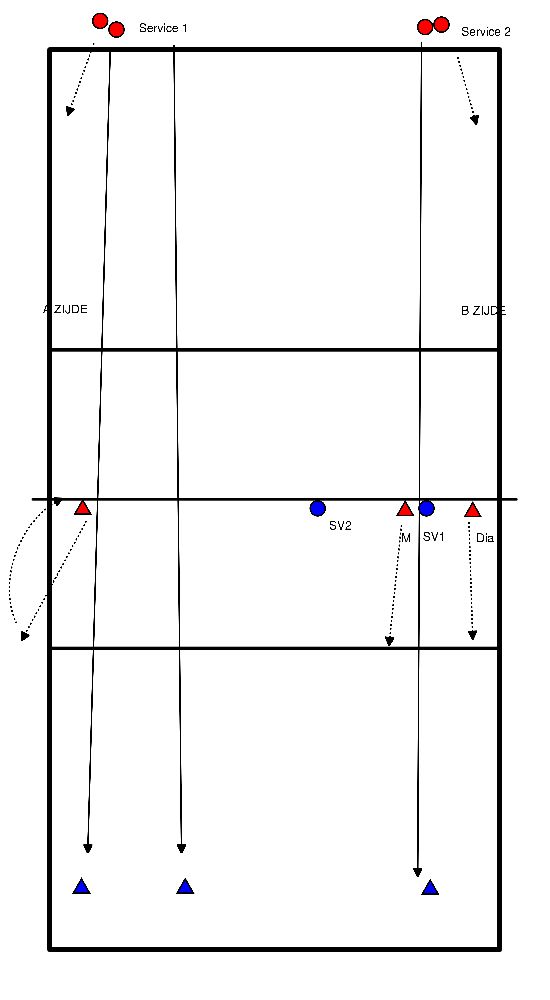
- A-side (PL's, 1 slide, 1 libero, 1 SV)
- Service 1 to 2 passers on the other side. (simple deep service, wrong service is 3 x push-ups).
- SP to SV 2.
- PL makes block jump and moves to UGP attack.
- SV 2 set up to #4.
- PL runs on from outside to inside and attacks straight through to #1 where service 1 defends.
- B-side (1 slide, 3 x centre, 1 libero, 1 SV)
- Service 1 to 1 passer across.
- SP to SV 1.
- M / Dia makes block jump and moves to UGP attack.
- SV 1 set up to #3 or #2.
- Good run and attack at #5 where service 2 defends.

- Balls often don't land neatly on the aerial as the attackers would like, they stay hanging/ out of the net/ or outside the aerial.
- Execution:
- The players receive a ball and learn to correct it.
- 1st pass is always used the same.
- 2nd and3rd passes will be used to correct.
- Balls will be thrown in underhand in the following positions.
- Position 1 Out of the net: -> player must stay behind the ball.
- Position 2 Hangs on: -> player must accelerate to the inside
- Position 3: outside the aerial: -> player must step outside
- Get behind the ball
- - So that you can hit the ball diagonally in front of you.
- Players can throw the ball in themselves or at one side through the trainer.
- step 1) catch the ball from the run-up
- Point of attention: get behind the ball well, do not hover, keep making the attacking pass.
- step 2) attack
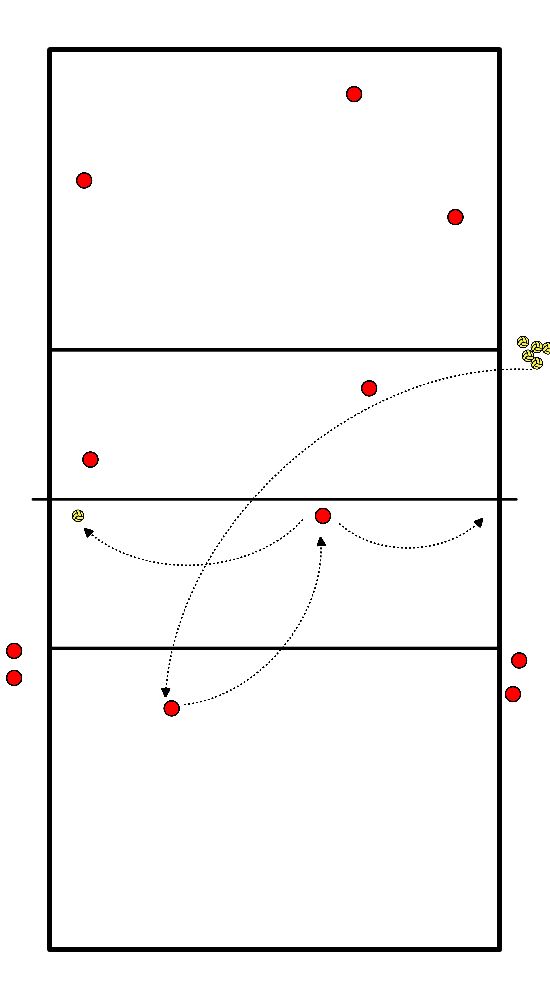
- Continued from Correction in attack pass - at lesser set up
- Player falls on lesser set up- stays hanging/out of net/out of aerial.
- set-up is given either on position 2 or 4
- The defense adjusts its view to the angle of the attack.
- phase 1: without blocking - defend the ball from being hit freely
- phase 2: with blocking attention on the defense position - one of the attackers goes on the ball
- one of the attackers is going to block on the middle position.
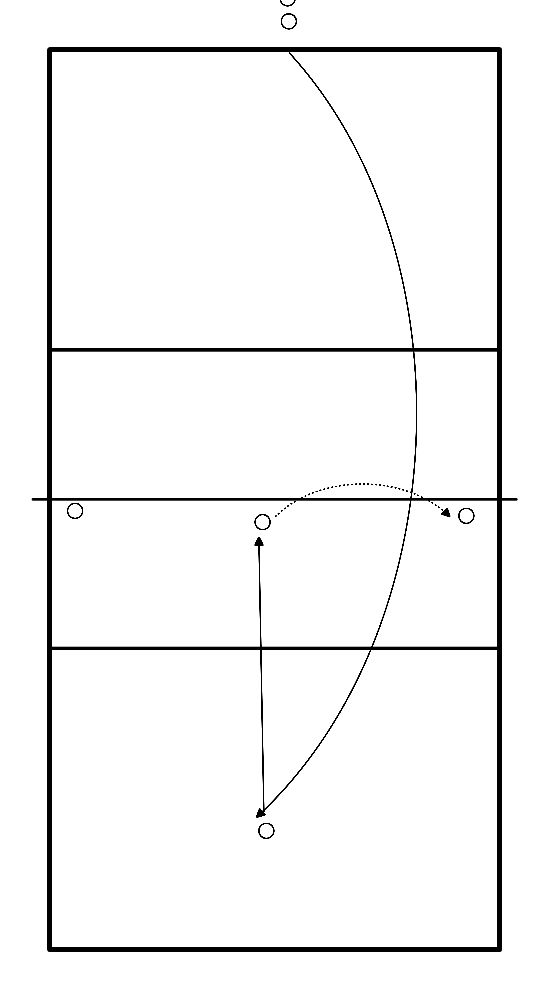
- Server to position 6
- Reception to player in the front center
- Plays forwards or backwards to position 2 or 4
lateral displacement to position 2 or 4 (street)
displacement slide
- Setter calls slide or street, to where the attack is given
- Attack to defender
- defender may attack on the position where the ball is coming from
- The one who made the attack, runs over and a 2 against 3 is played
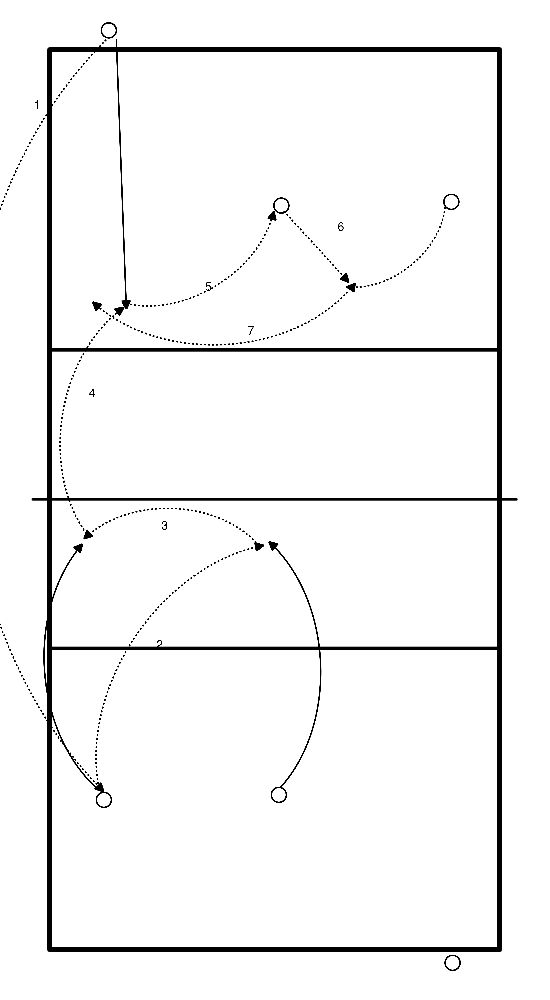
Organization: 6 players per field
- 2 play the serve, each on either side of the grid, at position 1
- Serve to 5 or 6, set up and pass ball to server
- Server defends to position 6,
- it performs the first contact
- and the previous attacker set the ball to position 2
- the defence player
- As long as there are 2 balls, continue, if there is 1 case, go for the point.
Variant: The defender is checked whether the defender is short or deep, short ball is pokey, deep ball is technical ball.