



Volleyballexercises for technique serving
- Serving is done simultaneously on both sides (or as simultaneously as possible).
- The defender provides the pass towards the setter position (position 3).
- At the setter position (position 3), the ball is caught.
- Players move along the blue lines.
- For larger teams, players can be added to the waiting area.
- With more than 10 players, the speed of the exercise is lost.
- Ensure good serve reception.
- Serves must be straight, but the server should aim to score.
- The passer is not well-trained if they only receive easy balls during training.
- The serving pressure can naturally be increased during the exercise.
- Two servers at the service area, one receiver, one catcher.
- The server serves, the receiver passes the ball to the catcher, who catches the ball and rolls it back to the server.
- Same as static, but the player follows the ball.
- The server becomes the receiver, the receiver becomes the catcher, and so on.
- See four players.
- The server serves the ball and follows it.
- The receiver passes the ball to the catcher.
- The rightmost player becomes the catcher.
- The server shifts to the left.
- The catcher becomes the server.
- If this does not work, one receiver becomes a reserve.
This activity is fun to do and brings a lot of enjoyment and competition! Relays naturally involve competition. This activity also simulates the stress factor that comes with serving.
Execution- The players are divided into equal teams and lined up at the serving area of the same side of the court.
- The first player of a team serves and retrieves their own ball.
- After tagging the next player, this player goes to serve, and so on.
- It is important for a player to serve quickly, but it must also be error-free, because otherwise the ball must be retrieved and served again!
- If the teams are small, it is fun to let everyone serve two or three times.
Adjust as needed by trainer.
- Points of attention:
- Feet in the correct place - under the shoulders.
- Hold the ball in front of you with your non-dominant hand.
- Prepare your hitting hand - arm it.
- Throw the ball up in a straight line in front of you, about 30 cm forward and 90 cm up.
- Take a final step forward, toward the ball, and use your whole body to skip the ball.
Start from pelvis ==> shoulder ==> elbow ==> hand. - Try to hit the ball with an outstretched hand.
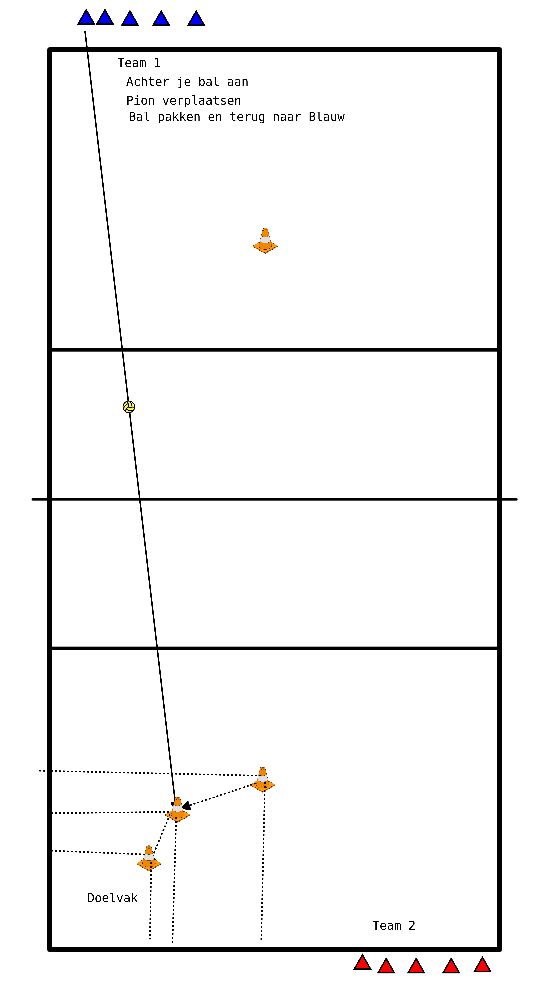
- Divide the group into two teams.
- Everyone has a ball.
- 2 Pawns in the center of each court as a starting position.
- Trainer makes choice in which part of the field to serve: left or right, short or deep.
- Serving from two sides.
- Chasing your ball and moving pawn.
- Rejoin your own team.
- If the server serves in the right part => the pawn moves to where the ball hit the ground. You make the goal area smaller.
- If the server does not serve in the correct part => then the pawn moves 1 meter towards the center of the field. Target area bigger.
- Exercise on time => for example 5 minutes.
- Team that has the smallest goal area after 5 min wins!
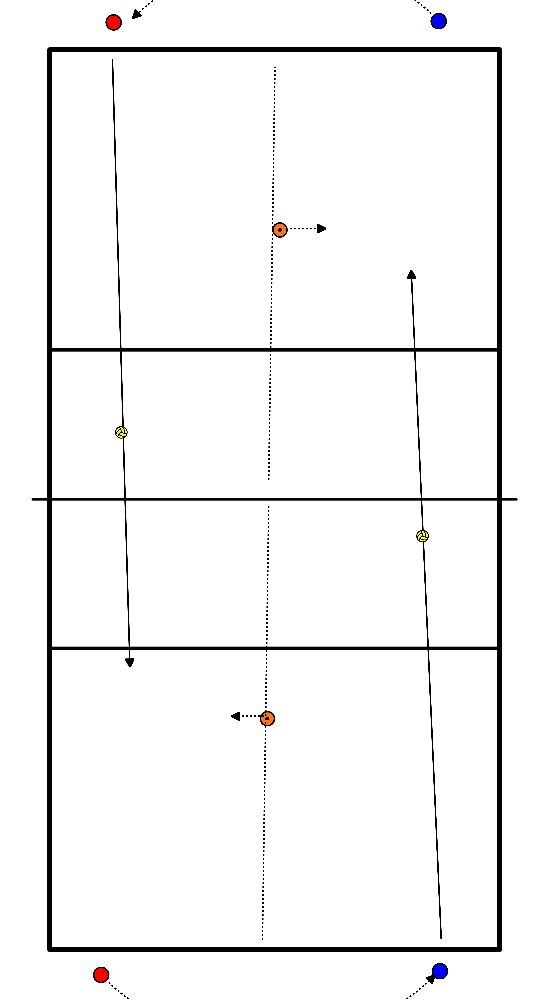
- Make pairs with 1 ball
- Trainer puts pawns in different colors in the center of the field. As many as there are pairs.
Always aim at a certain side of the pawn, trainer indicates which side.
- To the right of the pawn - straight through
- To the left of the pawn - diagonal
- In front of the pawn -short
- Behind the pawn -deep
Successful task: Move the pawn 1 meter so that the area becomes smaller.
Unsuccessful task: Move the pawn 0.5 meter back so that the area becomes larger.
Challenge: To get your own pawn as close as possible to the corresponding line of the field.
- Drawing is example for 'straight through' serve.
- Serve 5 minutes, whoever then has the smallest field is the winner.
- Servers take turns serving:
- Servers start serving, defenders --> pass to SV (pass MUST be good)
- Defenders (3 in the field and 3 waiting) --> after each pass the player with the waiting room switches
- TR is on the 2/3 position and he decides to whom the point goes.
- A good serve is a point BUT if the defenders pass this serve better the point goes to the passers
- Divide the team in pairs.
- Player 1 stands on the backline of the court and player 2 stands on a random spot on the other side of the net.
- The intention is that player 1 serves the ball into the hands of player 2.
- Player 2 is not allowed to step aside. If player 1 serves underarm into the hands of player 2 he gets 1 point.
- Overhand? --> 2 points.
- Change after 10 balls.
- The team with the most points wins.
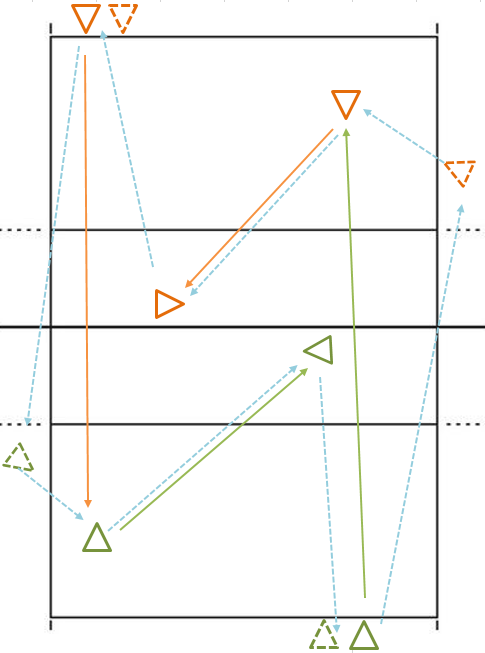
- Both sides serve at the same time (or as much as possible at the same time); the defender makes the pass to position [3] and at position [3] the ball is caught.
- The players run along the blue lines.
- With larger teams, players can be added in the waiting room.
- With more than 10 players the speed of the exercise is lost.
- Goal
- Serves pass well.
- Therefore, there MUST be straight serving, but the server must want to score.
- The passer will not be trained properly if during the training he only gets to play easy balls.
- Of course, the serving pressure can be increased during the training.
- Divide the group into 6 and a server.
- The server gets 3 turns to serve.
- Must try to make a serving point. If successful the server receives one point per serve.
- If the server plays a faulty serve the six field players receive one point. If the 6 field players manage to process the service they must play a rally consisting of a pass, a set-up and a smash/push ball.
- If they succeed, they also receive a point.
- After 3 service turns the server changes.
- Who has the most points?
- First each player gets a ball. Make a smash move, gradually building up to loosen the shoulder muscles.
- Smash on the floor and catch.
- Then smash against the wall, catch it yourself.
- Divide the group in two halves.
- A group starts with serving. Each player gets 2 balls.
- The other half first collects the balls, then each player gets 2 balls again, before serving back.
- Variation:
- Serve from behind the playing field position 1.
- Straight ahead.
- Other side collects balls, walks to own 1. position and serves straight ahead.
- Idem, only serve diagonally.
- Number of players serving and other pass/defending
- After the serve the server goes to the other side --> waiting room pass/defence
- pass to 2/3 --> discard
- Server --> other side waiting room (defence) --> passer --> returner --> returner --> serve
EXTENSION
- Instead of the off-side defender a fixed SV --> passer attacks own ball
- Attacker --> serve
- SV stays put (do change)
- Preparation:
- Hang a ribbon from the net at the spot where the playmaker wants the ball in his hands.
- The ribbon is the target for the passers.
- Three passers stand in the backfield and one player stands at the net.
- The passers are served continuously, and the servers MUST score.
- (low over the net and as deep as possible; when the passers change their position, the servers have to react to that).
- A pass is sent to the server who taps the ball through, gives a set-up or catches the ball (in case of a pass that cannot be handled).
- The trainer intercepts the set-up; if the exercise is going well, an attacker can be added.
- After 10 individual good passes a passer may change with a server of his choice.
Side a: formationSide
b: someone position 6 - position 5 and position 1
OBJECTIVE
: Side a gets every ball against and tries to score from this situation.
- First ball: serve side b
- Second ball: freeball coming from side b (side b builds up and tries to pass "difficult" freeball)
- Third ball: attack position 6
- Third ball: attack position 1
- Side a is not allowed to place the ball in the 3m line at side b, everything behind the 3.
- But side b is allowed to attack in the 3m line.
- Let's see how easy it goes.
A team of servers and a team of passers
The passers work as follows:
- 3 passers, 1 playmaker, 2 passers in the waiting room
- Passers make a pass formation and pass the ball to the 2/3 position
- Playmaker catches ball and rolls it to the players
- The passer goes to the 2/3 position to catch the ball
- The catcher tries to play the ball 2x for himself
- The MA, if not passing, takes the position of the passer (LA or RA), if the MA is passing then RA/LA remain standing
- The person in the waiting room takes the position of the MA
The server throws the ball up, catches it with one hand and throws it over the ball (DUS NOT SERVING).
After a certain amount of time, change positions and possibly serve the second round.
SIDE A:
- Player on position 3
- Player on position 6
- Position 5 -> attack at position 4
- Position 1 -> attack at position 2
SIDE B:
- 2 or 3 raisers position 5 - straight ahead
- 2 or 3 raisers for position 1 - straight ahead
- Mat position 1 - diagonal
- Mat position 5 - diagonal
- Mat position 2 short behind "block" = always point
- Mat position 2 short slanted behind "block" = alwayspoint
- Mat position 4 short slanted behind "block" = always point
Quiet storage straight ahead
- Storage between position 5 and 6 // storage between 6/1
- After reception Marie moves closer to position 1 to take the reception
- Reception - pass - attack
- Pass in turn
- Position 5 and 1 attack position 4 and position 2
INTENT:
- Ball does not fall to our side on attack = SOLVE
- Bad pass = SOLVE
- Taking risks is allowed
3 persons on a 3 meter line behind each other.
- Throw to each other
- After the action: tap the back line
- Top spin move under the net and make ball dead
- After the action: block at position 2 - touch the back line
- Top spin move over the net and play ball reception
- After the action: block at position 2 - touch the back line
- Control key
- After the action: backline tap
- Bottom hand - top hand
- After the action: tapping the baseline
- Direct key
- No after action
First 1 for 1:
- Player has a hoop
- Trainer throws the ball over the net, player has hoop in his hands and has to make sure the ball goes through the hoop.
- Player passes the hoop to the next player in line.
- Player puts ball in trainer's box
Next step:
- Divide the group on two halves of the field
- Player 1 serves the ball over the net
- Player 2 makes sure the ball goes through the hoop
- Player 1 joins the back at the hoop catchers
- Player 2 passes on the hoop and takes the ball to serve
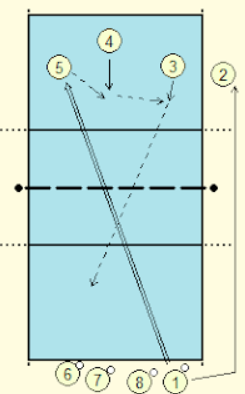
Three players line up to pass (numbers 3, 4 and 5). Player 2 stands ready at the side of the same court. The other players are ready with ball to serve on the other side.
- Player 1 serves the ball (and then runs straight to where player 2 is already standing).
- A player passes the ball to the server on position 2/3. The server gives a setup. And the third player plays the ball over the net.
- When the ball is over the net, the players turn: 2 enters the field (where 3 stood before) 3 goes to mid-back, 4 goes to the spot of 5 and 5 goes the serving spot of the other half.
- Then the next player can serve, on the drawing this is player 8. Etc.
Besides technique, communication is very important in volleyball. And both aspects apply to this exercise. And respond adequately to situations which are different than normal. In such an exercise you see very well how different players are.
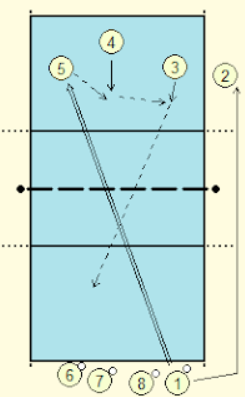
3 players position for passing (numbers 3, 4 and 5). Player 2 is ready on the side of the same side. The other players are ready with the ball to serve on the other side.
- Player 1 serves the ball (and immediately walks back to where player 2 is standing).
- A player passes the ball. Another player sets up. And a third player plays the ball over the net. All three players have to play the ball, or pass, or set up, or attack
- When the ball is over the net, the players rotate: 2 enters the field (where 3 was standing) 3 goes to centre back, 4 goes to where 5 was standing, and 5 goes to the serving spot on the other side.
- Then the next player can serve, player 8 on the drawing etc.
Necessary:
- 4 balls
- 7-8 players
SIDE 1: 1 player position 5 - rest of the players reserve along the sideline (3
)SIDE 2: 1 person storage position 1 - 1 person position 6 - 1 person position 5 (4)
- EXERCISE part 1
- 2 serves to position 5
- 1 raise to position 6
- 1 serve to position 1
Each player does the exercise 4 times, then change.
- EXERCISE part 2:
- From 1 to 1
- From 5 to 5
Each player does the exercise 4 times, then change.
- 3 players are ready to catch the serve, 1 player stands in the front middle where the passer is standing.
- The rest of the players at the back line with a ball.
- They are going to serve and the 3 players have to play the ball to the one in the front center.
- Save outside or ladder and pump 10 times, the passer may not leave the hoop.
- If the player does the reception and can catch the passer without leaving the hoop, they have a point.
- Reception player --> pass --> save. The first one to get 10 points wins.
- In today's exercise, the following techniques will be used: serving, attacking, passing and distributing.
- However, the emphasis is on the pass and the distribution.
- The players have to watch, think well and react adequately during this exercise.
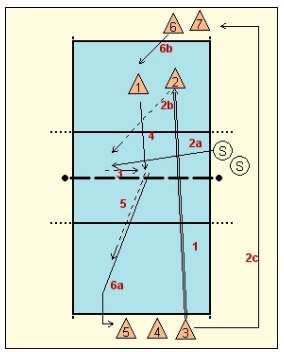 The diagram looks more complicated than the exercise is. The exercise goes as follows (I keep the numbering of the red numbers):
- 1 player 3 serves
- 2a one of the two playmakers runs to the position at the right front (the playmakers take turns)
- 2b one of the two passers (in this case player 2) passes the ball to the right front side
- 2c player 3 (who has just served) runs to the backline of the other half of the game
- 3 the server gives a setup to the player who did NOT pass. A setup to the centre if player 2 has passed and a setup to the outside if player 1 has passed.
- 4+5 the player who did not pass attacks (in this case player 1)
- 6a the attacker retrieves his own batted ball and joins the back of the line of serves.
- 6b the attacker's place is taken by the first player in the row behind the court.
As soon as the ball is struck the next service is executed.
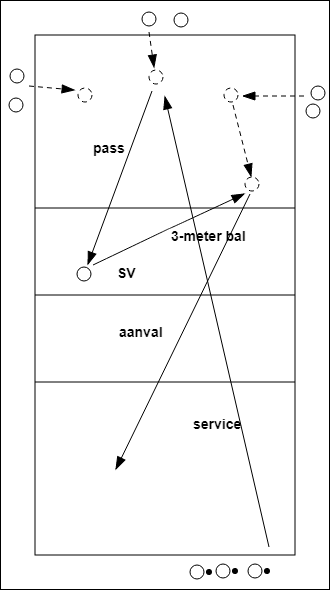
- Server hits the ball and serves.
- From the side and back three defenders quickly enter the field, one passes to the SV at the 2 position.
- He gives a three-metre pass to one of the defenders who did not pass.
- Passers swap with the reserves.
- After x times swap roles.
- Option:L the server defends the three-meter ball.