



Volleyballexercises for technique setting / overarm technique
Last update: january 2026
Objective
- Shift focus and quickly switch between actions.
- Create groups of three players with one regular volleyball and one tennis ball.
- The player with the tennis ball is the juggler and stands in the middle.
- Player 1 passes the volleyball to the juggler.
- The juggler throws the tennis ball to player 1.
- The juggler returns the volleyball to player 1, who throws the tennis ball back to the juggler.
- Player 1 passes the volleyball to player 3.
- Player 3 passes the volleyball to the juggler.
- The juggler throws the tennis ball to player 3.
- The juggler returns the volleyball to player 3 and receives the tennis ball back.
- Repeat this cycle.
- This requires concentration and quick switching from the players.
- If no tennis balls are available, two volleyballs can also be used.
Execution
- Defender 1 starts behind the baseline.
- The coach plays a high ball into the court.
- Defender 1 moves in and plays an overhead pass to the setter.
- The setter sets the ball backwards to position 4.
- The attacker hits straight and retrieves the ball.
- Defender 1 becomes the attacker and defender 2 takes the defensive position.
- With blocking.
- With middle attackers.
- With outside attackers.
Execution
- Form a group of three players.
- One player stands at the net, the other two stand at both sides in the back court.
- Player B throws the ball to Player A.
- Player B goes under the net.
- Player A plays the ball underhand to Player C.
- Player C plays the ball underhand to Player B.
- Player B catches the ball.
- Player B throws the ball to Player C.
- Player B goes under the net.
- Player C plays the ball over the net to Player A.
Execution
- Player A throws or hits the ball towards Player C.
- Player C passes the ball to Player B.
- Player B provides a set-up.
- Player C attacks.
- Try to attack or play the third ball onto the mats, either straight or diagonally.
- After each ball, the players rotate one position within their own group.
- If there are enough players, a block can also be placed.
Goal
- Players learn to play smart by placing the ball just over the net or into the back corners.
- 6 players
- Row 1: 3 players with a ball behind the trainer
- Row 2: 2 players ready to attack on the left front
- On the other court, place 5 hoops: 1 in each corner and 1 in the center of the court.
- A player from row 1 pushes the ball into the trainer's hands and immediately moves to the reserve position of the setter.
- The trainer tosses the ball to the middle front.
- The setter plays the ball overhead to the right front or left front as a setup.
- The setter immediately moves to the line of attackers after playing the ball.
- The player runs in and tries to play the ball into a hoop. If successful, the setter and the player earn a point.
- The player retrieves their own ball and joins the line of servers.
- Throughout the exercise, it is important to move immediately after the play action.
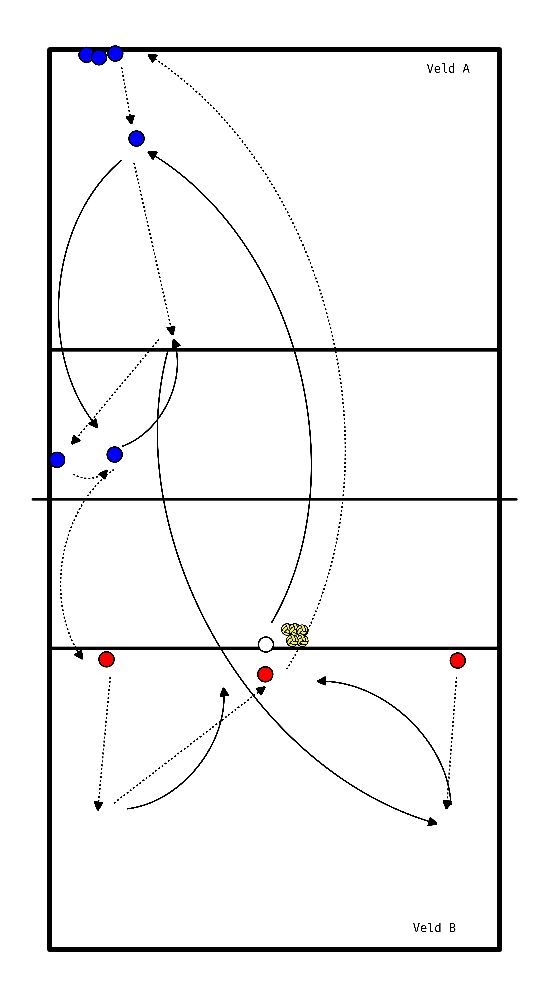
Organization
- Field A.
- Players on 7 meters P1(row) and 1 player on p2
- Reserve on p2
- Field B:
- Trainer with ball carrier on 3 meter line
- Players on p1 and P5 (both on 3 meter line) and on p6
Execution:
- Trainer throws ball up high.
- Player on p1 passes to P2 gets setup on 3 meter line and plays overhand to p5 or p1
- Underhand play up and catch at trainer.
- Run:
- P6 to reserve P2;
- P2 to backup P5b or P1b
- After catching reserve P1a
Exercise 1:
- Key your ball up.
- Bounce 1x and then dribble 2x.
- After the last high dribble key up again.
- When dribbling, alternate between left and right hands.
- Note! Dribble Left = Right foot in front. Dribble right = Left foot forward.
Exercise 2:
- Same as exercise 1 but with 1 single dribble.
- Button up 2x, let collide 1x.
- Note! Play your ball high enough above your head. Do not lower it.
Exercise 3:
- Same as exercise 3 but with single key.
- Key up and catch your ball. Keep your ball in the air by tapping it 3x with your right hand. Then key up again.
Exercise 4:
- Same as exercise 1 but tap your ball with the left.
- Key against the wall instead of up.
- You tap the ball back 3x with your right hand.
Challenge:
Key against the wall and catch your ball. Tap the ball 3 times and key against the wall again. The one who can do that the longest without the ball falling to the ground has won.
Key against the wall and catch your ball. Tap the ball 3 times and key against the wall again. The one who can do that the longest without the ball falling to the ground has won.
- All players have a ball.
- Divide the group into two - maximum 4 to 5 players per group.
- Near the net is the ball pit.
Exercise per group:
- Play up overhead in front of yourself and keep playing.
- Slowly move towards the net, keep playing up.
- Overhand: Play up high, quickly get under the ball, stand still and then play.
- At the net: => play the ball IN the ball pit. The distance does not matter.
- Ball on the ground => start again from the back line.
Same exercise can be done with underhand play up to the net + play IN the ball box.
For the better players there can be a third round:
- Ball bin on the back line of the other field, players must now pass the net. Play over it, themselves under it. Underhand or overhead no longer matters, as long as the back line is crossed.
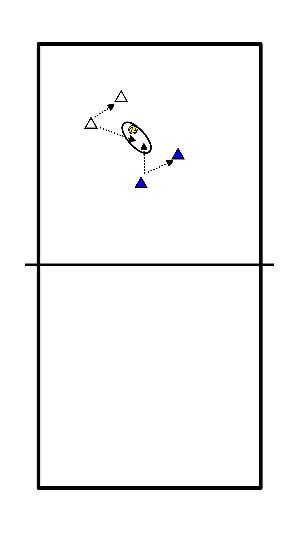
- Spikeball is a fun game you play with a net in the middle and a small ball.
- 2 teams of 2 players play against each other.
- Everything is allowed in terms of technique. This is easily adapted to volleyball, where after 3x games the ball may be played into a hoop.
- After that it is the other team's turn.
- It is a 360 degree field, so through the hoop the ball may go in any direction.
- Always play the game 2 against 2.
- Vary the level of difficulty for the players. For example: catch 1x for C youth, do not smash, and so on.
Give each player a ball and stand by the wall.
- Stand 30-40 cm from the wall.
- Ball in key position above head.
- Only fingers push ball against wall and catch back in hands.
- Elbows stand firm and hands remain, otherwise ball in face.
- Have players stand a little further, about 1 meter.
- Throw ball up and keys against the wall.
- Now do extend elbows and knees, make yourself big!
- Catch the ball back.
- Now try to key on the concrete beam. So push high.
- Trying to key through.
Those who can do this technique well may then play over the net.
- Ball for themselves collide on the ground and then key over the net.
- Back through the other side of the ribbon.
With threesomes or twosomes with trainer.
- Player 1 plays ball BH over the net. 2 other players on opposite side: 1 in back defending and 1 set-up. Defender plays over the net to player 1.
- Note: setup along the net. Turn in!
- Variation 1: 2-team starts in the back and runs forward. The player who does not pass gives set-up.
Variation 2: 2-team starts in the middle and runs to the back. The player who does not pass gives set-up.- Try to play through.
Field is divided into 4 squares and in each square there is a pair; one behind the other.
The exercise expands and proceeds successively in this way:
The exercise expands and proceeds successively in this way:
On one side of the field everyone plays straight and on the other side everyone plays diagonally so that the ball "goes around.
- Underarm passes within 3 meters and immediately pass overhead to the other side. Then run after the ball.
- Same, only now the ball is not passed on, but instead a setup is given.
- The 2nd person plays the ball overhand over the net.
- The one who gave the setup runs on and the one who played the ball over the net goes back to pass.
- Same, only now both persons are going to defend. The field runs to the double back line, 6 meters.
- The ball is passed in jump to the opposite side. This may be long and short and it is up to the two defenders to solve this.
- The one who jumps the ball goes after it.
- Idem, only now the attacker is calm and defensible. Everything else remains the same, so the attacker rotates after the ball.
The pairs, as they stand now, stay together.
- First a game is played on half-field straight.
- Then the winners and losers play against each other on half field diagonally. Back line is 6 meters.
- Games are played to 10 points.
All together Guusje game.
2 tally replay.
- Play in, peppering.
- Touch the ground 1/2 hands
- 1x check for yourself, 2nd ball smash or push ball
- Throw on overhand and make sure there is a good pass.
Possibly diagonally follow must be a 3 and a 4 team.
Divide the group in 2:
Guusje/Neele/Delfin/ Tootsy
Variations:
- 2 defenders
-1 setter
-1 attacker
After 4 minutes switch positions. Make sure everyone goes full speed.
Evelin/Senne/EseraiTrainer throws the ball from pos.4 ,
- SV plays the ball back BH. 2 setters alternate (note: good technique, tight ball clear past the net) Eserai catch it high because of technique timing
- SV makes a block on 3 and plays the ball back BH.
- SV plays the ball backwards to the receiver at position 2
- SV makes a block at 3 and plays the ball backwards to the receiver at position 2.
2 tally replay.
- Play in, peppering.
- Touch the ground 1/2 hands
- 1x check for yourself, 2nd ball smash or push ball
- Throw on overhand and make sure there is a good pass.
Possibly diagonally follow must be a 3 and a 4 team.
Divide the group in 2:
Guusje/Neele/Delfin/ Tootsy
Variations:
- 2 defenders
-1 setter
-1 attacker
After 4 minutes switch positions. Make sure everyone goes full speed.
Evelin/Senne/EseraiTrainer throws the ball from pos.4 ,
- SV plays the ball back BH. 2 setters alternate (note: good technique, tight ball clear past the net) Eserai catch it high because of technique timing
- SV makes a block on 3 and plays the ball back BH.
- SV plays the ball backwards to the receiver at position 2
- SV makes a block at 3 and plays the ball backwards to the receiver at position 2.
Guusje game
2-tables
:- replay pass.
- 1x control for your own and then BH back.
- 1x bra check in front of your own and then high bra back, so that fellow player can also play overhead.
Diagonal ball checking.
Also try BH.
Trainer bounces ball high from position 5, player has to run in from position 2 and play ball overhand back to player at position 5, this player catches the ball and joins the back of the line, player who played the ball overhand goes to position 5 to catch it.
Same but the player who has to play the brace plays backwards to the player behind him. This player catches the ball, throws the ball to the player at position 5. Everyone moves one spot forward.
3 against 3 in the 3 meter area, only BH, 3 times pass and then over the net, no match but technique exercise.
Divide into 2 groups:
group 1.
(after 5 balls switch groups, and when entering the field also switch positions)
- same but finish the attack, and group 2 collects the balls.
2-tables
:- replay pass.
- 1x control for your own and then BH back.
- 1x bra check in front of your own and then high bra back, so that fellow player can also play overhead.
Diagonal ball checking.
Also try BH.
Trainer bounces ball high from position 5, player has to run in from position 2 and play ball overhand back to player at position 5, this player catches the ball and joins the back of the line, player who played the ball overhand goes to position 5 to catch it.
Same but the player who has to play the brace plays backwards to the player behind him. This player catches the ball, throws the ball to the player at position 5. Everyone moves one spot forward.
3 against 3 in the 3 meter area, only BH, 3 times pass and then over the net, no match but technique exercise.
Divide into 2 groups:
group 1.
(after 5 balls switch groups, and when entering the field also switch positions)
- same but finish the attack, and group 2 collects the balls.
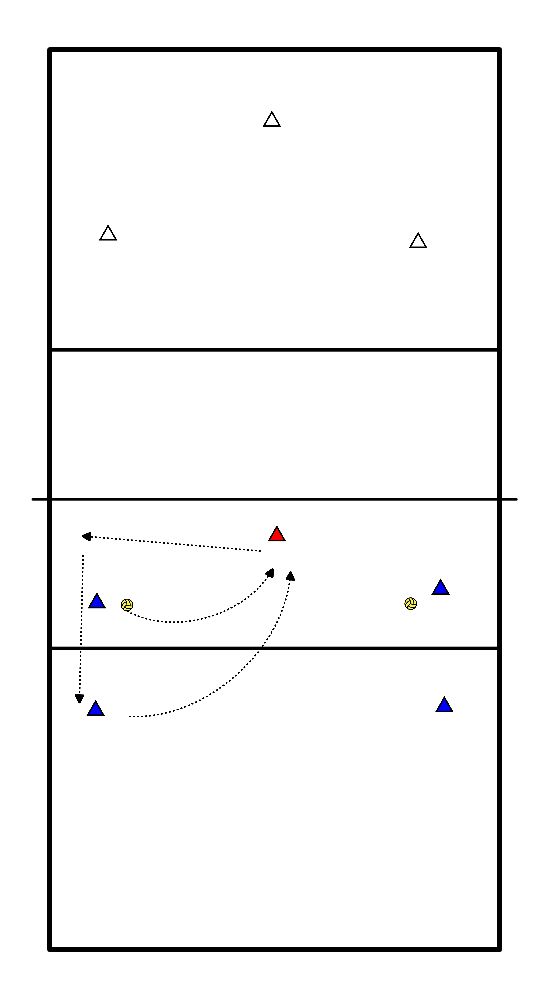
Exercise 1:
- Ball inspector to setter.
- Setter passes alternately to 4 & 2 .
- Attackers slide through. We continue to play through.
- Variation: Can be on 2 sides or build out with attack behind the 3
Exercise 2:
- Same exercise 1; 1 defender and 1 attacker per side.
- We play over the net.
- The attackers pass the balls diagonally to the defenders.
- We play on in one time.
- Variation: Place ball overplay or technical attack.
Exercise 3:
- Players slide under the net and work in pairs of 3. Attackers become defenders and vice versa.
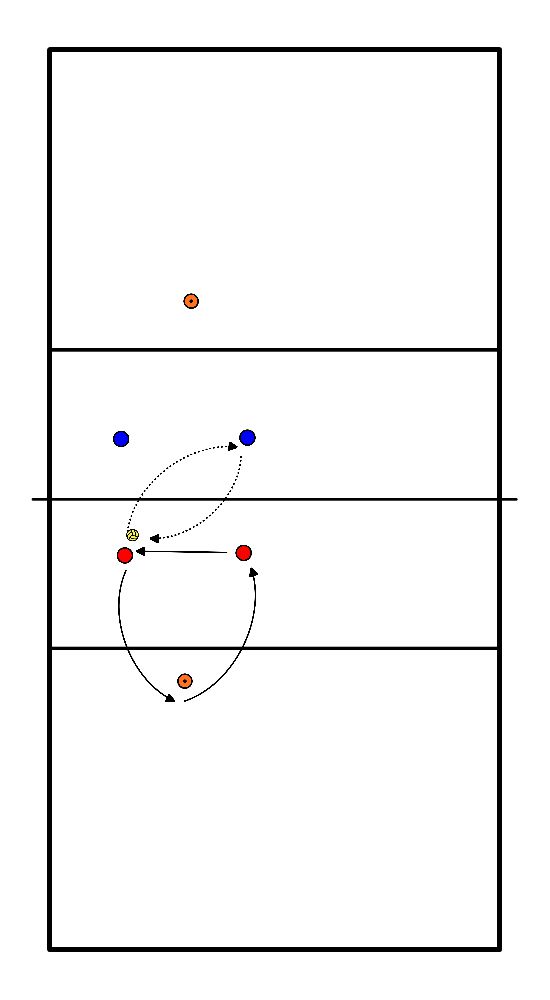
Organization:
- Make pairs
- One duo on each side of the net
- Place a pylon 5 metres from the net.
Execution:
- Ball is played diagonally from left to right over the net.
- The player who played the ball goes with a shuffle backwards around a pylon and connects in front.
- The player on the right moves with a sidestep to the left for the next ball
- After a few rotations, change direction
- Now play from right to left
- Pay attention: the net foot is a bit in front of the other one
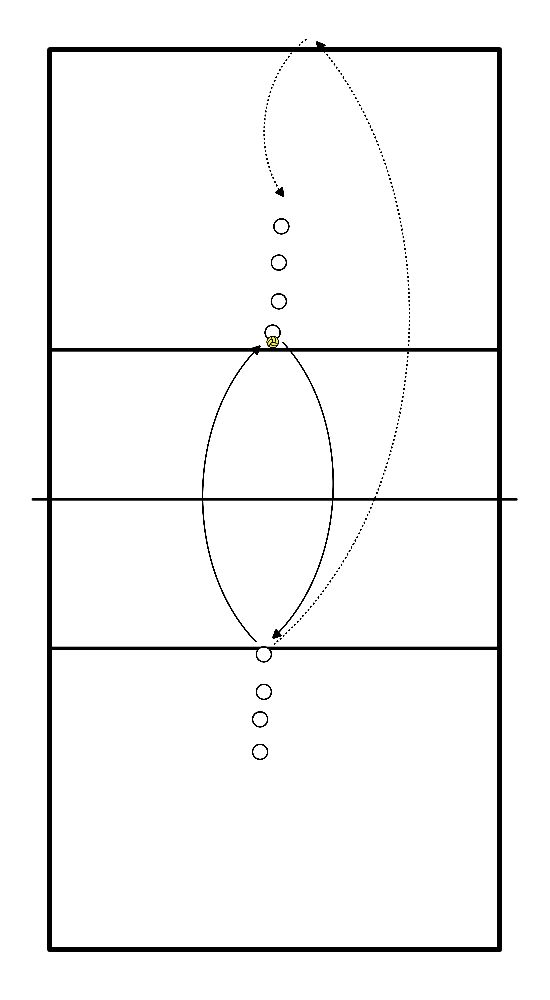
- Organization:
- Divide 2 quads on both fields.
- Players stand on 3m-line.
- The first player on field A has a ball.
- Implementation:
- Player on field A with the ball throws it with 2 hands from the neck over the net, runs under the net over the backline and joins behind it.
- The first player on field B catches the ball and throws it back and runs under the net as well.
- Regularly change the way of throwing: with: right hand, with left hand and throws from chest height.
- After 2 or 3 minutes let the bra play. Now it is no longer necessary to walk over the back line.
- After 2 minutes, make a block jump before passing under the net.
- Then after the block jump, move sideways and make another block jump.
- Attention point:
- The rally must be kept going.
- In case BH cannot be played, OH may be played.
- In preparation for attack on p3.
- Organisation:
- Player on 2/3.
- Trainer with ball pit on p5/6.
- Other players on 3m-line p3.
- Execution:
- Trainer throws ball and player on 2/3 gives a setup on3.
- Player on 3m-line runs in and catches ball and delivers it back to Tr.
- Have player on 2nd/3 set up 5 balls.
- Make sure the setup stays short on the p3 and not on the p3/4.
- Expansion:
- No more catching but attacking.
- Objective:
- Develop ball sense, be able to control ball close to your body.
- Everyone has their own ball, can be combined with a warm-up.
- Let the ball bounce on your right fist.
- Up to maximum eye level.
- Arm is stretched out and is almost horizontal.
- Stay in one place as much as possible.
- Later on, alternate bouncing with your left hand.
- Now do the same while following the yellow lines in a certain pattern.
- The person in front chooses the route (watch out for rear-end collisions!); who wants to take this role? (requires even more concentration and a sense of responsibility a la captain's role)
- Play the ball with only your right hand above your head, up to a maximum of 30cm higher than your hand
- Your upper arm is pointed 45 degrees upwards and your forearm 45 degrees in the other direction; this brings your hand above your shoulder again.
- The ball is played mainly with your wrist and forearm; stay in one place as much as possible.
- Later on, alternate with the left hand.
- Afterwards also in pattern.
- Play the ball in a fixed routine for yourself, for example:
- Square:
- Underhand R, overhand R, overhand L, underhand L, underhand R, ...etc. (change later to the right)
- Cross:
- Lower hand R, upper hand L, upper hand R, lower hand L, lower hand R, ...etc.
- In teams of four (preferably) with each its own ball.
- Stand in a square; all equally spaced.
- Throw the ball to the next person and catch the ball that is thrown to you.
- First throw underhand and catch underhand; then throw abovehand and catch abovehand.
- Then expand by passing 1 ball.
- Choose a spot opposite the wall.
- Sit in front of the wall with your feet against the wall.
- Play overhead against the wall. (Ball just above eye level)
- Pay attention to the movement of the wrist and a little bit of the forearm.
- The ball will only bounce about 10cm this way.
- If necessary, extend the game by slowly standing up, playing standing up for 10 seconds and then sitting down again.
- Let them play a route along the wall: bounce briefly (10cm) and play overhand (right).
- At the end of the route, take a distance of 2 meter from the wall and keep on playing overhand while walking left until the beginning of the route, close to the wall.
- Everyone in line; if you lose the ball, pick it up and go back to the line.
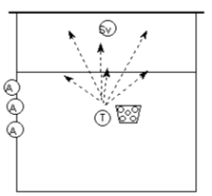
Trainer throws balls
- Sv plays set-up
- Attackers attack over the net. Go and get the ball. On the other side of the net
- Place ball in ballcarrier
- Also perform with set-up to position 2
- Also perform with alternating set-up to position 2 and position 4.
- Trainer throws 6 balls on different spots.
- Sv must always return to home position.
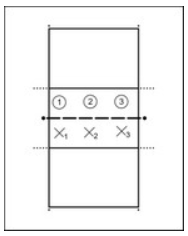
- It is only allowed to play overhand
- Before the ball goes over the net each player must have hit the ball once (so in total the ball is played 3 times).
- A goal can only be scored inside the 3-meter line. If the ball falls outside the field, or behind the 3-meter line, it is a point for the opponent.
Nice exercise to learn to place the ball overhead within the 3-meter range and to play your teammates with precision overhead.
The one who makes a mistake is replaced by the reserve.
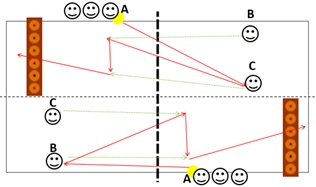
- Player A throws ball over the net.
- Player B or C passes the ball over the net.
- The other player quickly runs under the net and sets up the ball for the same player who passed.
- This player tries to get a pawn off the bench with overhand play or a hitting move.
Which pair or team has knocked the most pawns off the bench after X number of minutes?
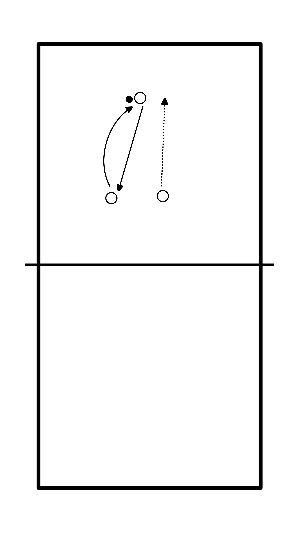
- Three players stand in a triangle.
- The one who does NOT get the ball moves to the opposite side next to the other player.
- Again, the one who does not get the ball moves.
- Start simple by first playing the ball up in front of yourself and then serving one of the other two players.
- The one who does not get the ball moves to the other side
- Later on, make it more difficult by taking away the play-up part
- Finally, you pass in front of yourself and hit the ball in a controlled way.
- Super exercise for getting very tired very quickly.
5 hoops distributed over the field:
- 1 in the corner at position 1
- 1 in the corner on position 5
- 1 in the corner on position 2
- 1 in the corner at position 4
- 1 on the 3 meter line - in the middle of the field
A on pass:
- Self-touching - A plays back - attacks/allies on returned ball
OR
A on pass:
- Passing to right post - someone on position 5: himself passes to A - A passes and attacks
At the centre: someone stays on to pass the ball to the centre