



Volleyballexercises for technique system
Last update: january 2026
Positions and Movements
- The attack comes from the right.
- The middle hitter and opposite hitter block.
- The outside hitter moves to the centre.
- The setter moves forward.
- The trainer hits the ball.
- Players move to their positions and defend the ball from the trainer.
- After each defensive action, players rotate one position.
- Remaining players defend individually and place the ball in the cart.
Execution
- Players stand in the correct zone.
- The trainer serves or throws the ball.
- After each service, players rotate.
- Only serve when players feel they are positioned correctly.
- Also serve when they are not positioned correctly, especially to the uncovered position.
- Players must correct each other on where they should stand.
- Occasionally throw a ball into a difficult zone.
- Recognise their own zone.
- Decide who takes which ball.
- Shout loudly in case of doubt.
- Make clear agreements in advance!
Objective
- The aim is to tactically place or hit the ball.
Execution
- Use tip balls at the middle position or hit the ball deep to position 1.
- Place hoops to simulate a constant block, which can later be replaced by an actual block.
- Replace cones at position 1 with a box over which the ball must fall, over the 'defender'.
- The coach hits or plays a ball in, which is first passed to the setter.
- The setter provides a set-up to the outside.
- The attacker chooses either a short tip ball to the middle position (where a hoop is placed) or aims for position 1 with a hit or quick overhead ball.
System play out:
- 6 setter stands in lineup and alternates among themselves.
- Fixed 2 setters, at 4 change, at 3 fixed, at 2 fixed.
- Fixed mid-back.
Everyone moves along, and everyone communicates; call loose, attack, call names.
- Setter after set.
- Passer after pass, backfield toward attack.
- Backfield creeps behind attack, block coverage.
- From attack.
- From service.
- From service with a 2nd ball -2nd ball freeball.
- There is a team lineup. On the other side are the remaining players.
- There is serving by the remaining players and a side-out is played with a tactical attack. Prick center or attack in corners; there are no defenders at that time.
- This ball is followed by a rally ball from the trainer and must be scored "hard" and the rally must be won from the remaining players.
- The 1st ball counts for 1 point, the 2nd ball counts as 2 points. For both sides. Which side wins?
The players receive a rally ball from the trainer. The players will receive an assignment from the trainer beforehand.
The assignments are as follows:
The assignments are as follows:
- Hard attack from positions 2 and 4.
- Jab ball from position 2 and 4.
- 1st tempo attack to the middle.
- Long ball into the corners from position 2 and 4.
- Ball to free net defender from position 2 and 4.
- Place ball on playmaker.
Each task is performed twice, once with the playmaker behind and once with the playmaker in front. Assignment 6 only with the playmaker behind.
- Trainer stands on a cabinet section at position 2 or 4.
- Trainer throws up a ball and hits/pins a ball into the court where there is a team lineup.
- Goal is to defend these balls and take over the rally.
- We play sets to the 15, where scoring directly from the defense scores 2 points and scoring the ball in the rally -through an opponent's mistake or otherwise- scores 1 point.
- On the opposite side is a trio. These three players defend and attack from behind 3 meters.
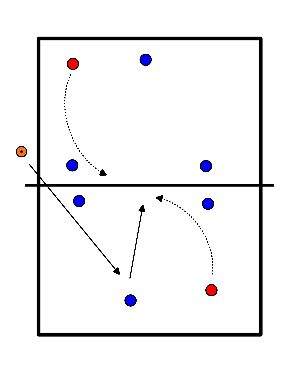
- Trainer hits a ball into the field at mid back where a passer is standing,
- He passes it to 2/3 .
- SV comes running in from right back and gives a set on outside or back.
- They attack the other team.
- If they can continue to play, the rally continues.
- When a point is made you start hitting the ball into the field at the other team.
- Who is the first to the 3 points
- Then you rotate 3 spots
- Why? Because otherwise you have to jump and attack 2 times in a row as left forward and then 2 times in a row in the backfield. Afterwards you have variation.
2 groups:
Group 1 is going to serve and pass, on a long half of the court.
Group 2 is going to smash.
Group 1 is going to serve and pass, on a long half of the court.
Group 2 is going to smash.
- Fixed setter.
- Attacker stands facing the net.
- At the signal of the trainer, the player plays a block, and the ball comes from the trainer towards the setter. After the feint block, the attacker goes backwards for an attack.
- This can be a 1st tempo ball short, normal for a middle or a 2nd tempo ball for a runner, outside.
- Just vary in this, and have attacker do both variations.
Swap.
Set-up:
Set-up:
- Block on 2. (basket) Mid front (Setter) and 2.
- Agree who does the block coverage. My preferred position 1. The person closest to it, of course 6, 5 and 4 must defend field.
After 5 balls rotation. Variation a 2nd and/or 3rd ball can follow.
If there is still time, block on middle, and/or block on 4. Note: block coverage.
4 v 3 or 4 v 4.
Full set, doesn't have to be a regular setter. Trainer starts the rally.
If there is still time, block on middle, and/or block on 4. Note: block coverage.
4 v 3 or 4 v 4.
Full set, doesn't have to be a regular setter. Trainer starts the rally.
Organization:
- Trainer/player and ball pit on field B p4.
- Block field B on P2/ P3 and defend p5.
- 2 players on field A on P2/ P3 block.
- Defending field B on P4 and P5.
Execution:
- Trainer/player hits ball to P4/ P5.
- Block and turn immediately after the action.
- Defend ball, setup and attack on P4.
- Block-defend-catch.
Run:
Attack p4-block p2-block p3-reserve
block p2-block- p3-reserve p5-defend p5
Two players are setter who alternate under the net:
1:
1:
- Trainer throws the ball on from position 5/6.
- Player plays ball 1, overhand to forward position 4
- Player comes from position 5 and completes the attack.
- SV plays ball 2, BH to the back position 2.
- Player comes from position 1 and finishes the attack.
Player at position 1 and 5 before the attack, change position each time after the attack.
Group changes from ball retrieval to attack.
2:
- Trainer throws the ball on from over the net.
- Passer at position 5 gives a pass to SV
- The continuation is the same as the previous exercise:
- Playmaker plays ball 1, overhand to forward position 4
- Player comes from position 5 and completes the attack.
- SV plays ball 2, BH to the back position 2.
- Player comes from position 1 and finishes the attack.
Explanation with change to position 6. fixed center in the backfield.
- From the service.
- From receive.
So change setter and change solid middle backfield.
Play some rallies: from service, and from receive.
Note: lunar formation.
Possibly explain ABC or agree on signs.
Match 4 against 4.
Note: lunar formation.
Possibly explain ABC or agree on signs.
Match 4 against 4.
Organization:
- Trainer with reserve player and ball pit on field B p4
- Block at field B on p2/p3 and defend p5
- 2 players in field A at p2/p3 (block)
- Defending field B at p4 and p5
Execution:
- Trainer hits ball to p4/p5
- Block and turn immediately open
- Defended ball attacks on p4
- Block-defend-catch
Running:
- Attack p4-block p2-block p3-reserve
- Block p2-block- p3-reserve p5-defend p5
- 6 plays a number of rallies
- Where especially the movement in the field has to be good.
- Two fixed setters
- GREAT VARIATION:
- Set from 2.5 instead of 3.
- The setter indicates this himself.
- WHY?
- If the opponent has big blockers in the middle and on the left, the setter can play the ball to the outside to avoid the block.
- Setter indicates this with fingers (you can also agree on other signs).
- 2 fingers means pass to position 2,5.
- No sign means pass to 3.
- The other players have to move with the pass.
- Minimum service pass, with 3 players, preferably 4 players.
- Maybe practice with a setter from the right back.
2:4 system.
- Setter goes to midfield
- If the setter is on the right frontside he can indicate to stay there (pos. 2.5)
2:4 system
- Setter comes from the backfield to the right front.
- Setter starts at 1, protected by position 2.
- Setter goes to 2,5.
- Pos. 2 can attack on 2 and so can pos. 3 and 4.
- Setter starts at 6, protected by position 5.
- Position 5 goes to 6.
- Position 4 goes to 5.
- Position 2 can back off a bit, also applies to other setter on pos.
- Setter goes to 2.5.
- Setter starts on 5, is protected by position 6.
- Position 1 and position 4 are in the backfield.
- Position 2 and 3 can move back a bit.
- All passes go to 2.5.
- Setter comes out of the backfield
- And has 3 attackers each time.
- 6-3 (or ideally 6-6)
- Build up calmly.
- If necessary, 2 attempts.
- Stroke not correct, trainer plays a ball.
- Play out the rally. (If there are too few players, you cannot play on that position).
- The side where the ball falls receives an attack from the trainer.
- Then the trainer throws a freeball to the other side.
- Freeball MUST be played to position 1.
- Series of 3 balls.
- 2/3 scored?
- Team gets a point.
- Up to 10.
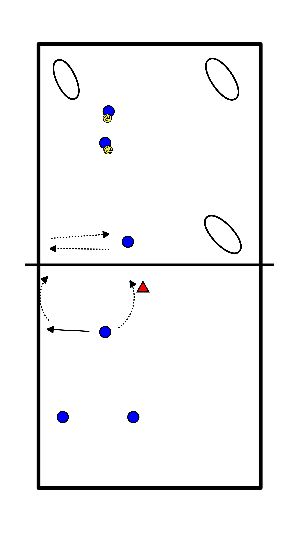
- Ball is played in at the 6m line.
- Defend ball to passer who chooses where to play !
- pos 4 or pos 3
- 1 blocker leaving on center pos. who tries to block
- pos 4 or pos 3
- Play 20 times, then switch
- Cover by passer + possibly defender on pos 5
- After handing in the ball, defend according to the blocker's signal.
- Hoops (goals) in front:
- Street, slide far & slide short (net)
- The goal is to play the ball in threes. This requires the commitment of every player.
- So line up three players.
- They solve a thrown ball (by the trainer), by playing in threes.
- The first ball is passed to the upper-position.
- The 2nd player, who has the job of upper-player, runs to the upper-place.
- The 3rd player then prepares for the attack.
- At first keep the ball on one side of the net, by not actually hitting the 3rd ball, but catching it.
- Then 3 other players move in to do the same.
- On the other side of the net, the same is practiced with the other half of the team.
- After a while, when the ball is regularly played in threes, the ball is actually played to the other side.
- The team on the other side then plays the ball back in threes.
- And so on; play over as long as possible.
- No scoring, it's about playing in threes.
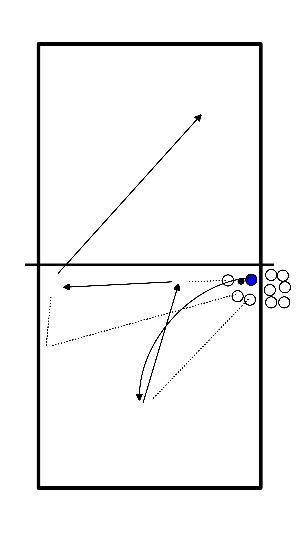
Purpose of the exercise:
Improve out of system situations and communication
- 3 players gather around the trainer and pass the ball.
- Trainer holds the ball in front of him.
- When all players have put their hands on the ball, the trainer throws the ball somewhere in the backfield.
- Through communication and especially listening, it must be clear who plays the first, second and third ball.
- What do you do as a striker in a difficult out of system situation, what do you want your strikers to do?
- Is there a lot of risk in finishing or do you want to see controlled balls hit in various positions?
- Go ahead and play as a trainer.
- Very good exercises to repeat out of system situations.
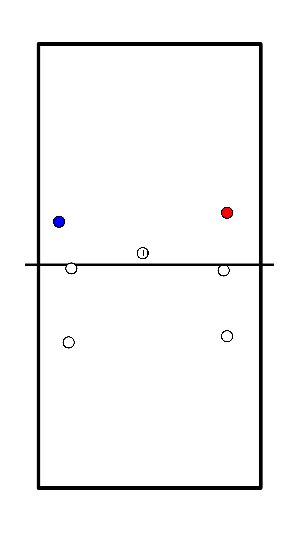
- Learning the defense system
- 1 side with 4: leave 1st time (= at net / 3M line)
- Surplus on the other side.
- Red/ blue throws the ball in nr PASPLEK.
- Then the ball is passed to pos 2 or 3.
- This player catches the ball and then makes an attacking run and throws the ball over.
- Attacker who doesn't get the ball does AP + sliding dive to cart and takes new ball.
- Side with 4 does the right moves.
- Catch the ball --> position 1 runs in puts BH pass to position 4 --> plays over
- 5 balls and turn over