



Volleyballexercises for u12
3 players in front of the net in positions 2-3-4.
The trainer hits the ball and the players have to decide if they want to block the ball and if so where.
- the ball should be blocked and if so where. So the midfielder moves to the relevant side and the non-blocking front player moves back.
- The ball comes up high and must therefore be defended. The players all move backwards except the sv
Extend this by including the 3 players at the back.
See picture. Each 3 (or 4) players 2 balls. 2 players at the net a few meters apart, other player(s) in the backfield.
- Exercise 1: Players take turns throwing the ball, player in the backfield plays the ball back underarm.
- Exercise 2: First ball comes deep, 2nd ball comes short
- Exercise 3: Throwers stand a little further apart and throw straight: player with ball on the sideline throws deep, other short. Passer moves left/right.
After x-number of balls or after some time swap places.
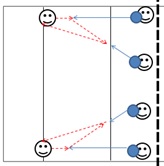
- 2 rows of players
- 1 row on the left back
- 1 row at the right back
- 1 catch
- Pass left and right
- Pass to receiver
- Ball in ball bin, join shortest row
- Passer becomes receiver
- Passing, overhand pass
- Pass, underhand pass
- Tackle, underhand pass
- Tackle, pass, set, attack
- Tackle, pass, set, attack straight, with block
- Tackle, pass, set, placed ball diagonally, within 3 meters (blockers come off the net), pass to trainer
- Pass, set, attack (shot) straight ahead, with block and line player
- Pass, set, jump ball, with 3 meter defender
- Place 3 pawns around a player.
- 1 to the left, 1 to the right and 1 behind (working player)
- Another player, with the ball, is going to indicate to which pawn the working player has to move (good posture = hands loose in front of the body).
- At an unexpected moment, the player with the ball throws the ball (preferably not too easy) and the intention is that the working player defends the ball.
- Repeat this a few times and then change players.
Goal: ball lane recognition, take position in time.
- Ball path: A throws to B, B passes to C.
- Direction of play: A, B, C
- B moves (before the ball has passed the net) to the right position (90%) and is active instead of re-active.
- B assumes the correct position when the ball passes the net.
- B adjusts in the remaining time to the correct position (10%).
- Possibly build up:
- First B catches the ball with bent arms.
- after that B passes the ball underarms.
Learning the pancake roll in 5 exercises:
1. dry practise, step-by-step (repeat 5 times) (
below describes a roll to the right; swap right/left for a roll to the left) - start position
underhand pass (sit low)
- step out one leg (right) to the side and bend the knee very deeply -
slide(
right) hand over the ground diagonally right to the front (pancake)
- sink through until the right hip is on the ground -
swing the legs
over the hips to the other side - during the swing
bend the
stretched (left) leg and stretch the bent (right) leg - by the speed of the swing turn through
so that you come back in the underhand pass position
2. Get used to it (is also good to use as a warming-up exercise) -
start on the sideline facing the net -
roll to the other sideline in three times
-
roll back to the
first sideline in three times
(or walk back if you want to learn the roll in one direction first)
3. gaining experience (repeat 5 times) -
pairs with 1 ball - thrower with
ball near the net, defender at 6 or 7 meter
- throw the ball, so that it lands on the ground 2 meters next to and 1 meter in front of the defender
- the defender tries to hit the ball with a pancake roll (the roll is first more important than hitting the ball)
4. get accuracy -
trio or quartet with 2 or 3 balls (1 defender, the rest is throwing) - the throwers
stand on LV, MV and possibly on RV, the defender stands on the sideline (LA)
- the LV throws the ball so that it lands on the ground 2 metres next to and 1 metre in front of the defender - the
defender tries to hit the ball with a pancake roll
- as soon as the defender has finished the roll, the MV throws the ball so that it lands on the ground 2 metres next to and 1 metre in front of the defender
- the defender tries to hit this ball with a pancake roll as well
- as soon as the defender has finished the roll, the LV throws the ball so that it lands on the ground 2 metres next to and 1 metre in front of the defender again - the defender tries to hit
this ball with a pancake roll as well - after 5 times the
players rotate through on position
5. roll in both directions -
trio with 2 balls (2 throwers, 1 defender) - the throwers
stand on LV and MV, the defender stands on the sideline (LA)
- the MV throws the ball so that it hits the ground on the right side, 2 metres next to and 1 metre in front of the defender
- the defender tries to hit the ball with a pancake roll to the right
- as soon as the defender has finished the roll, the LV throws the ball so that it lands on the ground on the left side at 2 metres next to and 1 metre in front of the defender - the
defender tries to hit this ball with a pancake roll to the left - after 5 times the players
turn around in
position
- Make threes
- Each trio one ball.
- Player in the middle runs an 8. Every time this player comes in the middle a ball is thrown:
- A throws (or plays overhand) the ball to B (in the middle).
- B plays the ball back to A underhand and then runs around A until he is in the middle again.
- A meanwhile passes the ball overhead to C.
- C plays the ball overhand back to B.
- B passes the ball back to C underhand and then runs around C until he is in the middle again.
- Etc.
- After 2-3 minutes, the player in the middle changes.
Variation:
- To make it easier, player A and C can also have them throw instead of playing overhand. This can be an underhand throw/catch or an overhand throw/catch.
- To practice standing still while playing/catching, you can also let player B throw and catch underhand.
2 teams.
- Throw the ball quickly and tactically over the net with the aim of hitting the ground within the lines before a defender can grab it.
- If you succeed in doing so, you earn 1 point.
- You have to throw the ball immediately after catching it, holding the ball is not allowed.
- Extension 1: After each action turn 1 position clockwise.
- Extension 2: After each throwing action, walk to the net and touch it before you can go back.
- Game to e.g. 5 points or best of 3/5/7 or certain fixed time.
2 groups start at the back line of each half of the field, spread over the whole length, pairs (per large).
- VW walk to the net, through the net with 2 hands to partner; VW walk to the backline. 6x
- VW walk to net, jump and clap hands above net; AW walk to backline. 6x
- VW walk and lift heels to net, jump and clap hands above net; VW walk and lift knees. 6x
- ZW low pull-up passes, quarter turn and jump with hands above net. 6x
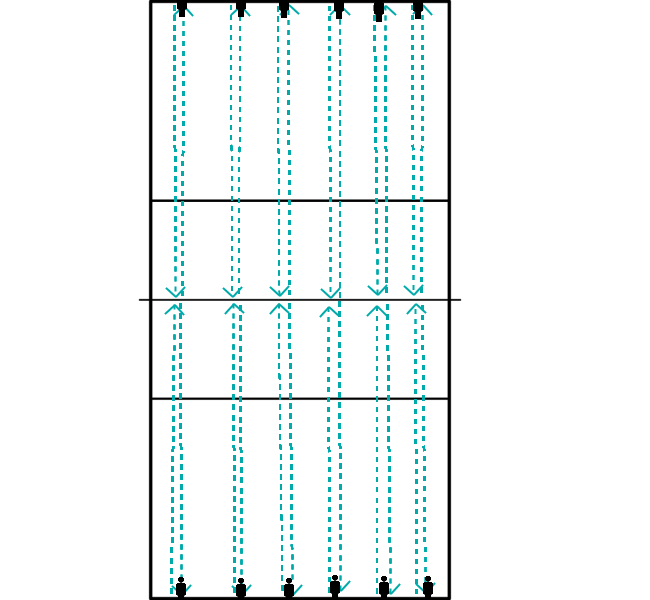
- Across and back (2x)
- Sideways to the other side and back (1x)
- Cross pass to the other side and back (1)
- Lift your knees across and back (1x)
- Heels to the other side and back (1x)
- Arm swing forwards, backwards (1x)
- Frog jump to the other side and back (1x)
- Crossing to the other side and back (1x)
- Sideways hop across to the other side and back (1x)
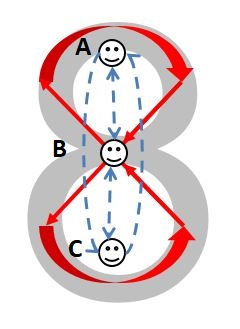
- Make threes
- Each trio one ball.
- Player in the middle runs an 8 each time. Each time this player gets in the middle, a ball is thrown:
- A throws (or plays overhand) the ball to B (in the middle).
- B plays the ball back to A underhand and then runs around A until he is in the middle again.
- A meanwhile passes the ball overhead to C.
- C plays the ball overhand back to B.
- B passes the ball back to C underhand and then runs around C until he is in the middle again.
- Etc.
- After 2-3 minutes, the player in the middle changes.
Variation:
- To make it easier, player A and C can also have them throw instead of playing overhand. This can be an underhand throw/catch or an overhand throw/catch.
- To practice standing still while playing/catching, you can also let player B throw and catch underhand.
- The team starts in basic formation.
- MV moves to the left and together with LV sets up a block.
- The other players move to corresponding defensive position.
- Trainer checks and corrects position of players.
- MV moves to the right to block with RV/SV.
- The other players move to the corresponding defensive position.
- Trainer checks and corrects position of players.
- Repeat this number of times in one motion, rotating frequently so everyone has been in each position.
- Make threes
- Each trio one ball.
- Player in the middle runs an 8 each time. Each time this player gets in the middle, a ball is thrown:
- A throws (or plays overhand) the ball to B (in the middle).
- B plays the ball back to A underhand and then runs around A until he is in the middle again.
- A meanwhile passes the ball overhead to C.
- C plays the ball overhand back to B.
- B passes the ball back to C underhand and then runs around C until he is in the middle again.
- Etc.
- After 2-3 minutes, the player in the middle changes.
Variation:
- To make it easier, player A and C can also have them throw instead of playing overhand. This can be an underhand throw/catch or an overhand throw/catch.
- To practice standing still while playing/catching, you can also let player B throw and catch underhand.
- Player 1 at position LF at the net, player 2 at MA to defend.
- Player 3 (= SV) on RA (use pawn to indicate RV position; SV has to start behind it).
- LF throws ball to MA with arc.
- SV runs in at that point from RA, around the pawn (RV on ~3 meter line) to SV position (between MV and RV position)
- MA passes the ball to SV
- SV catches the ball above the head (all players turn 1 spot, or repeat exercise 5 times)
- Can be extended with setup to LF where
- player 1 throws the ball from the net
- then goes to the 3 meter line (for the run to attack)
- simulates an attack and takes care of the setup.
- If necessary expand with an attack instead of catching.
4 laps around the field in a running pace.
Stand on the backline and calmly walk to the net.
backwards to the backline.
Alternately lift your left and right knee to 90 degrees back to the net (knee lift 90gr)
Heels back to the back line. (2x)
Calm walk to the net, left arm turns forward.
back to the back line right arm turns forward.
Calm walk to the net with both arms turning forward at the same time. back to
the back line walk forward arms turning backwards.
cross pass back and forth.
On your heels to the middle of the field and then on your toes to the net.
Back 8 skippings with high knee deployment and then a short sprint and easy run to the back line.
At the back line, do the same thing again, but now towards the net.
On the baseline again 8
skippings with a sprint to the net. Same again.
After this again active skipping with high explosiveness.
3 sets of 15 movements half squats. (Stand with your feet shoulder width apart and toes pointing slightly outwards) You move as if sitting down to 45 degrees. (15x without stopping) 10 count break and again 15x and then 10 count rest and again 15x.
Lunge (get out, knee not past the toes and back straight arms in the side) 3x left, 3x right (4 sets)
Reach to the net.
Stand facing the net, arms above your head and at a leisurely pace make your back as long as possible (pretend) 3 sets of 5 stretches.
Shoulder girdle slowly.
Stand with your back to it about 50 cm from the net. Raise your arms above your head.
Go to the net with your hands while gently arching your back and hit the net. Also 3 sets of 5 repetitions.
Servicepass training for 4 to 12 persons4
persons:
2 servers at the servicepoint.
1 passer1
receiver
(dynamic) same as static but dancer plays ball on receiver. Passer plays to off-setter. (server becomes reserve, reserve becomes passer, passer becomes receiver etc.)
6 persons.
2 servers3
passers1
receiver
(static) see four persons
(dynamic) server serves the ball and runs after his/her ball.
Passer passes the ball to the receiver. The player on the right becomes the server and the server
moves in on the left. Catcher becomes server. If this does not work out 1 passer becomes reserve.
Extend with fixed sv and extra player on pos 4, who will attack. Passer becomes attacker, when pass is wrong the passer goes away.
Extend with blocking.
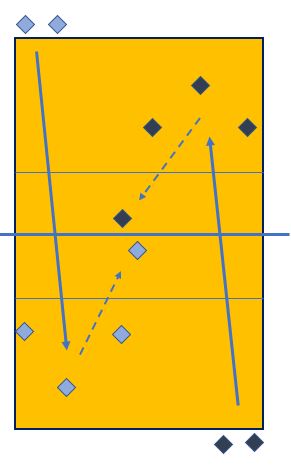
- Three players on the back line.
- At about one meter from the sidelines you put a pylon.
- The other players stand around the field to pick up the balls.
- The trainer at the net throws the balls into the field at a high speed.
- It is up to the players to pass the balls back to the trainer, or at least to hit the ball.
- Then the players join in again at the back, and so they keep running and looking at the ball.
- The remaining players stand around the field to collect the balls played away and pass them back to the trainer.
- Expansion:
- Pawns further apart, throwing faster, hitting.
See picture. Each team 2 balls. 2 players at the net a few meters apart, other player in the backfield.
- Exercise 1: Players take turns throwing the ball, player in the backfield plays the ball back underhand.
- Exercise 2: First ball comes deep, second ball comes short
- Exercise 3: Throwers stand a little further apart and throw straight: player with ball on the sideline throws deep, other throws short.
After x-number of balls or after a certain time swap places.
- 2 rows of players
- 1 row on the left back
- 1 row at the right back
- create with 4 pawns a virtual line where they have to stand behind
- trainer stands at the other side of the net and throws the ball somewhere in the field.
- 1 of the 2 front rows calls LOS orIK (agree who takes short or deep)
- This player passes the ball over the net to the previous player.
- catch a round for the next player
- If you did not have the ball, join the shortest row.
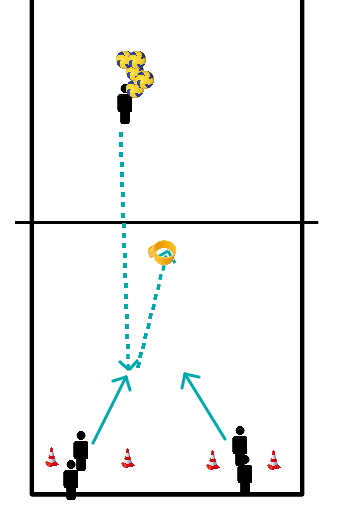
- 1 playmaker
- 1 "false-dead" in the other half
- 1 attacker without ball
- Rest with the ball in a row behind the attacker.
- Number 1 with the ball throws to the distributor, who gives a set up and the attacker tries to score.
- The shamode tries to pass the ball and catch it, if he succeeds, the attacker is "dead" and has to take over the place of the shamode who may now join the row
- If the attacker scores he gets the ball himself and joins the back of the row
- Ladder walking at high speed. Can be extended with left-right stepping out of the ladder with one or two feet.
- Slalom around the pawns.
- Attack pass to the net and shuffle backwards (3x attack pass and 2x shuffle).
- Step under the net.
- Sideways past the net with head under net edge.
- Make a dive across the field.
- Walk around the pawn and sprint over the backline.
- Run back to starting position.
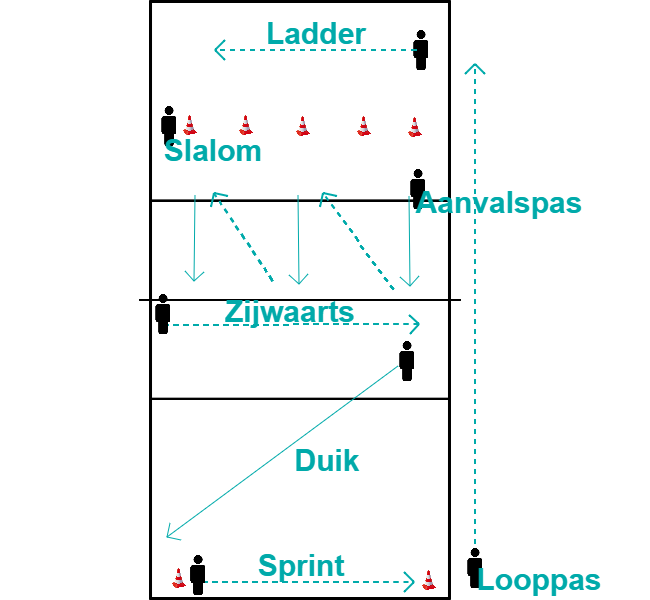
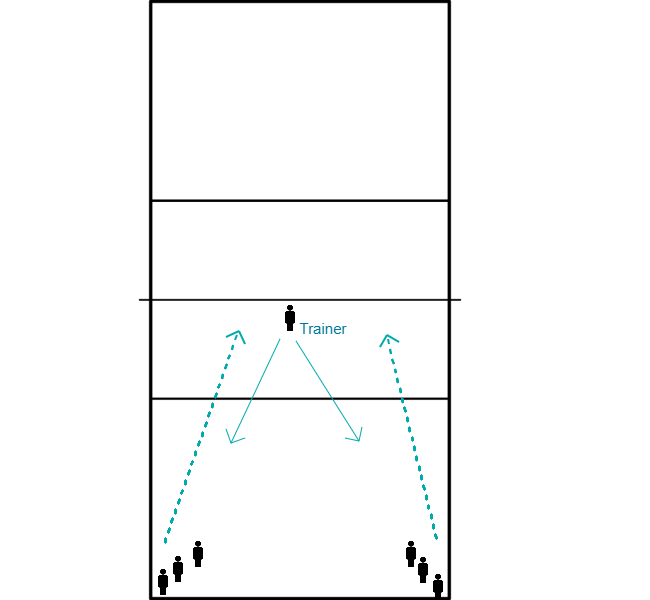
- Trainer stands with ball carrier at the net
- Players divide into 2 groups
- 1 group stands on the left side of the field other group stands on the right side of the field
- Trainer throws the ball alternately left and right of the field,
- players have to catch the ball and put it back in the cart and then close again on the other side.
- Extension: players can play reception to the net and catch the ball themselves.
The aim is to shift focus, so don't dwell on it for too long but be ready for the next action straight away.
- Make 3 teams with 1 regular volleyball and 1 tennis ball.
- The one with the tennisball is the lummel (player 2) and stands in the middle.
- Player 1 plays the ball to the dummy, the dummy throws the tennis ball to player 1.
- The dummy plays the ball to player 1 and player 1 throws the tennisball to the dummy again.
- After this player 1 plays the ball to player 3, player 3 plays the ball to the lummel, and the lummel throws the tennisball to player 3.
- to player 3. The dummy plays the ball to player 3 again and gets the tennisball back. etc...
- requires concentration of the players and fast switching.
- If you don't have tennisballs you can also use 2 balls.
A short but intensive warming up to get the heart rate up and warm up properly.
This is completely without the ball.
- To start this warming up we first start with 2 to 3 laps around the field.
- This is to warm up the muscles a little bit.
- Then we stand in a circle.
- And do the following exercises in order with a 10 count rest each time
- 30 sec. Jumping jacks
- 30 sec bench (with the back against the wall and knees in an angle of 90 degrees)
- 30 sec push-ups
- 30 sec crunch (abdominal muscles)
- 30 sec Squats
- 30 sec planking
- 30 sec alternating Lunges First left and right or vise versa
- we do this two times
See picture. Each 3 players 2 balls. 2 players at the net a few meters apart, other player on the 3-m line and shuffle always from front to back: first r-for then l-for.
- Exercise 1: Players take turns throwing the ball, player in the backfield plays the ball back underhand.
- Exercise 2: First ball comes deep (BH return), 2nd ball comes short (OH return) - must be catchable!
- Exercise 3: Throwers stand a little further apart and throw straight: player with ball on the sideline throws deep, other short (not catchable)
- Exercise 4: player with ball on the sideline does an intermediate test and then gives a deep ball, player in the field takes this ball OH and plays it to player B at the net. Player B can then immediately return a ball on the 3-meter line or test the ball to the player on the sideline and then the exercise starts again.
After x-number of balls or after a certain time swap places.
- 2 rows of players
- 1 row on the left back
- 1 row at the right back
- create with 4 pawns a virtual line where they have to stand behind
- trainer stands at the other side of the net and throws the ball somewhere in the field.
- 1 of the 2 front rows calls LOS orI (agree on that)
- this player passes the ball (in/to) the basket that is between position 2 and 3.
- Ball in the basket is 2 points for the team, against the basket is 1 point.
- Set a target for the team, for example 25 points.
It is possible to add a distributor and an attacker, provided the assignment runs well.
Ladder walking at high speed. Can be extended with left-right stepping out of the ladder with one or two feet.
Slalom around the pawns.
Attack pass to the net and shuffle backwards (3x attack pass and 2x shuffle).
Around the pole
3x block jump pos 2, 3 and 4. (In between, move sideways).
Make a dive across the field.
Walk around the pawn and sprint over the back line.
Run back to starting position.
- 2 rows of players
- 1 row on the left back
- 1 row at the right back
- create with 4 pawns a virtual line where they have to stand behind
- trainer stands at the other side of the net and throws the ball somewhere in the field.
- 1 of the 2 front rows calls LOS orIK (agree on that)
- this player passes the ball over the net to the other (who did not call loose)
- player who has caught the ball puts it in the bin.