



Volleyballexercises for u14
- Rotate the hand and clap the ball 25 times.
- Overhead: Keep the wrist up, clap 25 times.
- Underhand: Keep the wrist up, clap 25 times.
- Keep it up as many times as possible.
- Quickly bounce it 25 times.
- Practice the arm swing without the ball, 25 times.
- Hit the ball held by a person, 25 times.
- Throw and catch with a tennis ball, 25 times.
- Hit the volleyball against the wall, 25 times.
- Stand in an elevated position, place a mat to land on.
- Stand ready and jump without movement, 25 times.
- Open to the setter and hit from the elevated position at the net, 25 times.
- Everyone retrieves their own ball.
- Approach with one step dry to the net, start on one leg, 25 times.
- Game in two teams: one team approaches from one step and hits the ball, the other tries to hit the ball.
- In pairs, toss with your hitting arm, gently hit to each other.
- High-Medium-Low, Low-Medium-Right variations.
- Toss the ball, approach, and hit over the net at position 4, run after the ball.
Hand
- knock on the ball - turn hand through 25 x
- Tap on ball - OH wrist up 25 x then hold up as many times as possible
- Knock on ball - BH wrist held up 25 x then hold up as many times as possible
- knock on the ball quickly 25 x clash
- tapping on the ball quickly 25 x letting it collide, whip and snap , on the ground exercise holding balls up
- swing through
Armswing
- dry practice 25 x
- hitting ball that person is holding 25 x
- throwing with tennis ball & catching 25 x
- hitting with volleyball against wall 25 x
Open to setter
On raise - skirting - and put down mat to come down on.
- get ready, jump off do no move 25 x
Open tosetter and hit
- hit from elevation at the net, over the net 25 x everyone get their own ball
Run-up 1 step
- dry to the net start on 1 leg 25 x
game run-up
- 2 teams
- 1 does approach from 1 step hitting the ball
- other tries to hit the ball
Throw up the ball per 2
- throw up with your striking arm, calmly hitting each other
- H-M-L
- L-M-R
- Trailing the ball
- There are 3 mats.
- Players must change mats 10 times. They can be tapped and then they lose the points.
- 2 teams play against each other.
- Ball must be thrown OH.
- If one has caught the ball, one may not run with the ball.
- If one drops the ball one must leave the field of play. One can return if the other fellow players have caught the ball 3 times.
- Throwing on and touching back, pay attention to good posture, stand firmly wide, make small passes towards the ball.
- Passing and touching back from movement:
- Running backwards
- Walk sideways
- Running forward
- 1x to yourself and then play over.
- Trying to run after.
Per 2 after action hitting cone.
- Throwing ball. Pay attention to posture, do it slowly but do it well. 3 minutes.
- Hit ball under the net, throw up with spin.
- Hit ball above net aimed, soft to person, hip open. The other person catches the ball.
- Ball is thrown from other side, then you hit it.
- Player A throws up with spin, and hits to player B, B does OH to player A, player A passes to player B who hits to player C and so on. Just out of position, without jumping.
- Now at the net.
- Player A throws ball up with spin, and hits ball to player B, B does OH to player A, B goes to pos IV, player A passes to pos IV player B who hits to player C and so on. Attack at position 4.
- Throw tennis ball against wall and catch back 10 x.
- Throw tennis ball up and hit against wall 10 x.
- Volleyball hit against wall and catch 10 x.
- Volleyball hit against wall and keep hitting 10 x.
- Volleyball hit against wall and play OH up and hit back 10 x.
- Volleyball hitting against wall and playing BH up and hitting back 10 x.
- Volleyball hitting against wall alternating OH and BH play and hitting back 10 x.
- Field by 4.
- A and B in defense positions V and I.
- C on raise.
- D serve, after serve ball pick up.
- Band with 4 balls.
- Raise is on position 4.
- D does simple serve to A or B.
- A and B build up and play ball over it D catches off and puts ball in band.
- A and B assume starting position on 3 meter line.
- C hits ball after which A and B shuffle backwards with A on position 1 -feet straight- B on pos IV -slanting-. C attacks, A and B build up and get back in starting position on 3 meter line.
- D throws ball up from behind the 3 meter line, A and B shuffle backwards, and keys ball high into the backfield -not to score- . A and B defend and build up.
- After 10 times, A and B switch with C and D.
- A and B stand in reception at positions V and I, and move to the front after building up.
- C tips the ball, left or right, doesn't matter. First 5 balls easy, then 5 more difficult balls. A and B build up and play over.
- After build up, or ball away, back to player D. This plays short over the net. Defending.
Organization A , B, and C the passer stand in reception.
- D throws ball easily over, build-up and over play go:
- A at position IV , B at position V and C at position I.
- D crawls on the raise and plays to A or B.
- C comes running in from position I and builds back up there is easy play to D.
- Back to starting position, D now plays short to A.
- Left 3 steps - Right 3 steps - hit ground in split. 10 x then change.
- Shuffle diagonally back - ball hitting ground , sprint diagonally forward. 10 x then switch.
- A has ball and quickly throws left-right to B. This throws back immediately and shuffles to the side. 10 x then exchange.
- A throws ball to B shuffles back from left-right and throws back. 10 x then change.
- Exercise 3 but with playing back OH. 10 x then switch.
- Exercise 4 but then with return play OH. 10 x then switch.
7 . A throws ball up, B shuffles to back, B stops in split, touches ground and as A keys ball BH tight to B, does defense back to A . 10 x then switch.
8. A tips ball to B, B plays high to A, A does intermediate key, B shuffles to back as A tightly keys to B, B does defense back to A. 10 x then switch.
Same as 7 but now attack.
10. Same as 8 but A now attacks.
Organization: A at net / B with ball at back line.
11. B throws ball high to A and runs to 3 meters and takes defensive position -ground tapping. A tips ball, B defends ball to A, and runs to back line, A tips ball to B who catches.
12. B throws ball high to A, runs to the 3 meters, gets tip ball, plays back to A, A does interjection, B shuffles backwards, A attacks.
13. B throws ball to A , runs to 3 meters and gets tip ball, plays high back to A, A can now choose, new tip ball or TT and attack backwards.
Organization: A at the net with the ball / B at the back line, facing the wall.
14. A calls name and throws up for attack, B turns around and defends the ball, then like exercise 13. A may choose.
Perform each exercise 2 x.
- Forward 2 x in each step.
- Forward 3 x in each step.
- Forward 4 x in each step.
- LV in RV in LV out RV out, foot in foot out.
- LV in LV out/RV in RV out/LV in and so on.
- Standing next to ladder RV in jump LV in sping RV in next box jump.
- Pump stance LH in RH in and so on.
- Sideways 1 x in each step.
- Sideways 2 x in each step.
- Sideways 3 x in each step.
- Forward step sideways in each step L and R.
- Forward step 2 x sideways in each step L and R.
- Feet parallel.
- As you sink through your knees to the ground your body goes forward.
- On your toes, weight forward.
- Knees above your toes.
- Shoulders in front of your knees.
- Triangle of your body.
- Hips under the ball.
- Hips low.
- Elbows together.
- Flat on the ground, bend on the ground, then slide forward.
- Player A holds the ball against the outstretched arms of player B who is in defense position.
- Player B first goes through his right knee, then through his left knee, and comes back straight, right left . Focus on arms and on staying low in defense.
- b checks the other and corrects attitude from last week.
- 1 player hits 10 against the wall for himself.
- 3 meters from the wall
- Catches ball in front of himself, not hitting directly yet, moving to ball.
3 In pairs:
- a hits wall via ground, b catches ball (above his head in attack position)
- Before catching, b throws his ball up to a
- B throws up and hits wall, a catches ball, before catching a throws his ball up to b 10 x
5. Same as 3 but b keys ball up and catches and then does the drill.
6. Same as 3 but b keys ball up, 2CT - low - high and hits own ball.
7. Per two 1 ball.
- Hit ball directly against wall, no CT, try as high a range as possible 5 x.
- It is not about the attack itself but about the timing and technique.
- First of all, again a short explanation of the attacking run and pass. (if necessary mark with tape/feet)
- Trainer/playmaker gives setup after playing the ball 1 to 6 times for himself.
- Player waits with walking until the ball leaves the hands of the distributor/trainer.
- Explanation and feedback on offensive run/pass.
- Player takes ball and walks to the other side of the court to the right front position.
- Here stands another coach/player who gives a setup WITHOUT waiting.
- The important thing is that each 2 team is serious about the drill, and really training each other.
- Doubles play OH, using the benches as a net.
- OH, replay.
- Player 1 throws the ball on close to the bench, after the pass (by player 2), player 2 runs to the back line, taps it, and comes in again.
- Player 1 throws the ball at the backline, after the pass (by player 2), player 2 runs to the bench, taps it and back.
- Same as the first exercise, but player 1 tries to OH the ball 2/3 times himself, and then pass to player 2.
- Player 1 standing on the bench:
- Throwing the ball overhead, a bit harder and tighter if possible. Player 2 tries to pass the ball back.
- Also in motion, shuffle backwards.
- On each half of the pitch there are 2 benches, in the width of the field.
- Start with slalom around the benches, from half court to half court and back again.
- Instead of walking between the benches, do the connecting pass with the bench.
- Idem cross pass.
- Jump over the benches.
- Balancing over the benches:
- Move left and right leg next to the bench.
- 1x 2-person and 3x 3-person per bench.
- Skip step alternately.
- 2 feet equal.
- Li/re on, li/re off.
- Various other exercises.
- 3 numbers, that means that every time the teams change, since there are 11 players.
- CAUTION:
- Don't make a fuss about getting the players ready, I don't want to see the same teams every time. Everyone counts for himself.
- Trainer puts the ball in play, on the side where points are made, this can be done in different ways.
- Also, the ball is put into play at a high rate when the teams need to rotate.
- Starting with the no-go area to score points.
- The 3-yard line.
- So hopefully they are smart enough not to defend in the 3 meter area.
- Free play, full out, have it all.
- player 1 at the net midfield
- number; players at mid-back with the ball
- row of players on the left (or right) side in front
- 2 corpses as disturbance/block on other side of the net
- 2 players as defence at the other side of the net
- player with ball throws to midfield
- midfield puts up HIGH
- left front attacks
- if hitting fails: play smart over the net
- if ball lands on the ground in the field you have a point
- Defenders try to prevent this.
- Everyone keeps on turning.
- Tackle becomes playmaker
- Defender joins the row of attackers
- Attacker passes under the net and becomes 1st defender.
- 2nd defender takes ball, passes under net and joins row of attackers
- The aim is for the team to pass to position 3 (midfield).
- Place a mat at this position.
- One person stands on the mat to catch balls.
- Team line-up on one side of the field.
- Rest + trainer on other side.
- Team members of trainer serve ball, pass correctly (person on mat must be able to set up ball with both feet on mat) = point for passer. Pass wrong is change of person who passes wrong with server.
- After a few minutes/balls rotate positions.
- If necessary, trainer throws really balls in the field. Possible to extend game with set-up and play over net.
Divide group into two/three teams.
1. Row back line, 1 ball, roll ball, ball just over 3 meter line - pick up (the faster you roll, the sooner you win)
2. Rows of back line, 1 ball, run to net, throw and catch short over net (4x)
3. Rows of back line, 1 ball, run to net, two meters distance, throw ball into net and catch
4. Lines at wall, 1 ball, 5x ball overhead against wall
5. Lines at wall, 1 ball, 3x throw ball underhand against wall, pass against wall, catch, etc.
6. Drive at wall, 1 ball, 3x throw ball from distance against wall (throw hard and far)
Divide group into two/three teams.
1. Row back line, 1 ball, roll ball, ball just over 3 meter line - pick up (the faster you roll, the sooner you win)
2. Rows of back line, 1 ball, run to net, throw and catch short over net (4x)
3. Rows of back line, 1 ball, run to net, two meters distance, throw ball into net and catch
4. Lines at wall, 1 ball, 5x ball overhead against wall
5. Lines at wall, 1 ball, 3x throw ball underhand against wall, pass against wall, catch, etc.
6. Lines near wall, 1 ball, 3x throw ball from distance against wall (throw hard and far)
- We make groups of 4.
- We practice the line-up first with a serve ball from the trainer and then a normal/attack ball from the trainer.
- It is important that there is a change of position, the volleyball technique itself (pass, reception, ... are important but in this exercise it is not important).
- When the group has had both it is the next group's turn.
- The group that just had the ball goes back into the box and stands at the window,
- 5 times with nose against the window and then walk to the other side, by then the next group is about ready.
- 10 times back and forth to the net
- 5 times backwards and forwards
- 4 times sideways (connecting pass and face one way)
- 4 times front to back crossing (also face one way)
- 4 times heels touching butt and backwards
- 4 times lift the knee and return backwards
- 4 times sitting low on the side (pass posture) face one way
- 4 times waving arms (left and right)
- Stretching and stretching (calves, thighs, ankles loose, hips loose, arms stretching (front to back))
- Make groups of 3,
- One player stands at the back line with the ball to serve,
- the other two players move to the other side of the net.
- The first player is going to serve, the other two are going to defend and call.
- The player not defending runs forward and catches the ball.
- It is rolled to the player who defended and the player who caught goes under the net to the player who saved.
- It goes on like this all the time.
- Building up with a pass and possibly attacking.
- If the ball falls between the players or falls without being called, as punishment sit-ups or pumps.
- The team is divided into groups of 6.
- 4 children serve, 2 children catch.
- The children stand up one by one (start short, as it gets better we stand up further and further).
- On the other side of the net are 2 children who must catch the ball. They have to call out if they want to catch it.
- We do this 5 times, then we pass. (Children who catch the ball will serve, 2 of the serving children will catch the ball.
- When we get it right, we'll take it a step further.
- The child that does not catch the ball walks to the net (place will be indicated) and stands crosswise to the net.
- Child who caught the ball throws it in a curve to the child who stands at the net and this child catches the ball overhand and rolls the ball back to the server.
- This is done 5 times and then the ball is passed to the other players.
- When we get it right, we'll take it one step further.
- Same as last exercise but this time the one who goes to the net doesn't roll the ball back but throws it overhand to player 2.
- who in the meantime also walked to the net (place will be indicated).
- He catches the ball and rolls it to the server.
- This is done 5 times, after that the ball is passed to the other players.
- When we get it right, we'll take it one step further,
- Then the ball is not rolled back, but played overhand over the net.
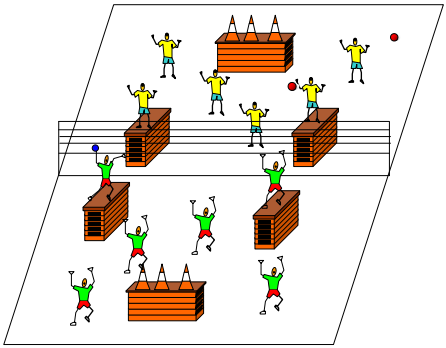
- The 2 throwers stand on the boxes and the attackers walk on the ground.
- The throwers and attackers try to knock over the pylons or throw off attackers at the opposing team.
Rules:
- You are not allowed to defend your pylons, you can use chalk to make a circle in which the pupils are not allowed to stand.
- As a thrower and as a declarer you can choose to aim at the declarer or at the pylons.
- The defender is not allowed to fend off but if he catches the ball the thrower is out and a new thrower has to come in
- When a player is thrown out, he/she has to sit on the waiting bench, when a pylon of the opposing team is knocked down, all the keepers can go in again.
- Throwers cannot be thrown off.
- When the opponent's pylons have been knocked down, you have won the game, or when all of the opponents' helpers have been removed.
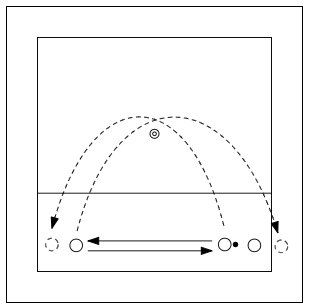
- The players start by throwing the ball over, close to the net (within 3 m).
- After throwing the ball, each player walks around the pawn at about 5 m and to the other side.
- Variation
- One of the players then decides how the ball will be passed and how the players will move around the pawn.
- The other players imitate this player.
4 game forms for warming-up for youth teams.
Game form 1: ( Korfvolley )
- Theme of the training: Playing above the head
- Explanation:
- A game of Korfball, same rules, but it is only allowed to score with an overhand ball.
- More difficult:
- The ball must be pinned by a team mate.
- Easier:
- Draw a circle around the basket, where only the attacking team is allowed to go.
- Scoring:
- 1 point for every ball scored
- 2 points for a teammate who passes the ball to the attacker.
Game form 2: ( Basketball volleyball )
- Theme of the training: Playing with hands
- Clarification:
- Make 1 group per basket and throw the ball under a left or right angle from under the basket.
- The players have to play the ball underhand in the basket.
- Harder:
- Hit the ball in a controlled way instead of throwing it in.
- Catch the ball before it hits the floor via the basket.
- Easier:
- Throwing the ball straight instead of in an angle.
- Reduce the distance to the basket.
- Point count:
- 1 point for every scored ball
- 2 points for a passed ball
- 3 points if the ball is caught in follow-up.
Game form 3: ( Tennisvolley )
- Theme of the training: attack
- Explanation:
- Tension the net at tennis height and make teams of 3 or 4 players.
- The ball must be played back and forth and smashed into the ground on your own side.
- The receiving side may not let the ball bounce first.
- Turn over every time the ball is played to the other side.
- You will see that this is a very difficult exercise when the ball lane recognition is not in order.
- Harder:
- Jump on attack
- Easier:
- No spin
- Ball may not end within 3 meters
- Point count:
- 1 point for every scored ball
Game form 4: ( Trefvolley )
- Theme of the training: Defence
- Explanation:
- Game of dodgeball where all the defensive techniques of volleyball are allowed as defence.
- Player throws the ball to his opponent, who tries to defend the ball so his teammate can catch it.
- Harder:
- Field must be divided into front and backfield, catching teammate must be in the frontfield.
- Thrown ball must be a batted ball.
- Easier:
- Throw with 2 hands from the neck.
- Throw with 2 hands from the chest.
- Point count:
- 1 point for every ball defended
General:
- The warm-up for youth should be playful and always with the ball.
- Do not warm up too much, stretch, play volleyball immediately.
Code cracking.
- 2 Teams against each other
- Exercise set 1
- 4x sprint over 1 half of field
- 10x situps
- 30 seconds planks
- 10x jump on the bench with both feet next to each other
- Exercise set 2
- 10x BH turn catch
- 10x BH OH sit catch
- 10x BH catch over net
- 40x service against the wall and catch
- 1324321441
- 3423112434
- 2243121341
- 4132124321
ON 1 FIELD:
- groups of3/4/5
- 2 groups per field
- 1 group bats, after the serve the person who bats starts to run around the bases around the field (baseball)
- the other group is on the opposite side: 3 persons defend, 1 person catches on position 3
- the defenders have to get the ball to the receiver as soon as possible, when the receiver has the ball in his hands, he will call loudly stop and everybody has to stop walking
- when the server lands in the net or the runners have not reached a base in time, they are out and must wait until the changeover to play again
- when the server hits an ace, this is a homerun: the same goes for when the defenders punt the ball away
- the catcher of the defending team must stand on a mat and may not leave the mat to catch the ball
- when the attacking team has 3 players out, it is a change.
- if you are playing with 3 people, the substitution takes place when 2 people are out, if you are playing with 5 people, the substitution takes place when 3 people are out.