

Volleyballexercises for u17
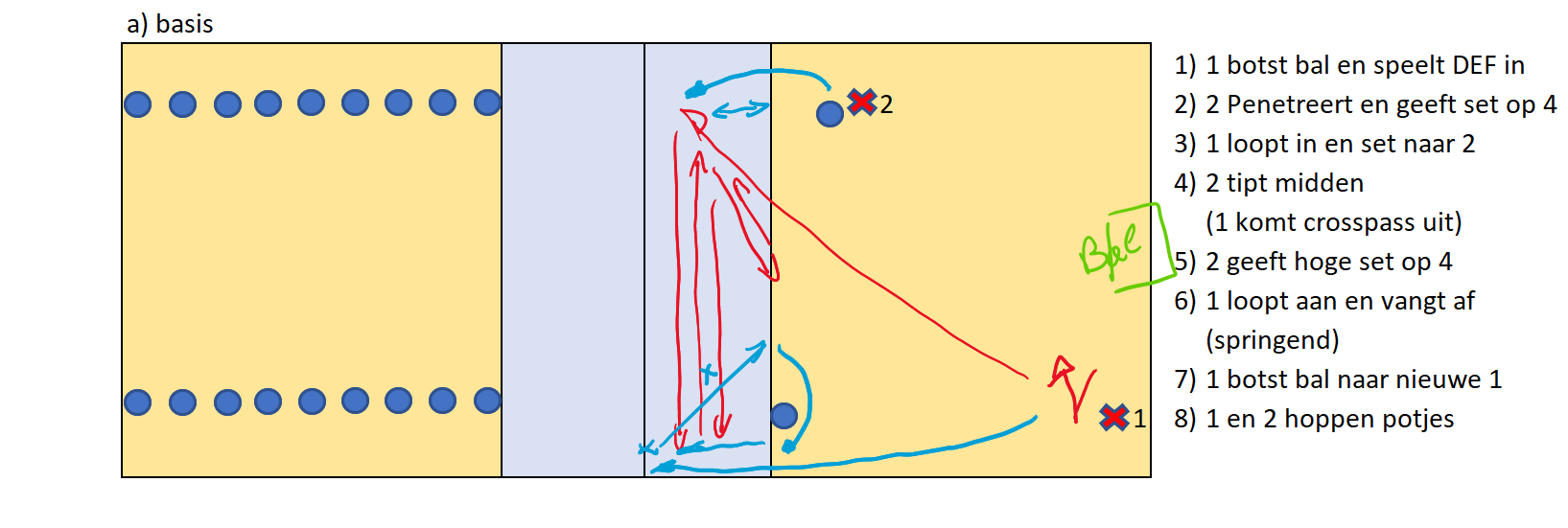
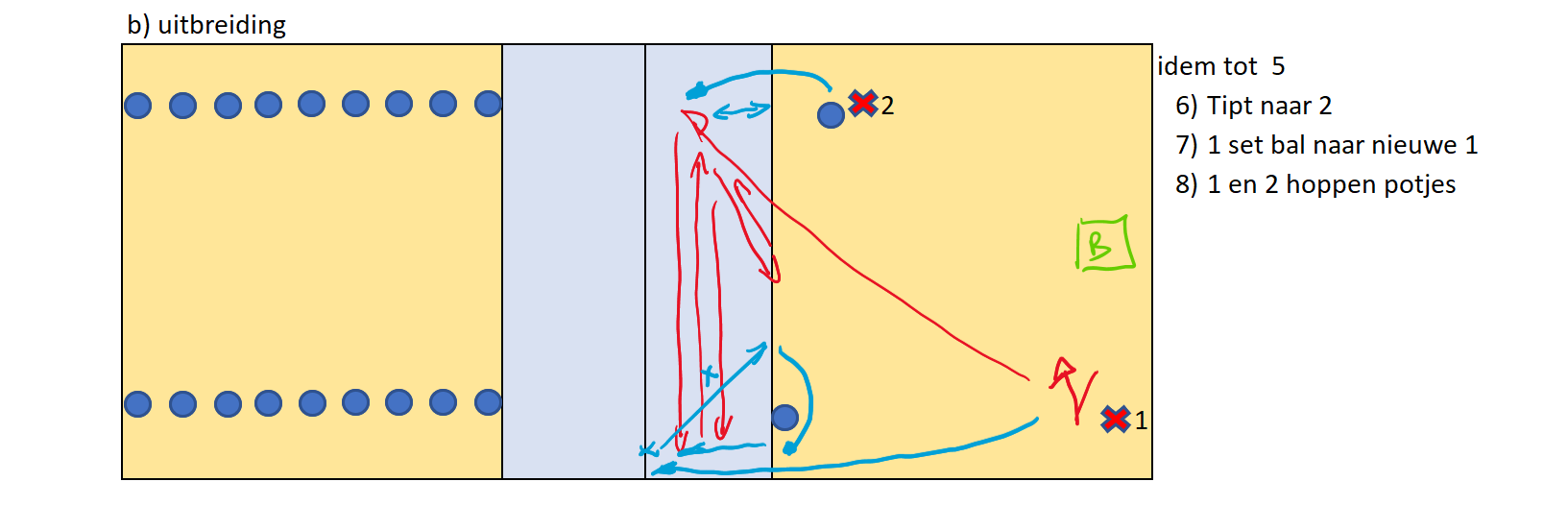
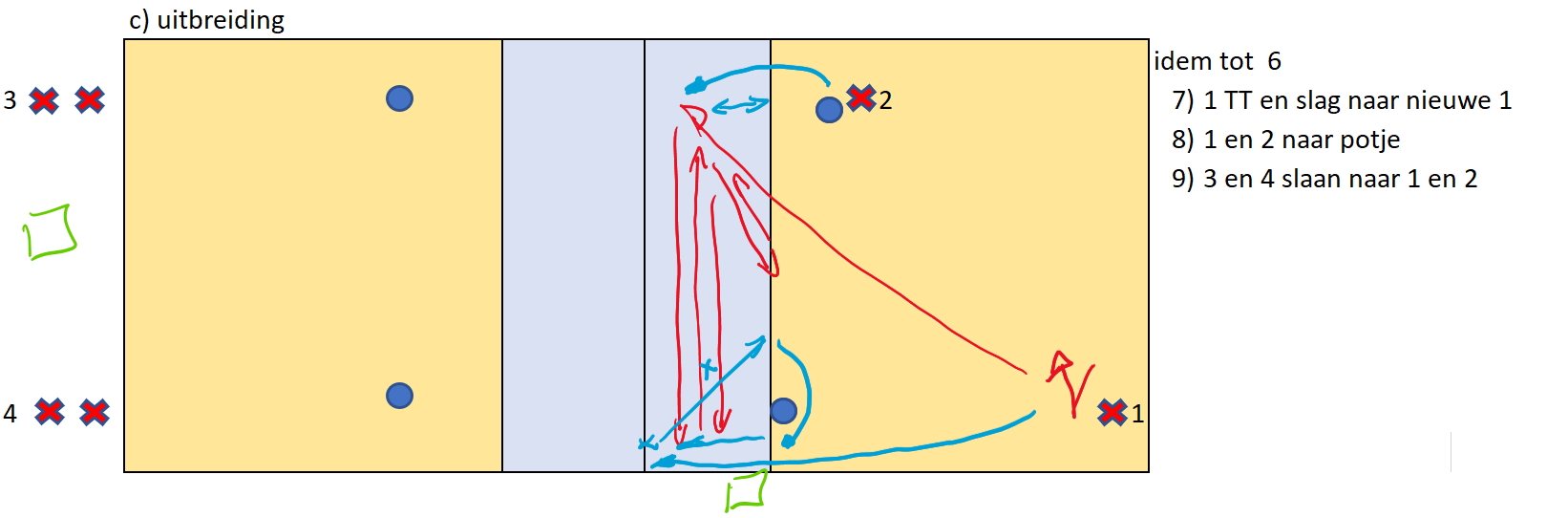
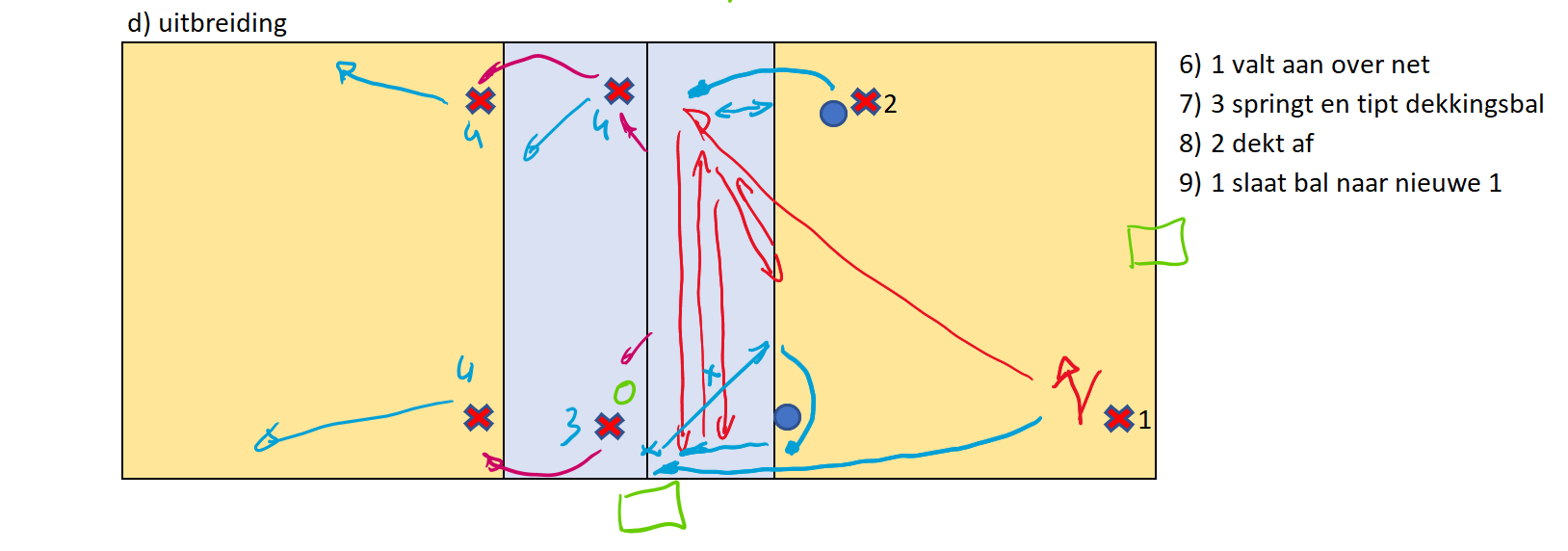
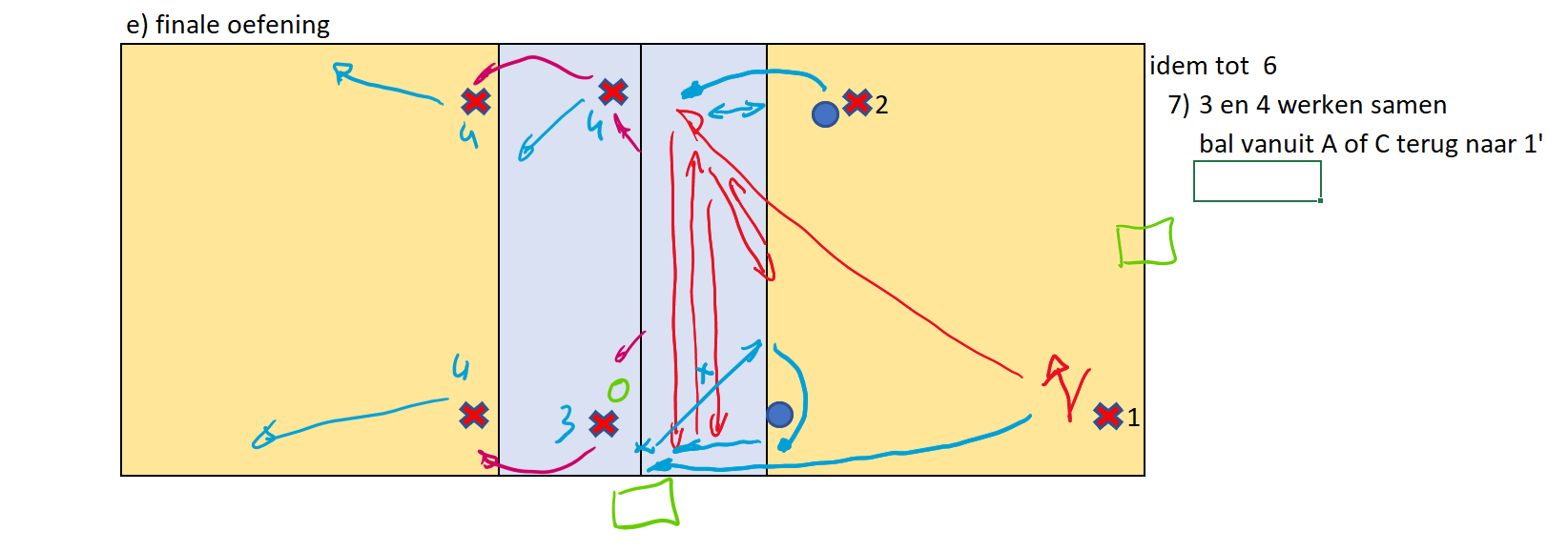
Trainer stands with ball box at the net, position 2/3, players stand at position 1, 5 and 6 for defense.
Trainer throws ball to players:
- If ball at position 1, players of position 1 and 6 exchange after playing back ball
- If ball at position 6, players remain standing
- If ball at position 5, players of position 5 and 6 clear after playing back ball
- As long as the passing remains good at 2/3, the coach continues to pass the ball.
- Players not participating stand around the field and make sure the ball pit stays filled.
- We make a square of benches with +/- 15 balls in it.
- 2 players go into the square and the rest of the players stand around it.
- The players in the square get 60 seconds to throw as many balls as possible out of the square, it is up to the other players to throw as many balls back into the square.
- After the 60 seconds the balls in the square are counted and then it's up to the next 2 players.
- (In between there is a rest period of about 60 seconds).
- The duo that has the least balls in the square at the end has won.
- The others do a punishment (for example clean up the balls and the benches.
- 5 (or minus 4) players per side of the field, with 1 ball.
- 4 players stand in the field and 1 player stands at the back line with the ball.
- The 4 players in the field are lined up and the player at the back line of the other side is going to pass the ball over the net (overhand or underhand does not matter for this exercise, but the ball must be over the net!)
- The players are going to defend this ball to the player who gives the pass (this one is run in from position 1).
- This player catches the ball above his head and gives a high pass.
- The ball is caught at the net (no attacking).
- The ball then goes to the server.
- The same exercise is done but now with the other side of the court. After this it is back to the first side to serve.
- So there is one place rotated.
- After a while the same exercise can be done with an attack (key over the net) where it is important that when the attack is done over the net player 1 and 3 exchange places!!!!!!!
- All players take a ball (except 2 players).
- The 2 players without the ball both stand in the middle on one side of the net.
- The other players all line up at position 4,
- the first player throws his ball/or touches in a good intention towards the player who gives the pass.
- The first player throws his ball/or key in a good intention to the player who gives the pass.
- The ball is caught and this player continues to the other side of the net.
- This player does the same while the second player can already set up at the first pass.
- When all players have been through both passeurs they will be exchanged.
- Until everyone has passed. (If this works well after a few practice sessions, you can then build up to a possible attack as well!)
- The team is divided into 2 groups (4 according to the amount of players).
- team 1 = storage team
- team 2 = catch team
- Team 1 serves 1 for 1.
- They start close to the net and when they succeed they can move further and further away.
- Team 2 forms a line on the opposite side behind the back line.
- When player 1 of team 1 serves, player 1 of team 2 comes in the field to catch the ball.
- He catches the ball and walks outside the square to team 1 to serve and joins the back of the line.
- The server walks outside the square to team 2 to catch the ball and joins the back of the line.
The team is divided into 2 (or more) equal groups.
The groups compete against each other during different tasks:
- walk forwards to the cone, tap the cone, walk backwards
- walk forwards to the cone, tap the cone, walk backwards
- walk forward to the cone, tap the cone, walk backwards, take player 2 to the cone, player 1 stays behind and player goes to get player 3 ...
- walk with ball forward to the cone, put ball on cone and walk backward, 2nd player walks forward to the cone, takes ball and walks backward and passes ball.
- Passing the ball while sitting above the head
- pass the ball through the legs
- pass the ball left/right
- get to the other side by moving hoops
- The 2 groups now form 1 big group.
- get the mat across while sitting above your head
- getting the big ball across without touching the ground
- Speed ladder is from the back line towards the net, in the middle of the field.
- Players move every round with a different movement pattern for the footwork through the speed ladder towards the net, then at position 3 a block, move to position 2 or 4 (alternate) and there a block again.
- Then walk a lap around the square until when they are back at the ladder.
ladder exercises:
- 1 foot per square
- 2 feet per section
- left in, right out
- 2 in front, 1 in back
- jump open
- There are 6 players standing with their backs to the net, three on each side.
- A stands on the back line,
- the first player throws the ball
- and it is caught by A and thrown back.
- 2nd player throws a short ball,
- A walks forward and catches the ball and throws it back.
- 3rd player throws a deep ball,
- A moves backwards (facing the net) and catches the ball and throws it back.
- Catches the ball and throws it back.
- A walks to the other side of the net
- where he stands in front of player 4,
- Player 4 throws a short ball,
- A catches and throws back.
- Player 5 throws a deep ball,
- A moves backwards (facing the net) catches the ball and throws it back.
- Player 6 throws a short ball,
- A moves forward (facing the net) catches the ball and throws it back.
- Passing.
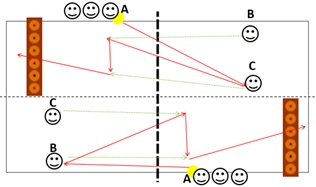
- Player A throws ball over the net.
- Player B or C passes the ball over the net.
- The other player quickly runs under the net and sets up the ball for the same player who passed.
- This player tries to get a pawn off the bench with overhand play or a hitting move.
Which pair or team has knocked the most pawns off the bench after X number of minutes?
Four exercises are set out, which are completed in time. The teams collect points. After the 4 exercises a mini tournament is played, where all teams play against each other.
- Exercise 1. This is done together. All teams do the same exercise at the same time. Two players lie side by side on their stomachs behind the back line. Number one of the team jumps up and runs to the net. When nr.1 is lying on his belly, nr.2 can leave.
- Exercise 2. No. 1 hits with smash the ball via the ground and the wall to no. 2. No. 1 stands behind a line with two pawns, no. 2 stands on the mat.
- Exercise 3. Nr. 1 serves from behind the 7 meter line, to nr. 2. Nr. 2 passes the ball to himself and plays immediately with an overhand ball the ball over the net to nr. 1. Every good ball that is caught is 1 point. After 2 minutes you can change.
- Exercise 4. No. 1 runs with the ball to the net, from a pylon, passes the ball under the net to No. 2. No. 2 runs with the ball in her hands to her own pilar and back again. Nr.2 then throws the ball over the net to nr.1. Nr.1 runs to her own pilon, and returns to pass the ball under the net. Etc.
Tournament:
- team 1 - team 2 5 minutes
- team 3 - team 4 5 minutes
- team 1 - team 3 5 minutes
- team 2 - team 4 5 minutes
- team 1 - team 4 5 minutes
- team 2 - team 3 5 minutes
followed by possibly a big game.
What you need:
- Exercise 2. mat and 2 pawns, some balls
- Exercise 3. some balls and antenna makes smaller field.
- Exercise 4. single balls and aerial
After each part, a short rest and then through again. Parts with * need a bench, 2 to 4 persons per bench
- Part 1:
- 30 step-ups* (getting on/off the bench)
- 15 push-ups* (feet on the bench)
- 30 step-ups*
- Part 2:
- 30 east-west step-ups* (right foot on bench left foot next to it â€" left foot on it right foot next to it)
- 10 squats jumps (bend knees and jump as high as possible while stretching)
- 6 or more players of which 2 are fixed on the sideline and they play overhand or hit.
- The other 4 players stand in pairs opposite the other two on the sideline.
- The two players play overhead and pass the ball to the other side.
- The pass is brought and after the pass you step forward then sideways and step backwards. Repeat.
- Learn to move 'through' the pass.
- We like dynamic passing.
- Variant of not playing the ball overhead but hitting it in control.
- 'Chaos Easy' starts as a warm-up, but ends as a real battle.
- The players are put in the field (it doesn't matter where).
- The ball is caught and immediately thrown over the net (one play).
- As the player catches, he throws the ball.
- When a player has thrown the ball, he/she goes to a wall (back of the field or on the side) and taps it, then comes back into the field.
- The other players on the team have moved forward one spot.
- You notice how difficult it is to score.
- When someone throws the wrong ball (into the net or out), he/she has to sprint around the opponent's field.
- the number of players present are all outside the field of play.
- In the middle of the field there is a hoop with a number of balls in it.
- 1 less than the number of players
- Players do a number of exercises, for example
- planking
- sit-ups
- push-ups.
- when the players have completed these exercises, they lie on their backs.
- At the sign of the trainer they run to the middle, and try to conquer a ball.
- They keep on running until there is only one ball left.
- The winner of the game decides on a punishment for the other players.
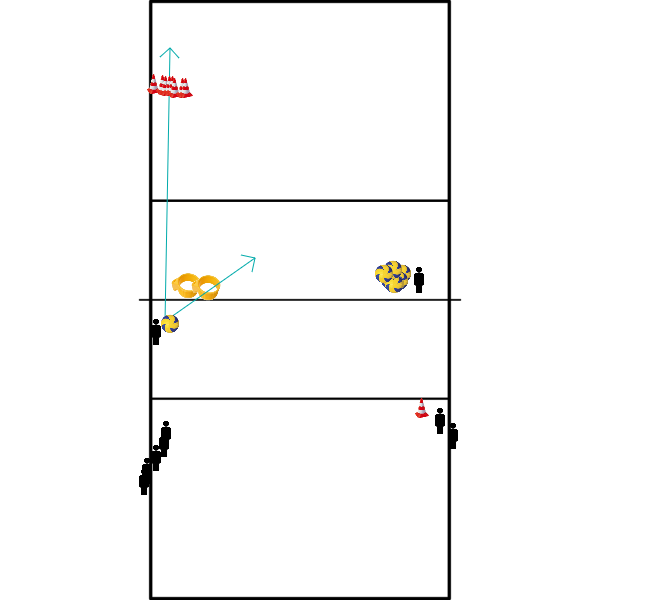
- Put 6 hoops down, on the 6 positions. (P1 t/m 6).
- Make 2 fair teams, easiest is from 4 players per team.
- One person from each team starts in the hoop at position 1.
- The rest of the team stands with a ball on the other side of the hoop, behind the back line and vice versa.
- As soon as the trainer indicates it, both teams start serving on the hoops.
- The person standing in the hoop tries to catch the service without stepping out of the hoop.
- When a service is caught, the person who served the ball moves to position 2, to catch the ball in the hoop.
- The person who was in position 1 goes to his own backline to serve.
- The team that catches the ball first at position 6 is the winner.
- Important is to concentrate on a good service every time.
- The goal of this exercise is to tactically put away or hit the ball.
- This by means of a tap ball on midmid, or a ball deep on position 1.
- By using baskets you can create a 'constant' block, which eventually can be replaced by a real block.
- The pawns at position 1 can best be replaced by a cupboard, over which the ball must fall, over the 'defender'.
- The trainer hits a ball, or plays a ball in, which is first passed to the distributor,
- the playmaker gives a set-up to the outside.
- The attacker decides whether to try a short passed ball at midmid (where there is a hoop),
- or looks for position 1 with a hit or a fast overhand ball.
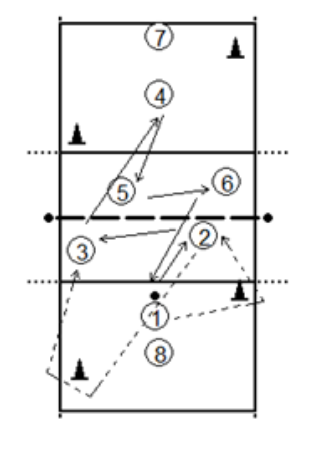
1 pass on 2,
2 set-up on 3,
3 BH on 4 -
4 pass on 5
5 set-up on 6,
6 BH on 8
etc. Turn over: - 1 runs around the pawn to the position of 2.
1 moves around the pawn to the position of 2
2 moves around the pawn to position 3
3 to the other side to the position of 4, etc.
- A line-up of six players stand in the field.
- On the other side stands the trainer, included if necessary.
- Three players stand at the net with 1-2 balls and one server stands (this can also be the trainer).
- The first ball is served and handled by the 6 players.
- Where the attack is played, the person standing with the two balls at the net, throws the ball back over the net very quickly.
- In this way the attacking cover is trained.
- From this cover, all attackers must of course return as quickly as possible to give support.
- A short run is important.
- You will therefore be training a lot of blocking without actually blocking
- Keep on blocking until the net players have run out of balls, until it is not safe or until they simply cannot play anymore.
- Rotate through a position every so often so that side-out is trained on every position.
- After throwing the ball, the net players should look back to make sure that the previous ball doesn't secretly roll back under the net.
After each part, a short rest and then through again. Parts with * need a bench, 2 to 4 persons per bench
- Part 1:
- 30 step-ups* (getting on/off the bench)
- 15 push-ups* (feet on the bench)
- Part 2:
- 30 east-west step-ups* (right foot on bench left foot next to it â€" left foot on it right foot next to it)
- 10 squats jumps (going through the knees and jumping as high as possible when stretching)
- Part 3:
- 20 side shuffles over 4 meters
- 10 slit-squat jump (jump and go through 1 knee, other knee each time)
- Part 4:
- 30 step-ups* (stepping on/off the bench)
- 15 push-ups* (feet on the bench)
- playmaker, attackers, 1 ball
- SV only plays the ball high outside
- Attacker hits and retrieves own ball
- SV only plays the ball fairly flat outside
- Attacker hits and retrieves own ball
- SV only plays the ball far outside
- attacker hits and fetches own ball
- SV only plays the ball high midfield
- attacker hits the ball and fetches own ball
- SV only plays the ball fairly flat at mid
- attacker hits the fast ball and fetches own ball
- SV plays the ball just before the 3-metre line
- attacker hits the ball and picks up own ball
- SV only plays the ball high outside
Part 1
- The players are divided into two equal teams.
- The balls are distributed equally on both sides of the net.
- The aim is to have as few balls on your own side as possible.
The way to pass the balls / course of play:
- Roll
- Throwing (overhand, underhand, one arm)
- Storage (underhand, overhand)
Part 2
- The trainer places a ball on the half way line.
- On either side of the net, a line of players stands at the back line.
- At the signal of the trainer they run to the ball, whoever has it may keep it.
Which team collects the most balls?
Variations:
- The players on both sides of the net are numbered (so that 2 players of the 2 different teams have the same number)
- Storm at sea: if your number is called, you must try to get the ball as quickly as possible and get back behind your line (= point + safety for the opponent).
- If you are tapped by your opponent when you have the ball in your hands, you have to drop the ball (you can pick it up immediately afterwards and continue playing).
- The trainer puts several balls on the middle line and everyone plays against everyone else and tries to collect as many balls as possible. (Several times, not as many balls as players, can also be played with a time limit, ...)
Purpose of exercise:
To teach the body that you should never give up.
Exercise Explanation:
- In volleyball, we are so conditioned that after the ball hits the ground, everyone stops playing.
- Because of this, you sometimes get players to lower their heads before the ball hits the ground.
- Through this very fun game form, you teach your body to just keep going after the bounce.
- You will see that your body gets used to never giving up.
- You are playing a game.
- When the ball hits the ground, you go after it, while you, as coach, count how many times it hits the ground before the ball is finally played up.
- Suppose Team A has got the ball up after 6 bounces, then they have to pass, set-up and attack 6 times.
- Points are awarded when the ball no longer bounces but rolls and when the ball has bounced a total of 20 times.
- So trainer, you will have to count!
Goal of the exercise:
- Defending everything and getting the ball high inside the three-meter line
Explanation of the exercise:
- This is a nice defensive drill to get into after the warm-up.
- The trainer stands inside the 3-metre line.
- There is a line of players at the back line.
- The trainer throws, pokes or hits balls in all directions.
- The person in front of the row has to defend the ball, in such a way that the ball ends up as close to the trainer as possible within the 3-metre line.
- If this doesn't happen, that person goes to jail at the ball pit.
- But if the person behind the one with the bad defending ball, manages to get the volleyball right to you as trainer, the first one is bought free and does not have to go to prison.
- When people are in prison, they may only re-enter the field when the others have defended the ball twice without errors within the 3-metre line.
- The players will help each other, even if one player makes a mistake that could be made better by another.
- Tip: when using a high ball pit, the trainer will have the balls on the grip quicker.
Purpose of the exercise:
- To allow players to experience what it feels like to 'leave' later for the attack
Exercise Explanation:
- If volleyball players feel they are starting the attack pass too early,
- or the coach feels that the attackers are coming too early,
- this is a good exercise.
- The playmaker is put down with a ball carrier.
- He gets the assignment to play 5 or less times for himself.
- The attackers do not know how many times this will happen, so they can only leave when the set-up is given, not before.
- The attackers will have to come in more aggressively and will build up more speed and thus more height, provided they have a good brake pass.
- If this goes well, the trainer can decide to move the playmaker closer to the attackers, so that the distance the set-upper has to travel is shortened.
- This should make the attackers even more alert.
- This exercise is done in pairs, standing about 4 meters apart.
- One player rolls the ball to the other.
- The latter must stop the ball with two hands behind his/her back.
- In this way, the player can only stop the ball in a low forward position: shoulders in front of the knee, knee in front of the feet.
- Make sure you understand that the exercise is for learning to adopt a low posture when passing / defending.
- Physically, this exercise is very taxing on the legs, so don't do it for 5 minutes, but play three series of 10 balls.
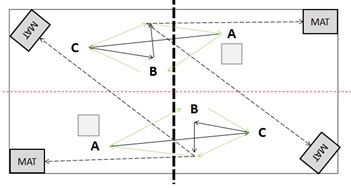
- Player A throws/strikes the ball towards player C.
- Player C serves the ball to player B.
- Player B gives a pass to c.
- Player C passes to the mats.
Goal: try to attack/play 3rd ball on the mats (straight or diagonal).
After each ball move one place in your own group.
Extension: When there are enough players one could also choose to place a block.
1 plays overhand to 2
2 plays overhand back and moves alternately 3 meters to the left or right
and returns to the starting position.
1 plays the returned ball directly to the left or right of 2 and changes after 2 mints. VARIATION: 2 plays overhand