

Volleyballexercises for u18
Last update: january 2026
Execution
- Divide the players into pairs, facing each other at a marker.
- On command, players move sideways to the sideline, each in a different direction.
- Return to the opposite sideline and then back to the marker.
- The player who touches the marker first wins.
- The next pair starts immediately after the first round.
- Ensure rotation within the pairs after each round.
- If there are more than 9 players, set up the game in duplicate.
- This activity is also suitable for independent execution while preparing the next activity.
Execution
- Players form pairs and stand opposite each other at a distance of 2-6 metres (the players determine the distance themselves).
- Player 2 hits the ball to player 1.
- Player 1 passes the ball back to player 2.
- Player 2 provides a set-up to player 1.
- Player 1 hits the ball.
- Player 2 passes the ball back to player 1.
- Player 1 provides a set-up to player 2.
- Player 2 hits the ball.
- Repeat the cycle of pass, set-up, and smash.
Formation
- Two lines of players: one line at left back and one line at right back.
- Create a virtual line with four cones where they must stand behind.
- The coach stands on the other side of the net.
- The coach throws the ball somewhere in the court.
- One of the two front players in the lines calls "MINE" or "I GOT IT" (agree beforehand).
- The player who calls it passes the ball to position 2 or 3.
- The other player catches the ball at position 2 or 3.
- The player who catches the ball returns it to the coach.
- Both players join the other line.
Execution
- Set up two gymnastics boxes, starting as low as possible (one layer).
- Place the boxes at a distance equivalent to an attack approach apart.
- Optionally, place marker mats for the approach.
- Jump with both feet onto the first box and land with both hands raised off the box.
- Perform an attack approach to the second box: short, long, connect, take off (rhythm: 1...2.3).
- Note: take off with both feet and swing the arms backward during the large step.
- End on the box with both hands in the air (optionally clap hands).
- Then perform two block jumps at the net. Pay attention to lateral steps and move around the cone.
- The trainer throws a dive ball: slide on the stomach, retrieve the ball, and place it in the bin.
- Join the end of the line for the next jump.
Execution
- Perform ladder running at high speed. Step out of the ladder left-right with one or two feet.
- Slalom around the cones.
- Attack step towards the net and shuffle diagonally backwards (3x attack step and 2x shuffle).
- Step under the net.
- Move sideways along the net with your head under the net edge.
- Make a dive diagonally across the court.
- Run around the cone and sprint over the baseline.
- Jog back to the starting position.
Organization:
- Making duos with 1 ball
- Distribute across the 2 fields
- Player with ball stands on the 3 meter line
- Player without ball at the 7 meter line
Execution:
- Player on 3 meter line throws ball straight up
- Player on 7 meter line runs in and catches the ball above the front zone
- After 5x change and make 3 series
Accent:
- Pay attention to outlet before 3 meter line
- Without brake pass
Starting position:
- Net hangs at 1.10 meters - 1.50 meters
- 2 teams on each side of the net.
Progression:
- Ball is passed underhand
- Ball is caught after a collision
- Run to the net for a key throw
- Smash / overhead attack over the net.
- Catch after bots.
Expansion:
- serve phase
- overhand serve
- catch without collision
- additional action
- receptive phase
- Pass-throw to partner at the net. Partner runs to the net.
- Reception to the net.
- pass
- throw up for yourself + pass to attacker
- direct pass to reception.
- attack
- catching ball + attack
- do not catch ==> direct attack on pass
Pairs a ball.
- 1 player bounces ball, other player tries to take it away without grabbing the opposing player. If successful, the role changes.
- In pairs pass the ball from one side of the room to the other. Without running with the ball yourself. Who is the fastest? If it goes wrong, pick up where it went wrong.
- Same, but then throw it. If it goes wrong then start again.
- Ball in the middle of the room between the players. Players on the back line on coach's signal run to the ball. Who has the ball first?
- Players one meter apart with ball in the middle on the floor. On signal from trainer. Hands on head/ knee/ shoulder/ or ball.
- 1 of the two has the ball and holds it with two hands. Opponent has hands just above the ball. As soon as the other drops the ball, try to catch it before it hits the ground.
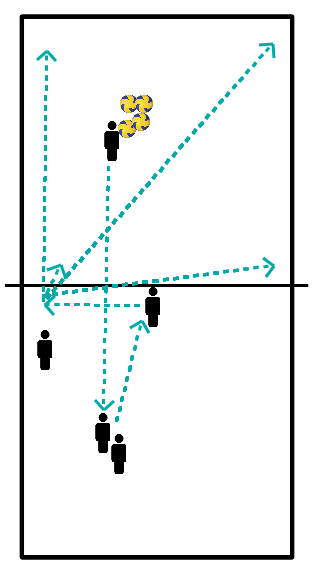
2 groups:
6 offensive players
4 defensive players
6 offensive players
4 defensive players
- Trainer starts with a throw-on at position 6
- Player at position 6 passes the ball to SV -3-.
- SV plays ball to position 4 for attack.
- 4- puts a block and defends the ball. If the ball is defended the rally continues.
- Note a blocker and someone in the backfield. After single ball routing.
- Emphasis is on attack. Smash.
- Rotating players.
6 vs. 4 free play.
4-talstarts service themselves.
Rotate.
4-talstarts service themselves.
Rotate.
2 teams -2 touch
2 teams play against each other. Teams may only:
2 teams play against each other. Teams may only:
- Play ball underhand.
- Play ball overhand.
- Play push/puncture ball.
- Do not smash!
Initial goal: keep the ball in play.
Variation goal: competition, make it as difficult as possible for each other. Run on everything, react, dive.
2-team OH overplaying. Control, high balls, get ready low.
From movement:
Variation goal: competition, make it as difficult as possible for each other. Run on everything, react, dive.
2-team OH overplaying. Control, high balls, get ready low.
From movement:
- After OH move left and right. First to left, then back to right.
- After OH to the back, and catch up again. Change after 10 balls.
OH with trainer from position 2Trainer throws the balls to:
- From a row:
- Move from side field.
- Move from center field.
- Move from the backfield.
- Movement from 3 meter area.
- From a row:
- Pass the throw from the trainer and catch it yourself at position 3.
- 3 in a row:
- Fixed catcher on 3. Each time 3 moves up and adds a player on the outside.
Attack, DIAGONAL, applies to everyone:
- Full smash or good tight push ball.
- And/or far ball into the backfield.
1. Attack diagonal.
- Player 1 in position 5 throws the ball towards 2/3.
- Player 2 at position 1 runs towards 2/3 and provides a set-up for the attacker coming from position 5. attack is at position 4/3.
- Attacker retrieves the ball, setter moves into group position 5.
2. Same with a defender.
- This defender really has to do everything possible to get the ball somehow anyway.
- Defender gets the ball and joins the group of setters, attacker becomes defender, setter becomes attacker.
3. Same but with 2 defenders.
4. Same but with 2 defenders and a blocker. Fixed group of 3.
4. Same but with 2 defenders and a blocker. Fixed group of 3.
- Blocker comes from position 3.
- They can switch between blocker/defender positions.
- Swap after a certain number of balls.
5. Same but with fixed setter.
- This means that the group at position 1 disappears. Fixed group of 3.
- Blocker comes from position 3.
- These may switch positions blocker/defender among themselves.
6. Same but with fixed setter, 2 defenders, 2 blockers. Fixed group of 4.
- These may switch positions.
Walking exercise:
a. Sprint to the 3 meter line.
b. Side connecting pass
. Blocks at 4, 3 and 2.
d Pass under the net, to the 3 meter line, turn around and backward through to the back line
. Sideways to the other sidef
. Sprint to the start.
Pass and follow. Under the net. Around the pawns.
Catch ball from 5.
Pass ball from 5 towards setter on 3. Finish set-up and fetch ball. Setter becomes passer. Variation from 1.
Watch out for attacking pass. Every ball full out.
3 vs 4
3 serves on 4. Team 4 must attack with a set-up and smash. If you can't get it right, free ball. And continue to play the rally.
Emphasis: 3 players must go to the net and execute a block. Note the third player must connect. During the rally the 4 should also emphasize the block, with the SV connecting left and right.
a. Sprint to the 3 meter line.
b. Side connecting pass
. Blocks at 4, 3 and 2.
d Pass under the net, to the 3 meter line, turn around and backward through to the back line
. Sideways to the other sidef
. Sprint to the start.
Pass and follow. Under the net. Around the pawns.
Catch ball from 5.
Pass ball from 5 towards setter on 3. Finish set-up and fetch ball. Setter becomes passer. Variation from 1.
Watch out for attacking pass. Every ball full out.
3 vs 4
3 serves on 4. Team 4 must attack with a set-up and smash. If you can't get it right, free ball. And continue to play the rally.
Emphasis: 3 players must go to the net and execute a block. Note the third player must connect. During the rally the 4 should also emphasize the block, with the SV connecting left and right.
- 3 laps of warm up
- Play in 2 teams
- 2x OH followed by 2x BH
- 3 or 4 teams, pass the ball
- Then run after the ball with the whole group on the diagonal field.
- Play from 2 to 5, but run around the pawn on 1 and 4.
- Sparring in variations:
- Team of 4 or 3 plays from a fixed spot
- 2 defenders
- 1 setter
- 1 attacker
- Setter plays the ball BH to the attacker,
- The attacker starts to push the defenders,
- These play the ball to the setter.
- Push ball can become smash.
- Each 4 minutes on position.
- 2 groups will practice passing and running.
- Trainer throws ball to:
- 3 process the ball to setter on 2,5 (setter runs every time from 3 to 2,5) and plays a rally.
- Points of attention
- Setter goes on defence after the set-up.
- All players move with them. '
- Attack on 3 or 4
- Variation that the trainer indicates which attack is played.
- This means who completes the smash and in what direction.
- Fixed setter in this exercise.
- The other four collect the balls.
- Variation on this:
- 2 take care of the block
- Other 4 defend and play counterattack if possible.
- 3 laps of warm up
- Play in 2 teams
- 2x OH followed by 2x BH
- 3 or 4 teams, following the ball under the net. Do not touch the net.
- Then run with the whole group on the diagonal field. Play from 2 to 5, but run around the pawn on 1 and 4.
- Sparring in varia
Team of 4 or 3 plays from a fixed spot- 2 defenders
- 1 setter
- 1 attacker
- Setter plays the ball BH to the attacker,
- Attacker starts push to defenders
- Defenders play the ball to setter.
- Pushball can become smash. Each player 4 minutes per position.
- Complex exercise
- Player at 6 processes ball to setter.
- Setter goes to position 4 and player comes from position 5 to complete attack.
- Player goes out to get the ball.
Variation:- One player defends the attack in the backfield.
- One player blocks attack and one player defends backfield.
- 2 groups will practice passing walk.
- Trainer throws ball to
- 3 processes ball to fixed setter at 2.5 setter runs from 3 to 2.5 each time
- Setter plays the ball backwards to position 2
- Here the defender catches the ball and rolls the ball to the other side where the players collect the ball in the ball pit.
- Then the same to position 4.
Points of attention: - Setter goes into defense after the set-up.
- All players move with him.
- Attacking 2 or 4
Variation that the trainer indicates which attack is played. This means who completes the smash and in what direction.
fixed setter in this exercise the other four collect the balls.
Variation on this:- Attack is rounded off. 2
- players block.
- 4
- others
- defend and play a counter-attack if possible.
- TR throws the ball on at position 6.
- Defender at 6 plays the ball to a setter.
- Defender must move to pos. 1 after this pass and must process a throw-in from position 2 by player.
- Setter plays the ball to 4 for attack.
- Then defender must be ready again at 6, setter gives a ball at 3 and attacker plays a 2nd attack.
- Attacker becomes defender, defender on free spot and free spot becomes attacker.
Other players collect the balls in the ball pit
Formation:
- 4-player team with fixed setter
- Serve other half of the game.
After the service, the server walks into the court and processes a throw-in from the TR.
Next, the player processes an attack from the 4 setter.
Organization:
- 1 person who's 'it' and 3 balls
Execution:
- The person who's 'it' tries to tick as many people as possible without the ball.
- The ball may be thrown over to "protect" players.
- Players may hold the ball for a maximum of 5 seconds.
Goal:
- Working together and getting as few players as possible to tap the ball.
1 game lasts approx. 1 minute and can be played more than once
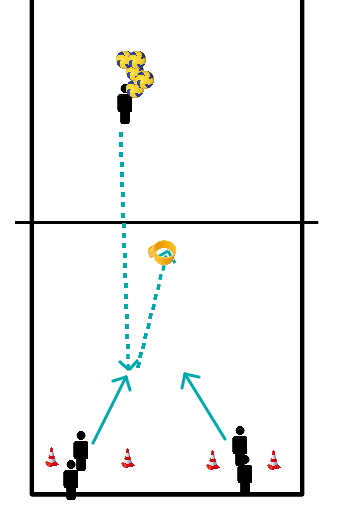
- 2 rows of players
- 1 row on the left back
- 1 row at the right back
- Create with 4 pawns a virtual line where they have to stand behind.
- Trainer stands at the other side of the net and throws the ball somewhere in the field.
- One of the two players in the front of the line calls out LOS orIK (let's agree).
- This player passes ball to p2/3.
- The non-passer catches the ball on p2/3.
- The receiver returns the ball to the trainer.
- Both players join in the other row.
- 2 rows of players
- 1 row on the left back
- 1 row at the right back
- Create with 4 pawns a virtual line where they must stand behind
- Trainer stands at the other side of the net and throws the ball somewhere in the field
- One of the two front row players calls LOS orI (let's agree)
- This player passes the ball over the net to the previous player.
- Catch a round for the next player
- If you did not have the ball, join the shortest row
- Divide the team into four groups.
- Each group gets an ace (hearts, diamonds, spades and clubs).
- The rest of the cards are covered in the middle of the room.
- The 4 groups stand in a corner of the room.
- One player may walk to the center of the field, turn over one card and then return.
- Only if the card has the same shape as your own ace, you may take it.
- If wrong, the card must be covered and they return empty-handed.
- In order to first collect all cards of the own figure.
- 2 rows of players
- 1 row on the left back
- 1 row on the right back
- 1 SV
- create with 3 pawns a virtual line where they should stand
- Player stands at the other side of the net and throws the ball somewhere in the field.
- 1 of the 2 front rows calls LOS orI (agree on this) and plays the ball to SV
- This one calls new SV
- SV takes ball and puts ball in ball pit
- SV joins one of the rows
- Extension 1:
- Setter plays ball back briefly to player who did not pass, pass back to setter
- Setter hits ball (calmly) to player who did not pass
- Trainer throws the ball to the midfielder
- He passes to SV
- SV gives setup
- Striker plays the ball SLIMLY overthe net
- so just over the net
- Or in the back of the field in the corners
- Attacker hates the ball and puts it with trainer (in the box)
- Everybody turns 1 spot (runs after their own ball)
- If necessary put hoops (= opponents) where they do not have to play.
- Give instructions all the time