



Volleyballexercises for u21
Last update: january 2026
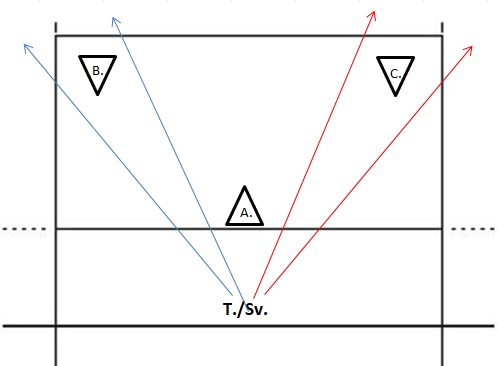
- The purpose of the exercise is to train the defender A in his reaction ability as well as to work together in handling the ball.
- Important for this exercise:
- EVERYTHING is touche!
- The ball that is played/tossed by the trainer (high and far; not hit!) is allowed to come well outside the lines, because the ball must be handled as if it jumped off the block.
- A. stands with his back to the net and concentrates on the defenders B/C.
- If the ball is played by T/Sv. then either B or C demands the ball ("LOS!") and moves to play the ball.
- A. sprints after B/C and offers himself vocally ("HERE!").
- B/C must be able to hear where A is before playing the ball.
- B/C plays the ball high to A and A plays the ball well inside the 3-metre box. T./Sv. makes the catch.
- If there are 8 or more players, this exercise can be done at both ends; if there are less than 8 players, it is played at one end and B/C rotate with players waiting outside the lines.
- In that case, work at a high tempo so that nobody stands still for too long.
- A. changes after 5 or 10 balls; every player takes the position A. twice.
- NOTE: The exercise goes at a high tempo!
- When A. has handled the ball, the next ball follows immediately.
- It is up to the player turning in the ball to get in position in time!
- Expansion:
- Place a basket on a spot of your choice within the 3-meter section.
- The second ball must touch the basket (top) or go through the basket.
- Goal
- Training 3-meter offense and defense.
- Handling hard balls by the defense.
- The exercise
- There are two teams facing each other.
- The teams are balanced in numbers as much as possible.
- The trainer introduces the first ball so that a back player can immediately (with pressure) execute a 3-meter attack, after that the rally is free.
- The team that wins the rally then receives the first ball from the trainer.
- If there are 8 players or less, only attacks from behind the 3-meter, with more players it can be chosen to place players at the net or to make it a King's Court exercise. (The losing side rotates out of the court; all attacks then continue to come from behind the 3-meter).
- This activity promotes:
- Cooperation
- Communication
- Dealing with disappointments
- Fun
- Working method
- Make a circle of your players of maximal 12 players.
- If you are doing this with a large selection you could split the first team and second team or make a circle of men next to a circle of women.
- Give the following instruction:
- Hold out your hand to someone across the way and hold it tightly.
- Then give someone else your other hand.
- This creates the team knot.
- Make sure you get out of the knot without letting go of the hands.
- Variation
- Nobody can say anything.
- Everyone can say something.
- One person can say something.
- You can, after the group is out of the knot, have the group discuss what the best tactic is and then put them back "in the team knot".
- Evaluation
- Watch carefully what happens, who takes the lead, who gives up quickly?
- How does the group solve the problem?
- Organization
2 teams. 1 on each field.
Line up at 7 m intervals.
Front player has the ball.
- Execution
1st ball is thrown over the net and the 1st player on that field plays the ball overhand over the net again.
The direction does not matter.
Then the 2nd player is going to play this ball overhand over the net as well.
All players rejoin behind their own line.
If the ball falls to the ground or into the net, a point is earned.
Immediately throw the ball over the net again.
At 15 points there is a winner.
When there are more players add extra tasks (like a block jump or a dive).
- Coach stands in the middle at the net.
- Three players are standing in the field.
- Trainer throws/plays the ball to the players.
- It does not matter how they do it, but the ball must arrive at the trainer.
- Trainer may not take more than one step to get the ball.
- The ball can also be played to the trainer in two or three times.
- When there are 7 or more players the same thing can be done at the other side, but then instead of a trainer there is a player at the net.
- It is important to make sure that the ball is passed to the trainer.
- If there are extra players, someone can stand in the queue.
- If the ball falls to the ground, the substitute will take that spot. (In the case of a large difference in level of play the substitution can be made as well).
- 1 player at position 2.
- 1 player on position 3.
- Coach or player on position 4.
- Rest of the players in a line behind the back line at position 1.
- Player at position 2 throws a deep ball.
- Player passes back.
- Player at position 3 throws a short ball inside the three meter line.
- Player passes back ball.
- Player/coach at position 4 hits or throws a deep ball.
- Player passes it back and joins the back of the row again.
- Don't forget to pass regularly!
- There is one passer in the field at position [6].
- The trainer or a playmaker stands with the balls at the net at position [3].
- The ball is introduced by hitting or pricking and there is a variation in short/long and hard/soft.
- The passer keeps the ball from the ground (prio 1) and provides the pass to [2/3] (prio 2) where the ball is caught by a team mate.
- This exercise can be played in two variants.
- A. [suitable for large teams]
- After the pass, a new player is rotated into the field and the passer joins the back of the line.
- High tempo!
- The team can be split in two, so that one team always picks up the balls from the other team.
- B. [suitable for small teams]
- The passer remains standing.
- He quickly takes up his position again after the pass and processes a new ball (10 in total).
- The other players spread out to collect the balls.
- After 10 passes the passer takes off and the ball is passed.
- High tempo!
- Organization:
- Field A:
- Sv on p2.
- Attackers on 4 and start at the net.
- Trainer throws in balls.
- Field B:
- Block on p2 and Libero on 5.
- Explanation SBS6. (Stand still, Block Stroke arm to P6)
- Field A:
- Execution
- Tr throws on, setup and attack at 4.
- Block blocks the strike arm and the libero defends the attack if necessary.
- Block stays in place for 5 attacks.
- Expansion:
- Field B:
- Block on p3 connecting to attack on P2.
- If the block is gone before the setup is given, the Sv may play the ball over the net at p3.
- Field B:
- Important:
- First walk (arms loose and not extended), then stretch and pass.
- Stand still when passing but continue the exercise.
- Throwing (2 players at the same time)
- Move from the left- and right-back to the middle 3-meter and pass; 8 balls 7.
- From left and right back to front 3-meter move and pass; same side 7 balls.
- From left and right halfway side-shuffle. Pass in the middle; same side 7 balls.
- Block at the net and then pass on 3-meter line; same side 5 balls.
- From midfield to left- and right-back bring shuffle pass; loop 5 balls.
- Hit (4 at the same time):
- From left side (3-meter) 1st ball from center attack directly on player; shuffle towards mid-back with immediately a slide attack from outside position.
- From position 5 direct middle attack on player; shuffle to position 6 ball thrown in.
- From position 5 direct mid-attack on player; shuffle to position 4 ball thrown in.
- From the right side (3-meter) 1st ball from mid-attack directly on player; shuffle towards mid-back with immediately a slide attack from the outside position.
- Extended (3 at a time):
- From right long ball from outside attack; short shuffle for diagonal attack. (left player right player alternate)
- 3 passers with random balls. (attack, throw, long balls, short balls)
- Per person 1 hoop.
- Running next to the hoop, take as many steps as possible with your left foot through the hoop.
- Running next to the hoop, take as many steps as possible with your right foot through the hoop.
- Running next to the hoop, tapping the ground with your left hand through the hoop.
- Running next to the hoop, tapping the ground with the right hand through the hoop.
- Overtake the hoop and let it roll between your legs.
- Next:
- Throw in tight in pairs (3x*) and keep the hoop moving in front of/next to you.
- Pass over and immediately crawl through your own hoop.
- Overplay OH and roll over the hoop.
- Organisation:
- Field A.
- Playmaker on p2.
- Passer on p5.
- Attacker on p3.
- Field B.
- Trainer on p4.
- Blocking on p3 and defence on p1 and p5.
- Execution:
- Training hits on passer on p5.
- Pass, setup and attack.
- Pay attention:
- Attacker must be near the ball at the same time as the playmaker.
- It is played about 50 cm above the net.
- Attacker has no choice and must run and jump for the ball.
- 5 full laps in run around the field, bouncing left-right.
- Then all on the sideline: (6 -6):
- Ball on the ground, sitting low to halfway around the field and back (10 X).
- Ball on ground, sideways low moving to opposite side, rolling back ball and inciting to dive and arrive at opposite side in front of ball again.
- Ball 2 x BH up and 3rd ball BH forward, etc to opposite side and AW back in the same way.
- Same as OH.
- 2 x 6 before the 3 m line, throw ball over the net into the opposite side's backfield and catch after 1 bounce.
- In 2 pairs:
- In 2 x BH pass over and flat on belly, get back up as soon as possible and continue playing.
- 8 x controlled attacks after which the roles are reversed without stopping.
- Defender with back to attacker when kicking ball on front feet, on signal to turn around to defend (10 x).
- (Defender passes ball back to player at the net, turns around and taps back line, sprints forward and defends ball on 3m-line.
- (Russian passing-drill (1.10 min)
- This exercise can be done in 3 or 4 teams.
- Minimum number of players is 6 and maximum 8 per available field.
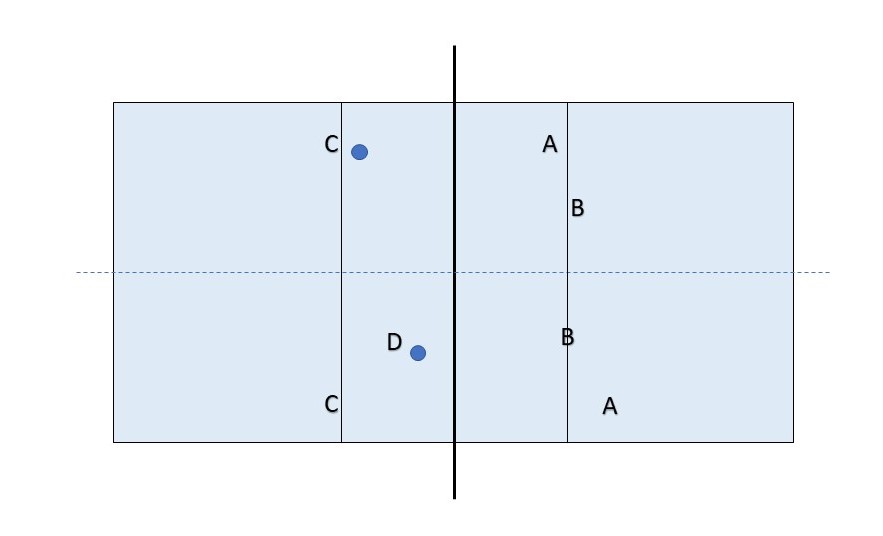
- In a 4-player team, two players on each side of the net.
- Use during the exercise half a net width per 3-4 team.
- In a 4-player team:
- 2 players on each side.
- The ball is thrown over the net at the start.
- Player A plays the ball for himself and at the 2nd contact he gives a set-up for player B.
- Player B tips the ball over the net with 1 hand.
- Player C plays the ball for himself and then gives a set-up for player D.
- D tips the ball over the net.
- After a team has played the ball over the net the players change places.
- In the case of a 3-player team:
- 2 players on one side of the net and the other player only on the other side.
- Player C has the ball and throws it over the net to the 2 team.
- Player A plays the ball for himself and at the 2nd contact he gives a set-up for player B.
- Immediately after giving the set-up, player A goes under the net.
- Player B tips the ball over the net with one hand.
- Player C plays the ball for himself and gives a set-up for player A.
- Player C goes to the other side of the net immediately after giving player A a set-up.
- Player A tips the ball over the net to player B.
- Player B plays the ball for himself and gives a set-up for player A.
- After giving the set-up player B goes under the net.
- Expansion:
- Possible mandatory blocking of tip ball by player not doing the passing.
- Possible mandatory blocking of tip ball by player not doing the passing.
- Organization:
- 2 players on p2 with balls.
- 2 players in the backfield.
- 2 (or more) players out of the field.
- Implementation:
- During 1 minute, the players on the p2 are going to keep the field players busy with attacks, tip balls, etc.
- Let 1 player on p2 work and as soon as a ball is not defended, the 2nd player takes over.
- The players off the field take care of ball safety.
- After 1 minute the players on p2 become defenders, defenders go out of the field and 2 new ones on p2.
- All on the 3 meter line facing the net.
- If necessary divide in two halves.
- In slow motion synchronise the attacking pass. (right-handed)
- The next steps are in an arc towards the net; by doing this all at once in synchrony, they oblige each other to run in an arc:
- Left small step; take arms to the front; start of forward force
- Right big step; arms all the way back; deep in knees; accelerationof forward force
- Left foot in front of the right (close step), with the foot parallel to the net; forward force is slowed down
- Throw both arms up and push off with 2 feet up; forward force is converted into upward force
- Right arm backwards like baseball/arrow pitcher; left arm points in direction of desired ball path; strike ball and land through knees approx. 0.5m in front of the net
- Each player has a sit up ball - 9 different core-stability exercises
- The Grasshopper:
- To get the most benefit from this exercise, make sure your body is in a straight line from head to toe, your hips are square (parallel to the ground) and your abs are tucked in and braced.
- Your hips should not sink at all during the movement, especially when you return to full length from the knees inwards.
- Another important point is to make sure your shoulders fall over your hands at all times, so your body doesn't rock back and forth, largely losing the benefit of this stability ball exercise.
- If you have sensitive wrists, use a pair of dumbbells as a base for your hands, this will keep your wrists in a more neutral position and reduce their strain.
- Push ups:
- Keep your hands on the side of the ball so your wrists are more neutral and very slowly lower to the ball to make this a good challenge.
- Just before your torso hits the ball, explosively (yet controlled) push back up.
- Straight Leg Deadbug:
- To get the most out of this exercise, make sure your arms and legs are always pressed into the ball.
- Even if you extend one arm and leg to just above the ground, the leg and arm still holding the ball should be pressed into the ball.
- Back leg position:
- Place your arms to the side or under the lower back if more support is needed there.
- Start with your legs perpendicular to the ground and on either side of the ball.
- Then rotate your legs so that your right leg is in front of the ball (facing you), while your left leg is on the other side (facing away from you).
- Pause at the end of each turn and then turn again so that the legs are reversed.
- Hamstring Roll-Ins:
- The key is to keep your hips high the entire time, so that your body is in a straight diagonal line from your feet to your head.
- Dig your heels into the ball as you drag it back to your buttocks.
- Squeeze your hamstrings and return SLOWLY to your legs fully extended (remember to keep your hips up).
- Ball Sensitive Twists:
- Start with your hands on the ground, shoulders above your hands, abs braced, body in a straight line and feet on either side of the ball, activating your groins to keep your legs from slipping.
- This alone is a huge benefit.
- Next, slowly rotate your hips to the right so that your foot touches the ground.
- Use your obliques to pull your hips back square and then to the other side.
- Remember to keep your hips at shoulder height the entire time.
- Ball Planks:
- Here I want you to dig your forearms and especially your wrists into the ball.
- This alone will increase your core activation 10-fold.
- Tighten and brace your abs, keep your hips up, and glutes and quads contracted.
- Next, simply move the ball around in a small circular motion, moving only your arms.
- Your whole body should stay still like cemented concrete.
- Lateral Scratch Runs:
- The ball should be under your head and shoulders and feel like a pillow, while your arms are stretched out to the side and fully locked/contracted.
- As with all of these stability ball exercises, the key with this one is to make sure your hips are up and your body is in a straight line from your knees to your shoulders.
- Push-Ups:
- This is a pretty easy move as you go down and pull your knees towards your wrists.
- This, of course, also causes the ball to roll inward.
- But the real test begins when you push yourself out of this "tucked in" position. Try it and convince yourself.
- 1 row behind the left or right buildup.
- Everyone with ball.
- Player 1 left or right structure in start with ball diagonally towards pawn for penalty line.
- 1 pawn on the middle of the build-up with 1 player without the ball behind it.
- Player 2 runs diagonally behind player 1 and receives the ball.
- Player 1 makes a 0 pass if player 2 doesn't pass in time otherwise make the change on speed.
- Player 2 shoots at goal.
- Player 1 walks backwards to the pawn in the middle of the build-up to receive the ball and shoot at the goal.
- Repeat until everyone has been there.
- 2 players leave the net,
- Someone else throws in a free ball, it is built up and attacked
- Team who threw the ball defends
- Reception, other player walks in and attacks reception player, reception player attacks, play on
- reception, other player runs in, buttons reception player, reception player plays high back and other player attacks, pass
- Create zones in the field
- Storage player calls street or slide
- In case of short serve: deep serve.
- On a deep serve: short
- Free match
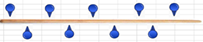
Supplies: A stick about 2.5 meters long and 1 to 2 cm thick.
- The group gets the assignment to put the stick on the ground but it has to stay horizontal.
- The group stands up straight (see drawing) and stretches both forefingers to the front at shoulder width and the upper and lower arms are at an angle of 90 degrees.
- The trainer places the bar on the forefingers pointing forward.
- From this position, the group should try to bring the bar down to the ground.
- The bar must remain horizontal and not be raised or lowered on any side.
- The bar should not be grabbed either!
In pairs
- Someone at the net (player A),
- Someone on the backline (player B)
- After each task with the ball, the players get a strength/physical exercise, alone or in pairs.
- (This happens when the players have also switched between themselves).
- After this, the players on the back line move on. This way you always have a different warming-up partner.
- Player B lies on her stomach on the back line, player A hits the ball, at this moment player B jumps up and tips player A, player B tries to defend the ball.
- After 10 hit balls, change.
- Legs crossed and 15 sit-ups
- Player B lies on her stomach on the back line, player A hits the ball, at this moment player B jumps straight attacks player A, player B tries to defend the ball.
- After 10 lucky balls, change.
- 10 blocks against each other's hands.
- Player A attacks to player B, player B defends and player A attacks again.
- After a certain time, change.
- Belly on 3m, straight, attack, belly 3m. 6x
- Player A chooses, short ball, far ball, attack, ... Player B defends everything, after a certain time change.
- Sprints around the field
Blockboard hang at position 4 - by two
- Trainer throws/strikes against block board
- Ball does not fall
- Reception - pass - attack - free pass over net and into the field
Blockboard at position 3
- Trainer throws/strikes against the blockboard
- Ball does not fall
- Reception - pass - attack - free transfer over net and into the field
Blockboard at position 2
- Trainer throws/strikes against the blockboard
- Ball does not fall
- Reception - pass - attack - free transfer over net and into the field
START: attack position 4 #STRAATMAT
LIES POSITION 1 VERTICAL
- Position 3: pass
- Position 5 reception
- Position 4: attack
- Position 3: attack (centre)
- Position 2: pass
START: attack position 4 #diagonalMAT
LISTENING POSITION 5 DIAGONAL
- Position 3: pass
- Position 5 reception
- Position 4: attack
- Position 3: attack (centre)
- Position 2: pass
START: attack position 2 # streetMAT
LISTENING POSITION 5 VERTICAL
- Position 2: attack
- Position 3: pass - back
- Position 3: attack middle
- Position 5: reception
- Position 2 opposite: pass
START: attack position 2 #diagonalMAT
LISTENING POSITION 1 DIAGONAL
- Position 2: attack
- Position 3: pass - back
- Position 3: attack middle
- Position 5: reception
- Position 2 opposite: play
SIDE A:
- Block position 2
- Block position 3
- 2 with ball at position 6
SIDE B:
- 2 with ball at pole position 2
- Player on position 3
- Player at position 5
- Attack position 4
OBJECTIVE:
- Ball is passed to position 5
- Position 5 brings reception - Position 3 makes pass
- Attacker attacks in the street #compulsory
- Matt at position 1
- Block tries to block ball
- Positions 3 & 5 in coverage
- IF BAL IS BLOCKED = pos 3 & 5 have cover ball
- Cover ball - pass - attack
- Cover ball - pass - attack
- Meanwhile position 6
- Throw it yourself - attack behind 3 meter line position 6
- Attack towards position 1 #REQUIRED
- Turn over:
- Attacker becomes block position 4
- Block position 4 becomes block position 3
- Block position 3 becomes reserve at position 6 (behind 3 attack)
- The one who attacked behind 3 meter line, comes to play ball
SIDE A: 2 persons with ball on 4 meter line position 5 - 1 without ball on 4 meter line position 1SIDE
B: 2 persons with ball on 4 meter line position 1 - 1 without ball on 4 meter line position 5
- Passing on:
- Position 5 side A throws straight over the net to position 1 side B - position 1 side B moves diagonally to position 1 other side, side A
- Position 1 side 1 throws straight over the net to position 5 side B - position 5 side B moves diagonally to position 5 other side, side A
- Discard
- Pass over the net + play reception to referee
- Technical attack from 3 to 4 meter line + reception to referee's chair
- Technical calm attack from 5 to 6 meter line + reception to referee's chair
- Steady service from behind line + reception to referee's chair