

Basketballexercises
Execution
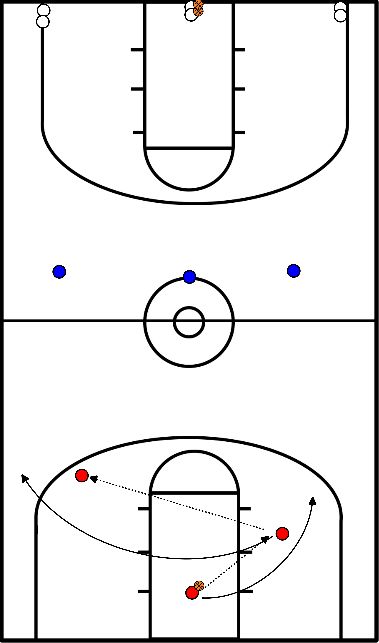
- Begin with the classic weave to the other side of the court.
- Return and perform the weave up to the halfway line.
- The next three players are ready to start the weave and meet the current three players at the halfway line.
- A 3-on-3 situation arises in which a score must always be made.
- After a score, the newest three players start the weave and the next three meet them at the halfway line for a new 3-on-3 situation.
Execution
- Use two balls.
- Everyone stands in a line at the free throw line.
- The first player shoots and tries to score.
- If you miss, you must attempt to finish the play.
- The second player must score as quickly as possible.
- If the player behind you scores before you do, you are out.
Execution
- Form two lines: one on the baseline and one on the wing, diagonally across from each other.
- The first person in the group on the baseline does not have a ball. This player runs along the baseline and requests the ball from the wing.
- In one movement: jump stop and shoot, or jump stop, pivot towards the basket and shoot. Variation is possible.
- The player on the wing runs to the elbow of the key and requests the ball.
- In one movement: jump stop and shoot, or jump stop, pivot towards the basket and shoot.
- Retrieve your own rebound and move to the other line.
Introduction
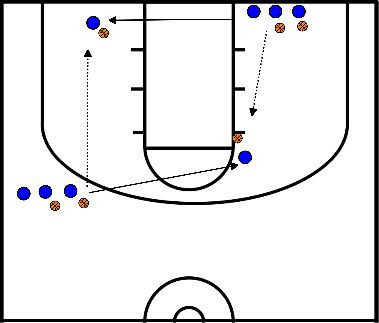
- This drill is suitable as a warm-up (passing/finishing) and as a breakdown for a "scissor" play or "split the post". Start basic and expand as the team is ready.
Execution
- Start with two lines at two spots, for example, two guard positions. With a larger team, work on two baskets with a minimum of 4-6 players per basket.
- Player #1 makes a preliminary move and cuts tightly over the cone or chair. Player #4 passes to the cutting player #1 and then cuts in the same way.
- Rotation: Each player retrieves their own ball and joins the line where they received the ball.
Variations
- Vary with speed; first master the technique of cutting.
- Receive the ball and shoot; pop-out when the defender goes underneath.
- Train aggression with a blocking pad; disrupt players' balance when cutting.
- After cutting, offer at the low post and finish with a post move.
- Work with a high-post player for passing and hand-off/hi-lo options.
- Eventually add defenders.
Teaching Points
- Set up and push off the defender on the outside foot.
- Cut aggressively, closely over the cone.
- Communication in passing: eye contact, asking for the ball with the lead hand.
- Finish with the left hand from the left side, and vice versa for the right.
Setup
- Three players start on the baseline.
- A fourth player stands around the free throw line and throws the ball towards the hoop.
- The three players rebound for themselves and try to score the ball in the basket.
- A score earns one point, but rebounding the ball again after scoring also earns a point.
- The first player to reach five points swaps with the player throwing the ball towards the hoop.
- Physical contact is allowed.
Execution
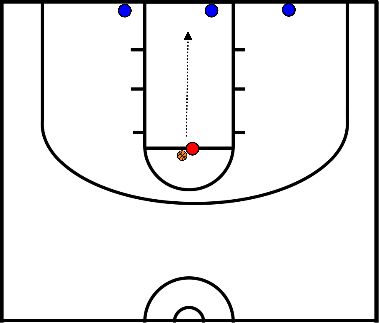
- At cones A: quick foot exercises
- At cones B: lateral movements
- Between the cones: sprinting
Execution
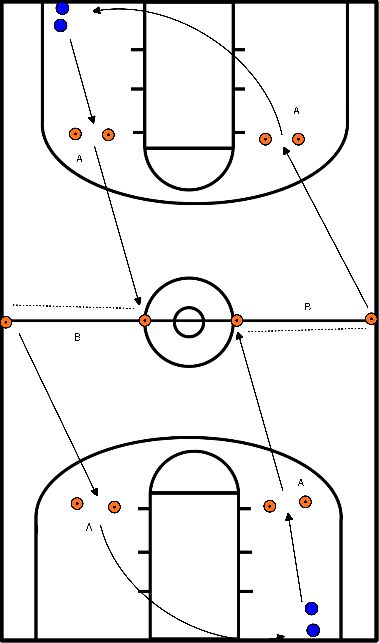
- Players divide themselves over two baskets.
- Each player takes two free throws consecutively.
- After the free throws, regardless of whether they score or miss, the player sprints up and down the entire court.
- It is important that they accelerate well and give 100% effort.
- After the sprint, they return to the free throw line and take two more free throws.
- Players build their conditioning and simulate a game situation where they must also rest during their free throws.
Execution
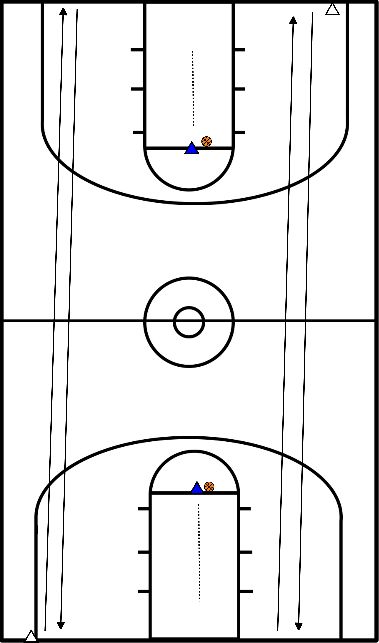
- Four players are involved in this exercise.
- The player with the ball starts at the top of the key and drives the ball into the paint.
- Then, he passes the ball to a teammate on the baseline.
- A flair screen is set on the weak side.
- The player with the ball then drives along the baseline.
- Finally, the ball is passed out to the corner for a shot.

Objective
- Perform all exercises demonstrated by the trainer.
Assignment
- The players stand in a semicircle so everyone can see the trainer.
- The trainer demonstrates several exercises.
- The players imitate him or her.
Execution
- Stand with legs apart.
- Roll the ball between the legs in a figure 8 pattern.
- Rotate the ball around your waist, legs, and head.
- Occasionally change direction.
- Bounce the ball on the ground with both hands and catch it again with both hands.
- Throw the ball into the air with both hands and catch it again with both hands.
- Who can clap first before catching the ball?
- Stand with legs apart.
- Move the ball in a figure 8 pattern between the legs without letting it fall to the ground.
Lay-ups with the Left Hand
- Players start with lay-ups on the left side.
- The number of players determines how many successful shots are needed.
- Begin with a warm-up run.
- After warming up, make 30 successful lay-ups.
- After the 30 lay-ups, players immediately proceed to 20 jump shots.
- These shots are taken from mid-range.
- Upon completion, switch sides.
- On the new side, start with another warm-up.
- Again, make 30 successful lay-ups and 20 jump shots.
5 versus 5 or 4 versus 4
- Depending on the number of players present.
- Start with a match without dribbling.
- Choose between a half or full court.
- Continue with a match where dribbling is allowed.
Execution
- Everyone has a ball.
- Everyone dribbles within a designated zone.
- If your ball is knocked away, you must retrieve it and score at the other basket.
- After scoring, you may return to the zone to participate again.