

Basketballexercises for u20
Execution
- Form two lines on the baseline.
- Players run around the coach.
- They score close to the basket on the opposite side.
- Repeat and shoot progressively further away, eventually from the free-throw line.
Execution
- Divide the team into three groups of four players each. One group stands on each baseline, and the third group is in the middle of the court. Players in the middle spread out along the midline.
- At the whistle, the players in the middle run to the baseline and ask for a ball. The player catches the ball, shoots at the nearest basket, and retrieves their own rebound.
- The player who passed the ball runs to the other side of the court for a pass from the other baseline. The rotation continues.
- Players must work hard for conditioning improvement.
- Set a target for passing and use correct footwork and shooting techniques.
- Ensure clean and accurate passes.
- Vary the type of shot (three-pointers, mid-range, lay-ups, etc.).
- Give players a time limit and a target for the number of scores to make.
- Adjust based on the team's level or the available time.
Execution
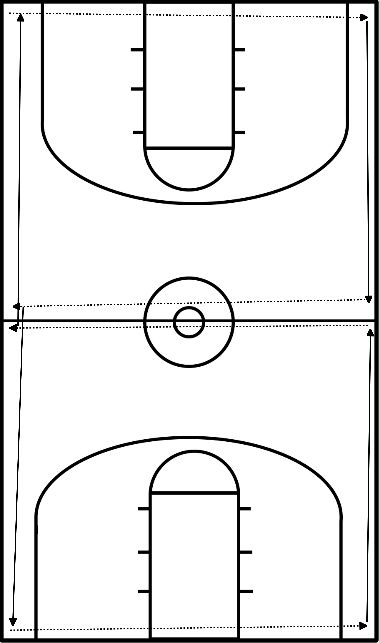
- Begin in the corner of the court.
- Slide along the baselines and the midcourt line.
- Sprint along the other lines.
- Run a figure-eight movement twice.
- Then take a short rest.
- Repeat this three times.
Description
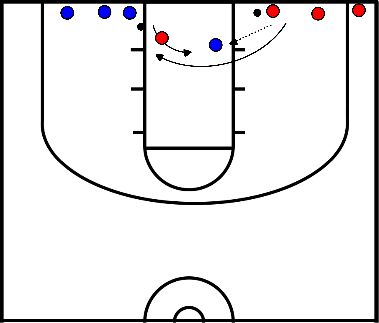
- Three players start on the baseline, with the middle player holding a ball.
- The middle player passes the ball to one of the other players and runs after the ball.
- The receiver passes the ball to the player on the opposite side and also runs after the ball.
- This process repeats as they move towards the basket on the other side of the court.
- When a player is close enough to the basket, they perform a lay-up.
- The player who performs the lay-up becomes the defender.
- The remaining two players become attackers and try to reach each other with a long pass.
- The defender attempts to prevent the attackers from scoring.
- If the attackers do not score, they must do five push-ups.
- The objective for the defender is to prevent the attackers from scoring.
Execution
- Player 1 has two balls and dribbles both balls towards the cone.
- Player 2 cuts from the corner to the wing.
- Player 1 makes a one-handed push pass to Player 2 on the wing.
- With the other ball, Player 1 performs a crossover and shoots the ball.
- Player 2 takes a jump shot.
Objective
- Develop the correct passing and shooting techniques.
- Improve communication between teammates.
Execution
- Divide the team into four groups.
- Place one group at each block and one group at each elbow of the court.
- Give each group one ball.
- The first person in each line shoots, follows their shot, and passes the ball back to the next person in line.
- After the rebound, the shooter passes the ball back to the line they were in and rotates clockwise to the end of the next spot.
- All four lines work as a team and keep track of how many shots have been scored in total.
- Communication is crucial; players must make game-related passes and take shots.
- The time limit can be adjusted from five minutes to another desired duration or number of scored shots.
- The shooting positions on the court can be varied.
Execution
- The rebounder (1) passes to the outlet player (2) and runs behind the outlet player along the sideline to the other side to receive the ball back for a lay-up.
- The outlet player (2) passes to the player in the centre circle (3), who then dribbles to approximately the three-point line and gives a bounce pass to (1) for a lay-up.
- Player (3) grabs the rebound and becomes player (1) on the other side of the court.
- With 10 players or more, there is also a player (4) in the far corner. In that case, player (3) passes to player (4), who then gives a bounce pass to player (1) and subsequently grabs the rebound and becomes player (1).
Execution
- Form two lines on the centre line with an outlet.
- The right line starts with the ball and performs a lay-up.
- The left line intercepts the ball as high as possible.
- The interceptor passes the ball to the outlet.
- The outlet passes to the next player in the right line.
- Repeat this process for a desired number of scores and then switch sides.
Objective
- Apply pressure on the dribbler during a press.
- Have each player sprint fully along the drawn lines and always close off the sideline.
- Repeat with defensive slides.
- Repeat with alternating slides - sprint - slides.
- Practice with an attacker without the ball. The defender must make slides as long as possible; sprint when necessary.
- The defender must close off the sideline in any case.
- Practice with the ball. The defender forces the attacker to turn at the sideline.
- Keep the exercise short and intensive.
- The defender must stand as close as possible to the attacker, considering the dribbler's skill and speed.
- The defender must use their foot to close off the sideline, forcing the dribbler to turn.
- The defender must accelerate and get in front of the dribbler before closing off the sideline.
- If the dribbler manages to dribble between the sideline and the defender, they may score. The defender continues to defend.
- If the defender succeeds in making the attacker turn at the sideline, they may then dribble, and the attacker becomes the defender.
- Start with a weak dribbler and have them begin with their weak hand.
- Initially, impose restrictions on the attacker: they may only change speed, but not direction, except at the sideline.
- Reduce the restrictions as the defenders improve.
Objective
- Quickly react to a stray ball and complete a subsequent one-on-one situation.
- The trainer stands in the middle of the key with the ball.
- Two players stand at the elbow and must only look straight ahead.
- The trainer passes the ball between the players; they can only move when they see the ball.
- The player who captures the ball scores on the basket at the opposite end.
- The other player tries to prevent this.
- The trainer passes the ball with such force that the players must sprint fully to keep the ball in play.
- Note: The defender must not commit fouls due to the risk of injuries.
- Speed of action is crucial.
- Do not be distracted by the defender.
- Start players in a sitting or lying position.
- Place two players side by side at the elbow, or with their backs against each other.
- Then play two-on-two.
Objective
- Concentration and energy in defence.
Organisation
- 4 versus 4 on one basket.
- New defenders after 3 stops (defenders gain possession).
- After a score or a foul on the shot, the defensive team loses one stop.
- The session lasts 12 minutes.
- The trainer counts down for prolonged attacks: 5-4-3-2-1-0.
Execution
- After 2 stops, the defence intensifies.
- On the third stop, they may attack.
- With 12 players: rotate with 4 after each stop, score, or foul.
- New attackers after each stop, score, or foul (trainer determines fouls).
- The team causing the third stop goes on defence.
Variations
- Three defenders, four attackers.
- 2 or 3 consecutive stops for a switch (with shot clock).
- 35 seconds of defence without a score or foul.
- On a stop, the clock remains, attackers try again.
- On a score, offensive rebound, or foul, the clock resets to 35 seconds.
Execution
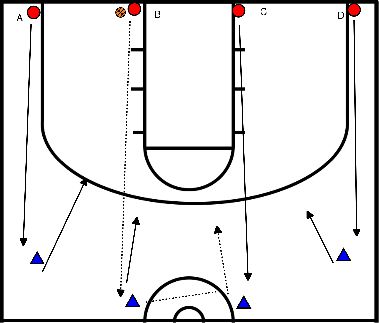
- Four players start on the baseline.
- Player B has the ball and dribbles towards the cone.
- Player B passes to player C.
- Players B and C move towards the goal for an attack.
- Players A and D sprint around the cone and take their defensive positions.