



Basketballexercises for technique warming-up
Execution
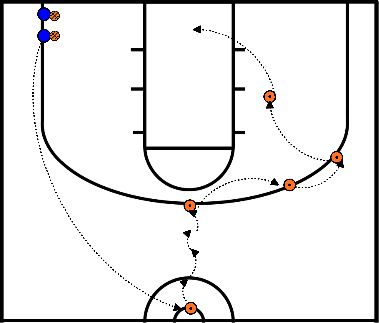
- Each player has a ball.
- Place the five cones as shown in the diagram.
- At each cone, players make a change of direction.
- Between the first two cones, they continuously execute their change of direction.
- After the cones, there is an opportunity to take a shot or a lay-up.
- Ensure clear changes in direction.
- Accelerate after each change.
- Show aggressiveness in the execution.
Execution
- Form a line of 5-6 players, with two lines per basket.
- Each line has one ball.
- The first player throws the ball against the backboard.
- The next player catches the ball and immediately throws it against the backboard again.
- Repeat this process.
- Place a cone further away where players must run around after their throw.
Execution
- Divide the players into two groups.
- The group without the ball tries to tag the player from the other group who has the ball.
- As soon as they have tagged the player, the ball is theirs.
- The player with the ball tries to pass the ball as quickly as possible to a teammate.
- Tagging someone with the ball scores a point.
- The team that scores ten points first wins.
- The children develop better ball control.
- The children learn to aim with the basketball.
- The children learn to dribble well.
- The children develop a sense of teamwork and learn to cooperate.
- The children move around in the gymnasium or on the sports field outside.
- Training sessions
- Lessons
- Fun activities
Execution
- Ensure that all players have a ball.
- The player starts at the cone next to the key.
- The player dribbles towards the basket.
- The player stops on two feet for a jump shot.
- The player begins the two-count rhythm for a lay-up:
- From the right side: first right foot, push off with left foot.
- From the left side: first left foot, push off with right foot.
- The player retrieves their own rebound and dribbles around the cone.
- The player zigzags through the cones.
- The player then rejoins the line at the basket.
- The first group to score 20 points wins.
- In a large group, this activity can be performed on both sides of the court.
Execution
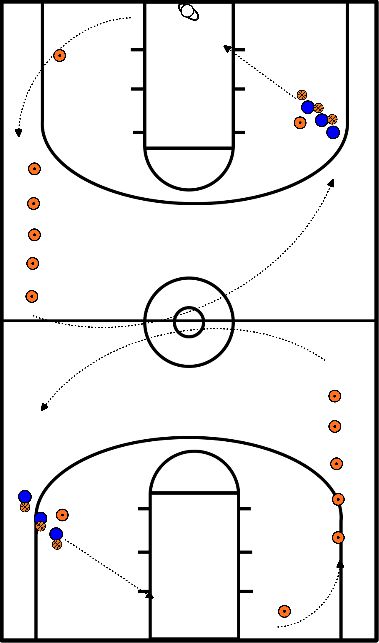
- Each player has a ball.
- The group is divided into two groups, each at a basketball hoop.
- The first player of the group attacks the first cone and performs a change of direction.
- At each cone, the player repeats the change of direction until reaching the hoop on the opposite side.
- The player finishes according to the indicated variation.
Change of Direction Variations
- Crossover
- Between the legs
- Behind the back
- Hesitation
- Fake move
Finishing Variations
- Lay-up
- Reverse lay-up
- Euro step
- Jump stop shot
- Floater
- Jump stop cross step
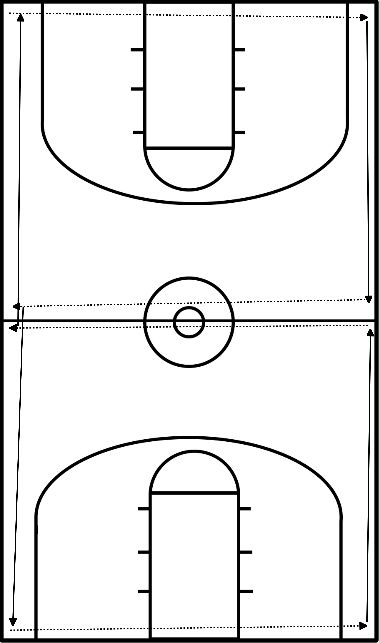
Execution
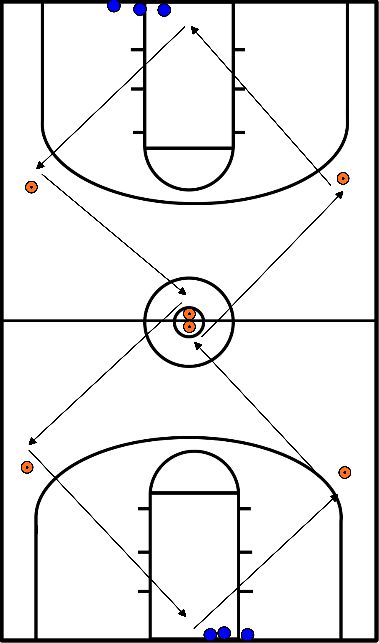
- Begin in the corner of the court.
- Slide along the baselines and the midcourt line.
- Sprint along the other lines.
- Run a figure-eight movement twice.
- Then take a short rest.
- Repeat this three times.
Execution
- Player 1 has two balls and dribbles both balls towards the cone.
- Player 2 cuts from the corner to the wing.
- Player 1 makes a one-handed push pass to Player 2 on the wing.
- With the other ball, Player 1 performs a crossover and shoots the ball.
- Player 2 takes a jump shot.
Execution
- The rebounder (1) passes to the outlet player (2) and runs behind the outlet player along the sideline to the other side to receive the ball back for a lay-up.
- The outlet player (2) passes to the player in the centre circle (3), who then dribbles to approximately the three-point line and gives a bounce pass to (1) for a lay-up.
- Player (3) grabs the rebound and becomes player (1) on the other side of the court.
- With 10 players or more, there is also a player (4) in the far corner. In that case, player (3) passes to player (4), who then gives a bounce pass to player (1) and subsequently grabs the rebound and becomes player (1).
Execution
- Form two lines on the centre line with an outlet.
- The right line starts with the ball and performs a lay-up.
- The left line intercepts the ball as high as possible.
- The interceptor passes the ball to the outlet.
- The outlet passes to the next player in the right line.
- Repeat this process for a desired number of scores and then switch sides.
Execution
- The players gather on the right or left side of the midline.
- The first two players have a ball.
- There are two catchers under the basket.
- From the midline, the player dribbles towards the basket and performs a lay-up.
- The catcher catches the ball and passes it to the next player in line.
- Repeat this until 15 successful lay-ups are made, then switch sides.
Objective
- Emphasis on various fundamental items such as passing, ball handling, transition, or shooting.
- Conditioning character for the core of the training.
- Complexity for brain training.
Execution
- Start with a multiple of 3 players. If not possible, one player steps out each time.
- Players #1, #2, and #3 start with a half weave to the midline.
- After the pass, #1 becomes a flyer, and after the pass from #3, he also becomes a flyer.
- #2 receives the ball last and dribbles to midcourt for a lay-up.
- #3 and #1 receive the ball from #4 and #6 for an outside shot.
- #5 grabs the rebound from #2 and restarts the exercise with #4 and #6.
- This repeats for a full court continuous drill.
Variations
- Ball handler must finish with at least one change of direction (e.g., spin dribble, reverse dribble, crossover).
- Limit the ball handler to a maximum number of dribbles for aggressive finishing.
- Flyers to stop with a jump stop or rhythm stop, or one dribble and pull-up.
- Flyers to make a jab step with a counter move.
- Start with a rebounding situation, vary with players in a line or at the board.
- Defend the ball handler with a close-out and box out after the score.
- Flyers make a "split the post" movement for timing.
Teaching Points
- Demand the pace from the players.
- Organization is complex; spend time organizing for younger ages.
- Make good stops when catching the ball.
- Ball handler must finish hard at the basket.
- Visualize the defender while dribbling.
- Use a speed dribble when the ball handler is the lead man.
- Good passing technique: pass ahead of the man, make eye contact, and pass firmly.
- Finishing: Go hard to the board and let the ball "kiss" the board.
- Shooting: Basics are footwork, making a good stop, and correct posture.
Execution
- Form pairs and start at the baseline on the right side of the court.
- Run together to the other baseline while you throw a chest pass back and forth.
- Maintain a distance of approximately 3 meters between each other.
- Return along the left side of the court, but now use a bounce pass.