



Beachvolleyballexercises
Formation
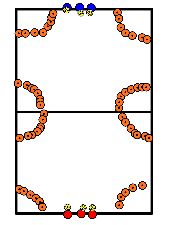
- The group is positioned at the four corners of the court. One player is the tagger and wears a team ribbon.
- On a signal, the players cross the court in three possible directions: the short side, the long side, or diagonally. Upon returning to their corner, they earn one, two, or three points respectively.
- The tagger tries to tag players. Tagged players must return to their corner before they can cross again.
- Try to score as many points as possible within the agreed time.
Running Training
- 30 seconds Jumping Jacks
- 30 seconds High Knees
- 30 seconds Heels to Buttocks
- 30 seconds Bridge with One Foot on Ball
- 30 seconds Jump Lunge Passing Ball Between Legs
- 30 seconds Skater Jumps
- 30 seconds Russian Twist (Feet Off the Floor)
- Build Up Burpees Starting from 25
- 30 seconds Regular Plank
- 30 seconds Alternately Lift Left and Right Leg
- 30 seconds Side Plank on Right Side, Other Arm Extended
- 30 seconds Side Plank on Left Side, Other Arm Extended
- 30 seconds Regular Plank
- 30 seconds Spiderman Plank
- Bicycle Crunch 2 x 1 minute (20 seconds rest)
- 3 x 8 Plyometric Clap Push-Ups
Execution
- Divide the players into two equal groups and place them on the backlines of the court.
- Each player must serve into two of the four corners of the court.
- The team that has everyone serve into the designated corners first, wins.
- Ensure the corners are not too small, to keep it enjoyable.
Execution
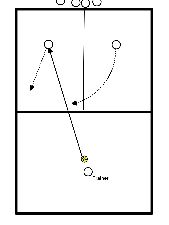
- Set up an attack on one side. The blocker stands in front of the attacker, pretends to jump, and steps back.
- The attacker plays a short ball over the blocker.
- The blocker defends the ball, after which the rally continues or the ball is scored.
- When the attacker comes to the middle, you can train on both sides. The same applies when the attacker plays a short diagonal ball.
- The blocker makes a step in the diagonal, pretends to jump, and then runs to defend the diagonal ball.
- The first ball must be played short. Afterwards, play against each other for the point.
- Apply it in a situation where the attacker has no restrictions. The trainer or a player throws the first ball from a table.
- The attacker may try to score the ball in the area just behind the net, along the line, or diagonally.
Execution
- Form two teams. Each team stands ready on the baseline on one side of the court.
- Place as many balls as there are players on both 3-metre lines.
- When the trainer shouts "GO!", everyone rolls the balls to the other side.
- After 3 minutes, the team with the fewest balls in their field wins.
Execution
- The first player serves the ball to a specific area on the court.
- The other players must serve to the same area.
- Anyone who does not hit the target area receives a letter.
- The first player to collect all the letters of the pre-determined word loses the game.
- As long as the ball lands within the target area, any type of serve is sufficient.
- Increase the serving distance. Start at 5 metres and execute. Repeat at 6 metres and so on, especially for younger players.
- If the first player hits the target area with a jump serve, the following players must also hit the area with a jump serve.
Game Description
- The game is played with a minimum of 4 players.
- 1 player is the mouse and wears a t-shirt or piece of cloth tucked into the back of their trousers.
- 1 player is the dog and holds a tennis ball.
- 2 players are cats without any attributes.
- The mouse walks around with the dog.
- The cats try to grab the tail of the mouse and bring it to their cone.
- The dog can tag the cat with the tennis ball, after which the cat must perform a penalty of their choice in the camp.
- With more players, an additional group can be formed and two games can be played simultaneously.
Introduction
- First, explain the theory of the pass.
- Illustrate the situation in the sand.
- Keep the ball on your own side and one metre from the net.
- The other player runs a banana or crescent route.
- The players stand together on the court and deliver a service pass.
- The setter runs the discussed path and catches the ball.
- Add a set and attack to make the exercise more challenging.
Jumping in Place
- Stand with your feet shoulder-width apart.
- Focus on a point on the floor and jump up and down on the spot where you stand.
- Stand upright, keep your hands in front of you and jump from side to side.
- Stand upright and keep running on the spot while kicking your heel up to touch your buttocks with each step.
- Lift the leg with the knee at a 90-degree angle.
- Quickly alternate this with the other leg.
- Stand with your feet shoulder-width apart.
- Bring your knee to your opposite elbow.
- Return to the starting position and repeat with the other side.
- Stand with your feet 6-12 cm apart.
- Extend your arms in front of you.
- Lower your body until your thighs are parallel to the floor.
- Return to the starting position and repeat the exercise.
- Keep your arms by your side and pretend to hold the end of a skipping rope in each hand.
- Jump up and alternately land on the ball of each foot, while simultaneously rotating your wrists as if spinning a rope.
- Jump with both feet up, while simultaneously rotating your wrists as if spinning a rope.
- Stand on the ground with your arms straight out to the side at shoulder height.
- Move your arms quickly in large circles clockwise.
- Stand on the ground with your arms straight out to the side at shoulder height.
- Move your arms quickly in large circles counterclockwise.
- Start with your feet shoulder-width apart.
- Keep your legs and arms straight.
- Kick your left leg up until your right hand touches your toes.
- Repeat with the other side.
Execution
- Two receivers receive a service. The pass is caught, and the roles rotate: the receiver becomes the catcher, the catcher becomes the server, and the server becomes the reserve.
- Ensure that the pass remains on their own side and is at least one meter from the net.
- The catcher provides a set-up which is then hit.
- Two receivers receive a service again. After the service, the server quickly stands somewhere in the field.
- After the pass is made, the passer looks where the server is standing. A set-up and attack follow, aimed at the server.
- Roles rotate as follows: the server becomes the reserve receiver, the receiver who attacked becomes the setter, and the setter becomes the server.
Execution
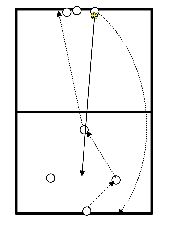
- Play in two equal teams according to the normal beach volleyball rules.
- With each ball contact, the feet must be off the sand.
- Optional: Rotate one position within your team each time the ball is played over the net.
- The ball must be played over the net on the third contact.
Formation
- 1 server
- 1 receiver
- 1 setter
- 1 catcher
- Visualize an inverted triangle between the receiver and the setter, with the top at the receiver and the bottom against the net.
- Start with an easy serve.
- The pass should be directed to the corner of the triangle, most centrally in the field.
- The setter sets the ball to the other end, with a maximum distance of 2 meters.
- Use a standing basket for more accuracy.
- The coach plays the ball back to the receiver, repeat and catch or optionally play out.
- With 3 players: 1 receiver and 2 setters, coach serves.
- With 5 players: 2 setters alternate.
- With 6 players: divide into two groups and use both sides of the court.
- Work on the correct technique – turn towards the post before giving the set.
- Provide the set in a dynamic movement along the attacker's shoulder line.
- Use a standing leg in a slight lunge position to initiate the setup.
- Start with a very easy serve for consistent passes.
- Increase passing pressure with a more difficult serve.
- Let the setter start from a deeper point in the field.
- Let the setter start from a blocking position.
- Vary with set targets; increase or decrease the distance to the target, shift the target per set.
- Aim for 5 perfect passes and setups in a row.
- Engage the partner by providing feedback or by attacking the ball without jumping.