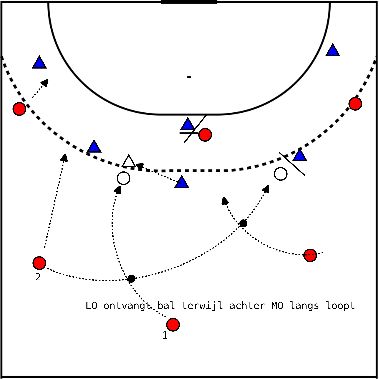



Handballexercises for technique attack / offense
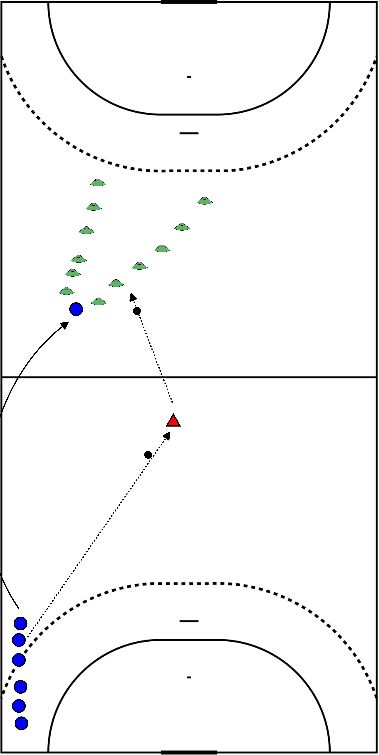
The players form a line at one end of the court.
- The 2nd player on the line passes the ball to the coach who will be between the centre of the court and the 12 meters.
- The 1st player on the line runs as soon as the pass is made.
- The coach will then pass the ball to the front of the 1st player who is running towards the opposite goal to receive the ball.
- The pass will not be towards the player's hands, but rather to a step in front of where they are, so they continue accelerating.
- This can be done with groups of 5 up to 9.
- Let's take a group of 7
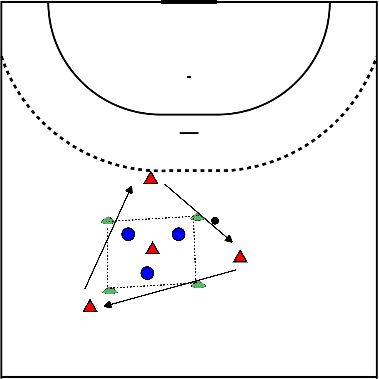
- Delineate an area where 4 people can stand and move around with a bit (not too much) room. Place 3 defenders inside, plus 1 line/pivot.
- The remaining 3 attackers will pass the ball around outside the area, with no bounce, and they score a point by either:
- Passing the ball effectively to the pivot
- Placing the ball inside the area without being touched by a defender
- The attackers can move freely, but limited to the 3 steps, 3 seconds with ball in hand, and no bounce.
- If these rules are broken, they become the defenders.
This can be done in groups of 2 or 3 players.
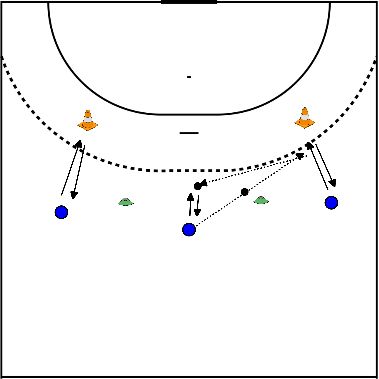
- This is to get used to receiving the ball in motion, facing the goal.
- This is a passing exercise as well.
- Let's take a group of 3 players.
- There will be two cones on the floor, at around 10 meters, on each side of the centre back, and 2 cones at the 7 meters in front of the half backs.
- The centre back has the ball, and for the half back to receive the ball, they need to start behind the cone of the 10 meters, and run in front of it.
- The centre back can only pass the ball in the direction after the cone. Once the half back receives the ball, they will do two/three steps towards the 7 meter cone, stop, and pass the ball back to the centre half who must start before the 10 meter cone and receive the ball after it.
- The half back then returns to their spot and the centre back continues the exercise with the other side half back.
- Depending on how many players there are you can use the full 6/9 meters or just a part of it.
- The defending players will hold hands two by two (so if there are 6 players, there will be 3 groups of 2).
- The attacking players will pass the ball around between themselves and around the area trying to "destabilise" the defence and find a gap so they can run in and touch down with the ball in the area.
- If the 2 groups of the defending players touch the attacker, the point does not count.
- if only 1 of the groups of the defending players touch the attacker, the point counts.
- If none of the groups of the defending players touch the attacker, it counts 2 points.
The goal is to get to 8/10 points (depending on how many 2 points they score) and then swap.
- If there's few players, shorten the court and if there's an uneven number, the defence stays with one less.
Pay attention:
- No lob passes
- No more than 3 passes
- No bounce (if possible)
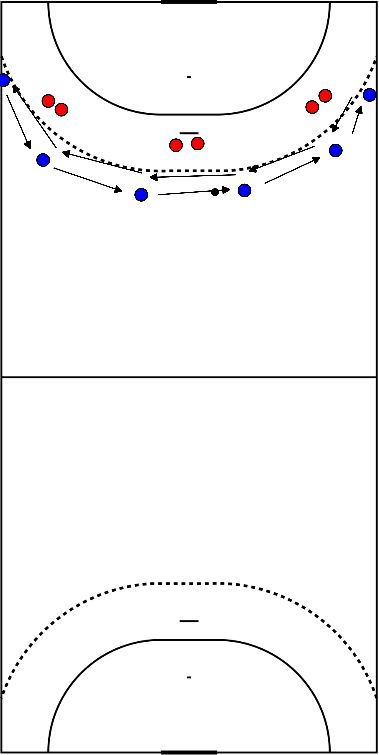
This can be done with groups of 3 to 7 - odd numbers ideally.
- Let's assume a group of 5 players.
- We'll have 3 attackers and 2 defenders.
- The 3 attackers will have a delimited running corridor in a straight line and they will have to pass the ball from one to the others while the 2 defenders will have to try and intercept the passes. The defenders have freedom of movement.
- The exercise can evolve in the types of passes in order to foster movement without the ball.
- First all types of pass, then no lob passes, then only bounce passes.
If the defenders intercept the pass, they continue the exercise acting as the attacking players in numerical inferiority. The 3 attacking players now have no restriction of movement.
This is to be done slowly at first, not as a fast break, to instill the idea of moving without the ball first. The speed can be adapted as the exercise goes on.
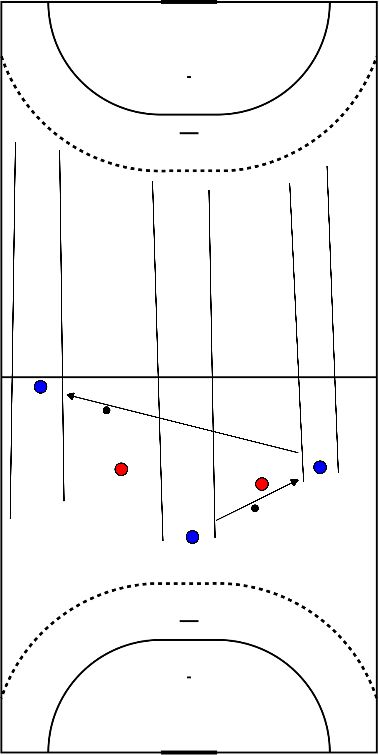
- Little 8 is the change of circle with the corner players.
- Middle build-up indicates which system is started. At small 8 the corners and circle start running;
- The right corner takes the initiative and runs towards the position of the circle (can be with or without ball!), the circle runs towards the corner and perhaps takes a defender with it. This may free up the circle which can be played through the build-up. If not, the substitute moves on to the other corner, until either a goal is scored or everyone is back in his/her own place.
- Important is watching each other's timing, not getting in each other's way and correct passing with bounce by the builder.
- Practice start with passive defenders, then active
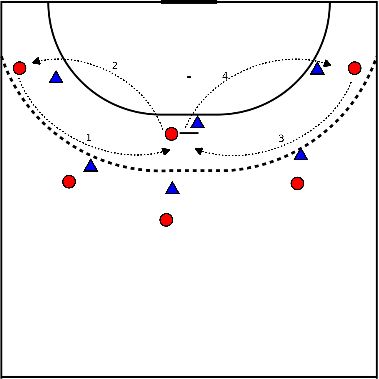
Divide team into 3 teams.
- Team 1 starts defending
- Team 2 starts attacking from the middle
- Team 3 gets ready on the middle line with ball
Once completed, team 2 starts defending and the 3rd team starts attacking from the middle.
- Team 1 takes the ball and gets ready on the middle line, etc.
The goal is to switch quickly from attacking to defending.
All positions at least occupied by 1 player with ball
On follow order is completed:
On follow order is completed:
- Right corner: round off with lop
- Right formation: round off with underhand shot (possibly 2 boxes with mat to create opening)
- Center formation: round off with jump shot over an F goal/mat (this is at 9 m)
- Left formation: round off with a dummy around the post
- Left corner: free choice of rounding
- Circle runner: turn and jump with 2 legs at the same time
Having rounded off choose another position
Goalkeeper gets a vest which he/she throws up, holds up ball and must catch the vest before it hits the ground. (or holds balloon in the air during exercise) Pay attention to goalkeeper posture (hands high, knees bent)
Goalkeeper gets a vest which he/she throws up, holds up ball and must catch the vest before it hits the ground. (or holds balloon in the air during exercise) Pay attention to goalkeeper posture (hands high, knees bent)
- Middle build-up indicates moment and system starts at Left corner
- Right corner goes deep
- Right corner takes up its position more to the right and applies pressure
- Left corner puts pressure
- Left corner puts pressure and walks backwards
- Center structure puts pressure on the left with the aim of taking center defender with it and then barricading/holding it with it
- Circle runner secures circle defender
- Left post runs behind Center post and receives the ball
Note: Right corner and Right build-up also put pressure to the right to keep defender with them so that Left build-up gets space
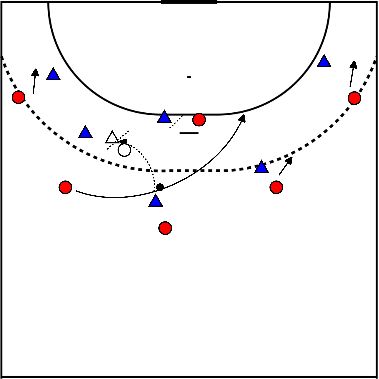
Goal of the exercise
- In this exercise, we improve our footwork during pressure and in rounding.
Exercise
- On the buildup positions, 3 pylons are in the point to the back.
- The 2 front pylons are at the 9 meter mark.
- One focal point stand beyond the pylon in the middle.
- Players play the point of attack and run without the ball towards the left pylon, in the forward motion they play the ball, in the backward motion they get it back.
- Players run around the back pylon and push again, this time they finish on goal
Variation
- Exercise can be performed at left build and right build position at the same time.
- After finishing, switch sides.
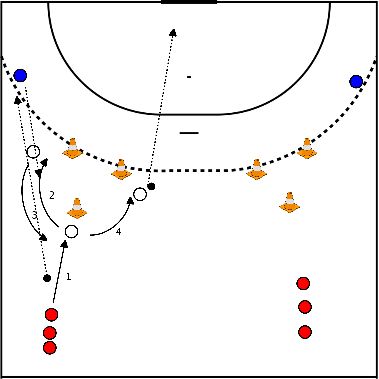
start from center line 5-on-4 or 5-on-5 or more
trainer throws ball to attackers after which defenders may start immediately.
goal is for attackers to score and/or defenders to conquer the ball
trainer throws ball to attackers after which defenders may start immediately.
goal is for attackers to score and/or defenders to conquer the ball
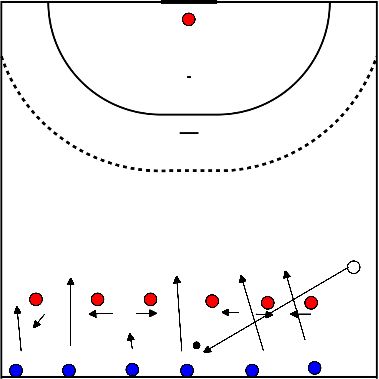
- Left corner puts pressure
- Left corner puts pressure and runs backward
- Center-back pressures left with goal to take center defender away
- Left-back runs behind center-back and receives ball
- Circle puts barrage left defender
- Right-back runs behind Left-back and receives the ball
- Left-hand build-up runs through and puts barrage on Right-hand build-up defender
- Right-back rounds or passes to the circle