




Handballexercises for u12
- Put a goal or put a mat in front of it and make compartments with tape or in some other way.
- Give the divided squares points.
- Each player may throw 3 times.
- Keeping track of the points and adding them up
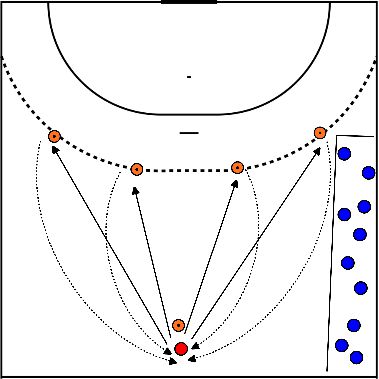
- Player starts at the pylon in the middle.
- Sprints to the left pylon.
- Picks up the ball and works it towards the goal.
- Player sprints back to the pylon in the middle.
- Now sprints to the right pylon.
- Picks up the ball and finishes on the goal.
- Player sprints back to the centre pylon.
- Sprints to the second pylon on the left.
- Finishes with the goal.
- Player sprints back to the centre pylon.
- Sprints to the second pylon on the right.
- Finishes with the goal.
- The other players remain in their places, dribbling
- Or they can do strength training
- Jumping rope
- Dribble with the ball in a square.
- All players are spread over the playing area.
- One player starts as the "hunter" and one player as the "prey".
- The "hunter" tries to catch the "prey".
- The "prey" can escape by running away or lying down next to another player.
- This player now becomes the "hunter" and the old "hunter" becomes the "prey".

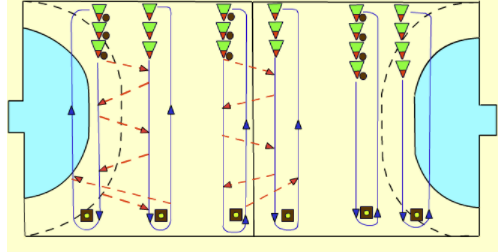
- This exercise is shown for 3 groups.
- Each team does a different exercise.
- This is done to show the possibilities and variations.
- The passes are only shown on the way out.
- Players continue with passes on the way back to their starting position. (5-10 passes are possible).
- The 1st group plays side passes inside the pylons and turns to the outside around the pylons and then plays long passes on the way back.
- The 2nd group plays side passes on the right side of the pylons and both turn left around the pylons and then play side passes again on the way back.
- The 3rd group runs (dribbles) around the pylons.
- All passes are possible, but the exercise is best for the quick, precise side pass. Also a good exercise for training acceleration.
- Pairs stand in pairs in a large circle.
- In the middle are (number of pairs - 2) balls.
- On a signal the players start sprinting on the outside (remember to indicate the direction).
- When the player is back with his/her partner, she/he crawls between his/her legs and takes a ball from the middle.
- Those who have not conquered the ball must do some push-ups or something similar.
- Then they change places and start the game again.
- Variations:
- Sprinting with side steps
- Sprint backwards
- Sprint in different directions
- Lateral sliding passes to the left and right


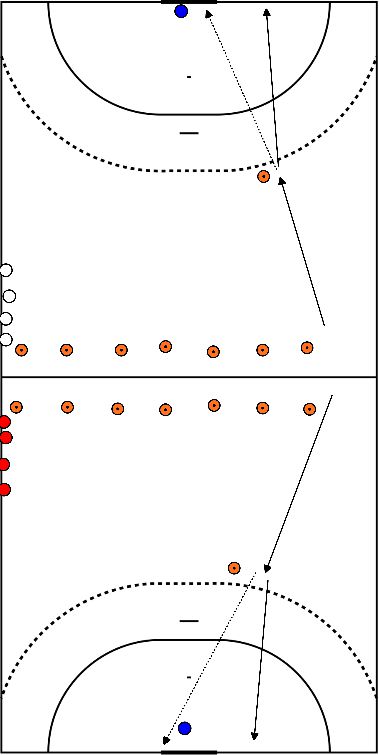
- 2 teams of 5 - 6 players.
- The exercise is performed as a relay race.
- The team runs a slalom around the pylons.
- The point from which the throw must be made is at the pylon at the free throw line.
- The moment the player finishes, the next player starts.
- Variations:
- The whole round is dribbled
- Each player makes 3 rounds:
- The first round the ball is carried between the pylons and dribbled along the long side
- The last round is the whole round dribbled.
- Carry the ball between the pylons and dribble the rest of the way
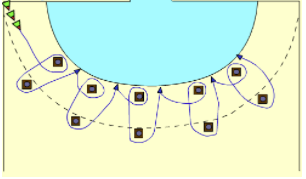
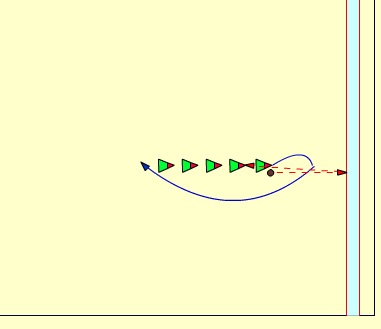
- LH starts from the corner
- Goes by sliding passes to the left around the 1st pylon
- Then you go backwards around the pylon, which is on the free throw line.
- From there forward again to the circle and sideways to the left around the next pylon.
- Then go backwards around the pylon, which is on the free throw line. Etc.
- The next LH does not have to wait until the first one is on the right side,
- But he must wait until there is enough space so as not to bump into the previous LH.
- Players stand back to back facing the wall at a distance of 4 to 5 feet.
- The first player throws the ball and gets out of the way of the second player who has to catch the ball.
- Then the second player throws and the third player catches the ball, etc.
- Variation:
- Larger run distance for being back in line.
- Put the pawn behind the row formed, they must first go around it before they can join the row.
- The first player has the ball.
- The ball is thrown against the wall and the first player jumps over the ball with their legs spread wide.
- The next player catches the ball and throws it against the wall.
- The first player joins the back of the row. Etc
- The exercise can also be performed as a competition.
- In which case the player who cannot catch the ball or jump over it must disappear from the line.
Throwing up in different ways in pairs
- With your right hand
- With your wrong hand
- With bounce
- Throwing to each other from a greater distance
- Throwing to each other from close range
- The focus here is on defending.
- Attackers are outnumbered, 3 and the defenders are 2.
- There is one attacker on the circle and two build-up players.
- The attackers are going to look for the defenders and try to play 1 on 1.
- The runner on the circle is going to offer herself and may also finish.
- It is important that the defenders talk to each other and step out and back in time.
Variation: 1 additional defender 3:3
Players make a square and make sure two corners are double occupied.
BASIC:
Ball is played around clockwise. Players follow the ball. Receiver starts slightly in.
- Playing out of the run
- Play with jump shot
- On signal exercises turn
VARIANT 1:
Ball is played around clockwise. Players go counter-clockwise. Receiver starts slightly in.
- Playing out of the loop
- Play with jump shot
- On signal exercises turn
VARIANT 2:
Ball is played around clockwise. Players cross diagonally. Receiver starts slightly in.
- Playing from the run
- Play with jump shot
- Turn on signal exercises
- All players stand in a circle.
- The ball is passed to the person next to you.
- with one ball
- Add one ball at a time
- The ball is passed to the person next to you but skip one player (uneven number of players).
- With one ball
- Add one ball at a time
- The ball is played randomly to someone, pay attention to eye contact.
- With one ball
- Add one ball at a time

- All players divide on the left and right corner (in pairs)
- Players in the left corner have a ball
- The trainer calls 'yes' and at that moment the LH sprints to his pylon.
- The RH sprints to his pylon
- Once around the pylon, he/she receives the ball and heads towards the goal
- First without a defender, then a defender, then two defenders
