



Hockeyexercises for technique hitting
Objective
- To warm up both physically and technically as preparation for the training session.
Setup
- The exercise is performed with a maximum of 4 players.
- You can set up multiple groups so that the exercise continues to function effectively.
- Players 1 start with the ball and pass it to players 2. Then they switch positions.
- Players 2 pass the ball back to players 1 and also switch positions.
Variations
- Vary the method of passing (hitting, pushing, slapping).
- Increase the distance between the cones so that players have to run further.
- Increase the distance between the cones so that players have to hit further.
- Increase both distances.
- Increase the speed.
- Deliver as many successful passes as possible within the time limit.
Key Points
- Stay low for good control.
- Stick should already be on the ground when receiving the ball.
- Pass the ball to the forehand side.
- Stand still when receiving the ball.
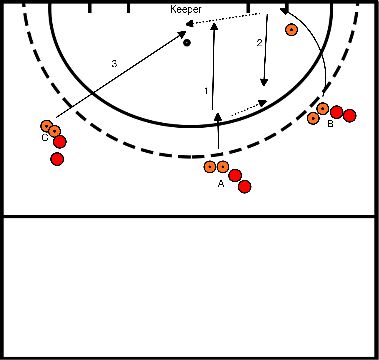
Lines up the ball and rounds on goal.
Meanwhile, B has started pushing the ball on the pawn with the ball on the stick.
B, with a tip-in, causes the ball to change direction and go into the goal.
Walk through the ball, let your stick point in the direction you want the ball to go.
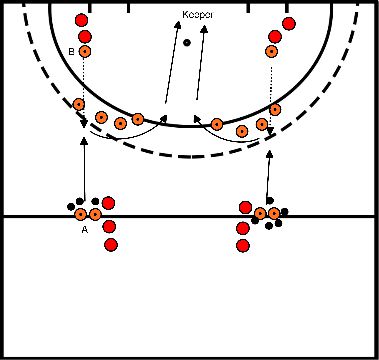
- A should make a hard directed push into the forehand of B.
- B comes offering and runs through the ball. stick to the ground moving forward.
Takes the ball in the run and accelerates with the forehand past the pawns.
Keeping the ball on the stick so NO tapping.
Enters the circle, lines up the ball and hits goal.
Hands together, left foot in front towards the goal, slightly sinking through the knees, finish your stroke. - On the other side is the same thing only there you have to step around the ball when driving past the pawns to keep it on your forehand.
- Swap on the same side so A to B's spot and vice versa.
- When all balls are gone, switch sides and do the exercise on the other side.
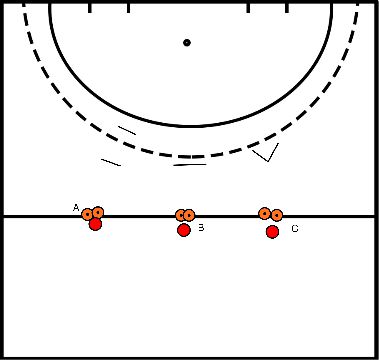
- Exercise at A:
- Two elevator actions with at the last one an acceleration towards the circle (practice also with backhand elevator)
- Exercise at B:
- Forehand turn they step in to the left and from there turn in the other direction and accelerate towards the circle
- Exercise at 3:
- Entry exercise to the left and accelerate and pass the other side.
- They walk in the direction of the finger and step in with their left foot and let the ball go in that direction as well and retrieve the ball and accelerate in the other direction and pull this acceleration through to the circle and then round off
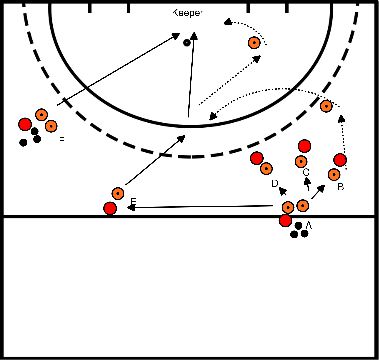
- Preparation to practice with the tip-in. Further practice with the hard and pure pass to each other.
- A push the ball to B on the forehand pay attention to the technique (hands apart, left foot in front, get power from your whole body, move your arms in the direction you are going)
- B push the ball back to A,
- A push to C
- C back to A,
- A push to D and D back to A.
- When B has played the ball back to A he turns and goes around the pawn and offers himself to the head circle to receive the ball.
- A takes the ball from D and gives a hard aimed flats towards E.
- E makes eye contact with the incoming B and gives a directed pass (may be push or flats)
- B takes the ball open, lines it up and completes with a strike on goal.
- After shooting, he accelerates around the pawns to run a tip-in ball.
- F makes eye contact with B and gives a hard aimed flat just as if he is going to score.
- B causes the ball to change direction.
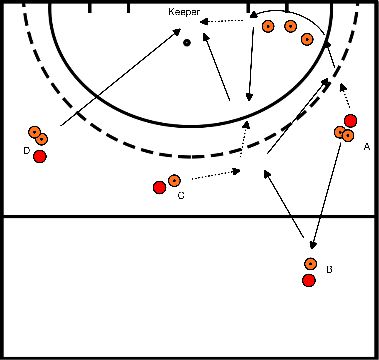
- A wants to play a free ball and there is a lot of pressure in front.
- The ball is therefore played back to B
- B receives the ball in the run and makes eye contact with the incoming C who receives the ball and again makes eye contact with the deep running A.
- A takes the ball in the open and drives with the ball on the stick at high speed towards the back line.
- Makes eye contact with the running C and gives a 90 degree pass on the forehand.
- C takes the ball and lines it up and finishes with a strike on goal,
- A stands there actively to tip the ball if necessary.
- To the stag of C, A is right there ready to tip the ball coming from D.
- D has a hard aimed flat as if he is about to score.
- A makes sure this ball changes direction and goes into the goal.
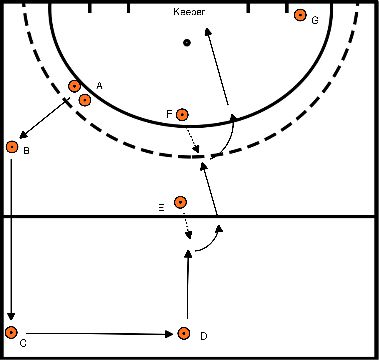
- A passes the ball with a push into the forehand of B
- B takes the ball open and sweep it through to C
- C takes the ball open and flicks it through to D
- D takes the ball open, makes eye contact with E,
- E comes running towards the ball and takes the ball in the run and turns to the right with the ball on the stick.
- E makes eye contact with F, F comes running into the ball and gets the ball from E who gives a hard push into the forehand.
- F takes the ball in the run it turns to the left and drives into the circle with the ball on the stick and lines the ball or and hits goal
- G can be added later in the exercise if the exercise is going well, it then runs before the tip-in of F
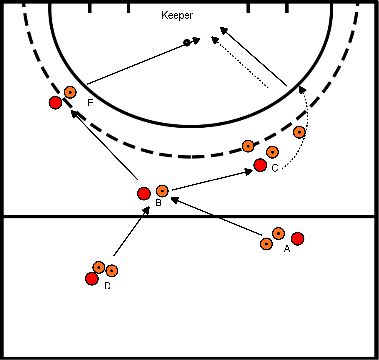
- Exercise in passing the ball cleanly and accepting it correctly.
- After that rounding off and going through to an action you have made.
- A pushes the ball to B. (look, aim and hit the forehand of your teammate)
- B receives the ball. (hands apart, stand actively, feet apart stick to the ground)
- B pushes the ball to C who receives the ball and takes it with them to the other side.
- Takes the ball with you (ball on the stick, hands apart, ball slightly in front of you).
- Lines up the ball and finishes on the goal.
- D pushes the ball after B has played it to C right away.
- B has to turn around immediately and pay attention.
- B receives the ball and makes a lap over the forehand.
- B flats the ball to E.
- E receives the ball and gives another flat to the second post.
- C runs into the ball E gives and changes its direction.
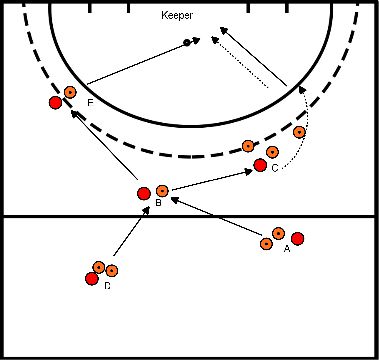
- Practice the clean passing of a ball the proper acceptance of a ball.
- Then the player finishes on target and runs to an action he has made.
- A pushes the ball to B. (look, aim and hit the forehand of your teammate)
- B takes the ball. (hands apart, standing actively, feet apart stick to the ground)
- B pushes the ball to C who accepts the ball and takes it straight to the other side.
- Take on the ball. ( ball on stick, hands apart, ball slightly in front of you)
- Lines up the ball and finishes on the goal.
- D pushes the ball when B has played the ball to C right away.
- B must therefore turn around immediately and pay attention.
- B takes the ball and makes a forehand pass
- B passes the ball to E.
- E takes the ball and gives another pass towards the 2nd post.
- C runs into the ball E gives and changes its direction.
- Orange 1 passes to Blue 2.
- Blue 2, 3, 4 try to score in the 2 little goals on the back line.
- Orange 1 tries to get in possession of the ball by defending on its strong side (fh). If he succeeds, he can score in the goal on the middle line (1½ meter wide).
- The exercise is started again when:
- Blue scores in 1 of the 2 goals on the back line at Orange.
- Orange 1 scores in the conversion in the goal of Blue.
- The ball goes over the back line.
Tips Ball possession
- Threaten with the ball and speed towards the goal.
- Look at each other as attackers when offering the ball.
- Help the ball carrier by running away from the ball.
Tips on no ball possession
- Guide with stick on the ground, forehand at ball height.
- Stay out of the ball carrier's physical space.
- Keep the ball on your forehand side. or v2 to create a 1:2 situation (double).
Passing tips
- At loss of possession: Pressure the ball immediately, cut off the shortest path to the goal.
goal.
- When gaining the ball: Keep the ball in quick action/goal attempt towards the goal.
Make it more difficult
- Use 1 goal instead of 2.
- Vary the tackling.
Explanation
3 (4) against 2 + goalkeeper
OrganisationField
: demarcated space (on half a field)
General
- The form starts when blue 1 passes to orange 1.
- Orange 1, 2 and 3 ( possibly 4) try to score in the goal.
- Blue 1 and 2 try, by working together, to take over possession of the ball on their strong side and then to score in one of the little goals on the centre field (circle size about 3 metres).
The form stops when:
- Orange scores in the goal.
- Blue scores in the conversion in one of the little goals on the half way line.
- The ball goes over the back line.
Exceptions:
- Ball over the sideline is a normal strike.
- Foul is a normal free hit.
Tips on ball possession
- Look before taking the ball (pre-scanning) and recognise space.
- Take free hits and hits as quickly as possible.
- Use push passes.
Tips on non-ball possession
- Work together (cover each other's backs), give pressure on the ball, keep the ball on your defensive forehand side (fake space).
- Force a pass to the back or force a pass wide; this is better than a deep pass.
- Make sure you are always between the ball and your own goal
Switching tips
- On losing the ball:
- Keep pressure on the ball straight away
- Get between the ball and your own goal as quickly as possible and help your team-mate
- On winning the ball:
- Look for the free space
- Play a confident pass or accelerate strongly yourself.
- Make it easier
- Vary the method of passing (e.g. push pass) or initial pass to another player.
- Make it more difficult
- Increase Pressure:
- Who scores the most goals in 10 ball starts);
- can Orange 1,2,3 score within 30 sec.
- Increase Pressure:
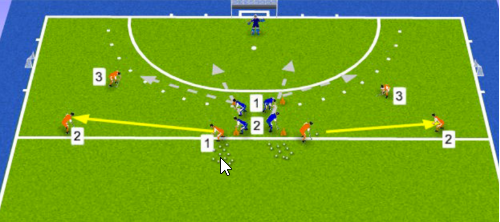
General
- Orange 1 starts with a pass from the sideline to one of the builders (orange 2,3).
- Orange defends out and scores in the goal (A) on the 23 meter line.
- When intercepting or winning a duel by blue (1,2) they score on the big goal (2 blue against 3 orange+k).
- Orange gives direct pressure on blue when losing the ball.
- The exercise starts again after a goal in 1 of the 2 goals, after a maximum of 2 switch moments or when the ball is out.
Tips ball possession
- Make the field wide.
- Take open after scanning the space (by builders).
- Keep depth between both lines (formation 2-1;1-1-1).
Tips non ball possession
- Make a choice between putting direct pressure on the ball owner or letting the opponent come and reducing space.
- Force a passing or running action to the outside (sideline).
- As a goalkeeper, coach the rear build-up player.
- Switching tips
- At Ball Loss:
- Put pressure on the ball holder.
- Play compact and reduce space.
At Ball Profit:
- Preferably play with the ball instead of the ball.
- Make sure there is a quick play point in the depth.
Make it easier
- Build up with 3 players, where the trainer gives the 1st pass to 1 of the 3 Orange players
- Make more difficult
- Provide an evental in players: 3 Orange (with goalkeeper) against 3 Blue (3rd player of Blue starts from the goalkeeper at 23 meters line).
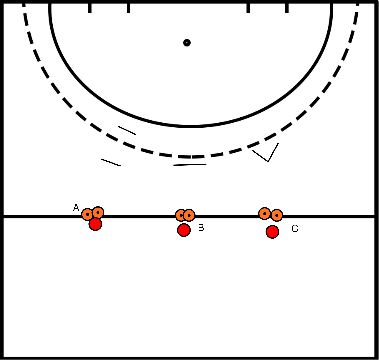
- Technique exercise
- 3 different actions we will refine and train further
- Exercise at A: Two lift actions with at the last one an acceleration to the circle (also practice with backhand lift)
- Exercise at B: Forehand turn them in steps to the left and from there turn them in the other direction and then accelerate towards the circle.
- Exercise at C: Entry exercise to the left and accelerate and the other side along it.
- They walk in the direction of the little v and step in with their left foot and let the ball go that way as well and bring it back and accelerate the other way and pull this acceleration through to the circle and then round it off.
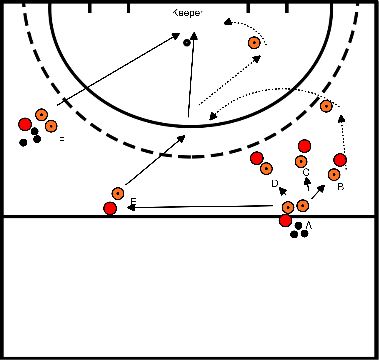
- Expansion to practice with the tip-in.
- Furthermore, it is practiced with the hard and pure pass to each other.
- A pushes the ball to B on the forehand pay attention to the technique (hands apart, left foot in front, force from all over your body, arms moving in the direction you are going).
- B pushes the ball back to A
- A pushes to C, C back to A
- A pushes to D and D back to A
- When B has played the ball back to A he turns around and goes around the pilon and calls to receive the ball.
- A takes the ball from D and gives a hard pass towards E.
- E makes eye contact with the incoming B and gives a directed pass (may be push or pass).
- B takes the ball open, aligns it up and finishes with a hit on goal.
- After shooting, he accelerates around the pilons to run a tip-in ball. F makes eye contact with B and gives a hard targeted pass just as if he is going to score. B causes the ball to change direction.
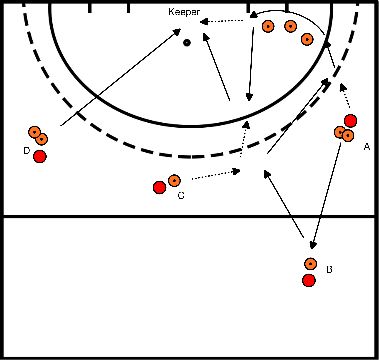
- Exercise with a buildup over right with tip-in variation in it.
- A Wants to play a free ball and there is a lot of pressure at the front. So the ball is played back to B
- B takes the ball while running makes eye contact with the running C which takes the ball and makes eye contact with the running A again.
- A takes the ball open and floats with the ball on the stick at a high speed towards the back line.
- Makes eye contact with the passed C and gives a 90 degree pass in advance.
- C takes the ball and lines the ball up and round with a hit on goal, A stands there active to tip the ball if necessary.
- Next to C, A is immediately ready for the tip of the ball coming from D.
- D has a hard targeted flats just as if he wants to score. A causes this ball to change direction and go into the goal.
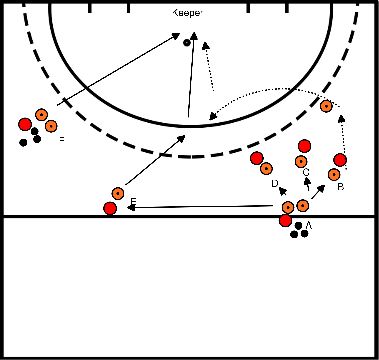
- Extension to practice with the tip-in.
- Furthermore, it is practiced with the hard and pure pass to each other.
- A push the ball to B on the forehand pay attention to the technique (hands apart, left foot in front, force from all over your body, arms moving in the direction you are going).
- B push the ball back to A, A push to C C back to A, A push to D and D back to A.
- When B has played the ball back to A he turns around and goes around the pilon and bids to receive the ball.
- A takes the ball from D and gives a hard facing flats towards E.
- E makes eye contact with the incoming B and gives a directed pass (may be push or flats).
- B takes the ball open, aligns it up and finishes with a hit on goal.
- After shooting, he accelerates towards the goal to run the tip-in.
- F makes eye contact with B and gives a hard targeted pass just as if he is going to score.
- B causes the ball to change direction.
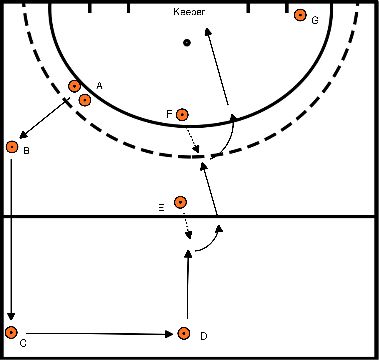
- A pass the ball with a push in the forehand of B
- B takes the ball open and passes the ball to C
- C takes the ball open and passes the ball to D
- D takes the ball open, makes eye contact with E
- E comes running towards the ball and takes the ball while running and turns to the right with the ball on the stick.
- E makes eye contact with F
- F runs into the ball and gets the ball from E who gives a hard push in the forehand
- F takes the ball in the barrel turning to the left and dribbles with the ball on the stick into the circle and aligns the ball or strikes goal.
- G can be added later in the exercise if the exercise goes well
- This runs before the tip-in of F
- This runs before the tip-in of F
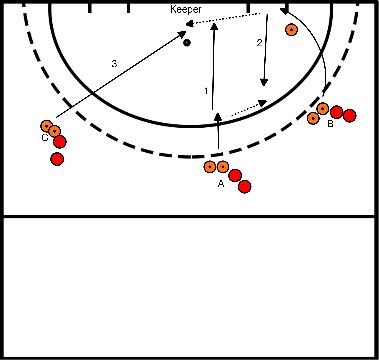
- A drives the ball with the stick into the circle, aligns the ball up and finishes at goal. At the bottom between, B dribbles with the ball on the pilon with the ball on the stick.
- B makes eye contact me A and gives a 90 degree pass on the forehand of A (preferably with a push)
- A picks up the ball on line and finishes at goal
- B runs after hitting the second ball from A towards C
- C gives a hard pass towards the circle
- Like he wants to score
- B uses a tip-in to change the direction of the ball and enter the goal (walk through the ball, let stick point in the direction you want the ball to go).
- You are running from
- A to B
- B to C
- C to A
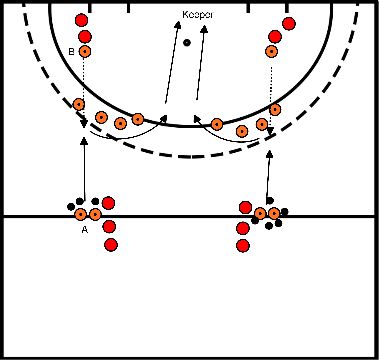
Points of attention
- A should give a hard targeted push in B's forehand.
- B comes offering and runs through the ball. stick on the ground moving forward.
- Takes the ball while running and accelerates with the forehand along the pilons, holding the ball to the stick so DO NOT give a tap.
- Comes into the circle, aligns the ball and strikes the goal (hands together, left foot in front in the direction of the goal, dropping a little through your knees, finish your stroke).
- On the other hand, the same thing is the same, only you have to drive along the pilons to keep the ball one step in front of you.
- Switch on the same side so A to the spot of B and vice versa. When all the balls are around you change sides and do the exercise on the other side.
The player with the red pilon is ready for the long corner. This player plays the ball to the left and gives the ball to the player coming from the white pilon. The player of the white pilon plays the ball as hard as possible into the circle (towards the goal).
When the long corner is taken, the players try to run into the blue and orange pilon and intercept the ball. The player who intercepts the ball scores on the back line and the other player scores on the 23-m line. It becomes a 1 to 1.
Swap: Red - White - Blue - Orange - Red
Attention: The player who takes the long corner stands ready as if he himself is going towards the circle. Pass the ball hard and low towards the dot.
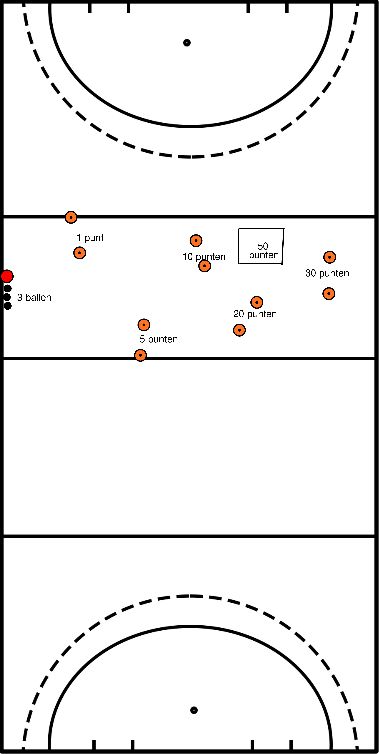
- Put out gates of pilons (2 meters wide). from sideline to sideline.
- Players get 3 balls on the sideline
- any ball they can pass through a gate
- In advance, the player indicates which gate he is going to play through
- Each gate has points, the further the gate the higher the points:
- 10 Meter gate = 1 point
- 15 meter gate =5 points
- 20 meter gate = 10 points
- 30 meter gate is =20 points
- 40 meter gate = 30 points
- See how many points each player scores, this makes it clear to the players that a long-distance pass is often not very accurate.
- In addition, you can show that pushing and flatting can be much more convenient than hitting.
- You can put (depending on the level) a square of 3M x3M on the field and if the players score and the ball lands in the square it is worth 50 points.