

Hockeyexercises for u12
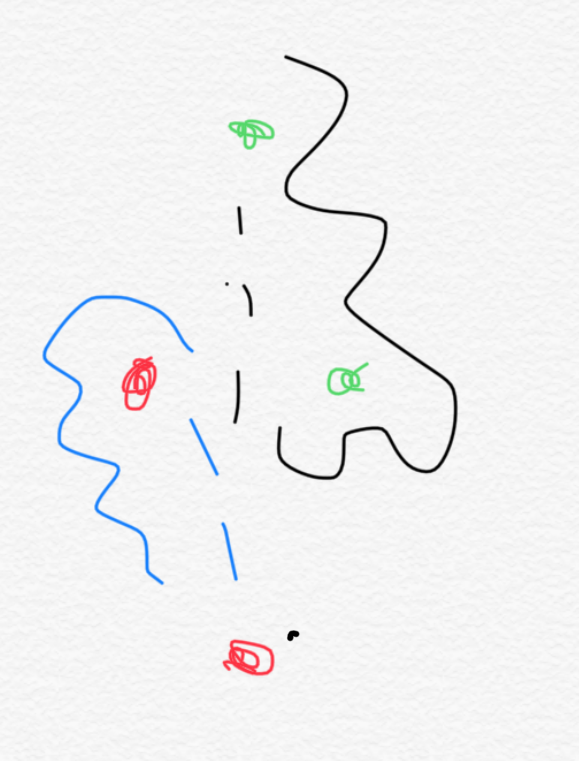
- Someone runs in from the red, takes the ball in the run and runs away strongly,
- he/she plays it to the other person who is standing near red.
- Green comes running in, takes the ball in the run and turns away strongly, playing to the other person who is standing near green.
- 2 pawns face each other,
- at a random distance (depends on whether you want to push or flatten, for example).
- Player 1 and 3 stand with pawn A.
- Player 2 stands at pawn B.
- 1 plays the ball to player 2,
- 2 receives the ball.
- After player 1 passes the ball, he runs after his ball towards pion B.
- When player 2 has passed again he runs in the direction of pion A.
- etc. etcde
- You can play this exercise with minimum 3 players, maximum 5 otherwise the intensity will be very low.
Overplaying to score
- Two players continuously play the ball over
- until one of them is so close to the goal
- that he can score in the goal.
Variation 2-1 situation:
- Under pressure from the defender, the attackers must now play together and try to score.
- The defender can score a point by conquering the ball and then dribbling over the dead ball line.
- This is the short side without a goal.
- divide the team by 2 and run it.
- Sit on top and blow the whistle on any fouls called
- so they get used to it.
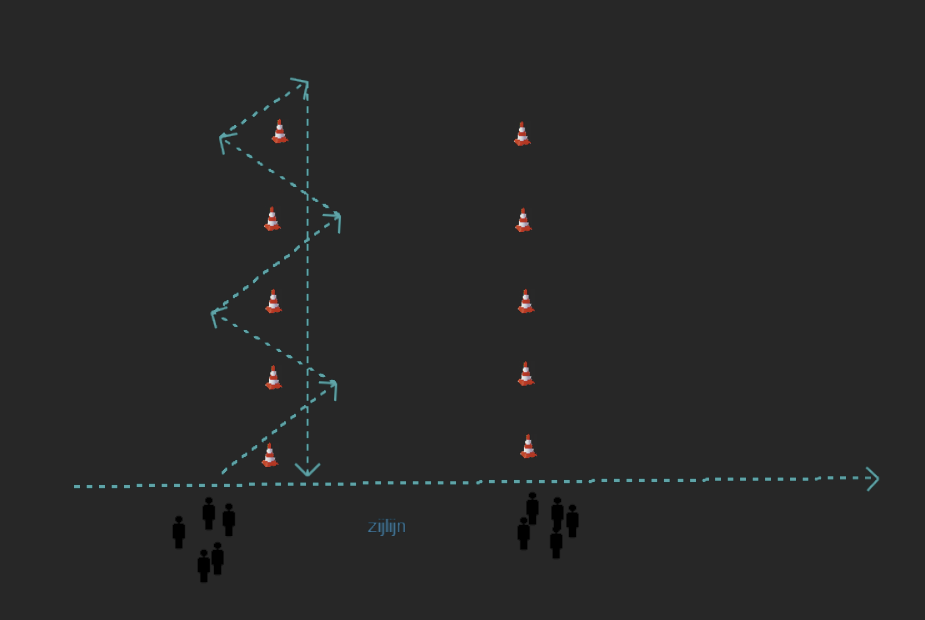
- A slalom exercise
- watch how the hands are holding the stick
- where they have the ball
- And if they use the stick properly when they run through the exercise!
- If it goes well, you can make a game of it and see if they master this. The team that has been through all the exercises first has won.
- Two players stand behind each other. Around them 4 pawns in an angle: 3 next to them/2 behind them
- The ball is passed to the player in front.
- She runs around the pawn in front, turns left and plays the second player between the pawns.
- The second player rebounds between the cones.
- This repeats itself, then the first player finishes on goal.
- Players divided into two groups on one side of the field.
- Two rows of cones next to each other.
- Players pass the ball back and forth while walking past the cones.
- Variations
- Individuals keep ball high along a row of cones, both groups independent of each other.
- Passing the ball two by two
- Individually dribble two balls at the same time, slalom through the cones
- Pass the ball and dribble a second ball at the same time (player says yes).
- Three of you play over 2 balls to the other side.
Goal
- To practise running through the ball in motion (accepting in the run).
Set up
- 2 players stand in a line (e.g. sideline)
- and 1 player stands 10-20 metres away.
- The first player of the team runs a few metres and then passes the ball to the second player.
- and passes the ball to the person standing alone.
- He starts running roughly at the time of the pass.
- This way, he runs through the ball at the moment he takes over.
- The person who passed then moves to the 1-ling position
- The exercise can be made more difficult by lengthening the distance between passes In addition, a passing move can be made before the pass.
Purpose
- Practicing different techniques. (Also useful to observe how things are going during the 1st training).
Set up
- All players line up on the baseline (or another line) and do a certain
- and do a certain exercise until the 23m line (or another line).
- This can be only floating, or floating + at whistle a drag or lift, etc.
- Important is that it is not about the fastest, but the best!
- You can make it easier or more difficult by making a difference in the exercise.
Purpose
: To get warm through a combination of passing, running, and picking up in the run and from standstill.
Format
:This exercise is also known from volleyball. The pawns are not exactly in a triangle. It is possible, depending on the number of players, to set up a multiple of the exercise.
- The player at A passes the ball straight to the player at B.
- The player at B plays the ball to the player at C and runs towards point A.
- The player at C receives the ball at point D and passes it to point A.
- For the changeover, A runs to B, B via D to C and C to A.

Variations:
- Variations can be made in terms of stroke. (hit, push, flats)
- The distances can be made larger or smaller to adjust the level of difficulty.
- Pawns can be placed to play in between. This is to increase the purity. When you make the cones smaller, the degree of difficulty increases.
- To play the ball from C to D there can be bounced.
- To play the ball from D to A you can play bounce.
- You can also place point C on the other side so that you reverse backhand and forehand.
- When you place point C at 90 degrees from point B, you can do the same exercise, only then you will hit point D from a different angle.
- When you set up different situations, you can rotate the exercise. Situation A is the standard, in situation B the exercise is mirrored, in situation C the exercise is set up so that point B and C are at 90 degrees from each other and situation D is a mirror of situation C.
Points of attention:
- As a trainer you can take a good look at the different techniques of your players.
- Sit low at the take-off.
- When playing the ball from C to D, the ball may not shoot too far in the direction of A. The intention is that the player coming from B should take the ball at right angles.
- Play the ball on the forehand where possible.
- Stand ready to receive the ball. (low to the ground, stick on the ground)
2 attackers and 1 defender.
- Attacker plays the ball to the other attacker
- The defender puts pressure
- The attackers try to score
- If they succeed, the game starts again.
Finish the training with a match shape on a half pitch
You can adjust the width of the field depending on the size of your team at the training.