



Hockeyexercises for u12
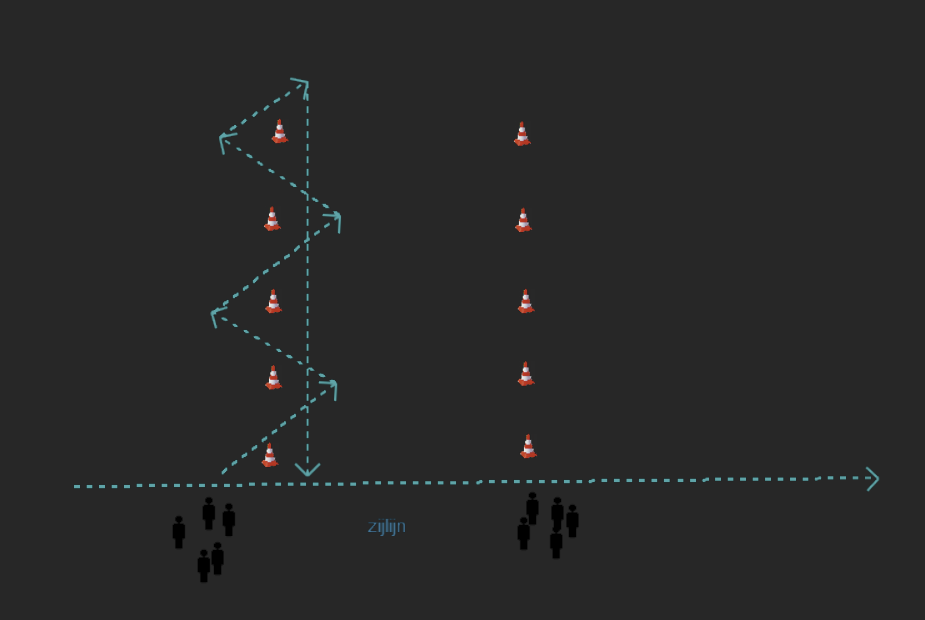
- A slalom exercise
- watch how the hands are holding the stick
- where they have the ball
- And if they use the stick properly when they run through the exercise!
- If it goes well, you can make a game of it and see if they master this. The team that has been through all the exercises first has won.
- Two players stand behind each other. Around them 4 pawns in an angle: 3 next to them/2 behind them
- The ball is passed to the player in front.
- She runs around the pawn in front, turns left and plays the second player between the pawns.
- The second player rebounds between the cones.
- This repeats itself, then the first player finishes on goal.
- Players divided into two groups on one side of the field.
- Two rows of cones next to each other.
- Players pass the ball back and forth while walking past the cones.
- Variations
- Individuals keep ball high along a row of cones, both groups independent of each other.
- Passing the ball two by two
- Individually dribble two balls at the same time, slalom through the cones
- Pass the ball and dribble a second ball at the same time (player says yes).
- Three of you play over 2 balls to the other side.
Goal
- To practise running through the ball in motion (accepting in the run).
Set up
- 2 players stand in a line (e.g. sideline)
- and 1 player stands 10-20 metres away.
- The first player of the team runs a few metres and then passes the ball to the second player.
- and passes the ball to the person standing alone.
- He starts running roughly at the time of the pass.
- This way, he runs through the ball at the moment he takes over.
- The person who passed then moves to the 1-ling position
- The exercise can be made more difficult by lengthening the distance between passes In addition, a passing move can be made before the pass.
Purpose
- Practicing different techniques. (Also useful to observe how things are going during the 1st training).
Set up
- All players line up on the baseline (or another line) and do a certain
- and do a certain exercise until the 23m line (or another line).
- This can be only floating, or floating + at whistle a drag or lift, etc.
- Important is that it is not about the fastest, but the best!
- You can make it easier or more difficult by making a difference in the exercise.
Purpose
: To get warm through a combination of passing, running, and picking up in the run and from standstill.
Format
:This exercise is also known from volleyball. The pawns are not exactly in a triangle. It is possible, depending on the number of players, to set up a multiple of the exercise.
- The player at A passes the ball straight to the player at B.
- The player at B plays the ball to the player at C and runs towards point A.
- The player at C receives the ball at point D and passes it to point A.
- For the changeover, A runs to B, B via D to C and C to A.

Variations:
- Variations can be made in terms of stroke. (hit, push, flats)
- The distances can be made larger or smaller to adjust the level of difficulty.
- Pawns can be placed to play in between. This is to increase the purity. When you make the cones smaller, the degree of difficulty increases.
- To play the ball from C to D there can be bounced.
- To play the ball from D to A you can play bounce.
- You can also place point C on the other side so that you reverse backhand and forehand.
- When you place point C at 90 degrees from point B, you can do the same exercise, only then you will hit point D from a different angle.
- When you set up different situations, you can rotate the exercise. Situation A is the standard, in situation B the exercise is mirrored, in situation C the exercise is set up so that point B and C are at 90 degrees from each other and situation D is a mirror of situation C.
Points of attention:
- As a trainer you can take a good look at the different techniques of your players.
- Sit low at the take-off.
- When playing the ball from C to D, the ball may not shoot too far in the direction of A. The intention is that the player coming from B should take the ball at right angles.
- Play the ball on the forehand where possible.
- Stand ready to receive the ball. (low to the ground, stick on the ground)
2 attackers and 1 defender.
- Attacker plays the ball to the other attacker
- The defender puts pressure
- The attackers try to score
- If they succeed, the game starts again.
Finish the training with a match shape on a half pitch
You can adjust the width of the field depending on the size of your team at the training.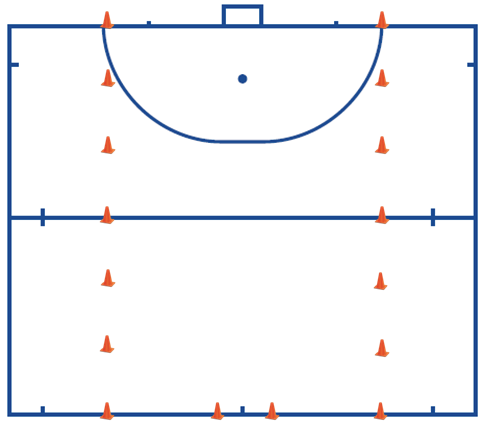
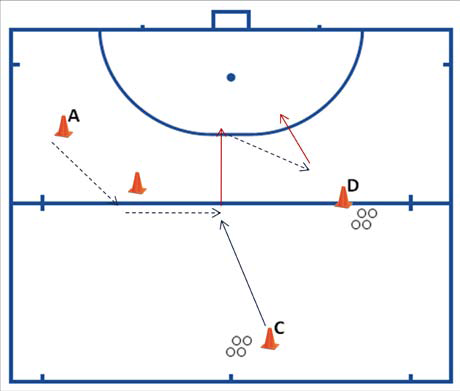
- Position the pawns as shown in the figure
- Spread the balls on pylons C and D.
- In this exercise you place a player on the pylons C and D.
- The rest of the team lines up at the A-post.
- From A the player walks around the pylon
- From the pylon, the player makes a sideways movement, facing the ball (facing C)
- Player C plays the ball into the forehand of A
- A takes the ball and turns to the right to open
- A runs towards the circle and finishes on goal.
- From here he runs to D and receives another ball.
- The player turns open to the left and again finishes on goal.
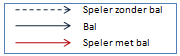
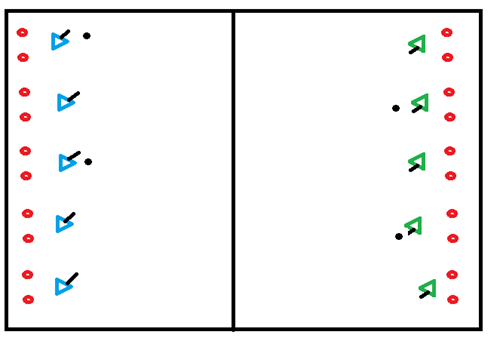
Two teams with substitutes, substitutions are made when a goal is scored.
Each person defends a goal, on each field there are 5 goals, so there are also 5 people who defend these goals.
If a goal is scored in your goal, you have to sit on the sidelines and you become a substitute. A new player (substitute) from the side enters the field and will defend the goal.
If a goal is scored, it is 1 point. The team that has the most points at the end of the game is the winner.
Overplaying to score
Two players continuously play over the ball until one student is so close to the goal that he can score in the goal.
Variation 2-1 situation:
Under pressure from the defender, the attackers must now play together and try to score. The defender can score a point by conquering the ball and then dribbling over the dead ball line. This is the short side without a goal.