



Hockeyexercises for u13
- Let the team run for about five minutes and then continue with the following exercises:
- put out the pilons as shown in figure one.
- Have the team make two rows on the sideline at the height of the 23-metre line.
- Perform the following running exercises on the dotted line:
- - Knee lifting (constructive 50%, 80%, 100%).
- - Heel to buttocks (building 50%, 80%, 100%).
- - Sideways
- - Cross step.
- - And finally, release the arms.
- Put out the pilons as shown in figure three, distribute the balls over pilons C and D.
- In this exercise you place one player each at pilons C and D, the rest of the team will line up at pilon A.
- From A the player runs around the pilon, from the pilon the player makes a sideways movement facing the ball (facing C).
- Player C plays the ball in the forehand of A, A takes the ball and opens to the right, runs towards the circle and finishes at goal.
- From here, he runs towards D and receives another ball.
- The player spins open to the left and finishes on goal again.
- The exercise is meant to simulate a game.
- It is therefore intended that one team consists of the defenders/defending midfielders and the other team consists of the attackers.
- The attackers can score in the normal goal (decide if they can hit high as in the game).
- The defending side can score by driving the ball.
- Over the line of the goals on the half way line.
- The attackers learn to play over and finish at goal and the defending side learns to defend to the outside.
- Put out six pilons in a row with +/- five meters between each pilon.
- This is best done on the 23 meter line as shown in figure 1.
- Again make two rows and let the team sprint from the sideline to the first pylon and back, then from the sideline to the second pylon and back.
- Repeat this until the sixth pylon.
- After these sprint exercises let the team run half a lap.
- Flat
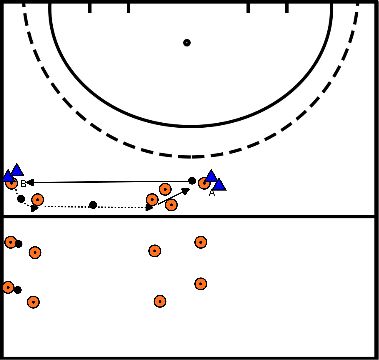
- Open reception,
- Accelerate & push pass out of the barrel (alternate with other techniques such as stroke, push pass, backhand pass).
- A flats to B (A runs after own ball);
- B takes it open and runs around the pilon.
- B accelerates with the ball stuck to the stick and plays the ball through the gates to A.
- Resumption
open and closed receptions
- Number one calls "open" or "closed" and then plays the ball to number two.
- Number two comes running into the ball and takes it on according to what was called.
- Then number two calls "open" or "closed" and plays the ball to number three.
- Number three enters the ball and takes it on according to what was called again.
- Then number three runs over the back line into the circle and plays it at the head of the circle to number four.
- Number four finishes on target.

- put out a square as shown in the drawing.
- Make teams of 3 people.
- There must always be one pilon open.
- Start with the ball at person 1, person must always have 2 possibilities.
- If person 1 passes to person 3, person 2 must move one square.
- This is how the exercise continues.

- 1 plays the ball using the bar to 2
2 runs in, controls the ball, moves towards the axis of the pitch and plays via the bar to 3
3 runs in, takes on and plays to the running-through number 2
2 Takes on and shoots (high) on target
Same for 4,5,6 if there are enough players for that
Press and hold 1-2-3-1 (or 1-2-3-4-5-6-1)

- 3 persons stand at the pilons and try not to let the player in the middle touch the ball.
- It is important that the diagonal pass is not made possible.
- So the players without the ball have to stand in the corners compared to the player with the ball.

Variation:
- Attacker plays to defender, and plays the ball back to the attacker.
- Then the attacker is allowed to attack towards goal.
- At 1, the ball begins and passes to the defender who then passes it to the out-going attacker.
- From there it is 2 to 1
- See number 2, only the players remain and it becomes a 4 against 2.
Game with different variations:
- with grip
- with globe
- with stick in weird position
- with other balls
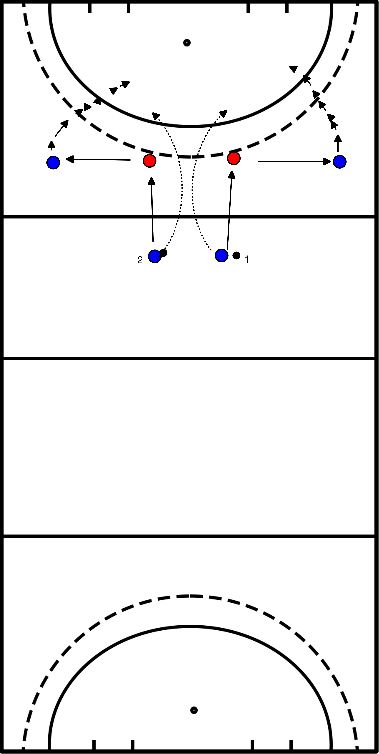
- Player A runs left towards the pilon straight ahead and retrieves the ball so that the pilon is played out.
- Then player A passes the ball deep on to player B, who runs in.
- Player B puts the ball back to player A
- Player A finishes.
Then player A does the task of player B and vice versa.