

Hockeyexercises for u14
Execution
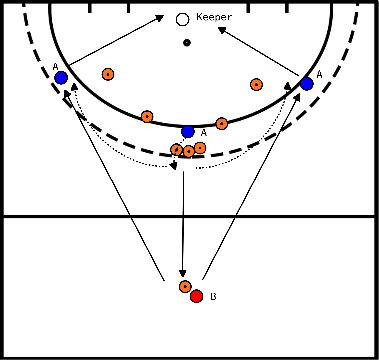
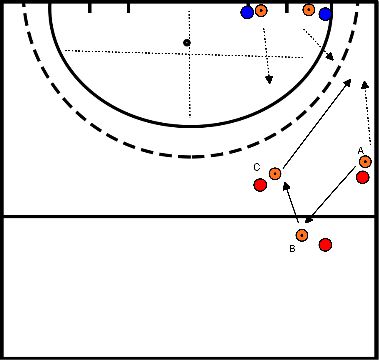
- A starts with the ball and passes to B.
- From here, a 3-on-2 situation begins with a tracking back defender who may start as soon as B has received the ball.
- The defenders try to apply pressure on the ball and ensure that the centre of the field remains closed.
- The attackers try to increase speed to prevent the tracking back defender from assisting in the defence.
- If the defenders regain possession of the ball, they may score in the goal at the 23-metre line.
Team Composition
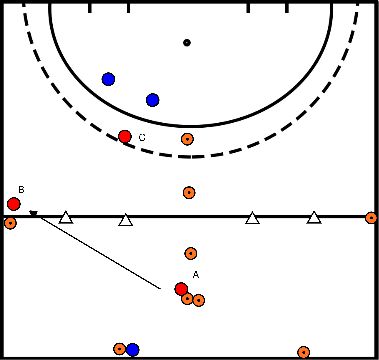
- Create 3 equal teams.
- Team 1: Defenders inside the circle.
- Team 2: Attackers inside the circle.
- Team 3: Players outside the circle as the "bowl".
- The "bowl" quickly passes the ball around and looks for an opportunity to pass to the attackers inside the circle.
- To receive the ball, the "bowl" must look ahead and know where the attackers are or will move.
- After an attacker receives the ball, they pass it back to the "bowl" and may enter the circle to score.
- The other players in the "bowl" do not participate in the attack but can regain the ball, after which the play starts over.
- One defender is allowed to leave the circle to put pressure on the "bowl".
- The remaining defenders stay inside the circle.
- The attackers are not allowed to leave the circle.
- If the defenders gain possession of the ball, they may score in one of the two goals on the side.
Execution
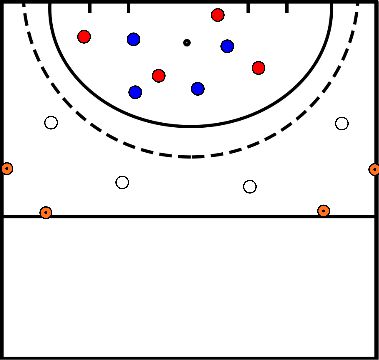
- Player A starts with the ball and passes to Player B.
- Player B receives the ball and passes to Player C.
- Player C receives the ball and plays it into the depth to the advancing Player A.
- Player A receives the ball and from here a 3 versus 2 situation begins.
- Consider the scoring positions in the circle and maintain eye contact with each other.
- For the defenders, communication is crucial; ensure they audibly communicate with each other about their positions.
Execution
- Conclude the training session with a match form on a half field.
- Adjust the width of the field depending on the size of your team during the training session.
Execution
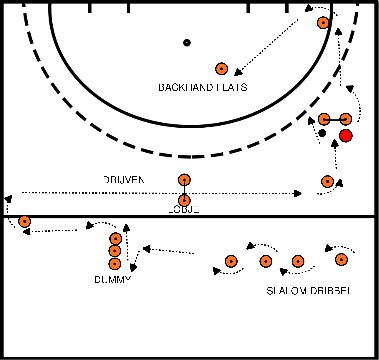
- Several exercises are set up on a quarter field.
- The players can start immediately one after the other.
- Exercises vary from slalom, dummy, herring trick to a lob.
- The goal is to focus on all techniques during the warm-up.
Objective
- To warm up both physically and technically as preparation for the training session.
Setup
- The exercise is performed with a maximum of 4 players.
- You can set up multiple groups so that the exercise continues to function effectively.
- Players 1 start with the ball and pass it to players 2. Then they switch positions.
- Players 2 pass the ball back to players 1 and also switch positions.
Variations
- Vary the method of passing (hitting, pushing, slapping).
- Increase the distance between the cones so that players have to run further.
- Increase the distance between the cones so that players have to hit further.
- Increase both distances.
- Increase the speed.
- Deliver as many successful passes as possible within the time limit.
Key Points
- Stay low for good control.
- Stick should already be on the ground when receiving the ball.
- Pass the ball to the forehand side.
- Stand still when receiving the ball.
Execution
- Players stand back-to-back.
- At a distance of 10 metres from each player, there is a cone with a ball on it.
- At the whistle or the command "START!", players run to the cone.
- They each pick up the ball, run back to each other, and hand the ball to one another.
- Subsequently, players walk with the new ball to the cone and place the ball on it.
- They both walk back to the centre and finish back-to-back.
- Optionally, this can be done in relay form or multiple times in succession.
Objective
- Make players understand that getting ahead of your opponent and quickly passing the ball is essential in an attack.
Execution
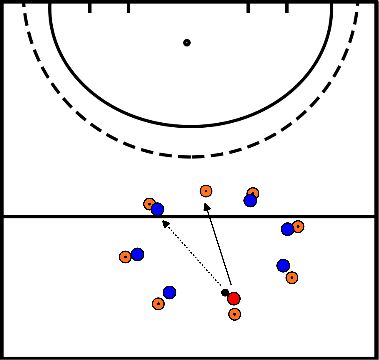
- There is one more cone than the number of players.
- After passing the ball, run to the empty cone.
Objective
- Various technical forms to warm up with.
- The setup can be either one-sided or two-sided, depending on the number of players.
- At point A, the player performs a drag movement and passes the cones.
- The player passes to point B.
- At point B, the player receives the ball and dribbles to point C.
- From there, he plays to the player at point C.
- The player at point C receives the ball, turns towards the goal, and finishes.
- After finishing, the player runs after the ball.
- Point D joins again at point A.
- One-sided or two-sided setup possible.
- Use the exercise to warm up the goalkeeper.
- At point C, sides can be switched.
- Play the exercise from both sides.
- Observe and improve various techniques of the players.
- When turning and dribbling, the ball should stay on the stick.
- Ensure players do not hinder each other at point C.
- All balls are played to the forehand of teammates.
Objective
- As attack: achieve efficiency from your attack.
- As defense: execute clever defensive plays.
- The field is limited to the dotted line.
- The attackers take the ball somewhere on the dotted line and try to score.
- The defenders attempt to clear the ball via the outside.
- The attackers score 3 points for a goal, 2 points for a forced penalty corner, and 1 point for a good scoring opportunity.
- The defenders earn 3 points when they clear the ball by playing between the cones, 2 points for a free hit, and 1 point when the ball goes over the sideline.
- Adjust the size of the teams based on the number of available players.
- Play with one team on the side and switch every 2 to 3 minutes to facilitate rest and discussion.
- Make the cones for the defenders smaller.
- Use a 'chameleon' to give the attackers a numerical advantage if scoring is difficult.
- Ensure clarity on who is marking which opponent.
- Defenders must stay low and avoid fouls.
- Attackers should actively seek a foot.
- As an attacker, target the opponent's backhand; an attack on the right side is often easier.
- Defenders should assist in defending if their direct opponent is not active.
Execution
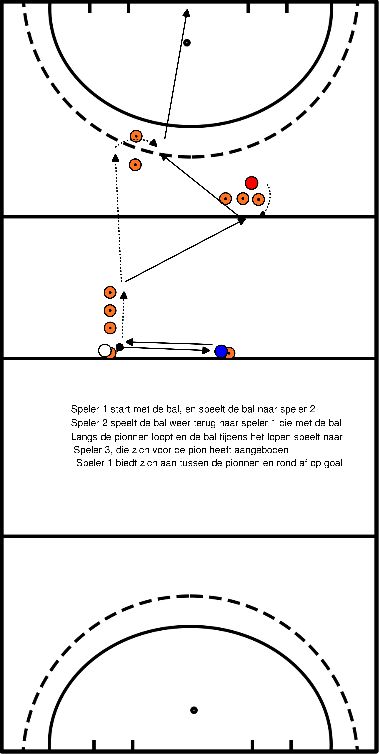
- Player A maneuvers through the cones.
- Player A delivers a firm and accurate pass to Player B.
- Player A moves away from Player B.
- Player B passes back to Player A, who receives the ball on the move.
- Player A takes the ball into the circle and finishes.
- Ensure quick, firm, and accurate passes.
- Receive the ball while moving.
- Maintain speed throughout the exercise.
- Optional: Add a defender in the circle for additional challenge.