

Hockeyexercises for u21
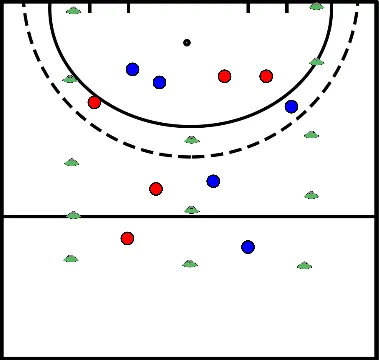
Execution Ball 1:
- A defender stands 1 metre inside the circle and plays the ball to a forward positioned at the penalty spot. Immediately after the pass, the defender is allowed to apply pressure on the ball. The play continues until a goal is scored or the ball is out of play. Both the forward and the defender remain in position to participate with the remaining 4 balls.
- The defender cannot do much with the 5 balls and aims to be a disruptive factor by applying pressure on the ball or deflecting the cross. If the defender intercepts the ball, they must push it away and start with the next ball.
- A player outside the penalty spot plays the ball hard to a forward on the baseline. After receiving the ball, the forward must quickly approach the goal circle and then plays the ball out in a 2 versus 1 situation (or 3 versus 1 with ball 3). This forward remains in position to participate with the remaining balls.
- A player dribbles the ball into the circle and passes it to one of the 3 forwards within the yellow circle. This is followed by a 3 versus 1 situation around the goal. After passing the ball, this player is done and does not continue in the attack.
- The rotation occurs in a cycle: player at left pass > player at penalty spot > player at right pass > player outside right penalty spot > defender > player outside left penalty spot. Then you repeat, meaning it is a cycle.
- This exercise cannot be done without a goalkeeper.
Objective
- Improve running technique and endurance.
Execution
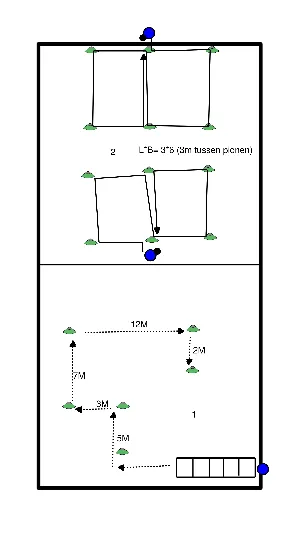
- Exercise 1: Ladder Drills and Sprints
- Use a running ladder for the first exercise.
- Perform the ladder drill twice, using a different technique each time (e.g., 1 foot per square and 3 steps forward, 1 step backward).
- After the ladder, sprint to the first cone, make a sharp 90-degree turn, and sprint to the next cone.
- Repeat this pattern to the last cone and then walk back to the start.
- Start a second round if necessary.
- Exercise 2: Figure Eights with Ball and Stick
- Use cones to mark the turning points of the figure eight.
- Each player runs a figure eight with ball and stick, attempting to make a sharp 90-degree turn.
- This exercise is repeated four times.
- Split the group in two so that each group performs an exercise.
- Switch exercises once both groups have completed their rounds.
- Only one player can be active per figure eight.
Summary
- Each player performs the following in total: 2x ladder drill, 4x figure eights, 2x ladder drill, and 4x figure eights.
Execution
- The exercise consists of three different roles: attacker, defender, and teammate. Each role has specific tasks that contribute to the aim of the exercise.
- Receive the ball from the teammate with a defender directly at your back.
- Try to win the duel by:
- Dribbling the ball through the small goal made of cones, which is positioned in the centre of the field.
- Passing the ball to your teammate, which is only possible after a few seconds.
- The aim is to outplay the defender and utilise one of these opportunities.
- Start directly at the back of the attacker and try to take the ball away.
- Keep the centre and the ball-goal line well covered, just like in a match.
- Results as a defender:
- Best result: you win the ball or the attacker commits a foul.
- Second possibility: the attacker passes the ball to the teammate, which is acceptable.
- Worst result: the attacker gets past you and through the small goal made of cones.
- Start with the ball and pass it to the attacker.
- Begin running immediately after the pass, around the outside of the cones.
- Once you are past the last cone, the ball can be played to you.
Objective
- Find a foot in the circle or shoot between the posts.
Setup
- Play two versus two or three versus three, where one defender initially starts in a disadvantageous position and must first catch up with the ball before fully participating in the duel.
- The exercise is conducted on one side but can be applied to both sides of the field.
- The group can be split into two teams, or the defenders can defend for three rounds and then pass on their bib.
Execution
- The ball starts with the defender at the top of the circle, who passes the ball to the outside.
- The attacker receives the pass, and the round begins immediately after the reception.
- The attackers try to score, while the defenders attempt to regain possession of the ball.
- If the defenders regain possession, they must dribble the ball over the 23-metre line.
Execution
- Number the sequence in which the balls are played. After a shot on goal or a cross for a player who tips, the player must continue running to a tipping position.
- Follow the ball sequence when rotating, so you move away from the play and do not cause obstruction.
- The player starts in the circle with an obstacle next to them (e.g., a board or mini-goal).
- The trainer plays the ball in with a bounce towards the player. The player may only touch the ball twice: first touch over the obstacle, second touch to shoot on goal.
- After the shot, the player continues to the second post.
- Another player runs with the ball along the edge of the circle, followed by a 'defender' who only shadows.
- The player with the ball tries to run past the defender's stick and shoot on goal into the far corner.
- After the action, players continue to their next starting positions.
- Player 3 passes the ball to a player on the penalty spot for a one-on-one with the goalkeeper.
- After the pass, player 4 rotates to starting position number 1.
- Use tennis balls instead of hockey balls for the first ball to promote technical perfection.
Execution
- A passes the ball to the advancing B.
- B passes the ball to the advancing C.
- B and D make a simultaneous running action.
- B (pivot) moves outward and offers themselves towards the sideline.
- D moves inward and seeks a position in the circle.
- B dribbles into the circle and passes to the chosen circle position of D, where D runs in.
- A rotates to the position of C.
- C rotates to the position of B.
- B rotates to the position of D.
- D rotates to the position of A.
Description
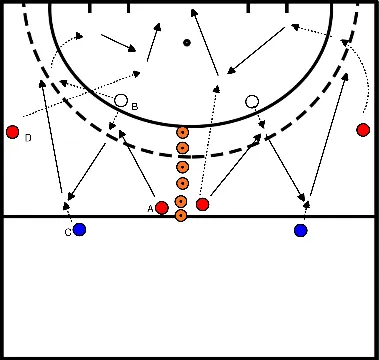
- Player A passes the ball to Player B.
- Player C moves into the space along the sideline and accelerates in that direction.
- Player C receives a hard pass from Player B.
- Players C and D play a two-on-one against the defender in red.
- Improve coordination and teamwork in numerical advantage situations.
- If the defender regains possession of the ball, they attempt to score in the small goal on the side.
Setup
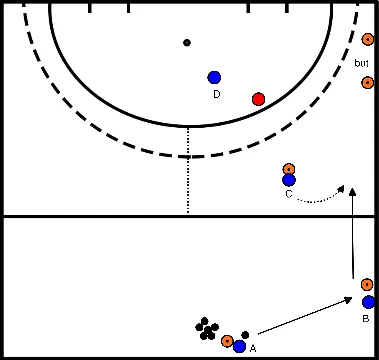
- Players A, B, and C are positioned on a line.
- The ball has gone over the sideline by the opponent.
- Player A quickly restarts play.
- Player A runs to the balls and restarts play with a self-pass or by passing to Player B or C.
- Players B and C run simultaneously with Player A and make themselves available.
- Communication between players.
- Delivering accurate passes.
- Creativity in play development.
- Effective movement to be available for a pass.
- Keep the centre closed.
- Push the attackers to the sides.
- Do not commit too early to the ball.
Execution
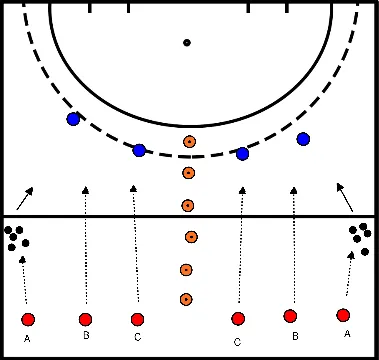
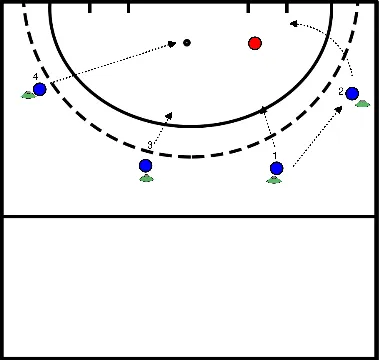
- Red starts at the penalty spot and moves to position 1. Player 1 passes the ball to Red, who then finishes.
- Afterwards, Red moves to position 2, receives the ball, and finishes.
- Meanwhile, Player 1 has passed the ball to Player 2.
- Player 2 executes a move towards the baseline and passes to Red at the penalty spot. Red finishes directly.
- Finally, Player 4 delivers a hard pass (push or hit) to Red, who tips the ball in.
Objective
- Keep the ball within the team and apply pressure when not in possession.
- Divide the field into a large playing area.
- Play with two teams against each other.
- The team in possession tries to keep the ball within the team for as long as possible.
- The other team applies pressure to regain possession of the ball.
- Switch roles after a certain period or when the ball is regained.
Execution
- Player 2 makes a run around a cone and receives a pass from Player 1.
- Player 1 continues towards the end line and overlaps Player 2.
- Player 2 advances slightly and returns the ball with a short pass back to Player 1.
- Player 1 dribbles the ball along the end line.
- Meanwhile, Player 3 receives the ball back and finishes on the goal.
Execution
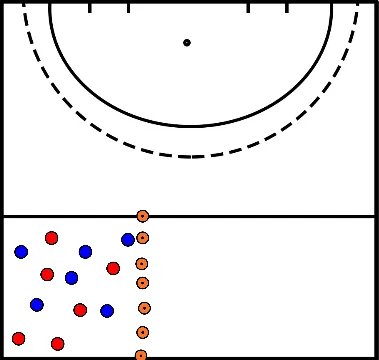
- Blue begins with the attack against red.
- After the attack, two players from blue go to defend.
- Red takes over the attack against the two defenders from blue.