

Korfballexercises for u7
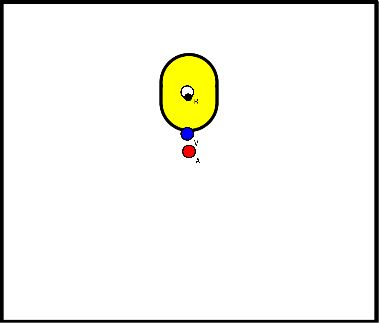
- Shot game in 2-team form. Playing against the other baskets.
- One of the two will shoot. If 2x is scored you call out to the coach.
- If you are the fastest, you have won and on all baskets the pairs are changed.
- The one who finishes first has earned a point.
- The other of the pair catches the ball.
- If the ball bounces on the ground then a goal goes off.
- Variation possible through through balls and off movement.
- Pay attention to the passing. Where does someone want the ball when you pass?
- Out of motion: keep moving after your shot to receive the ball. You keep running until you receive the ball again.
Place at least half the number of players participating in baskets distributed in a circle on field.
- One player stands under each basket with ball
- The remaining players stand in the middle between the lined up baskets
- Have players walk to a basket and pull a hook and then shoot.
- If the ball is in, on a regular basket, the player gets 1 point.
- Is the ball in, on a shooter's basket, then you get 2 points.
- If the player has scored, he walks to the center and chooses another basket to shoot at.
- If the player did not score, then you switch with the passer.
- Play like this to a self-selected number of points.
variation:
- follow-through
- pull away ball
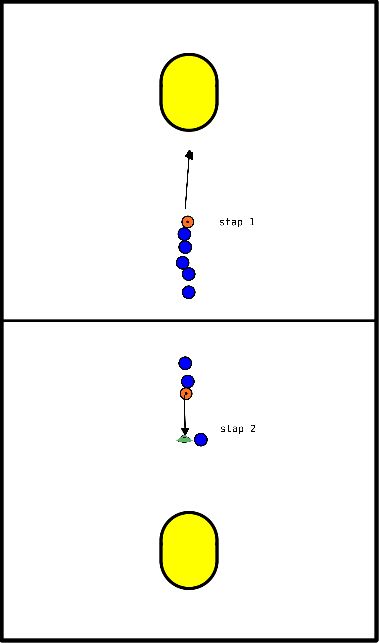
Step 1:
Each player has their own ball and lines up in a line with other players in a row 6 meters in front of the basket.
The first player in line runs toward the basket and takes a penalty throw with a quick motion. Runs back and joins the back of the line. The next player starts.
Each player has their own ball and lines up in a line with other players in a row 6 meters in front of the basket.
The first player in line runs toward the basket and takes a penalty throw with a quick motion. Runs back and joins the back of the line. The next player starts.
Step 2:
Same setup as step 1. Only now a player also stands in support, slightly in front of the penalty throw spot. This one puts the ball on 1 hand. The runner approaches, grabs the ball from the hand and takes a penalty throw.
Step 3:
Same as step 2. Only the declarer throws the ball up a little.
- You lay down 9 hoops or baskets in a square.
- You divide the team into 2 groups and have them start from a number of meters.
- Here they are given 3 pawns.
- The children must walk to the hoops and place their given pawn in one of the hoops to get butter cheese and eggs.
- When all the pawns have been used up they must move the pawns.

- Players line up on one side, in the middle a skipper.
- The skipper gets to decide how the players cross over to the other side.
- For example, in a frog jump or hopping.
- Everyone does this including the skipper.
- The skipper tries to tap as many children as possible.
You as the trainer start as the first skipper to set the example.

- Each pair must try to crack the code. This is a four-digit code where the sequence matters.
- Each exercise is a number; they can use this number in the code.
- When they have done 4 exercises, they pass this as the code, in the order in which they did the exercises.
- The trainer then indicates how many the players got right and how many are in, but not in the right place.
Exercises:
- 8 walk-through balls
- 5 rounds of running ladders pp
- 2 laps around the whole field
- 5 fallback balls right
- 5 safety balls left
- touch post small chance, 8 score
- 20 penalty throws
- 6 distance shots 6 m in front of the basket
- 6 distance shots 5 m behind the basket
- Players spread out in a box
- All players, except the ticker, have a ball
- The ticker tries to tap everyone.
- If a player is tagged, he or she goes to the posts to score.
- If successful, the player returns to the box.
- If a player drops the ball, they are also out.
Variations through different ways of holding the ball.

- On both sides of the basket are pawns.
- The shooter stands in front of the basket with the ball.
- The other players stand under the basket to duel for the rebound.
- After each shot, one player catches the ball.
- This player must first tap a pawn and then may catch again.
- The shooter shoots as soon as he has the ball.

Have the players play a game with defenders.
- Mention in advance that they should play around and then set up a support and rebound.
- Also mention that the support stays until a follow-through or shot comes. Because if the ball is spent for a shot and the defender gets to it in time then the ball can be played back on the support.
- The support remains until the defender gets in front of the support to avoid the returning pass
- Thus, the defenders must learn that after a spent pass is returned immediately in front of the support.
Put at least half the baskets of the number of players participating.
- One player with ball stands under each basket
- The remaining players stand in the middle between the set up baskets
- Have the players walk to a basket and pull a hook and then shoot it
- If the shot is on a normal basket the player gets 1 point
- Is the shot in at a shooter's basket then you get 2 points
- If the player has scored, he walks to the center and chooses another basket to shoot at.
- If the player did not score then you switch with the passer.
- Play to your own choice of points
To make the run-throughs a little more fun, we'll make it a contest!
- You put a number of baskets in a circle with one passer on each occasion.
- There are also more players than baskets in the middle
- Every run through counts for 1 point
- If you score a run-through, you take your turn
- If you miss the follow-through, you and the server swap positions
- The first player to score 6 points wins. Number of points to be determined on what the players can do.
variation:
- you can do different sizes of baskets and give them a different score
- for example an archer basket counts for 2 points
- Attacker and defender ready for the post. Offender under the post with ball.
- Defender moves up post.
- Play 1 x 1 until attacker has scored 1 time. Defender always tries to be there.
- The post of the defender who got the goal against gets penalty.
- Defender goes back to own post.
- Passing