

Soccerexercises
Field Setup
- 2 large goals
- Play in a formation of 4 against 4, 3 against 3, or 2 against 2.
- Players may touch the ball a maximum of 2 times.
- The ball may be controlled, but must then be played on in one touch.
- After a goal or when the ball is shot over the line, possession goes to the other team.
- Scoring from your own half is not allowed.
- A player must always be passed before the ball can be played on.
- If this is not adhered to, the opposing team receives a free ball.
Setup
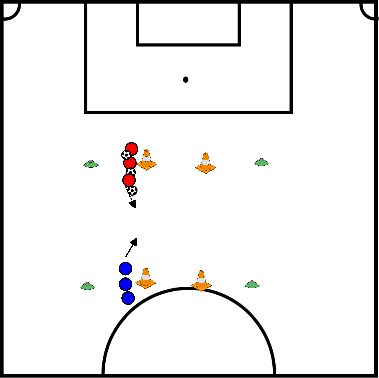
- Distances between cones: 10 metres long by 6 metres wide.
- Goals: Distance depends on age group.
- No bibs needed, as it is one-on-one.
- Red dribbles into the area and plays the ball to Blue.
- Blue tries to score on Red's goal.
- If Red intercepts the ball, they score on Blue's goal.
- After a goal or if the ball goes out of the area, join the queue at the opposite side where you started.
- Defence: Ensure you stay between the opponent and the goal. Be patient, bend your knees slightly, and stay on your toes.
- Attack: Maintain speed in your play. Once you stop, you are easy to defend. Unbalance your opponent with body movements. Tap the ball past your opponent and accelerate. Try to keep your body between the opponent and the ball.
Formation and Objective
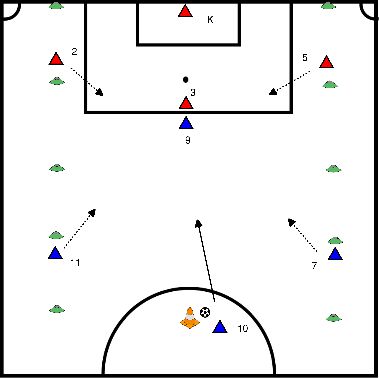
- Game form with attack against defence in a double diamond, 8 vs 8.
- Attackers attempt to score in the large goal.
- Defenders try to take the ball and play it back to the starting point.
- Field dimensions: 30 x 30 metres.
- The ball starts with player 10, who dribbles in.
- The goalkeeper, player 3, and player 9 are already in their positions.
- As player 10 departs, players 7 and 11 join in.
- Player 10 then plays to player 7, 9, or 11.
- From the first pass, players 2 and 5 join the defence.
- The attack ends with a goal, a ball over the end line, or when the defence gets the ball back to the starting point.
- After the attack, rotate or substitute, depending on the number of available players.
- Maximum 2 touches per attacker per attack.
- Maximum 5 passes until a mandatory goal attempt.
- Maximum 3 passes until a mandatory goal attempt.
- At least 2 triangles per attack.
- At least 2 double passes per attack.
Walk Straight Forward
- Jog to the last cone. Keep your upper body upright. Hips, knees, and feet should form a line. Do not let your knees buckle inward. Run slightly faster on the way back. Repeat the exercise twice.
- Jog to the first cone. Stop and bring your knee forward and upward. Rotate your knee outward and place your foot down. Keep your pelvis horizontal and your upper body still. Repeat with the other leg. Jog back after the course. Repeat the exercise twice.
- Jog to the first cone. Stop and bring your knee sideways upward. Rotate your knee inward and place your foot down. Keep your pelvis horizontal and your upper body still. Repeat with the other leg. Jog back after the course. Repeat the exercise twice.
- Jog to the first cone. Shuffle sideways to your partner. Circle around each other without changing your direction of view. Slightly bend your hips and knees. Shift your body weight to the balls of your feet. Jog back after the course. Repeat the exercise twice.
- Jog to the first cone. Shuffle sideways to your partner. Jump towards each other in the middle for shoulder contact. Land on both feet with bent hips and knees. Shuffle back to the first cone. Jog to the next cone and repeat. Jog back after the course. Repeat the exercise twice.
- Run quickly to the second cone. Run backward to the first cone. Keep hips and knees slightly bent. Run two cones forward and one back each time. Jog back after the course. Repeat the exercise twice.
Setup
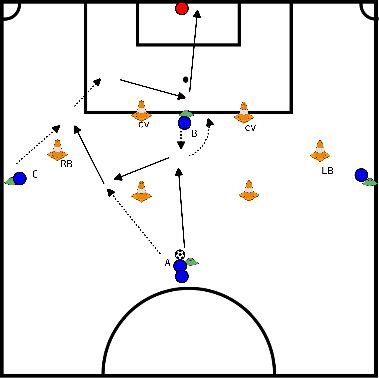
- Cones on the 16-metre line, 5 metres apart.
- Cones below at a distance of 10 metres.
- Cones on the side, 3 metres from the 16-metre line and 5 metres down.
- Player A stands 10 metres from the cones.
- A plays the ball to the incoming Player B and immediately runs to the side past the defender.
- B lays the ball off to A and returns to his starting position.
- As soon as B lays the ball off, C starts running to pass the full-back.
- A plays the ball into the path of C.
- C passes the last man and lays the ball back to B.
- B finishes.
- A becomes B, B becomes C, and C retrieves the ball and joins the back of the line, then switches to the other side.
- A must continue running immediately after the pass.
- B must create space to request the ball and then choose position directly.
- C must start at the right moment and not stand too deep to avoid being too close to the central defender.
Execution
- Divide your team into four groups of four players, each with one ball.
- Players pass the ball around within their team in the designated area.
- Players must remain in constant motion with frequent changes of pace to find space.
- Each team should attempt to maintain a diamond shape.
- Communication is essential; players must call for the ball and shout the name of the teammate to whom they are passing.
- Passes must be precise, either into the space or to the feet of the teammate.
- Players must not touch each other, and the balls must not collide.
- This exercise requires great attentiveness from the players.
- Add a passive defender who can defend any ball.
- Add an active defender who is allowed to win the ball.
Description
- Passing and kicking with mandatory movement towards the ball.
- Includes moving away from your opponent (cone).
Execution
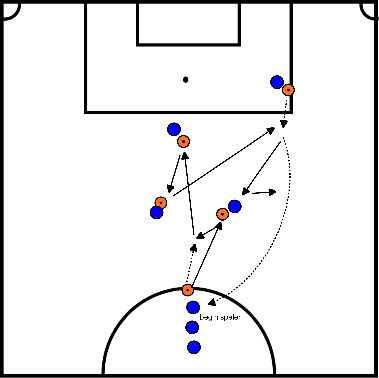
- Start with a pass to a teammate.
- Move directly towards the ball to intercept it.
- Practice getting free from your opponent by moving around a cone.
Organisation
- Play 6 versus 5 plus goalkeeper.
- When the team that must score on the large goal loses the ball, they must defend five small goals.
- Switch sides after 15 minutes.
- If the attackers of the triangle team lose the ball, this can quickly result in a counter-goal.
- Players who do not defend enough in competitive matches may find this game format less enjoyable.
- Ensure you mark your man on time.
- Do not rush in.
- Mark on the correct side.
- Pay attention to your posture during duels, bend your knees.
Field Setup
- Goalkeeper with defenders at the goal (near post and far post).
- Other defenders may take a free role.
- Attackers position themselves mainly at the far post.
- The player taking the corner kick passes with a strong ground pass to a teammate nearby.
- The teammate shoots the ball directly at the goal.
- Defenders attempt to block the ball.
- If the ball goes out, a new corner kick is taken.
- If the goalkeeper catches the ball, a new corner kick must be taken.
- Defenders must block the ball.
- If the goalkeeper catches the ball, attackers must immediately retreat to the midfield.
Execution
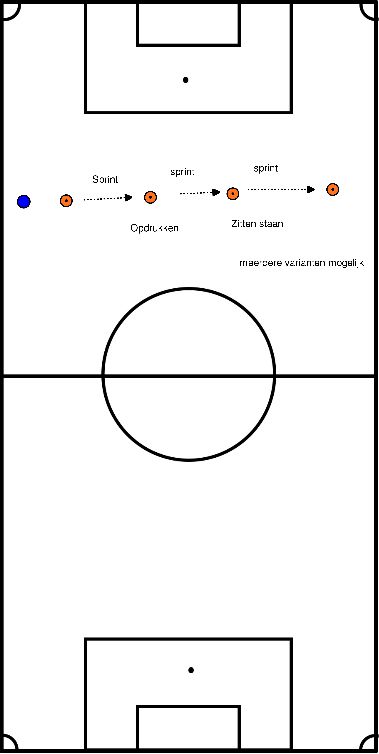
- Sprint from cone to cone.
- At each cone, perform a task:
- Task 1: Perform one push-up.
- Task 2: Sit down and quickly stand up again.
- Task 3: Jump as if heading a football.
- Many variations are possible.
Execution
- Set up cones according to the formation for 7 players.
- Each player turns out at least once.
- Make one wall pass.
- Execute a long pass twice.
- Ensure a good pass with reception.
- Turn with the play after delivering the pass.
Game Description
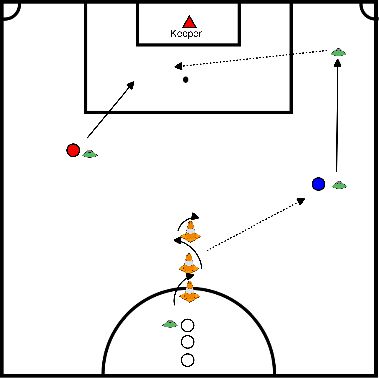
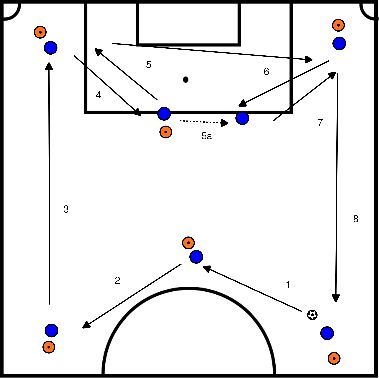
- The player with the ball starts at the back and dribbles through the cones.
- Then, he passes the ball to the player waiting on the right.
- The player on the right plays the ball to the incoming player on the left.
- The incoming player tries to shoot the ball past the goalkeeper into the goal.
- The players rotate positions after their action.
- The player who dribbled through the cones joins the player who made the through pass.
- The player who made the through pass moves to the finishing position.
- The player who finished retrieves the ball and joins the players at the back who need to dribble through the cones.