




Soccerexercises for u8
Execution
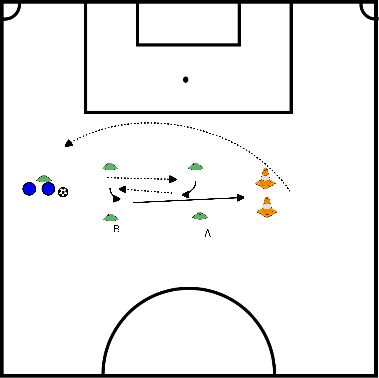
- Distance from point A to point B is 5 metres.
- Distance from point A to the goal is 5 metres.
- Distance from the cone to line B is 1 metre.
- The size of the goal varies depending on the age; younger players have a larger goal.
- The player dribbles to line A, cuts the ball, dribbles to line B, cuts again, and shoots the ball at the goal.
- The player retrieves the ball and runs around the outside back to the start.
- Cutting with the inside or outside of the foot.
- Cutting behind the standing leg.
- Dribbling with both the left and right foot.
- Dribbling: Touch the ball with each step.
- Make a short turn when cutting.
- At line B, cut so the ball is well positioned to step directly and shoot, without needing to go backwards for a run-up.
Content
- Defender number 1 delivers a long pass to attacker number 2.
- The attacker controls the ball and goes directly towards the goal to score.
- Defender number 1 engages in the one-on-one duel.
- If intercepted, the defender finishes on the small goals.
- If the goalkeeper stops the ball, the same applies.
- Defender number 1 may play with his goalkeeper.
- Defenders start with a ball.
- Attackers start without a ball.
- Switch roles and join after each turn.
- Distances can be increased or decreased.
- The attacker must accelerate towards the goal.
- The defender must control the pace.
- Switch immediately upon losing the ball.
- Encourage players to engage in duels.
- Upon ball recovery, immediately coach whether to play with the goalkeeper or go directly to one of the goals.
Field Setup
- Mark the field with 4 cones in a 20 by 20 meter area.
- Each pair of players receives a ball.
- The purple player must try to shield the ball from the blue player.
- The blue player must try to recover the ball without committing a foul.
- If a player recovers the ball, that player may shield the ball and the other player must try to take it back.
- On the coach's whistle, you must switch player groups.
- You may not switch to another player you have already played against.
- Use your body effectively when shielding the ball.
Organisation
- The game is played between two teams against each other.
- The attackers play towards a large goal.
- The defenders play towards four small goals on the sides.
- If the team that must score on the large goal loses the ball, they must defend the four small goals.
- After 15 minutes, switch halves.
- If the attackers lose the ball, it can quickly result in a counter-goal.
- Players who do not defend enough in competitive matches may find this game form challenging.
- Mark the opponent on time.
- Do not lunge.
- Defend on the correct side.
- Posture during duels, bend the knees.
Introduction
- This activity involves speed, agility, coordination, passing, and duels.
- Suitable for all age groups with possible variations.
- The FUN aspect is enjoyable for both young and old.
Execution
- Players A start shoulder to shoulder and sprint to the cones.
- Accelerate around the marker and move backwards to the pole.
- Move sideways over the hurdles and then back behind the pole.
- Accelerate forward to the furthest pole and then backwards to the other pole.
- Player B plays a ball to A who finishes on goal.
- The player who finishes first wins.
Variations
- For older age groups, the loser may receive an extra task.
- For younger age groups, points are accumulated.
- Players switch positions after each round.
- Player B can throw the ball so A must head it towards the goal.
Execution
- Player 1 engages in a one-two with player 2.
- Player 2 moves towards the ball.
- Player 1 provides a through pass to player 3.
- Player 3 plays into player 4, who moves towards the ball.
- Player 4 creates space for the incoming player.
- Player 3 passes to player 5 across the width.
- Player 6 moves towards the ball, and player 5 decides through the pass whether he wants the ball on the left or right.
- Player 6 controls the ball and scores.
- Start with a ball at player 1.
- Have three players at player 3 and player 5.
- Shift from player 1 to player 6.
- If there is no goalkeeper, player 6 goes for the goal.
- Distances can be increased or decreased.
- Pass to the outer foot.
- Maintain eye contact, create space, and move towards the ball.
- Add a defender at the position of player 2, player 4, and player 6.
- Ball can be played on the ground and/or through the air.
- For player 2, player 4, and player 6, first move away from the ball and then towards it.
- Only move towards the ball when player 1 has control.
- Ensure players do not play too close to each other, as it is easier to defend.
- Player 5 decides himself whether he wants the ball on the left or right through the manner of passing.
Execution
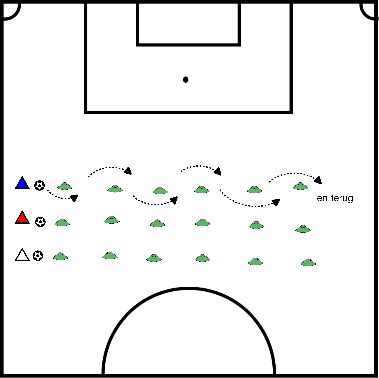
- Place 7 cones at a distance of approximately 15-20 meters from each other.
- With a small group: one player per series of cones; with a larger group: players one behind the other.
- Slalom at pace through the cones back and forth.
- Stop the ball next to the cone.
- The fastest player wins.
- Slalom at pace through the cones, but without slalom back.
- Stop the ball next to the cone.
- The fastest player wins.
Formation
- Arrange your team in 2 lines with 4-5 players per line.
- Use only 1 ball.
- Players receive the ball and pass it to the first person in the line opposite them.
- Immediately after the pass, they sprint and join the end of the line they just played into.
- This process repeats continuously.
- Players stand on their toes ready for the pass.
- Passes are clear and accurate.
- Players call out when they want to receive the ball and name the player to whom they are passing.
- With the first touch, they bring the ball under control, and the second touch is the pass.
- Apply the one-touch pass.
- Have one line pick up the ball and throw it back underhand to the other line, which returns it with a volley pass.
- Players receive the ball with their thigh and bring it under control before passing it back along the ground.
- Place a cone 5 meters on either side of the central point between the 2 lines.
- After the pass, players must run around the cone before joining the line.
Execution
- All players jog in a square across the field.
- Half of the players have a ball.
- Players with the ball pass to players without the ball, maintaining eye contact.
- The ball must not be held for more than 5 seconds.
- At a whistle signal from the coach, players without the ball sprint to a nearby player with a ball and try to take the ball away.
- Players with the ball try to shield the ball (1:1 duel).
- At the next whistle signal, resume jogging and passing.
- With an odd number of players, the player without a direct opponent receives a task, such as sprinting across the width of the field.
Content
- Player 1 or the goalkeeper takes a goal kick.
- Player 2 receives the ball.
- Player 2 gives a through pass to player 3.
- Player 3 plays into player 4 who comes to the ball.
- Player 4 creates space for the incoming player.
- Player 3 plays to player 5.
- Player 5 controls the ball and scores.
- At player 1, there are two players with a ball.
- At players 2, 3, and 5, there are three players.
- Rotate from player 1 to player 5.
- If the goalkeeper is absent, player 5 shoots on goal.
- Distances can be increased or decreased.
- Play to the outer foot.
- Make eye contact and come to the ball.
- Add a defender at position 4.
- Play the ball on the ground and/or through the air.
- In case of delay, player 1 takes the goal kick.
- When player 1 has control of the ball, only then come to the ball.
- At player 4, first move away from the ball and then come to the ball.
- Ensure players do not play too close to each other, as it is easy to defend against.
Field Setup
- 4 to 6 cones to dribble along.
- 2 cones in the goal.
- Player dribbles along or through the cones.
- Player attempts to knock over one of the cones with a powerful shot (using the top of the foot) in one motion.
- The player must retrieve their ball from the net themselves.
- The player must set the cone upright themselves.
- The player must collect the ball they missed themselves.
- Another player may only start once the first player has cleared their ball.
Setup
- Have the players form a circle approximately 15 meters away from you. You stand in the middle of the circle.
- Players start in their position in the circle and keep "jogging" on the spot. Call out "inward" and all players sprint towards you until they are about two meters away. Then they turn around and quickly sprint back to their position, where they remain in motion.
- Call out "outward" and all players sprint away from you. When you call "back," all players return to their starting position in the circle.
- Ensure that players are not standing flat-footed, but always on their toes. Players should be sweating profusely after this activity.
- Add variations such as sit-ups, push-ups, jumping, high knees, or sprinting to the right or left while maintaining the circular formation.