




Tennisexercises for u15
Execution
- Have the players stand in a line behind the baseline.
- The players make lateral shuffle steps one by one along the tramlines.
- Run along the net.
- Use an agility ladder.
- Repeat the series a few times.
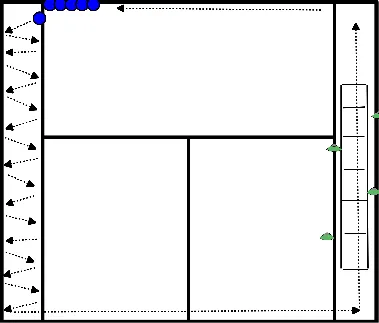
Setup
- Position the players in pairs, one behind the other, facing the wall.
- One tennis ball per pair.
- Player 1 stands closest to the wall and starts by throwing the ball against the wall.
- Player 2 catches the ball.
- Meanwhile, Player 1 moves back via the right side and then catches the ball that Player 2 has just thrown against the wall.
- Repeat at least 20 times.
- Make the exercise more challenging by catching the ball in a small cone.
Execution
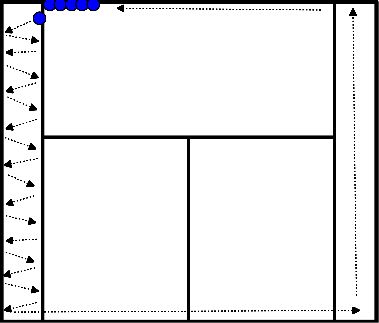
- Have the players stand in a line behind the baseline.
- The players perform lateral shuffles one by one between the sidelines towards the net.
- Upon reaching the net, they jog along the net, between the sidelines on the other side.
- Jog back along the baseline to rejoin the line.
- Repeat the sequence a few times.
Execution
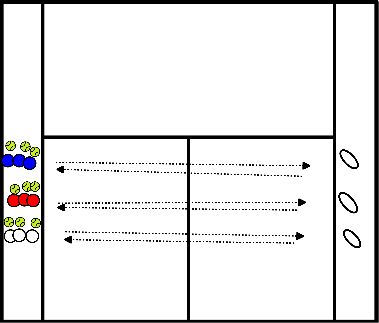
- Divide the players into groups of 2 or 3 and position them on the left side of the court.
- Give each player a tennis ball.
- At the start signal, the first player from each group runs with a ball to the right side of the court.
- Upon reaching the other side, the player places the ball outside the line and runs back as quickly as possible.
- The next player in the group repeats the action with his or her ball.
- When all balls are on the right side and the last player is back with the group, the relay is finished.
- The group whose last player returns first wins.
Execution
- Place the players in a line next to each other. Approximately 1 metre in front of them, place a tennis ball on the ground.
- Have them stand with their feet slightly apart.
- Quick steps - dribbling - on the spot.
- On the trainer's signal, while dribbling, they perform the following actions:
- Hands on the knees.
- Hands on the toes.
- Hands on the shoulders.
- Hands forward.
- Hands in the air.
- When the trainer shouts "Ball!", they must grab the ball as quickly as possible.
- Repeat and vary the commands for variety.
Execution
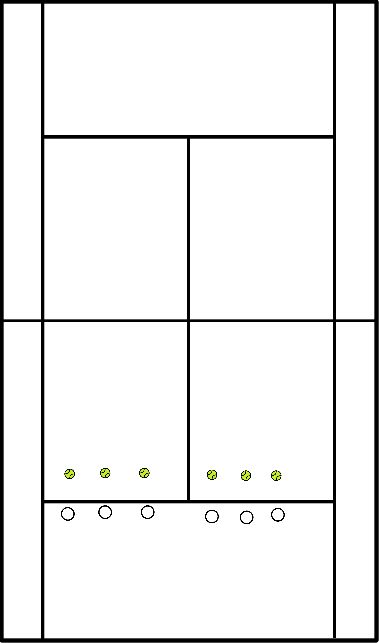
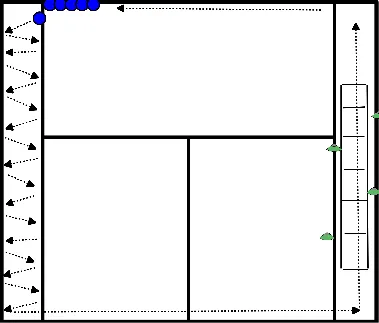
- Have the players stand in a line behind the baseline.
- Let them make lateral close steps one by one within the tramlines.
- Then they run along the net.
- Use an agility ladder for extra challenge.
- Repeat the sequence a few times.
Objective
- The student is able to execute forehand and backhand techniques in various ways in both doubles and singles play.
- Identify the principles that apply when constructing a point.
- Independently initiate and maintain game and practice forms.
- Participate in the lesson with attention and understanding, focus, diligence, and determination.
- Collaborate and communicate effectively.
- Apply knowledge of the rules.
Execution
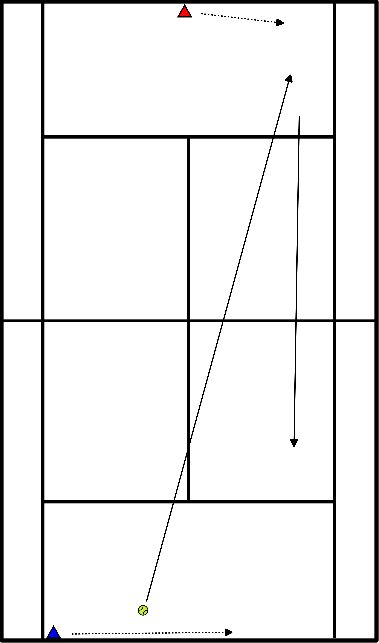
- The player on the opposite side starts in the middle of the court on the baseline and receives a low ball.
- The first ball must be played with a slice straight down the line.
- The player on the trainer's side begins at the singles line with a forehand or backhand, depending on the opposite line of the first ball.
- Play out the rally.
- Can you score with a volley? That earns 3 points.
Introduction
- The trainer briefly discusses the previous lesson: what did we do and what have you learned?
Technical Focus
- Zoom in on forehands and backhands.
Tactical Focus
- Construction of a point.
- Positioning in doubles.
- Collaboration and communication.
Execution
- Try to rally in pairs.
- Create space and hit the ball into the open space.
- Experiment with hitting harder, taking the ball earlier, and deliberately slowing down the game.
Variation
- Use different court lengths to experience how hard, soft, high, low, deep, or shallow the ball should be hit.
Rotation
- After the ball is hit incorrectly twice, the pair swaps with the waiting pair.
- Waiting students can monitor the task and participate mentally.
Execution
- The players stand in the centre of the court.
- One player delivers the ball using their foot, ensuring the ball bounces in a service box.
- The other player is required to approach the net.
- For a lower level: do not approach the net.
Execution
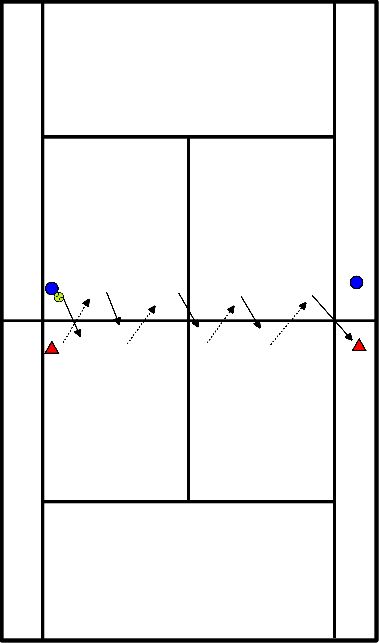
- The players start in one corner of the court on a mini-tennis court.
- They try to volley with each other to the opposite side of the court and back again.
- Count the number of times they can play back and forth.
Execution
- Play the ball straight over.
- After each stroke, you must touch a point.
- Move half a metre behind the baseline in the centre.
- Use only half of the court.