



Hockeyexercises for technique condition
- Jump on your left foot and hold balance for 10 seconds, then sprint to the red line.
- Repeat on your right foot and sprint to the red line.
- Perform high knees on the spot for 10 seconds, stay on your toes and sprint to the red line.
- Do 5 lunges on your right leg and 5 on your left leg, then sprint to the red line.
- Jump sideways over the line back and forth 3 times, then sprint to the red line.
- Repeat the sideways jumps, but with your back facing the field.
Execution
- Players stand back-to-back.
- At a distance of 10 metres from each player, there is a cone with a ball on it.
- At the whistle or the command "START!", players run to the cone.
- They each pick up the ball, run back to each other, and hand the ball to one another.
- Subsequently, players walk with the new ball to the cone and place the ball on it.
- They both walk back to the centre and finish back-to-back.
- Optionally, this can be done in relay form or multiple times in succession.
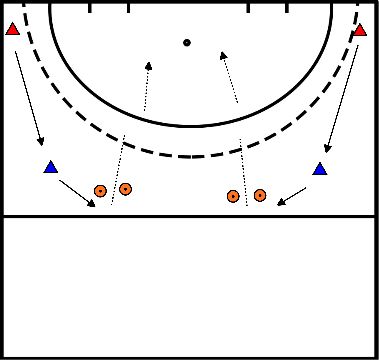
- 1 team to the right of the circle
- 1 team to the left of the circle
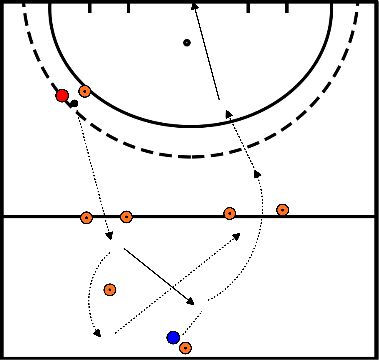
- One player from each team will stand at the blue pot and on the 23 meter line at the orange pots.
- The rest of the teams start at the red pots.
- The ball passes through a push from the red to the blue and from the blue to the orange pots.
- When the player at the orange potty receives the ball, this player dribbles until he is in the circle and then finishes on goal.
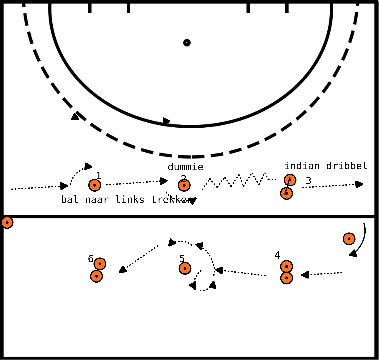
- To pawn 1 pace with ball on forehand on stick. At the pawn a passing move to the left.
- To pawn 2 tempo with ball on stick. At the pawn a dummy.
- To pawn 3 indian dribble. At the pawn hop over the stick and sprint with ball under control to the back line around pawn A to pawn 4 ball on the left side of your body with left or right hand on the stick. At the pawn a seesaw with backhand over the pawns
- Pull the ball to the forehand and at the pion 5 make a reverse and re past the pion
- To pawn 6 and there make a bounce over the pawns
- Slow dribble to the beginning of the pawn
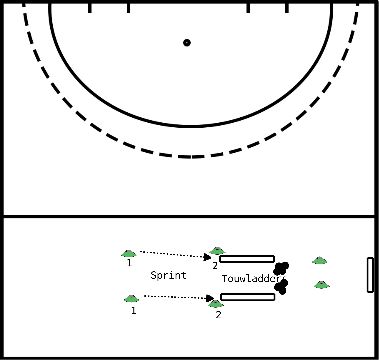
- A: sprint from 1 to 2
- B: perform rope ladder as per 5 exercises below
- C: take ball around the hat and finish on goal
Points of attention:
- Pay attention to your predecessor.
- Outside back.
- Exercise must be done at pace.
- two foot run -one foot in each box.
- Ladder Taps -right foot in each square, left foot outside.
- Two foot lateral run -sideways both feet in a box.
- Skiers.
- Squat Hops.
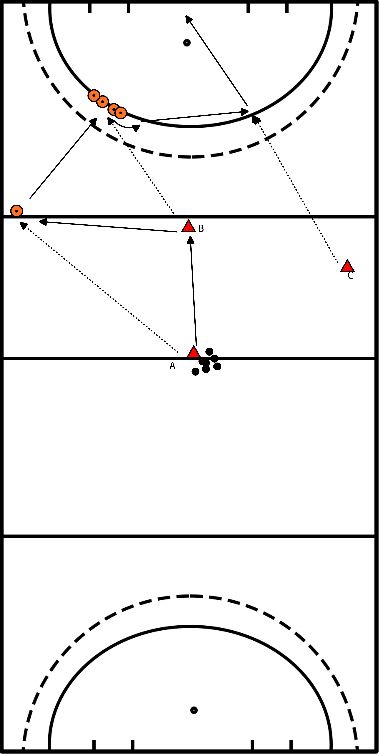
- Player A plays towards player B.
- A runs deep towards the first pawn -running line-.
- B passes back to A and runs deep towards the circle -short quick action-.
- A passes back to B.
- B takes on the forehand and spins away over the opponent's backhand -pawn-.
- C sprints in towards head of circle -timing-.
- B passes towards C possibly with the backhand sweep pass.
- C takes on, brings the ball into the circle and rounds. 2 actions, ball under control and round off.
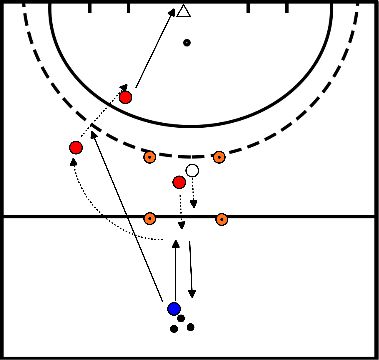
- Player RED comes out of the square and offers himself to player BLUE.
- BLUE passes to RED as he offers himself.
- Player WHITE pressures RED so it has to accept closed and plays back to BLUE (guard).
- Player RED makes an acceleration to the left or right next to the square.
- Player BLUE passes the ball to player RED looking carefully where RED asks for the ball (forehand or backhand).
- RED takes the ball open and penetrates the circle to finish on goal.
- TURN TO THE OTHER SIDE.
- RED JOINS AT STARTING POINT / BLUE JOINS IN THE SQUARE.
- 30 sec jumping jacks
- 30 sec knee lifts
- 30 sec heels against buttocks
- 30 seconds bridge with 1 foot on ball
- 30 sec jump-lunge with ball between legs 30 sec skating jumps
- 30 sec Russian-twist (feet off the floor)
- Build up from 25
- 30 seconds normal plank
- 30 seconds of alternating left and right leg lifts
- 30 seconds of side plank on right side, other arm extended
- 30 seconds side plank on left side, other arm extended
- 30 seconds of normal plank 30 seconds of spiderman plank
- 2 x 1 minute (rest 20 seconds)
- 3 x 8 pylo-clap push-ups
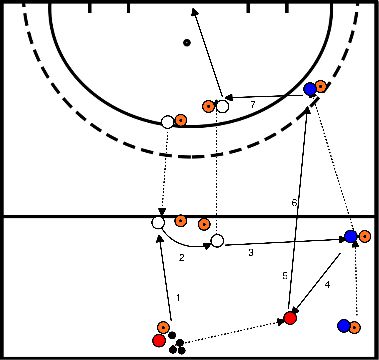
- Depending on the level of the player, put a bit larger or smaller.
- Can also be mirrored with a backhand finish.
- Ball starts at red.
- White runs back to give support and gets the ball.
- When they take the ball, they accelerate to the side where blue has walked to.
- Red makes the point of the triangle backwards and is played.
- Blue runs deep and white goes to the head of the circle.
- Blue is played and passes the ball to the player on head circle who scores.
Points of attention:
- Acceleration on take-off
- After a pass follows a run
- High ball pace
- Look at what is happening and anticipate
- Searching for eye contact
- 3:1
- 2:1
- or 3:2
The game is played with at least 4 players
- 1 mouse who has a t-shirt or piece of cloth in the back of his trousers
- 1 dog who has a tennis ball
- 2 cats without attribute
- the mouse runs around with the dog,
- the cats try to grab the tail of the mouse and bring it to their cone
- But the dog can tap the cat with the tennis ball and it will do a punishment of its choice in the camp.
- If there are more players a group can be created and 2 games can be played together.
- From the group, a scapegoat is appointed.
- The game is played all over the field.
- The group is lined up on one side of the field.
- On sign the children cross the field.
- One of the catchers tries to catch as many children crossing the road as possible.
- Variation
- The children walk to and fro on a signal.
- Back and forth without waiting for a signal.
- The children are not free on the other side.
- With two tappers.
- With boxes where there is one ticker in each box.
- The children can be tagged in every cell.
- Who has not been tagged on the way out and on the way back?
- Or which group of tickers has managed to tick the most children?
- The catcher must try to catch the others.
- When you are tagged, you stand with your legs apart and your arms crossed.
- Without the ticker knowing, the group has appointed a secret saviour;
- He may redeem the ticked by secretly tapping them.
- The game stops when the secret deliverer is caught.
- Players stand with their backs to each other.
- At a distance of 10 m from each player stands a pawn with a ball on it.
- At the whistle or START, the players run to the pawn, both grab the ball, run back to each other and hand each other the ball.
- Then the players run to the pawn with the new ball and place the ball on it.
- Then they both run back to the middle and finish with their backs to each other.
- It is possible to do this in a relay race or several times in a row.
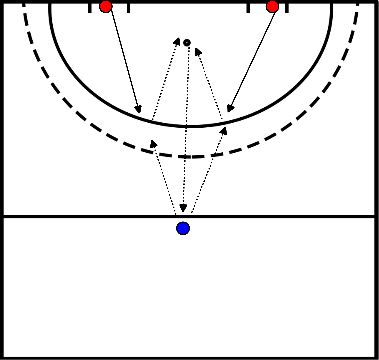
- There are 2 passers on the PC points on the back line to the right and left of the goal.
- The player starts behind the 25 yard line, receives the ball from the left, gets the ball to the semi-circle and then has to score.
- This player then sprints past the penalty mark, then sprints back behind the 25 yard line, and then has to run back towards the goal to receive the pass from the other attacker (right) and do the same (scoring, sprint past the strokepunt/puntball point and back to the 25 yard line)
- Keeper on target
- Place 2 gates of pilons on the 23-metre line (the gates are on the left and right side of the goalposts)
- Player red starts on the head circle and accelerates with ball through the gates.
- Immediately after passing the gates, red passes to blue.
- Red sprints around a pilon to put pressure and/or take the ball away from blue.
- After receiving the ball, blue accelerates with ball and runs through the gates.
- If blue passes through the gates, red is not allowed to take the ball and has to go back to the pilon.
- Blue accelerates into the head circle and shoots at the goal.
- Everybody's got a ball, you're facing each other on the 23-metre line.
- Left and right is a line of pilons.
- The ball is light under your legs, at some point the trainer tells you how to stand (on your left leg, or touch your ankles) then the trainer calls left or right and you have to run to that side as quickly as possible and the ball must lie still on the line with pilons,
- If the ball is still on the line, run back to the 23-metre line as quickly as possible.
- Whoever is first wins.
- The pilons are about 3 or 4 metres from the 23 metre line, on both sides.
Place 15 to 20 pylons over a distance of about 40 metres from the rear line towards the middle line, in a straight line. The spacing between them at the basic form is 2 meters.
Make 2 rows that are positioned behind the back line. The players do their exercise on both sides of the pylons at the same time towards the end of the series of pylons. There they turn and dribble with a wide curve back to the beginning. When the first two are at the fourth pylon, the next two can start.
Put players with an equal physical capacity next to each other. You can do a positional approach (defender versus defender, attacker versus attacker).
Exercise
1. On the signal the front 2 players start.
2. Sprint each time 2 pylons forward and then 1 pylon backward.
3. Keep your face forward, so don't turn during the exercise.
4. The intensity is 90% of the maximum capacity. Especially the forward runs (starting away) must be explosive and with short steps.
5. At the end of the series of pylons you turn with a wide bend and dribble easily back to the starting point.
6. Repeat this exercise once.
Variations
1. Identical to the basic form, but now with the pylons in a different pattern: between the first 2 pylons is 1 meter, between the next 2 meters, then 3 meters, 4 meters and finally 5 meters. After this you go down again (respectively 4, 3, 2 and 1 meter space between the pylons). In total you will have 18 pylons.
2. Identical to the basic form, but now with a different pattern: between the first 3 pylons 1 meter, the next 2 pylons 5 meter, then again 3 pylons with 1 meter, 2 pylons with 5 meter. After this, place the same pattern again (4 times the same pattern in 1 line, with a total of 18 pylons).
3. Identical to variation 3, but now you don't place the pylons in a straight line, but in curves.
4. You make a straight line of pylons and arrange them as you see fit. Make sure there is a lot of variation.
5. Identical to variation 4, but now with faint curves.
Intensity of the exercise
The intensity is 90% of the maximum effort. Panting, should be motivated execution with highly explosive character in the runs with a maintained body control and athletic posture, EMI 7/8.
- The tagger should try to tap as many children as possible.
- If you are in danger of getting tapped you can call a television show and then the tagger is not allowed to tap you.
- You have to stand with your legs wide.
- The rest can be relieved by crawling between your legs.
- When you are tapped, you stand by the trainer.
- Groups of 2 in a row.
- There is one tagger and one runner.
- The one who has to run away, because otherwise he will be tapped, will quickly stand in front of 2.
- The last one of these two has to run away quickly in order not to be tapped, because 3 is too much! If you get tapped, you become the tagger.
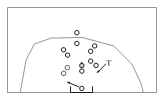
- The children are placed in 2 rows.
- The trainer stands just behind the 2 rows and rolls a ball forward.
- The front 2 players try to conquer the ball.
- The player in possession
- drives the ball towards the goal.
- The other tries to conquer the ball again.
- From a marked point, the ball may not be taken away and the player in possession makes a shot at goal.
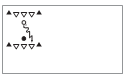
- The group is positioned in the four corners of the field.
- One who tags has to wear a party ribbon
- On a sign, they cross the field in three directions of their choice:
- the short side, the long side or diagonal.
- This results in one, two or three points each time they return.
- A tagger operates in the free space and obliges the tagged children to first go back to their corner before they may cross again.
- How many points can you score in a set time?
- Let the team run for about five minutes and then continue with the following exercises:
- put out the pilons as shown in figure one.
- Have the team make two rows on the sideline at the height of the 23-metre line.
- Perform the following running exercises on the dotted line:
- - Knee lifting (constructive 50%, 80%, 100%).
- - Heel to buttocks (building 50%, 80%, 100%).
- - Sideways
- - Cross step.
- - And finally, release the arms.
- Set up hats/pilons in such a way that they resemble a frying pan with a handle.
- The children are the eggs and dribble with the ball around the frying pan, they can always walk over the handle.
- The tagger is the cook, who likes to fry a delicious omelet with 3 eggs.
- So the cook tries to tag 3 eggs but is only allowed to walk over the handle 3 times.
- Each tagged egg is placed in the frying pan.
- How long does the cook need to tag the 3 eggs?
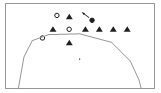
Place 15 to 20 pilons over a distance of about 40 metres from the back line towards the middle line, in a straight line. The spacing between them at the basic form should be 2 meters.
Make 2 rows of players that are positioned behind the back line. The players do their exercise on both sides of the pilons at the same time towards the end of the series of pilons. There they turn and dribble with a wide curve back to the beginning. When the first two are at the fourth pilon, the next two can start.
Put players with an equal physical capacity next to each other. You can put players next to each other based on their positions (defender versus defender, attacker versus attacker).
Exercise
1. On the signal the front 2 players start.
2. Sprint 2 pilons forward and then 1 pylon backward.
3. Keep your face forward, so don't turn during the exercise.
4. The intensity is 90% of the player's maximum speed. Especially the forward runs (starting) have to be explosive and with short steps.
5. At the end of the series of pilons you turn with a wide bend and dribble back slowly to the starting point.
6. Repeat this exercise once.
Variations
1. Identical to the basic form, but now with the pilons in a different pattern: between the first 2 pilons is 1 meter, between the next pilons 2 meters, then 3 meters, 4 meters and finally 5 meters. After this you reduce distances again (respectively 4, 3, 2 and 1 meter space between the pilons). In total you will have 18 pilons.
2. Identical to the basic form, but now with a different pattern: between the first 3 pilons 1 meter, the next 2 pilons 5 meter, then again 3 pilons with 1 meter, 2 pilons with 5 meter. After this, place the same pattern again (4 times the same pattern in 1 line, with a total of 18 pilons).
3. Identical to variation 3, but now you don't place the pilons in a straight line, but in curves.
4. You make a straight line of pilons and arrange them as you see fit. Make sure there is a lot of variation.
5. Identical to variation 4, but now with curves.
Intensity of the exercise
The intensity is 90% of the maximum effort. Panting, should be present in the forward runs, because they are highly explosive. Good body control and athletic posture should be maintained, EMI 7/8.