



Hockeyexercises for technique dribbling
- Various technical forms to warm up with.
- The setup can be either one-sided or two-sided, depending on the number of players.
- At point A, the player performs a drag movement and passes the cones.
- The player passes to point B.
- At point B, the player receives the ball and dribbles to point C.
- From there, he plays to the player at point C.
- The player at point C receives the ball, turns towards the goal, and finishes.
- After finishing, the player runs after the ball.
- Point D joins again at point A.
- One-sided or two-sided setup possible.
- Use the exercise to warm up the goalkeeper.
- At point C, sides can be switched.
- Play the exercise from both sides.
- Observe and improve various techniques of the players.
- When turning and dribbling, the ball should stay on the stick.
- Ensure players do not hinder each other at point C.
- All balls are played to the forehand of teammates.
- To be able to combine, run with and without the ball, turn open, pass, and finish on the goal.
- At least 2 participants are active. With a goalkeeper, there is a third person active.
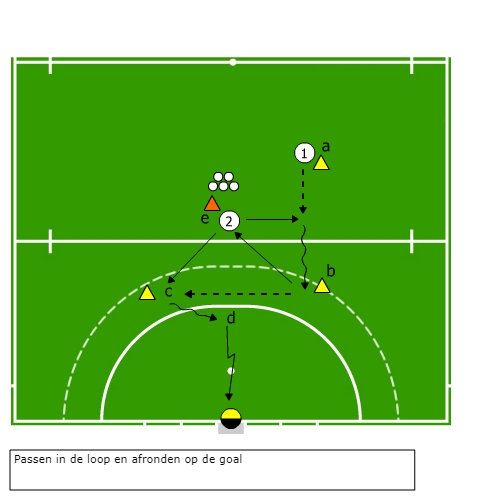
- Player 1 starts without the ball and runs from point A to point B.
- Player 2 stands at point E and plays the ball to player 1 in stride.
- At point B, player 1 plays the ball back to player 2 and continues to point C.
- Player 2 plays the ball to point C so that player 1 can receive it there.
- Player 1 turns inside and runs to the top of the circle.
- At point D, player 1 finishes on the goal and exits the exercise on the right side.
- Player 1 takes over the position of player 2.
- Player 2 runs to point A and joins the back of the line.
- At point B, player 1 can make a turn to position their body between the ball and the opponent.
- Player 2 can give the second pass in stride to player 1 between points B and C.
- The exercise can be mirrored.
- Instead of 1 player at point E, 2 different players can execute the pass.
- Player 2 can deflect the ball from point E to point C to increase the difficulty level.
- The objective of this training is to actively offer yourself between the ball and the defender, making yourself available for a pass.
- The player at point B starts running and moves in an arc past the orange cones to make themselves available.
- The player at point A passes to the incoming player and runs around the designated cones towards point B.
- The player at point C runs in an arc around the orange cones, paying attention to the position of the player at point B.
- The player at point B passes the ball to the player who started from point C.
- The player from point C receives the ball before the orange cones, dribbles into the circle, and finishes on goal.
- The player who has finished runs around the cones back to point A.
- Reduce the training area by removing one station, requiring fewer players.
- Change the starting position to adjust the direction of availability.
- Add an extra station at the goal for a tip-in, noting that more players will be needed.
- Keep the ball close to the stick while dribbling to prevent losing the ball.
- Make yourself wide when offering to effectively position yourself between the ball and the defender.
- Pay attention to timing when starting to run.
- Make passes before the orange cones to ensure clear running in front of the player.
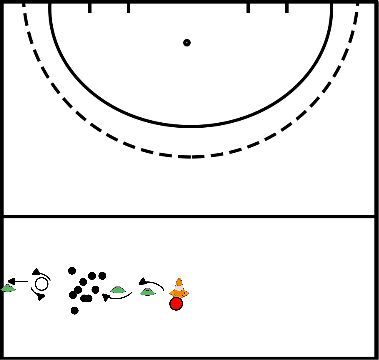
The goal is to get the ball from orange pawn to the green pawn.
The course:
- a slalom
- a mine field
- a round the hoop
- a sprint to the finish line
For example, give each team 15 balls and the goal: who first brought all the balls from the pawn to the green hat.
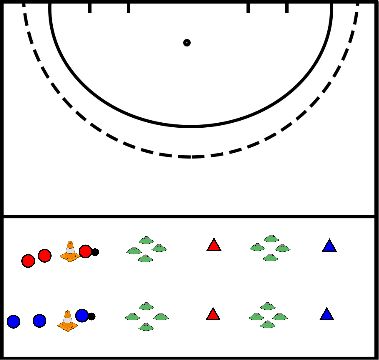
- Make two equal teams; team red and team blue.
- Start with ball at orange pawn.
- Float a lap around the green pawns and place ball with hand on pawn red.
- Then run a lap around the green pawns without ball and tap the blue pawn with your hand.
- Then walk another circle around the green pawns and take the ball off the red pawn.
- Then drive a circle around the green pawns with ball and pass the ball to the next one.
Note:
- Depending on the number of players, you can have everyone take 1, 2 or 3 turns.
- Once a player has had her/his last turn, she/he sits on the floor.
- If a team has all its players sitting on the ground, they win the relay.
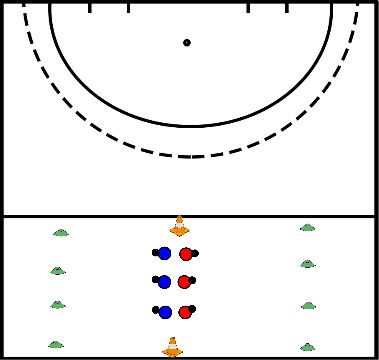
- Players red; the rats and players blue; the ravens all have a ball and stand with their backs to each other.
- Trainer says r(rrrr)atten: all red players drift with ball toward the pawn line; players blue leave their ball and try to tap players red for the line.
- The trainer says r(rrrr)aven: all blue players drive ball toward the pawn line; players red leave their ball and try to tap players blue for the line.
- Reach the line without being tapped, you get a point.
- Tap the player red/ blue before the line you get a point.
- Change opponents frequently.
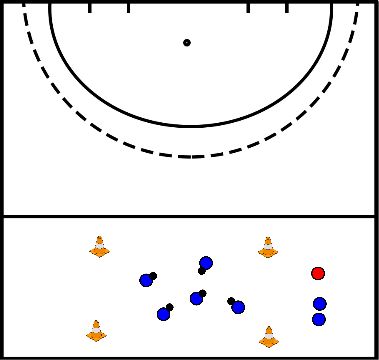
- All players start with a ball in the square and dribble/drive around in it.
- The trainer determines the moment to call stop!
- At that moment, all players make sure the ball is stopped as quickly as possible.
- Does the ball roll on. So does the player not have control of the ball he is off.
- When you are off, you wait by the side.
- The trainer may point to a waiting player to call stop!
- As a trainer, at some point you may indicate that the players should dribble faster.
- This makes it more difficult to stop the ball.
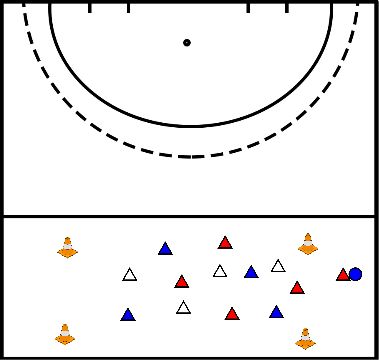
- Players all have a ball and dribble through the box of pawns.
- Scattered through the box are pawns of three different colors; at least 4 of each color.
- Trainer has in hand of all three colors -i.e. in the example red, blue and white.
- Trainer puts e.g. a blue pawn in the air --> All players try to drive around all blue pawns as quickly as possible.
- The first two players who have driven around all blue pawns get a point.
- Then a new round begins and the trainer chooses another color pawn -or the same color.
- Etc.
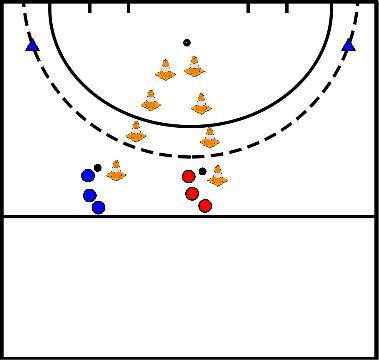
- As trainers, create two equal teams.
- Start the relay at the trainer's signal.
- The players slalom around the pawns. Both ball and body around the pawns. And rounds on goal; push or flatten.
- If the player scores, he may immediately sprint back and tap the next player.
- If the player misses, he must take a detour via the blue pawn at the side of the field and then sprint back and tap the next player.
- When it's your turn, you sit on the floor.
- Depending on the number of players, you can also choose to have all players take 2 or 3 turns.
- The next player may not start until he is tapped by the player in front of him.
- The team that has all players on the ground first wins the relay.
- There are different types of slalom to apply in this exercise:
- Normal slalom
- Slalom in which the player's body and ball are to the left or right of the pawn line
- Slalom where the ball is to the left of the row of pawns and the body is to the right
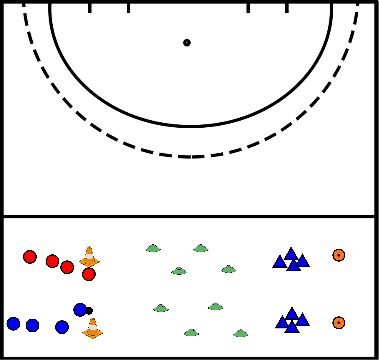
- The trainer makes two equal teams and divides them into two rows.
- The first player on each team starts with a slalom around the green pawns.
- Then he drives a lap around the blue pawns -right around.
- He puts the ball on the orange pawn and sprints back to the row of players.
- There he taps the next player.
- This one does exactly the same thing only without ball and stick.
- He picks up the ball from the cone and sprints back to the row.
- There he puts the ball ready for the next player, who travels the route again with ball and stick, and so on.
- The team that first, has all its players finish twice, is the winner of the game.
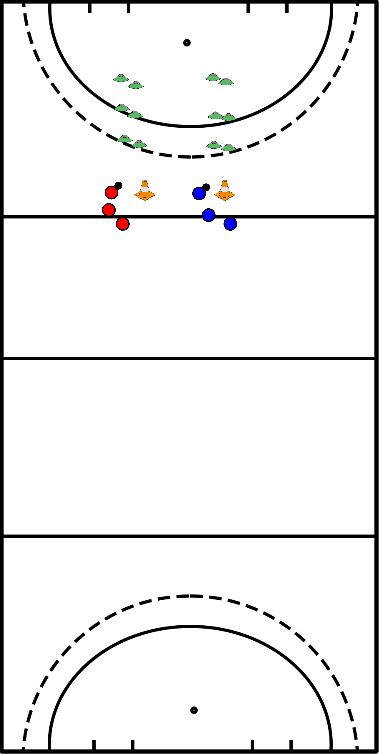
- The player does three passes behind the dummy and rounds on target.
- You can also do this exercise in relay form (do emphasize the proper execution of the exercise and not the speed).
- With the dummy, it is important that you pretend to pass to the left, but eventually accelerate right around the pawn.
- Make sure you step out well with your left foot and pass the ball well under you.
- After your move, accelerate briefly to the next double pawn.
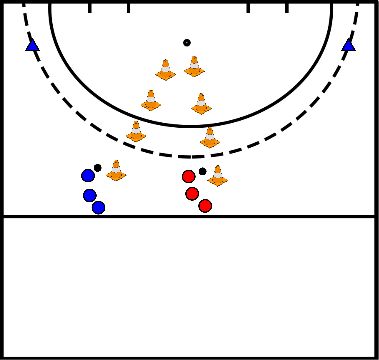
- Create two equal teams.
- Start the relay at the coach's signal.
- The player slaloms around the pawns -both ball and body around the pawns- and rounds on goal -push or flush-.
- If the player scores, he may immediately sprint back and tap the next player.
- If the player misses, he must take a detour via the blue pawn -on the side of the field- and then sprint back and tap the next player.
- When it's your turn, you sit down on the ground.
- Depending on the number of players, you can also choose to have all players take 2 or 3 turns.
- The next player may not start until he is tapped by the player in front of him.
- The team that has all players on the ground first wins the relay.
- There are different types of slalom to apply in this exercise:
- Normal slalom
- Slalom in which the player's body and ball are to the left or right of the row of pawns.
- Slalom where the ball is to the left of the row of pawns and the body is to the right.
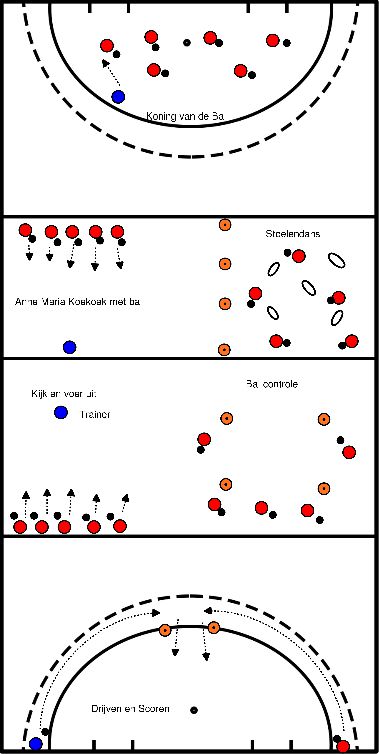
- Set out a box or grab a circle.
- Give everyone but 1 player a ball.
- The player without a ball wants to go take the ball from someone else.
- Ball taken away or out and field then that person goes to help take the balls away.
Anne Maria cuckoo with ball:
- Put all players on 1 line with a ball.
- Have 1 player stand on the other side.
- Have this person quietly call out Anne Maria Cuckoo.
- The players with the ball may then run, the ball must be stationary when the roper has turned around.
- If the ball is not stationary then players go back to the beginning.
Chairs dance:
- Give all players a ball.
- Have them float through the box and dribble with the ball.
- When you call Yes they float as fast as they can to a hoop/pion- depends on what you have on hand.
- Start by having everyone give another hoop/pion to stand at/in, then remove 1 each time.
Watch and perform:
- Line up all the players with 1 ball.
- They start floating with the ball, you indicate which way to go by pointing with your arms.
- You don't say anything about this.
- So they can't just look at the ball but must also look ahead which way to go.
Ball control:
- Give each player a ball.
- Have them float on a box with the ball.
- When you call Yes they float with the ball straight across through the box to the other side.
- Make sure they keep looking at each other so they don't collide with the other players.
Drifting and Scoring:
- Make 2 teams.
- Give all players 1 ball.
- Have them start at the back line outside the circle.
- On your signal, have them float the ball along the circle edge.
- When they reach the pawn they may score in the goal.
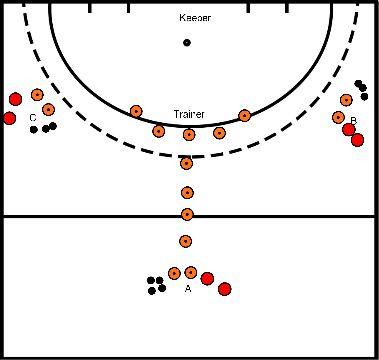
- A starts by slaloming through the cones and does so at speed.
- At the end he is told whether to pass the cones left or right and accelerates with the ball on the stick.
- A lines up the ball and hits goal
- He turns around and gets a ball from B on the forehand. He takes the ball, lines it up again and rounds
- Turns around again and receives a ball from C which you take on, line up and finish.
- We turn from
- A to C
- C to B
- B to A
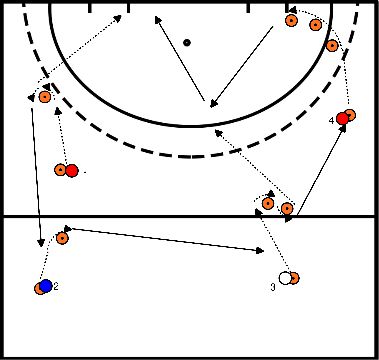
- Ball starts with player 1, who runs to the back line, turns close and passes the ball in the run to player 2.
- Player two runs towards the 23, makes a turn to the right and pushes the ball to player 3.
- Player 3 attempts to run towards header circle but retrieves the ball at the ion and passes to player 4.
- Player 4 runs towards the back line and passes the ball towards head circle.
- Player 3 has run on after the pass and has taken position between the head circle and the center spot and will choose from here between rounding or playing on the tip.
- Player 1 is ready for the tip.
- Direction of rotation in chronological order.
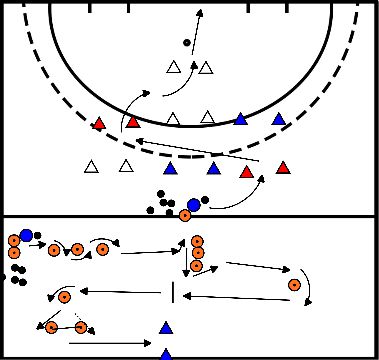
- Player starts with a ball
- You as trainer call 1 colour
- In this case you call RED
- The player drives through the 2 red gates
- At the end she goes through the white gate and flattens the ball on goal.
- Technique course
- Player starts with the ball and does a slalom
- Drifts further and puts a dummy near the pawns
- Drifts around the pawn
- Dribbles towards the balk on the ground and lifts the ball over it
- Dribbles on and goes around the pawn
- Does a herring trick near the cones
- Then passes the ball on to the goal
OrganizationField
: half field
Implementation
General
- Play direction of the game
- Goals in the middle of the field to stimulate awareness of the context of the game (from where do I defend, where do I score?).
- 1:1 : the trainer plays a ball to Orange 1 or Blue 2. Defender's goal is to prevent a goal and score himself.
- 2:1 : The trainer plays a ball to Orange 1 or Blue 2. When Orange 1 gets the ball, Orange 3 can join in the playing field of Orange 1
- Orange 1 and 2 play a 2:1 on Blue 4 (same if Orange 3 gets the ball (Section B)).
- 2:2 : Same as 2:1, but if Blue 2 gets the ball, Blue 4 may join the attack in the section of Orange 1 (Section A).
Tips on ball possession - Perform a feint when passing.
- Cut in after the passing action; protect the ball from the defender.
Tips on non-ball possession
- Find your opponent as quickly as possible.
- Keep your stick on the ball.
- Keep the opponent in front of you (on the forehand).
- ps changeover
At loss of ball:
- Put direct pressure on the ball handler, cut the shortest path to the goal.
On winning the ball:
- Perform a quick action/goal attempt towards goals.
- Making it easier
- Change the start location regularly.
Make it more difficult
- Vary the speed of throw.
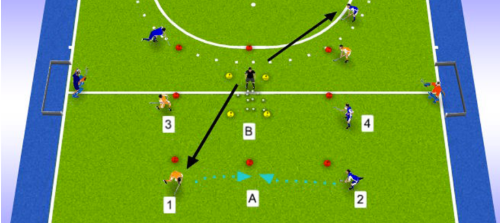
- Two teams with substitutes, substitutions are made when a goal is scored.
- Each person defends a goal, on each field there are 5 goals,
- so there are also 5 people who defend these goals.
- If a goal is scored in your goal, you have to sit on the sidelines and you become a substitute.
- A new player (substitute) from the side enters the field and will defend the goal.
- If a goal is scored, it is 1 point.
- The team that has the most points at the end of the game is the winner.
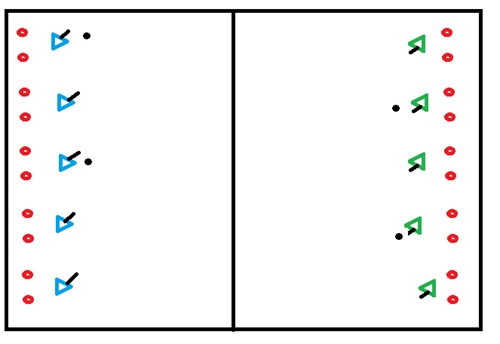
Overplaying to score
- Two players continuously play the ball over
- until one of them is so close to the goal
- that he can score in the goal.
Variation 2-1 situation:
- Under pressure from the defender, the attackers must now play together and try to score.
- The defender can score a point by conquering the ball and then dribbling over the dead ball line.
- This is the short side without a goal.
Purpose
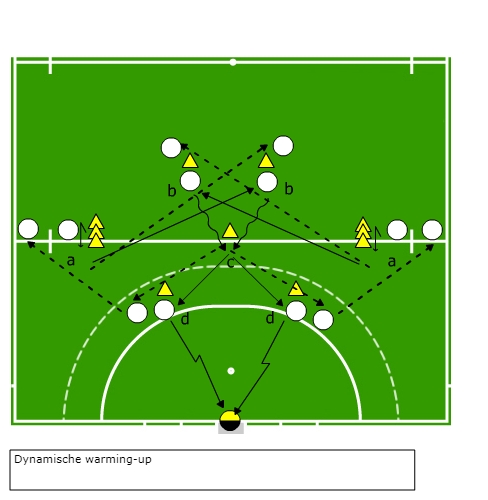
: Various technical forms to warm up.
Format
:The exercise can be set up one-sided or two-sided. This depends on the number of players in the training.
- At point A, the player makes a drag and passes the pawns. Then he passes to the player at point B.
- The player at point B takes the ball and dribbles to point C. From there he passes to the player at point C.
- The player receives the ball and turns towards the goal, completing the pass
- Before turning, you run after the ball. Point D rejoins point A again.
Variations:
- You can set up the exercise single-sided and double-sided.
- You can also choose to warm up the goalkeeper in this way.
- At C, you can switch sides. If you are coming from the right, play the ball to the right, so that you can practise from both sides.
Points of attention:
- This is a good time to look at different techniques of your players and polish them.
- When turning and dribbling, the ball must stay on the stick.
- There is only one point at C, so players should not get in each other's way and look for the next ball to enter play.
- All balls are played into the forehand of the teammates.
Goal
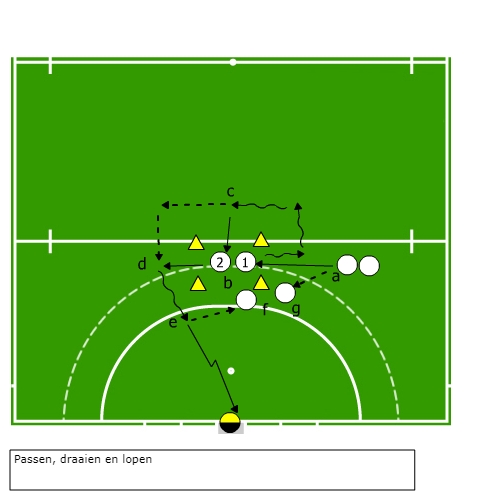
:To increase ball skills by alternating between playing without and with the ball, floating, hitting and bouncing.
Set-up
:A square just outside the circle is set up.
- The player outside the square plays the ball into the square.
- The ball is accepted by player 1. He takes the ball and drives around the pawn to point C.
- At point C he plays the ball into the square to player 2 and runs on to point D.
- Player 2 plays the ball to point D so player 1 can pick up the ball there.
- Player 1 walks to the edge of the circle and shoots at the goal from inside the circle.
- Before turning, player 1 takes the place of player 2; Player 2 goes to play the ball; The player who played the ball in becomes player 1.
Variations:
- Instead of shooting at the goal, you can also tip the ball in.
- Player 2 can play and pass instead of taking the ball.
- The exercise can also be played from the other side.
Points of attention:
- The ball stays on the stick. When the ball is attached to the stick it is almost impossible to take it away without a foul.
- Player 2 must play the ball in the right direction.
- To make sure the exercise runs smoothly, there must always be a reserve player at points F and G.
Goal
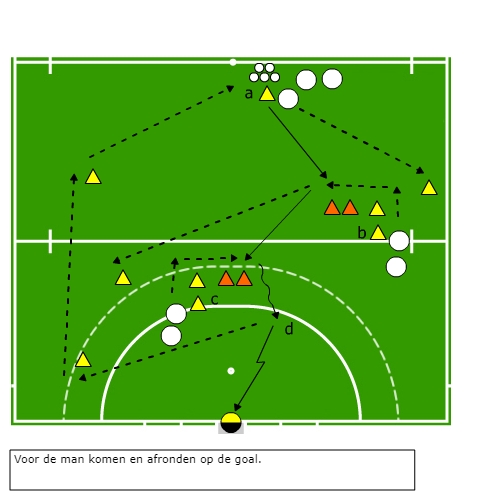
: The goal of this exercise is to actively pass between the ball and the defender, making yourself playable
Set-up
:In order to run this exercise properly, you need a minimum number of players. You can play with this when you make the exercise one station shorter.
- The player at B starts walking and runs with a curve past the orange pawns. By doing so, he offers himself for play.
- The player at A plays into the run-in player and runs around the indicated cones towards point B.
- The player with C runs in a curve around the orange cones. The moment of starting is important. He pays attention to how far the player at point B is.
- The player at point B plays into the player who left from point C.
- The player at point C receives the ball in front of the orange cones, runs with it into the circle and rounds the goal.
- The player who completed runs around the cones back to point A.
Variations:
- By removing one station, you can make the exercise smaller, requiring fewer players.
- The position from which the player who passes runs in front of the man starts can be changed. You can e.g. move point B more to the inside of the play area, making the direction of play different.
- You can also create an extra station near the goal for someone who is about to tip in Please note that you will need several players for this.
Points of attention:
- When floating, the ball is attached to the stick. This makes it almost impossible to take the ball away without committing a foul.
- When offering the ball, you have to make yourself wide so you can get between the ball and the defender
- Starting the run can be difficult to time, so pay extra attention to this
- The passes should be made in front of the orange cones, so that you are clearly running in front of the man
Passing in the run and finishing on goal
Objective:
Being able to combine, run with and without the ball, turn open, pass and finish on goal.
Set-up:
For the exercise at least 2 participants are active. When you also work with a goalkeeper, a third person is active.
- Player 1 has no ball and starts running from point A to point B.
- Player 2 stands on point E and stays there during the exercise. Player 2 plays the ball to player 1 in the run.
- When player 1 arrives at point B, he plays the ball back to player 2 and continues to point C.
- Player 2 plays the ball to point C so that player 1 can take it there.
- Player 1 turns inside and walks to the head of the circle.
- At point D, player 1 rounds the goal and runs out the exercise on the right side so he can run around point C and take over player 2's spot.
- After handing off player 2's final pass, he runs to point A and closes in at the back.
Variations:
- At point B, instead of passing the ball directly to player 2, player 1 can do a Swivel. In this way the player learns to put his body between the ball and the opponent.
- Player 2 can also pass to player 1 in the run from point B to point C. This trains you even more on passing and taking on in the run.
- The whole exercise can also be done in mirror image.
- Instead of one player on point E you can also have two different players make the pass. In that case, after the first pass, player 2 runs through and another player takes the ball and passes it to point C.
- If player 1 is fast enough, player 2 can also bounce the ball from point E to point C. This increases the difficulty by increasing the speed and adding the bounce.
Two teams with substitutes, substitutions are made when a goal is scored.
Each person defends a goal, on each field there are 5 goals, so there are also 5 people who defend these goals.
If a goal is scored in your goal, you have to sit on the sidelines and you become a substitute. A new player (substitute) from the side enters the field and will defend the goal.
If a goal is scored, it is 1 point. The team that has the most points at the end of the game is the winner.

- A starts slaloming through the pilons and does this at speed
- At the end he is told whether he left or right along the pilons and accelerated with the ball on the stick
- A aligns the ball and strikes goal
- He turns around and gets a ball from B on the forehand. he takes the ball, aligns the ball up and around again.
- Turn around immediately and you get a ball of C that you take, line up and complete
- We are running from
- A to C
- C to B
- B to A