



Hockeyexercises for technique pass around player
Last update: january 2026
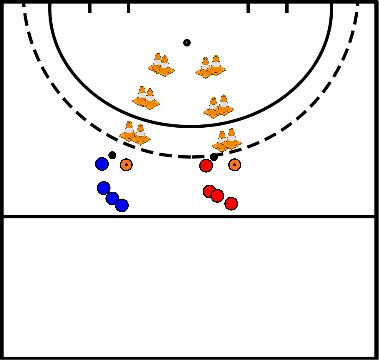
- Make two rows of an equal number of players.
- Players take turns drifting toward the three double pawns.
- Arriving at the double pawns, do the herring trick three times in a row and then flatten the ball on goal.
Herring trick:
- You play the ball to the right of the double pawn and pass it yourself to its left.
- Make sure you have control of the ball again before the next double pawn.
- So push the ball in a controlled manner.
Organization:
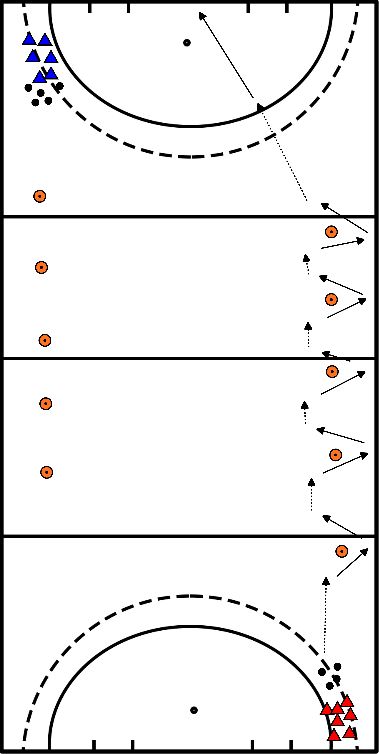
- Divide the group in half.
- Start with each group on the right side of the goal.
- Place 5 pylons on each side 1 meter from the bar.
Exercise:
- Divide the group in half.
- Start with each group on the right side of the goal.
- Place 5 pylons on each side 1 meter from the bar.
Exercise:
- On both sides, one player starts with the ball.
- Who floats to 1st pylon and bounces the ball on the beam and takes the ball back after the pylon.
- The player does this at all pylons.
- After the last pylon, the player drifts the ball to the circle and scores.
- The player takes the ball a connects at the other end.
Note:
- When drifting, keep ball on stick.
- When rebounding, turn in with the body so the ball makes a sharp angle.
- When drifting, keep ball on stick.
- When rebounding, turn in with the body so the ball makes a sharp angle.
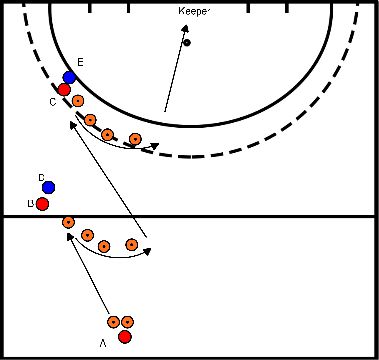
Exercise on both sides out
- A gives a push to B
- B takes the ball closed because defender D is in his back.
- B accelerates with the ball on his stick past the cones,
- D runs with B because he does not want B to pass.
- D may, when B has passed the cones, try to conquer the ball
- B wants to pass the ball to C.
- When D intercepts the ball he passes it to C so that this person can continue with the exercise.
- When B has gotten the ball to C C does the same and the defender E then goes to defend.
- When E gets the ball he can finish on goal.
- How do you turn, Va a goes to the spot of B,
- B goes to the spot of D, D to the spot of C,
- C to E's spot and E to A's spot
- Tips for the attackers
- Keep the ball close to you and screen it with your stick
- Pass the ball over your opponent's backhand side
- Accelerate so that it is already more difficult for the defender to stop you
- Tips for the defenders
- Keep your stick on the ground, then you can react much quicker to what your opponent does
- Keep your opponent on the forehand and make sure the AS is close!
- Let the attacker make the mistake and then intervene pass
- Guide your opponent in the direction you want him/her to go
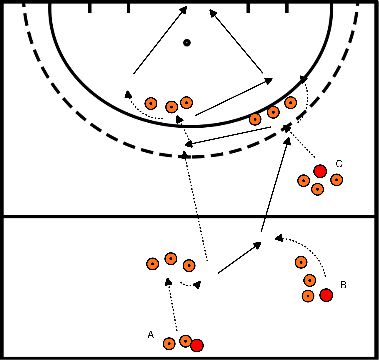
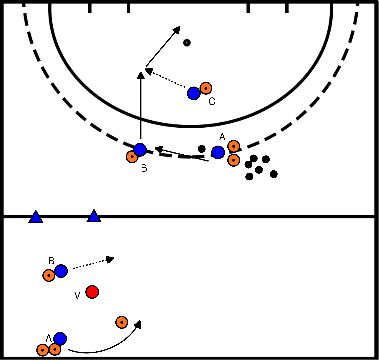
- A starts with the ball and runs up, meets an opponent.
- B runs in at the deep and gets a ball in the run from A
- C runs in and gets the ball in the run from B
- C receives the ball and runs towards the circle, meets an opponent and passes the ball to A who runs through.
- A runs towards the circle and makes a choice or she makes an action herself and goes left along the pawns and rounds on goal
- Or she chooses to pass the ball wide to the right to the run-in C and then C finishes on goal.
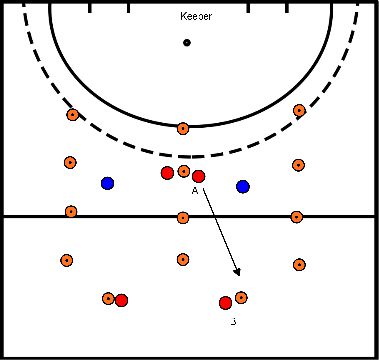
- Defending 2 attackers against 1.
- A passes the ball back to fellow player B.
- From then on, the 2 against 1 begins.
- Tips for the attackers:
- Play over the backhand side of your opponent.
- Do not run too much with the ball but keep passing.
- Make eye contact with your teammate.
- Tips for the defender:
- Keep the Ashes closed.
- Let the attacker make the mistake.
- Stand firm/active.
- Later add that if the defender has taken the ball away that he can score in a goaltending at the side.
- Attackers then have to start switching.
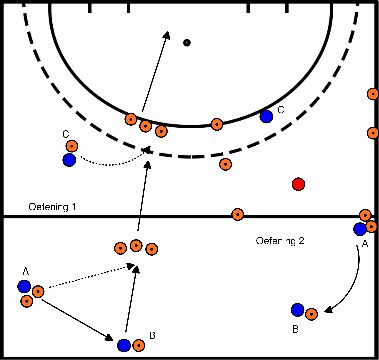
Exercise 1:
- A passes to B
- A runs on to the cones and receives the ball back from B
- A makes a lift action over the cones
- C runs in towards the pawns and receives the ball from A and also makes a lift action over the pawns.
- C finishes with the backhand on goal
- Tips:
- Open up the stick enough when taking the lift action
Exercise 2:
- A gives a high push to B
- B takes the ball and plays a 2:1 together with C.
- They want to score on the big goal.
- If the Defender takes the ball away they may score in the small goal at the side.
- Defender:
- Close up the shaft and push them out
- Stand between the person with the ball and the person without the ball
- You will then close off the pass line
- Attackers
- Create speed
- Over the backhand side of the opponent
- Only pass the ball when the person is really free, otherwise just hold on
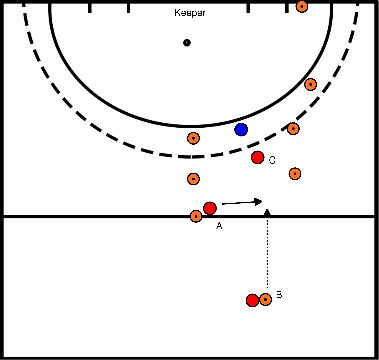
- B runs in towards the circle at speed
- B receives a targeted push from A for B to take him easily.
- From then onwards, the 2v1 starts.
- B and C against the defender.
- When the defender has taken the ball away he can score by driving the ball through the orange gate.
- Tips attackers
- Create speed
- Playing over the backhand side of the defender
- Make eye contact with the team-mate
- Tips for the defender
- Close the gap
- Stand between the pass line of the attackers
- Let the attacker make the mistake
- Set up the exercise on both sides.
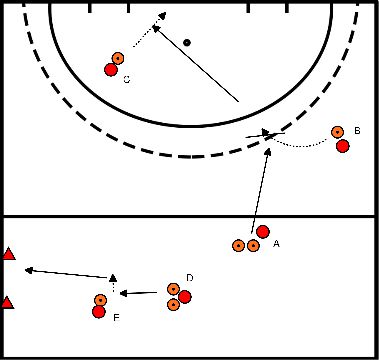
- A starts with the ball and makes eye contact with B.
- B runs in and receives a hard aimed pass from A.
- B takes the ball with an elevator action and controls the ball and accelerates to the circle.
- Lines up the ball and makes a hard pass to the 2 the post.
- C runs in and tips the ball from B into the goal.
- D starts with the ball and has a tightly aimed pass to E.
- Takes it so he can run around the ball and finish right away with a strike.
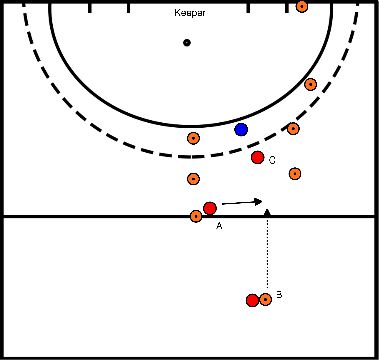
- B comes running in towards the circle at speed.
- He gets the ball from A who gives a directed push for B so he can take him easily.
- From then on the 2v1 starts. B and C against the defender.
- When the defender has taken the ball away he can score by driving the ball through the orange gate.
- Tips attackers
- Create speed.
- Playing over the backhand side of the defender.
- Make eye contact with teammates.
- Use the in-out running.
- Tips for the defender
- Close the shaft.
- Stand between the pass line of the attackers.
- Let the attacker make the mistake.
- Set up exercise on two sides.
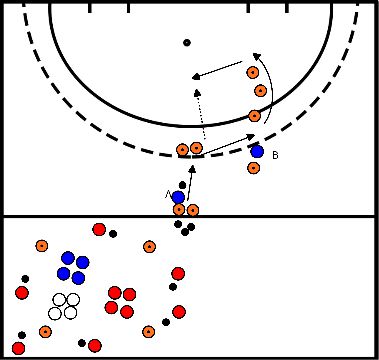
Color game
- Give each player 1 ball
- Set up a box with different coloured squares in it.
- The players dribble around the box
- You call 1 color and they dribble with the ball to the box.
- Passing move + drive
- A starts and drives forward
- At the pawns they make a dummy move and push the ball to B
- B accelerates floating around the pawns
- A runs through and gets the ball back from B
- A shoots at goal with a flat
Offering in depth
- A starts with the ball and gives a push to B
- B receives the ball and sees that C is running in depth
- B gives a push to C
- C takes the ball and shoots at goal with a flat.
- 2v1 with pass in depth
- A starts with the ball and drives towards the pawn
- From then on the defender can try to take the ball away from A
- A and B want to score in the goal together
- Ideally, you want them to run and hit the ball from deep
- Let them try a few times and then explain what you want to see as the coach
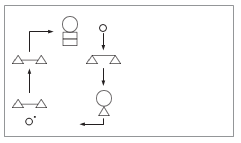
- With the different materials you can make nice courses.
- A course is a fun and fast way to get the children to repeat their skills.
- It is also possible to make courses with a certain theme.
- Possible themes are: drifting, slalom, passing, playing high, making tempo.
- The arrows and traffic signs can be used in all sorts of exercises in a course and in relays.
- Here are some examples of possible courses
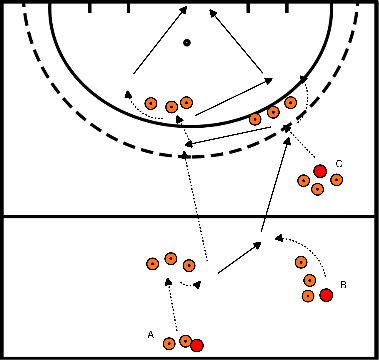
- A starts with the ball and runs up
- Encounters an opponent.
- B runs into the deep and gets a ball of A in the run
- C runs in and gets the ball from B in the run
- C takes the ball and runs towards the circle
- a player encounters an opponent there and passes the ball wide to the run-through A
- A walks in the direction of the circle and makes a choice or makes an action themselves
- Passes the pawns on the left and finishes on goal
- Or they choose to give the ball wide to the right to the run-through C
- Then C shoots at goal
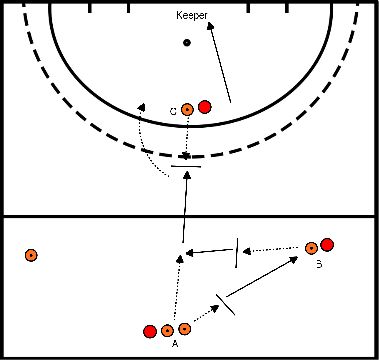
- Exercise with different lift passes.
- A runs to the bar and passes over the bar and gives a pass to B.
- B runs towards the ball and gives a lift pass to A.
- A has gone through to take the ball from B.
- A gives a hard flat towards C.
- C comes in front of the bar and lifts the ball in a movement over the beam bar accelerates towards the circle.
- C ball on the stick enters the circle.
- Aligning ball and shooting at goal
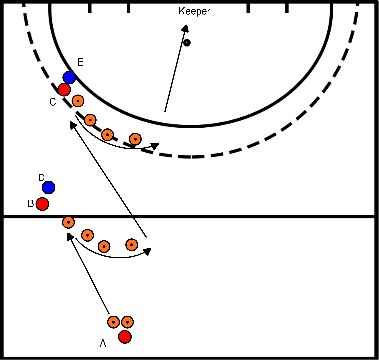
- Exercise expand on both sides
- A gives a push to B
- B takes the ball closed because defender D is in his back.
- B accelerates dribbling with the ball on the stick along the pilons, D runs with B because he doesn't want B to go along.
- D may try to conquer the ball when B has passed the pilons.
- B wants to pass the ball to C. If D intercepts, he passes the ball to C so that the person can continue with the exercise.
- If B gets the ball to C, C will do the same and the defender E will defend. If E picks up the ball, he can finish at the goal.
- How to continue, A goes to the spot of B, B goes to the spot of D, D goes to the spot of C, C goes to the spot of E and E goes to the spot of A.
- Tips for the attackers
- Keep the ball close to you and screen it with your stick
- Pass the ball over the backhand side of your opponent
- Accelerate to make it harder for the defender to stop you
- Tips for the defenders
- Keep your stick on the ground, you can react much faster to what your opponent is doing
- Keep your opponent on the forehand and make sure the line is closed!
- Let the attacker make the mistake and then grab the pass.
- Guide your opponent in the direction where you want him/her to go
- The exercise is meant to simulate a game.
- It is therefore intended that one team consists of the defenders/defending midfielders and the other team consists of the attackers.
- The attackers can score in the normal goal (decide if they can hit high as in the game).
- The defending side can score by driving the ball.
- Over the line of the goals on the half way line.
- The attackers learn to play over and finish at goal and the defending side learns to defend to the outside.
Aim
- Practicing some useful hockey techniques.
Set up
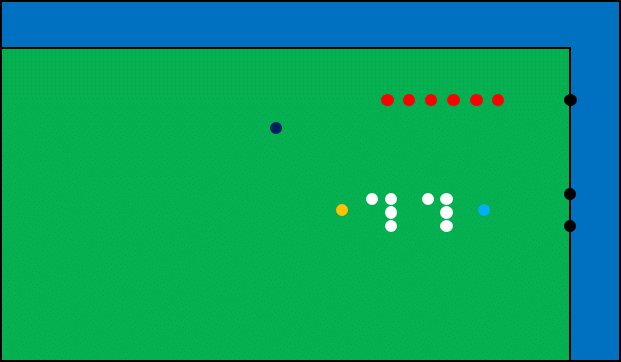
- The player starts at the top black pilon.
- He/she goes through the red slalom and then dribbles towards the (dark) blue pilon.
- From the (dark) blue pilon an Indian will follow
- Dribble to the yellow pilon.
- This is followed by passing moves, in this case a drag has been chosen.
- With other movements, the pilons may have to stand slightly different.
- But here the player runs to the left (end of the L) and drags in front of the 3 pilons the ball forcefully to the right.
- This is repeated again and then the player pushes the ball onto the black goal.
- This exercise can be made easier/complicated. E.g. by changing the passing movements, increasing/reducing the distance of dribbling, making the goal smaller/ larger, adjust the slalom slightly, etc. etc. You can really let your own imagination run wild.
- The trainer (T) rolls the ball (1) to one of the four front players (for example A).
- Player A receiving the ball (2) plays a duel with player V1 opposite him.
- The goal is to score the ball at the opponent's goal.
- If V1 manages to intercept the ball, he plays it to V2.
- Now V2 may try to score with player B.
- After a goal, the form of play starts over again.
Making it easier
- Play a 1-1 duel on the two fields for a few minutes, after a goal, the substitute player comes into play.
Make it more difficult
- After the ball is taken by V1, V1 and V2 may try to score against player A (now it has become a 2-1 game).
- A has to defend.
- If A takes the ball, he plays it to player B.
- Player A and B play a 2-2 duel on players V1 and V2.
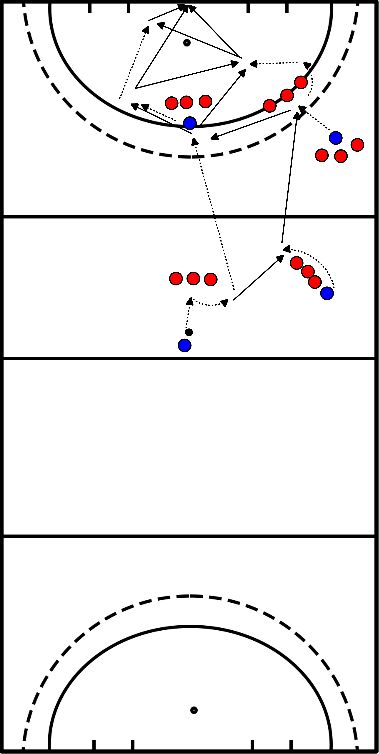
- The centre mid runs in towards the defender (red) he plays the ball to the right half, who runs into the free space
- The centre mid runs forward.
- Right half plays the ball between the defenders to the right front who comes running in between the defenders.
- Front right passes te ball to the left and goes past the defender and runs in the circle.
- The centre mid now has two options that influence finishing:
- 1: he plays the ball to the striker to the left within the circle area.
- Striker plays directly on goal OR crosses to the right front (and runs towards the front of the second post).
- 2: he plays it to the right of the central defender on the right front player.
- Right front attempts to shoot directly on goal OR passes towards to second post, striker tips it in.
- 1: he plays the ball to the striker to the left within the circle area.
- Tip: Because the game can change depending on choices, communication is key!
- Indicate where you want the ball and shout to whom you are playing it!