




Hockeyexercises for technique positional play
Last update: january 2026
Execution
- Balls start at the first cone. The first player passes the ball on the run to the second cone.
- The second player pushes the ball through the cones to the third player.
- The third player runs onto the ball and continues his path.
- Then he pushes the ball to the fourth player on the run.
- The fourth player runs around the cones and passes the ball to the top of the circle.
- The fifth player has moved to the top of the circle to finish the ball directly into the goal.
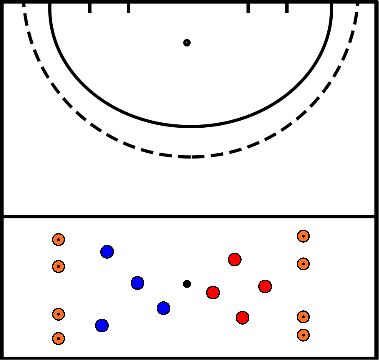
Party with four goals.
- The coach makes two equal teams.
- Each team defends two goals.
- It is allowed to play field hockey behind goal, but scoring is only allowed at the front.
Points of attention:
- Play with the 3 second rule; take the ball quickly after a foul. Takes longer than 3 seconds, free hit for the opposing team.
- If it is crowded on one side of the field, move the ball at pace to the other side where there is more space.
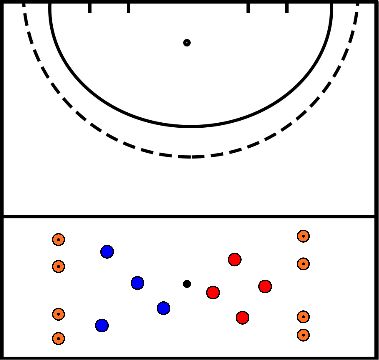
Party with four goals.
- The coach makes two equal teams.
- Each team defends two goals.
- It is allowed to play field hockey behind goal, but scoring is only allowed at the front.
Points of attention:
- Play with the 3 second rule; take the ball quickly after a foul. Takes longer than 3 seconds, free hit for the opposing team.
- If it is crowded on one side of the field, move the ball at pace to the other side where there is more space.
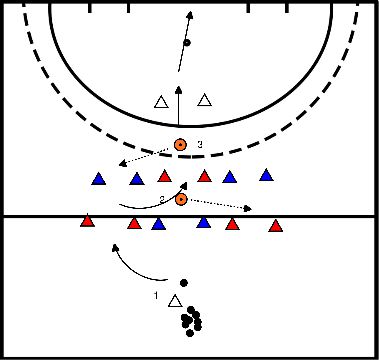
- The ball starts at the player to 1.
- The player at 1 chooses one of the three gates and wants to run through it.
- The defender at 2 may close a gate by standing in it.
- As a result, player 1 must make choices to go into an open gate.
- When player 1 walks through a gate, he does the same at the second row of cones, does the defender take the ball away? Then he gets to finish the course by himself.
- When you have passed through the two rows of gates, you may finish on goal.
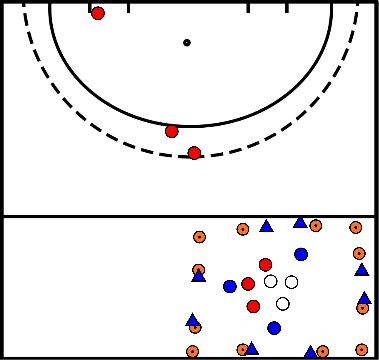
- Divide your team into 3 teams of 3.
- You are going to play 3 against 3.
- One team wants to start scoring by playing the ball against the tires.
- By keeping the ball pace high, you can play around the defenders.
- The defenders want to drive the ball through one of the blue gates.
- If the attackers play against the tire they switch with the team standing to the side, the defenders stay put.
- If the defenders play through the gate then the defenders go out and the attackers become the defenders and the new team will attack.
- If you have too many players then you can practice the attacking penalty corner
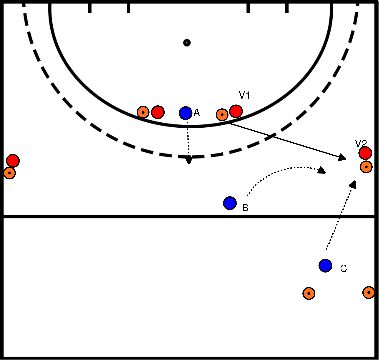
- V1 pass the ball to V2
- A.B,C are going to run the press together and make sure that V1 and V2 cannot put the ball in the goal
- A makes sure that the ball cannot pass through the axis and thus drives to the middle
- B runs the ball in the right direction and starts to put pressure on V2 from the side
- C is a bit further back so they dare to play the ball to V2 and when the ball is passed together with B he presses on the ball and makes sure it cannot go past the line
- When they have conquered the ball, the 3 of them build up to score a goal
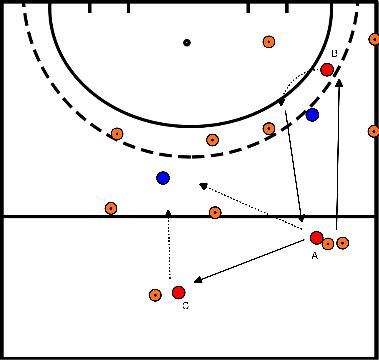
- A starts with the ball and plays it to B (defender is not allowed to intercept)
- B then wants to play the ball back to A (defender is allowed to intercept)
- When A has the ball again, he plays it back to C
- C takes the ball and plays a 2v1 with A who has run on
- Tips for attackers
- Keeping speed in your play
- Play over the backhand side of the opponent
- Look where your teammate is standing
- Tips for defenders
- Push them to the outside
- Close the passing line between the attackers
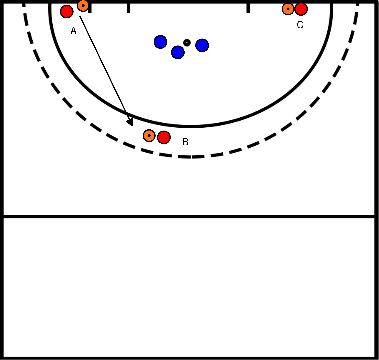
- A starts with the ball and first plays the ball back to B.
- When B has accepted the ball the 3v3 starts and the defenders may start to pressure.
- Tips for the attackers:
- Use the exercise of switching the strikers
- Only play the safe ball
- Remember the 4 squares in the circle
- Tips for the defenders:
- Keep your man in the circle
- Push them to one side
- Always put pressure on the ball (i.e. don't let them shoot)

- Party form with 2 teams and 1 goalkeeper.
- If there's an odd number of players then make 1 player (preferably a midfielder) a neutral player who always belongs to the BB team.
- The right of attack is taken over the 23 meter line by playing three times.
- The right of attack is lost only when the other side has reached the right.
- An interception does not change this.
- 3 cause penalty corner is a penalty ball (goal is to focus on effectiveness in the circle).
- 2 x 10 minutes with 5 minutes rest (match situation).
- Each team can be given an assignment such as full press / half court / put pressure on certain player when he gets the ball to improve strategy and coaching among themselves.
- Provide enough balls along the lines so that there can be a high ball tempo.
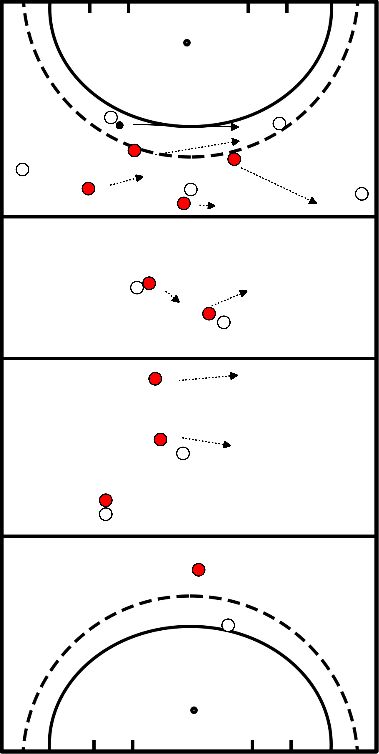
- full press:
- defend the inside areas
- force them to go wide
- Center striker: responsible for the 2 center backs,
- start on 5 m and inside,
- when they pass wide close them to that side
- Left and right forward: responsible for the right and left back,
- defend the inside and force them to pass or walk down the line
- Mid: man to man marking
- Lm and Rm: man to man and when they force the player to walk down the line block them in a double with the forward
- Right back and left back: man to man marking and intercept when they pas down the line
There is a square just outside the 23 in the middle.
3 teams between 4 and 6 players.
- Team A starts attacking from the right, trying to score;
- Pay attention to scoring positions (guard, spot, 2nd pole);
- If team A scores, the coach throws in a bonus ball
- If the ball goes out, it is for team B(defence)
- Team B's task is to play into team C's position;
- Team C then moves the ball to the right and starts attacking.
- Team A then goes to defend
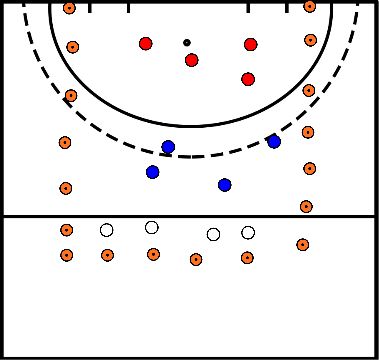
- Game with the three teams,
- Make three equal and fair teams.
- A team starts as the defenders (on the picture the red one).
- A team starts as the attackers (in the picture the blue one)
- a team behind the 23 meter line (on the picture the white one)
- For the defenders the intention is to pass the ball to one of the white ones in the box at the 23 meter line.
- For the attackers the intention is to score.
- When they have scored they get 1 point
- For the team behind the 23 meter line, they are supposed to take the ball as the defenders take it to their pass.
- If the ball is with the team that is behind the 23 meter line their attacks will start.
- The team that was attacking and the team that was defending will be in the box behind the 23 meter line.
- In this way, it keeps on turning.
- The one who gives the most points at the end wins.
- Tips for the attackers
- Play the freeman when you are in possession of the ball and make sure that someone runs deep into it
- Pass over your opponent's backhand side
- If you are not in ball possession make sure you close the lines to the people in the box behind the 23 meter line.
- Tips for the defenders
- Make sure you are defended outside the circle so that they can't pull out
- Keeps track of your own male
- Close the backhand side so they can't pass over it.
- If you do have the ball look up the space and keep passing until there is a hole and you can give it to the people in the box.
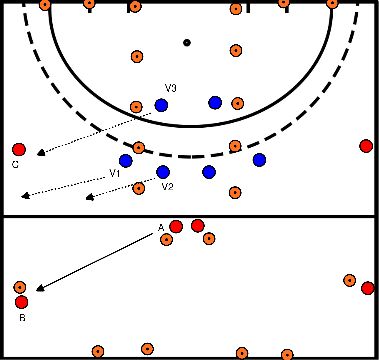
- Further practice with half court press.
- The goal is that they realize what to do when the ball is passed.
- How are we supposed to walk as a front runner.
- Ball starts at A
- The 3 defenders will stand in such a way that the line is closed and so the ball can only be passed to the sides or back out.
- A gives the ball towards B because the line is closed.
- Now comes what the whole exercise is about what the 3 defenders should do now.
- V1 slides so that it is in front of the ball so that the ball cannot be given straight forward.
- V2 stands between the person with the ball and the ball goal line
- V3 which dribbles to the attacker C who comes closer. V3 prevents C from getting the ball and defends on the inside. between the opponent and the goal.
- From here on it is a 3:3
- On the other hand it is exactly the same and discs the defenders the same.
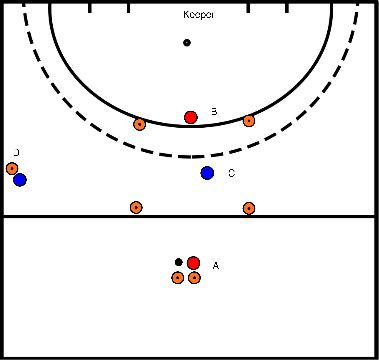
- Attack through the middle which starts with a 2:1
- B is a deep man starting in the circle. A starts with the ball and together with B he wants to complete the goal.
- C wants to slow down the game and close the pass lines so that D gives the time to come and help him.
- Goal of attackers:
- Ball pass over the opponent's backhand side.
- Playing a fellow player on the forehand
- Making eye contact with your fellow player
- Speed making
- Goal of the defender
- Float your opponent to your forehand (your backhand side must be closed)
- Accompany your opponent
- Slow down the game so that D gives time to come and help you
- When D has arrived, one goes on the deep man and the other puts effective pressure on the opponent and waits with the ball take away until the opponent makes the mistake.
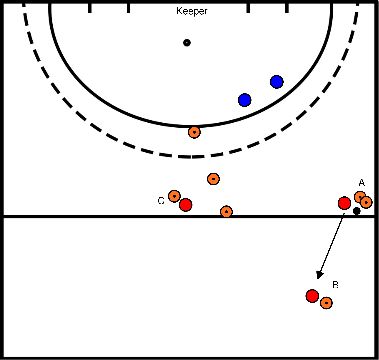
- An extension to the exercise of an attack over right under defenders.
- The goal of the exercise is that the 3 attackers want to get past the two defenders in an effective way.
- First have them do it again a number of times. After that the exercise that they have done for this purpose will come back.
- This is exactly what they have to do, only now there are defenders and they have to watch even more and give the safe pass.
- The first ball of A always goes back and from there they can build up.
- It then becomes a 3:2
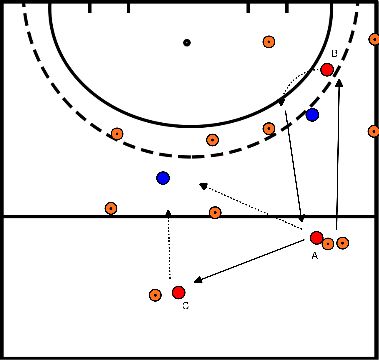
- A starts with the ball and plays the ball to B (defender must not intercept)
- B then has to play the ball back to A (defender may intercept this ball)
- When A has the ball again he plays it back to C
- C takes the ball and plays a 2 against 1 together with A who has ran through
- Tips for attackers:
- Keep speed in your game
- Play over backhand side of opponent
- See where your fellow player is standing
- Tips for Defenders
- Push them to the side
- Close the pass line between the attackers.
Aim
- A game is not only fun, you also learn a lot from them.
Set up
- Very simple: 2 goals, some vests and some balls.
- Surely no more explanation is required?
- This kind of game isn't really for training something specific (e.g. playing outside with a box in the middle), but just to have fun.
- If a team goes loses way too easy, you can enter the rule that they have to pass 3 times before they can score.
- Or you can make that team's goal smaller.
INSTRUCTIONS
- 2 teams
- 5 players per team
- 3 goals per team
- 2 yellow independent goals in the centre of the pitch
- Game: team blue against team red.
- Team red scores at one of the 3 blue pilons and team blue scores at one of the 3 red pilons.
- When the ball goes through one of the two yellow goals, the goals turn around.
- Team blue scores at the blue pilons and team red scores at the red pilons.
- When the ball goes through one of the yellow goals again, it turns around again.
AREAS OF CONCERN
Ball possession Take a good look at which of the 6 goals there's a lot of free space
Not in ball possession Trap the player with the ball from multiple sides
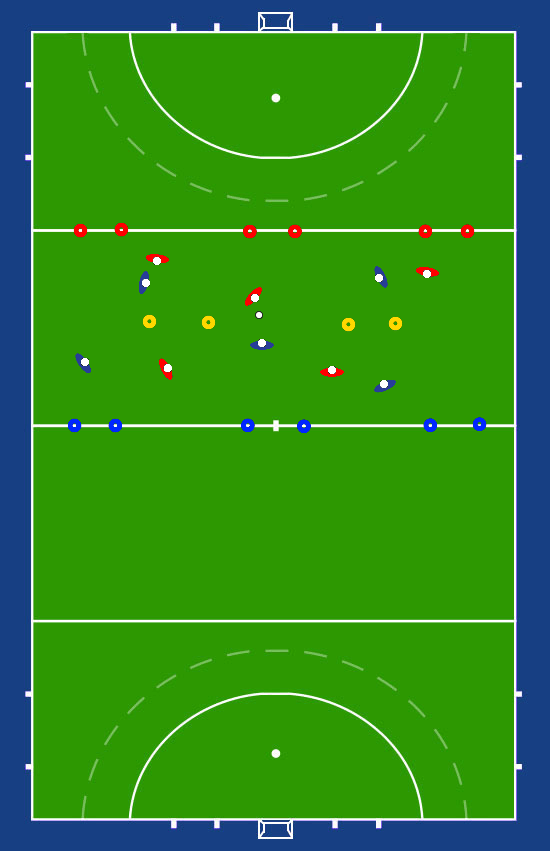
- Balls are at the first pilon.
- The player at the first pilon passes the ball to the second pilon,
- who pushes the ball through the pilons to the third person.
- The third person runs in on the ball and runs even further,
- then he pushes the ball to person 4 while he's running.
- Person 4 runs around the pilons and passes the ball at the top of the circle,
- where person 5 has just run up to finish the ball in the goal.
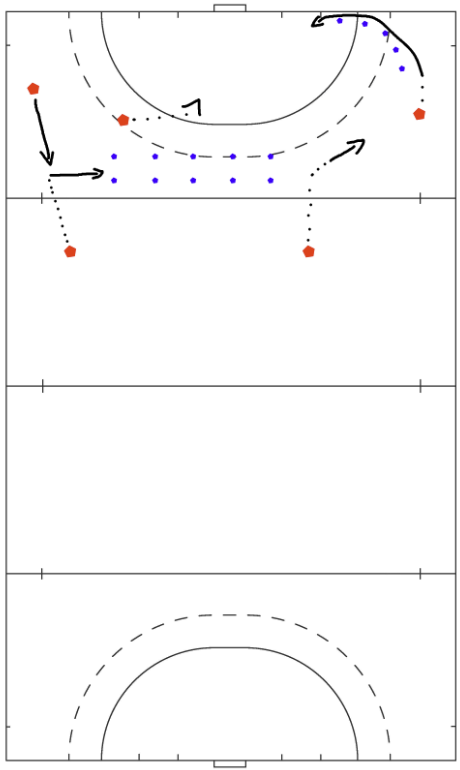
- You start with 3 teams, A, B and C.
- The game will be played on about half a field,
- the ball divider/referee is in the centre of the field in a marked square,
- this square can't be played through.
- There is a goalkeeper in the goal and two goals on the half way line.
- Team A starts defending,
- team B is attacking,
- team C is divided over the 2 small goals.
- Team A has to make sure the ball reaches team C.
- At this moment team B is defending and attacking team C.
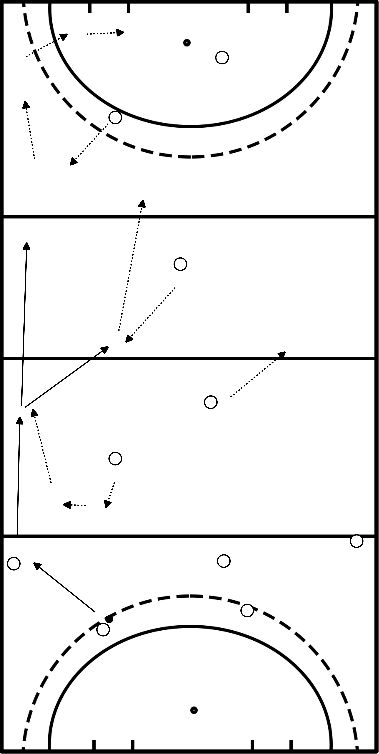
- defenders:
- 4 man build stretch the field and dare to play forward
- center mid; postion offset that means always be on the other side as the ball ( always help side )
- Lmid and Rmid: start small and not on the same hight, lead outside and get the ball on the line moving forward (help side mid open up)
- center stricker: start up high and make a lead into the ball when the LMid or Rmid is leading outside
- Left forward and right forward: lead outside and move back inside if you get the ball. if you dont get the bal lead forward and inside.
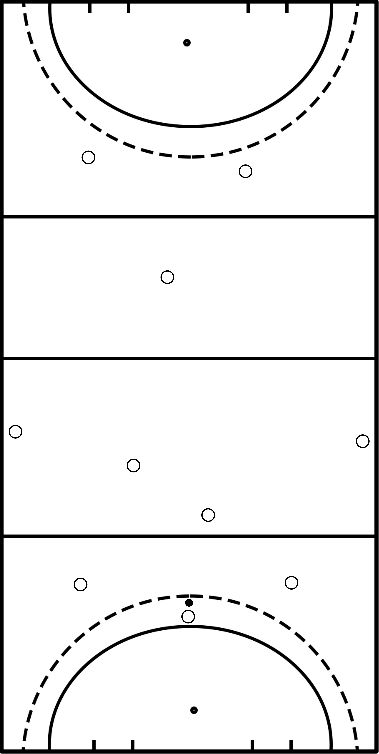
- Defender:
- central free defender moves into mid field, Left and right back come more inside
- center mid; move up a bit so the central defender has more space
- LM and Rm : open the field as wide as possible
- Center striker : connect with the CM mid or RM and LM
- Left and right forward: stretch the field
- Zone :
- if the opponent plays zone marking you can try to play inside or trow a high ball wide into space man to man:
- play inside drop and bite and go asap wide. look for the 2-1
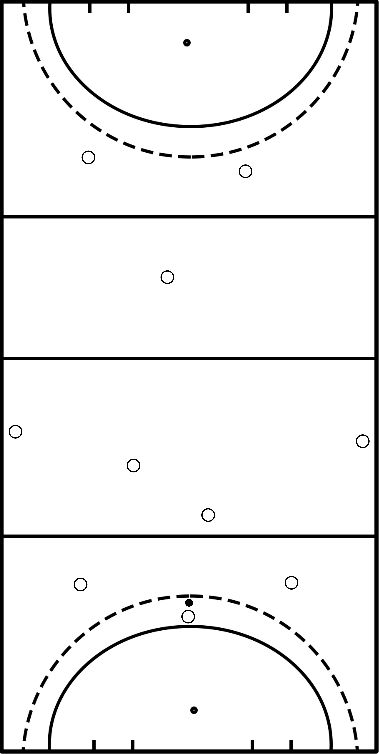
- Defender:
- central free defender moves into mid field,
- Left and right back come more inside
- center mid; move up a bit so the central defender has more space
- LM and Rm : open the field as wide as possible
- Center striker : connect with the CM mid or RM and LM
- Left and right forward: stretch the field
- 5 man build is the same only difference is that the central mid is dropping in to the defense line
- Zone :
- if the opponent plays zone marking you can try to play inside or trow a high ball wide into space
- man to man:
- play inside drop and bite and go asap wide. look for the 2-1