




Hockeyexercises for seniors
Objective
- Quickly transition between attack and defence.
Setup
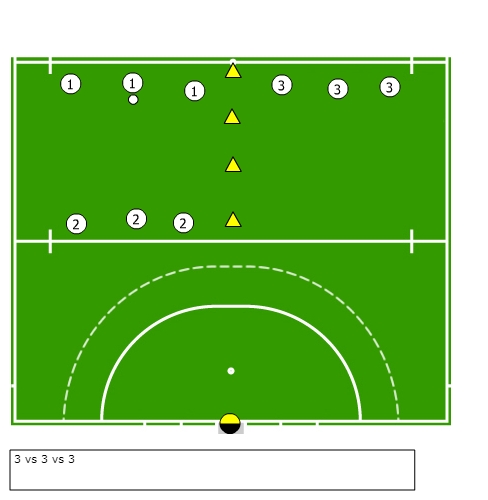
- The field between the 23-metre line and the centre line is divided into two parts.
- There are three teams of 3 players each.
- Two teams play against each other, while the third team has a rest period.
- Team 1 and Team 2 play against each other: The objective of Team 1 is to score. The objective of Team 2 is to get the ball to Team 3.
- When a goal is scored, the other team must switch to defence for the next game.
- Example: Team 1 scores against Team 2, then Team 2 plays as the defensive team against Team 3.
- When Team 2 intercepts the ball, they pass it to Team 3.
- Team 3 starts the attack on Team 1 as soon as they receive the ball.
- Team 1 then transitions from attack to defence.
- Team 2 takes the place of Team 3 and waits for the game between 3 and 1 to conclude.
Variations
- The number of players per team can be adjusted.
- The field can be made narrower.
Key Points
- The game should continue as much as possible.
- As a coach, it is helpful to have enough balls on hand to support the game.
- To seek the flanks instead of hitting the ball through the centre of the field. Teams look for solutions and are inclined to shift the game. This increases the percentage of ball possession.
- Two teams are formed, depending on the number of available players. In the middle of the field, there is a square or rectangle where neither the ball nor the player may pass through.
- Adjust the size of the square or rectangle to change the level of difficulty. The larger this area, the more challenging it becomes.
- You can agree that players may run through the area, but the ball may not pass through it.
- Ensure there are no items in the area and use flat cones to prevent tripping.
- With an odd number of players, you can play with a 'chameleon'. This player always joins the attacking team and thus constantly changes roles.
- Place balls at the side of the field so that when a ball is out, a new ball can be immediately picked up to continue play.
- As a trainer, stand in the middle of the field and coach both teams.
- As attack: achieve efficiency from your attack.
- As defense: execute clever defensive plays.
- The field is limited to the dotted line.
- The attackers take the ball somewhere on the dotted line and try to score.
- The defenders attempt to clear the ball via the outside.
- The attackers score 3 points for a goal, 2 points for a forced penalty corner, and 1 point for a good scoring opportunity.
- The defenders earn 3 points when they clear the ball by playing between the cones, 2 points for a free hit, and 1 point when the ball goes over the sideline.
- Adjust the size of the teams based on the number of available players.
- Play with one team on the side and switch every 2 to 3 minutes to facilitate rest and discussion.
- Make the cones for the defenders smaller.
- Use a 'chameleon' to give the attackers a numerical advantage if scoring is difficult.
- Ensure clarity on who is marking which opponent.
- Defenders must stay low and avoid fouls.
- Attackers should actively seek a foot.
- As an attacker, target the opponent's backhand; an attack on the right side is often easier.
- Defenders should assist in defending if their direct opponent is not active.
- A2 plays the first ball to A3 who is going to score after a trick play,
- The second ball then goes from A1 to A2 who takes it in stride and speeds up.
- And when the defender runs along, a left handed lift (reverse if not possible) and passes to A3 on the backline,
- Who also lifts with forehand and then makes the choice:
- at right angles, header, penalty spot
- or via A2 to two post for A1.
- Defenders can score in p1 and p2,
- Change after three goals.
- 2 x 2 defenders.
Emphasis is on good footing during takeovers and being able to accelerate and lift, scan the surroundings of the ball and time the ball well and keep the body in between.
Goal
:As an attack is to get the most out of your attackAs a
defense is to defend smartly.
Set-up:
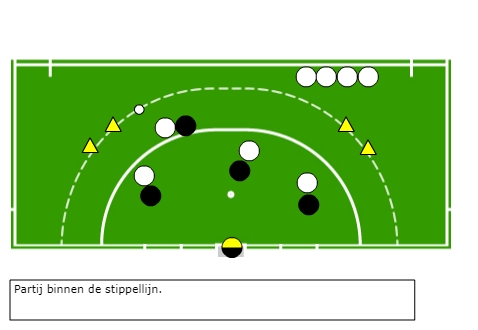
- The field is up to the dotted line.
- The attackers take the ball from somewhere on the dotted line and must try to score.
- The defenders must try to defend the ball from the outside.
- The attackers score 3 points when they score; 2 points when they force a corner and 1 point when they have a good scoring chance.
- The defenders get 3 points when they defend the ball by playing in between the pawns; 2 points when they get a free hit and 1 point when they manage to play the ball over the touchline.
NB When defenders score, the ball does not have to be run between the pawns or accepted behind the pawns.
Variations:
- Adjust the size of those teams according to the amount of players available. You can also have one team on the sidelines and play a 2 to 3 minute game each time. That way there is a break and the players have time to discuss and analyse.
- The scoring pawns for the defenders can also be made smaller.
- You can play with a 'chameleon' and thus give the attackers an overtal when scoring is not going well.
Points of attention:
- Make sure it is clear who is picking up which man.
- As defenders, try to keep a low profile and prevent fouls.
- As the attackers, try to actively look for a foot.
- Look for opportunities to double-team When you, as the defender, realise that your man is not being active enough in the attack, help your buddy defend and push the attacker into a corner
- As the attacker, look for the backhand of your opponent. A right-wing attack is therefore often easier to execute than the other way around
Goal
:To be able to quickly switch between offense and defense.
Format
:The field between the 23m line and the halfway line is divided into two parts. There are three teams of 3 players. Two teams play against each other, the remaining team has a break.
- Team 1 and 2 play against each other. Goal of team 1 is to score, goal of team 2 is to get the ball to team 3.
- When one team scores, the other team has to start the next game as defender. E.g. Team 1 scores against team 2, then team 2 plays as defensive team against team 3.
- When team 2 has taken possession of the ball, they play it to team 3. Team 3 starts attacking team 1 as soon as they receive the ball. Team 1 must then switch from attack to defence. Team two now takes the place of team 2 and awaits the play between 3 and 1.
Variations:
- The number of players per team can be adjusted.
- The field can be made narrower.
Points of attention:
- The game should continue as much as possible. To do this, it is useful to have a lot of balls with you as a coach so you can throw them into the exercise.
Purpose
:The purpose of this exercise to learn how to link up with a defender to create space for your teammate.
Set-up:
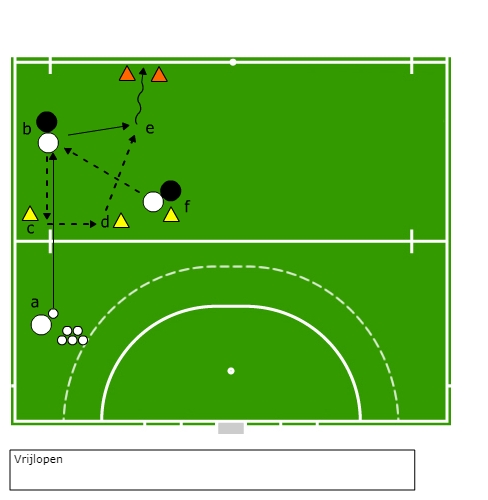
- The player at B runs in from point C to point D. From there he runs towards point E.
- When the player coming from point B passes station C, the player from F runs towards point B.
- The player standing at A passes the ball to the player coming from F.
- The player who receives the ball plays the ball on towards point E.
- From point E the ball is driven through the pawns.
- Turning around goes as follows. The player coming from F stays on point B. The player from B goes to point A and the player from A goes to F. The defenders only turn around; B goes to F and F goes to B to defend.
Variations:
- The exercise can also be performed in mirror.
- The exercise can also be played in the direction of the goal with the intention of scoring.
- The exercise can be played with or without defenders.
- The defenders can defend passively or actively.
- The exercise can be linked to the exercise "Overtal on take-off". This also changes the passing game!
- The player who receives the ball from A can also pass the ball to increase speed.
- The players from F can also make a sprint, the one who can take the ball can pass to E.
Points of attention:
- Defending can quickly become boring.
- If the pass from A is not going well, make the distance smaller.
Goal
:As an attack is to get the most out of your attackAs a
defense is to defend smartly.
Set-up:
- The field is up to the dotted line.
- The attackers take the ball from somewhere on the dotted line and must try to score.
- The defenders must try to defend the ball from the outside.
- The attackers score 3 points when they score; 2 points when they force a corner and 1 point when they have a good scoring chance.
- The defenders get 3 points when they defend the ball by playing in between the pawns; 2 points when they get a free hit and 1 point when they manage to play the ball over the touchline.
NB When defenders score, the ball does not have to be run between the pawns or accepted behind the pawns.
Variations:
- Adjust the size of those teams according to the amount of players available. You can also have one team on the sidelines and play a 2 to 3 minute game each time. That way there is a break and the players have time to discuss and analyse.
- The scoring pawns for the defenders can also be made smaller.
- You can play with a 'chameleon' and thus give the attackers an overtal when scoring is not going well.
Points of attention:
- Make sure it is clear who is picking up which man.
- As defenders, try to keep a low profile and prevent fouls.
- As the attackers, try to actively look for a foot.
- Look for opportunities to double-team When you, as the defender, realise that your man is not being active enough in the attack, help your buddy defend and push the attacker into a corner
- As the attacker, look for the backhand of your opponent. A right-wing attack is therefore often easier to execute than the other way around
Goal
: Searching for the flanks instead of passing the ball through the middle of the field. Teams will look for solutions and tend to shift the game. The % of ball possession will also go up.
Set up
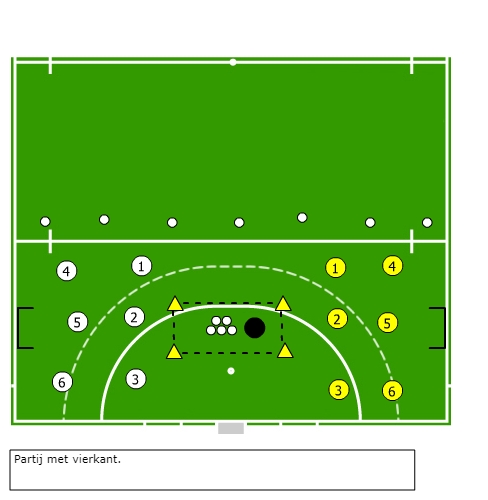
:Two teams are made. The size of the teams depends on the number of players available. In the middle of the field there is a square or rectangle which marks where both ball and player may not pass.
Variations:
- You can change the size of the square or rectangle to adjust the difficulty. The bigger this field, the more difficult it becomes.
- You can agree that you can walk through the field, but that the ball cannot pass through.
NB Make sure that there are no objects in the box and preferably use flat cones to prevent tripping up. - If there are an odd number of players, you can play with a 'chameleon'. This player will join the attacking team and change roles all the time.
- Place balls at the side of the field, so that when a ball is out, a new ball can be picked up to continue play.
- As trainer, stand in the middle of the field and coach both teams.
Two teams with substitutes, substitutions are made when a goal is scored.
Each person defends a goal, on each field there are 5 goals, so there are also 5 people who defend these goals.
If a goal is scored in your goal, you have to sit on the sidelines and you are changed. A new player (substitute) from the side enters the field and will defend the goal.
If a goal is scored, it is 1 point. The team with the most points at the end of the game is the winner.
Variation:
First 1 ball, then several balls in the field.

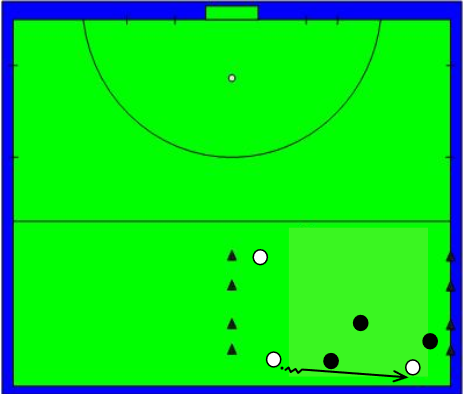
The pass to the right goes diagonally forward and over the backhand side of the defender, the pass to the left you play wide and goes over the forehand side of the defender.
Therefore the pass to the right is preferred over the pass to the left.
- Put out the columns as shown in the figure
- Spread the balls over pylon C and D.
- In this exercise you place a player at pylon C and D.
- The rest of the team will line up at pylon A.
- From A onwards, the player walks around the pylon
- From the post, the player makes a sideways movement facing the ball (facing C).
- Player C plays the ball in the forehand of A
- A takes the ball and turns right open
- A runs in the direction of the circle and finishes at goal.
- From here he runs to D and receives another ball.
- The player turns open to the left and finishes on goal again.
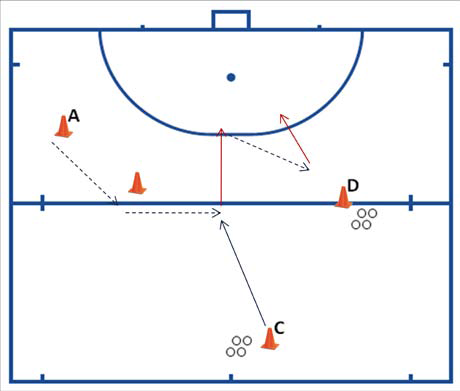
- Put out the pilons as shown in figure three, distribute the balls over pilons C and D.
- In this exercise you place one player each at pilons C and D, the rest of the team will line up at pilon A.
- From A the player runs around the pilon, from the pilon the player makes a sideways movement facing the ball (facing C).
- Player C plays the ball in the forehand of A, A takes the ball and opens to the right, runs towards the circle and finishes at goal.
- From here, he runs towards D and receives another ball.
- The player spins open to the left and finishes on goal again.
- Place all the hoops in the room (islands).
- On the outer side of the square, dribble with the ball to the left, dribble to a hoop and stand in it with the ball.
- Dribble around the corner to the right
- On the trainer's sign, dribble inside the square around 5 different hoops, counterclockwise.
- change the number of hoops
- always go to a different color hoop
- All children dribble with the ball in a designated area.
- The trainer is 'mother/ father'.
- Regularly the children ask: "Mother what time is it?"
- If the mother mentions a random time, the kids just keep driving the ball.
- But when mother answers, "It's bedtime", all the children try to get out of the area as quickly as possible before they are tagged by the mother.
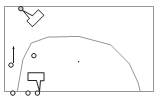
- Put the pilons as shown in the figure
- Spread the balls over pilons C and D.
- In this exercise you place a player at pilons C and D.
- The rest of the team will line up at pilon A.
- From A onwards, the player walks around the pilon
- From the post, the player makes a sideways movement facing the ball (facing C).
- Player C plays the ball in the forehand of A
- A takes the ball and turns right open
- A runs in the direction of the circle and finishes at goal.
- From here he runs to D and receives another ball.
- The player turns open to the left and finishes on goal again.
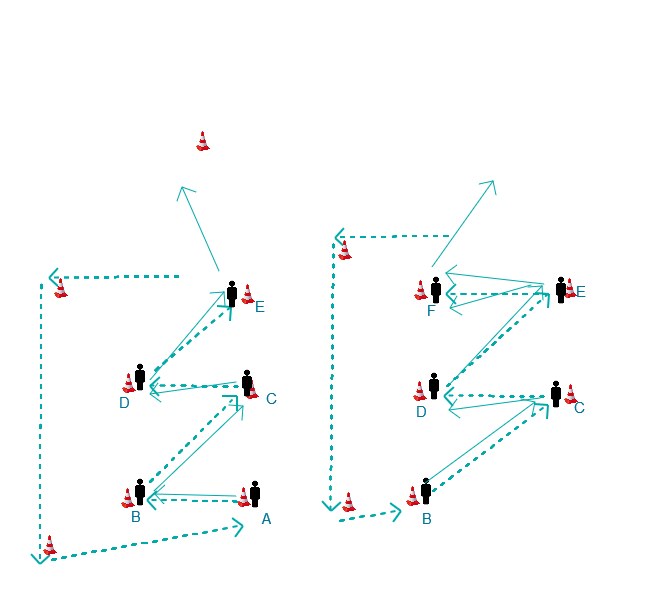
Passing and scoring
- Each pilon has a player on it.
- Player A plays wide to the left to player B and chases the ball.
- Player B plays the ball diagonally to the right to player C and chases the ball
- Player C plays wide to the left to player D and chases the ball
- Player D plays diagonally to the right the ball to player E and chases after the ball
- Player E takes on and scores with flat / stroke
- Player E continues to the left around the extra pilons (out of practice) back to position A
Variation:
- Balls start on the left from position B (pilon/position A is omitted), before that a pilon is added to the edge circle (position F).
- player 1 plays the ball from position B diagonally to the right to player 2 at position C and chases the ball
- Player on C plays wide to left to player in position D and chases after the ball
- Player in position D plays the ball diagonally to the right to player E and chases after the ball
- Player in position E plays wide to the left to player in position F and chases the ball
- Player in position F takes on the fh or high bh and scores with a (backhand) stroke and
- Runs outside the exercise to start position (B)
Variation 2:
- 2 rows of players behind pilons A and B
- Player 1 plays the ball wide to the left and runs straight to position C
- player 2 takes the ball and plays player 1 diagonally to the right in the fh while running (towards position C) and runs straight ahead towards position D.
- player 1 takes the ball in the fh around position C and plays the ball wide / backwards back to player 2 (towards position D) and runs to position E
- player 2 takes the ball (preferably with fh) and with foot position in direction E and plays the ball diagonally forward back to player 1 (direction E: rather just in the circle / edge circle than behind player 1)
- player 1 takes on and strikes / fats as fast as possible towards goal (do not bring the ball back) and runs outside exercise back to position B
Variation on 2:
- After that player 2 has delivered the ball to player 1 the 2nd time / last time, he / she becomes (passive) defender at the next set
- the defender is not allowed to go into the circle (or rather not even behind the line (position C/D) from where he/she started (position D)
- takes off the ball then floats over a line between position A and B.
- The 2 players that come up stay inside the box (width of pass lines) but are free in construction, they may also cross behind, cross over but no passes in the air (no lifts).
- the No. 1 scores and, just like the defender, runs outside back to another position. The No. 2 becomes defender
Accents:
- hands apart while controlling
- foot positioning open
- control it for a follow-up pass or even a quick bounce back
- Score after 2 contacts (control, max 1 other touch)
- see hands/feet position/distance from the ball at hitting and flats accents
- https://www.youtube.com/watch?v=O5W-zK1tptw
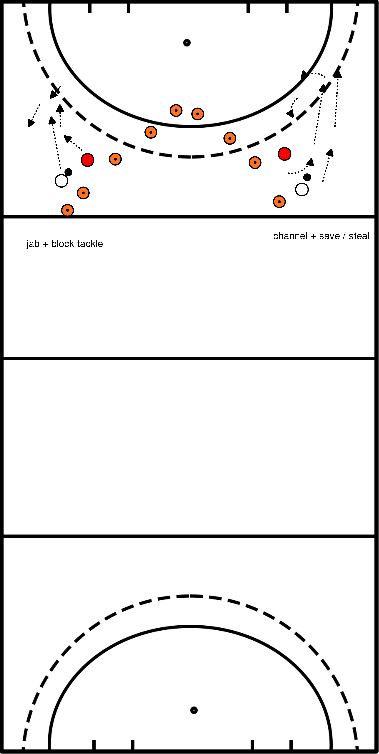
- jab: take your stick in your left hand and poke the bal or close to the ball to put pressure on the bal.
- left food forward right food back
- move quick forward and back
- forse them to one side ( FH side)
- channel:
- pick up the speed of the attacker
- change body postion to force them outside
- follow the attacker and make a steal Fh or save backhand
- block tackle:
- step in to the bal
- sit low with your stick on forehand side
- mostly after jab you block tackle