



Tennisexercises for technique forehand
Objective
- The student is able to execute forehand and backhand techniques in various ways in both doubles and singles play.
- Identify the principles that apply when constructing a point.
- Independently initiate and maintain game and practice forms.
- Participate in the lesson with attention and understanding, focus, diligence, and determination.
- Collaborate and communicate effectively.
- Apply knowledge of the rules.
Introduction
- The trainer briefly discusses the previous lesson: what did we do and what have you learned?
Technical Focus
- Zoom in on forehands and backhands.
Tactical Focus
- Construction of a point.
- Positioning in doubles.
- Collaboration and communication.
Execution
- Try to rally in pairs.
- Create space and hit the ball into the open space.
- Experiment with hitting harder, taking the ball earlier, and deliberately slowing down the game.
Variation
- Use different court lengths to experience how hard, soft, high, low, deep, or shallow the ball should be hit.
Rotation
- After the ball is hit incorrectly twice, the pair swaps with the waiting pair.
- Waiting students can monitor the task and participate mentally.
Execution
- The players stand in the centre of the court.
- One player delivers the ball using their foot, ensuring the ball bounces in a service box.
- The other player is required to approach the net.
- For a lower level: do not approach the net.
Execution
- Four balls are randomly fed.
- After each ball, the student must move around the cone using a sidestep.
- Move from back to front.
- The four cones are lined up one after another within the doubles lines.
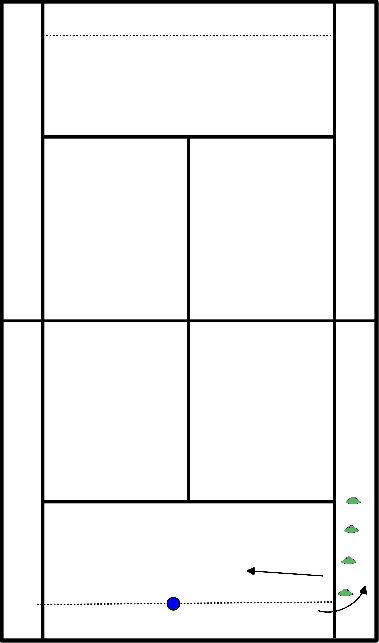
Execution
- Four balls are randomly indicated.
- There is a cone on each side of the court.
- For a forehand, the forehand cone must be tapped.
- For a backhand, the backhand cone must be tapped.
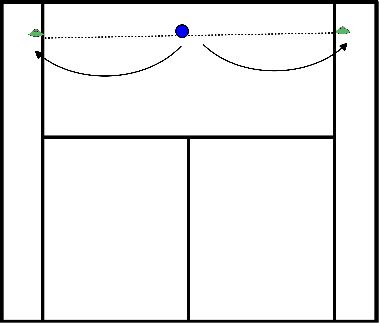
Execution
- Obstacles are placed on the opposite side of the net.
- The players throw balls and try to knock over as many obstacles as possible.
Execution
- There are 10 cones distributed across the court.
- Players take turns attempting to hit a cone.
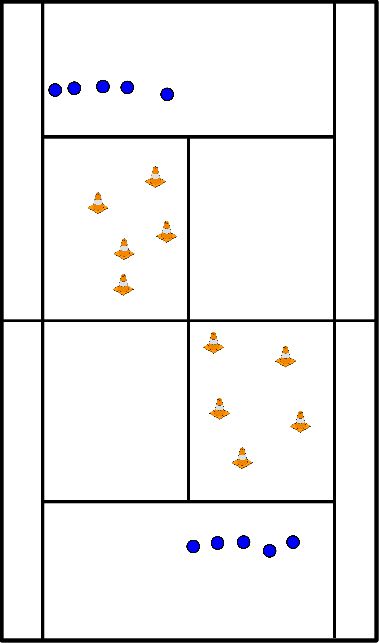
Execution
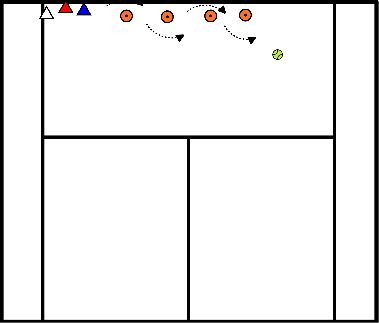
- The player zigzags as quickly as possible with their face towards the net between the cones.
- The next player may start when the player in front of them is halfway through.
- The trainer throws a ball forward.
- The player must hit the ball back with a forehand after one bounce at the end of their sequence, then with a backhand.
- Hop on the left or right foot.
- Circle around each cone.
- Jump over the cones with both feet.
- Same with backhand on the other side, throwing and starting.
Execution
- Place the ball on the racket and let it roll over the strings without letting it fall off.
- Keep the ball on the racket while touching the floor, sitting down, standing up, hopping, and running.
- Try to keep the racket at chest height.
- Throw the ball up with the racket and catch it again with the racket.
- Throw the ball a little in front of you, run after it, and catch it again with your racket.
- Throw the ball up, let it bounce once, and then catch it with the racket.
- Keep hitting the ball upwards without catching it and try to walk around while hitting the ball upwards.
- Who can do this without mistakes and without touching anyone?
Closing the lesson: doubling
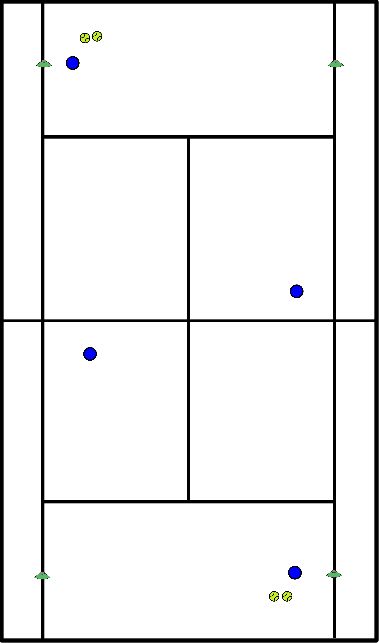
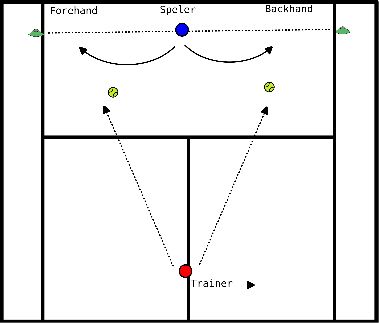
- Four balls are indicated at random.
- There is a pot on each side of the court.
- If a Forehand is played, the Forehand pot must be tapped.
- If a Backhand is played, the Backhand pot must be tapped.
The children themselves play the ball up underhand or overhand and try to rally straight through the amount indicated on the game cards.
- A 4 is four passes
- A picture (jack, queen and king) counts for 5
- An ace is for 2
- A joker is a lucky card, they just have to play on that, as it counts for 1. It must be in, of course.