



Basketballexercises for technique defense
Execution
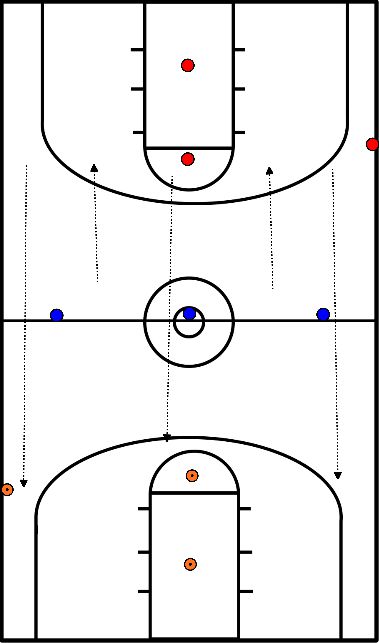
- 3 attackers against 2 defenders, with rotation each time.
- The defenders must help each other if an attacker is unmarked.
- The attackers learn to take advantage of a numerical superiority and finish.
- Improve speed, accuracy, good passes, and teamwork.
Execution
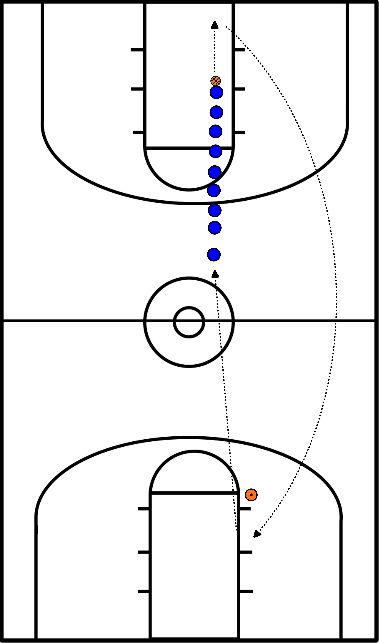
- Everyone stands in a line, one behind the other.
- The first player throws the ball against the backboard.
- The rest of the players time their jump to catch the ball in the air and throw it against the backboard again.
- The twentieth player throws the ball into the basket.
- Repeat this on both the right and left side.
- Players run around a cone or coach each time and rejoin at the back of the line.
Execution
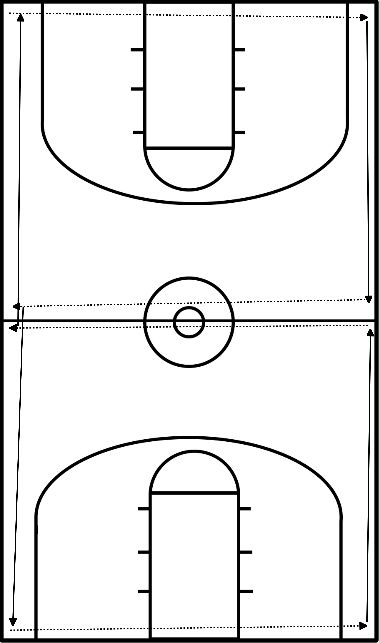
- Begin in the corner of the court.
- Slide along the baselines and the midcourt line.
- Sprint along the other lines.
- Run a figure-eight movement twice.
- Then take a short rest.
- Repeat this three times.
Description
- Three players start on the baseline, with the middle player holding a ball.
- The middle player passes the ball to one of the other players and runs after the ball.
- The receiver passes the ball to the player on the opposite side and also runs after the ball.
- This process repeats as they move towards the basket on the other side of the court.
- When a player is close enough to the basket, they perform a lay-up.
- The player who performs the lay-up becomes the defender.
- The remaining two players become attackers and try to reach each other with a long pass.
- The defender attempts to prevent the attackers from scoring.
- If the attackers do not score, they must do five push-ups.
- The objective for the defender is to prevent the attackers from scoring.
Objective
- Apply pressure on the dribbler during a press.
- Have each player sprint fully along the drawn lines and always close off the sideline.
- Repeat with defensive slides.
- Repeat with alternating slides - sprint - slides.
- Practice with an attacker without the ball. The defender must make slides as long as possible; sprint when necessary.
- The defender must close off the sideline in any case.
- Practice with the ball. The defender forces the attacker to turn at the sideline.
- Keep the exercise short and intensive.
- The defender must stand as close as possible to the attacker, considering the dribbler's skill and speed.
- The defender must use their foot to close off the sideline, forcing the dribbler to turn.
- The defender must accelerate and get in front of the dribbler before closing off the sideline.
- If the dribbler manages to dribble between the sideline and the defender, they may score. The defender continues to defend.
- If the defender succeeds in making the attacker turn at the sideline, they may then dribble, and the attacker becomes the defender.
- Start with a weak dribbler and have them begin with their weak hand.
- Initially, impose restrictions on the attacker: they may only change speed, but not direction, except at the sideline.
- Reduce the restrictions as the defenders improve.
Objective
- Concentration and energy in defence.
Organisation
- 4 versus 4 on one basket.
- New defenders after 3 stops (defenders gain possession).
- After a score or a foul on the shot, the defensive team loses one stop.
- The session lasts 12 minutes.
- The trainer counts down for prolonged attacks: 5-4-3-2-1-0.
Execution
- After 2 stops, the defence intensifies.
- On the third stop, they may attack.
- With 12 players: rotate with 4 after each stop, score, or foul.
- New attackers after each stop, score, or foul (trainer determines fouls).
- The team causing the third stop goes on defence.
Variations
- Three defenders, four attackers.
- 2 or 3 consecutive stops for a switch (with shot clock).
- 35 seconds of defence without a score or foul.
- On a stop, the clock remains, attackers try again.
- On a score, offensive rebound, or foul, the clock resets to 35 seconds.
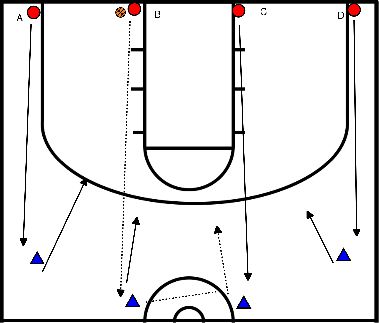
Execution
- Four players start on the baseline.
- Player B has the ball and dribbles towards the cone.
- Player B passes to player C.
- Players B and C move towards the goal for an attack.
- Players A and D sprint around the cone and take their defensive positions.
Execution
- Play a short game of five-on-five.
- The duration of the game is 10 minutes.
- The team with the most points at the end wins.
- In case of a tie, the team that scores first in overtime wins.
- Keep strict track of time: 2 x 5 minutes with a 2-minute break.
Execution
- A player takes free throws.
- The remaining players take positions for the rebound.
- Players attempt to secure the ball by boxing out.
- After every two free throws, players switch positions.
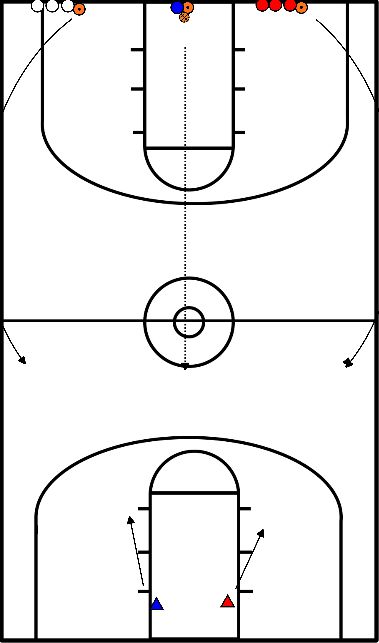
Setup
- Players gather at the baseline in two groups.
- One player stands under the basket with the ball.
- Two players are ready to defend on the opposite side.
- The player with the ball dribbles to the other side.
- Players on the left and right run along the sideline to join the offense.
- The defense freely chooses whom to defend but remains active without taking a position in or around the key area.
- The player who finishes or loses the ball returns together with the two defenders.
- On the opposite side, two new defenders are already prepared.
Game Setup
- Make two teams of five players each.
- Play a game and apply the exercises that were done today.
- Make substitutions every 30 seconds if necessary.
Execution:
- Play freely on one or two baskets, depending on the number of players.
- No dribbling allowed, only passing.