

Hockeyexercises for u12

Goal: Improve passing. To improve finishing on goal.
Organisation: Half playing field 2 attackers (Z) â€" 1 goalkeeper Course with 1,2-ties, dribbling and finishing on goal. After each pass you have to run to get the ball back from the attacker.
Tip: Before shooting on goal, pay attention to the position of the goalkeeper!
Variations: Practise different passing moves, both anti-clockwise and clockwise.
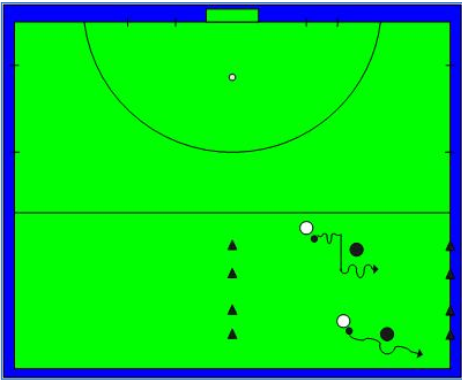
Try to pass your opponent over his backhand side, which is also your forehand side (and accelerate, when you pass your opponent)
When the ball rolls to the left, you can get it to your forehand with your tip to the right
If the attacker passes the ball back to the support player, the support player can pass the ball to the other side of the field (move the ball).
The defender on the side of the field, where the ball is not, must always stay behind the other defender (in 6-a-side hockey).
- The players are divided into teams of 3.
- The game is played 3-3 on different fields.
- Players can score in 2 goals and therefore have to defend 2 goals as well.
Variation:
- Take away a goal.
- Each team can only score on 1 goal
- and therefore only have to defend 1 goal.
The exercises can be played in 2 variants the variant for really beginning hockey players (this exercise can be used for a clinic for example) and the variant intended for beginning hockey players who have already been in touch with hockey.
Variation 1:
- Player 1 plays the ball to player 2,
- Player 2 receives the ball and passes to player 3.
- Player 3 receives the ball and shoots at goal.
- Player 4 tries to stop the ball with the bottom of his foot or with his stick.
- Player 4 retrieves the ball and joins the back of the line at the starting pawn of player 1.
- For safety's sake don't shoot on target when player 4 picks up the ball.
- It is also possible to get the balls out of the goal later or use a break for that.
- This is for safety reasons.
Two teams with substitutes, substitutions are made when a goal is scored.
Each person defends a goal, on each field there are 5 goals, so there are also 5 people who defend these goals.
If a goal is scored in your goal, you have to sit on the sidelines and you are changed. A new player (substitute) from the side enters the field and will defend the goal.
If a goal is scored, it is 1 point. The team with the most points at the end of the game is the winner.
Variation:
First 1 ball, then several balls in the field.
- Player 1 plays ball on player 2.
- player a runs on and receives the ball back, player 1 now plays ball on player 3 and receives the ball back again and shoots the ball at goal.
- variation:
- instead of shot on goal,
- gives player 1 a pass for the goal on player 4
- player 1 takes the place of player 4.
- player 2 and 3 remain.

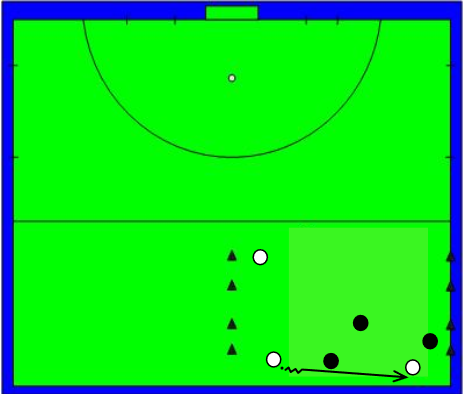
The pass to the right goes diagonally forward and over the backhand side of the defender, the pass to the left you play wide and goes over the forehand side of the defender.
Therefore the pass to the right is preferred over the pass to the left.
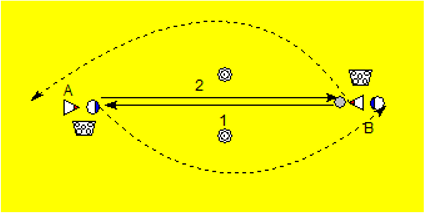
- This is a basic exercise in preparation.
- Just like a tennis player who prepares for training with basic strokes, the players must prepare for the complex training and competition forms, with direct simple passes on top of each other.
- In this way, the trainer has the ability to see technical errors in each individual player and correct them as early as the basic exercise.
- The players pass the ball directly between two pylons and walk counter-clockwise to the other side.
- The size of the target and the distance between the players will be adjusted according to the age and level of the players.
General
- Orange 1 starts with a pass from the sideline to one of the builders (orange 2,3).
- Orange defends out and scores in the goal (A) on the 23 meter line.
- When intercepting or winning a duel by blue (1,2) they score on the big goal (2 blue against 3 orange+k).
- Orange gives direct pressure on blue when losing the ball.
- The exercise starts again after a goal in 1 of the 2 goals, after a maximum of 2 switch moments or when the ball is out.
Tips ball possession
- Make the field wide.
- Take open after scanning the space (by builders).
- Keep depth between both lines (formation 2-1;1-1-1).
Tips non ball possession
- Make a choice between putting direct pressure on the ball owner or letting the opponent come and reducing space.
- Force a passing or running action to the outside (sideline).
- As a goalkeeper, coach the rear build-up player.
- Switching tips
- At Ball Loss:
- Put pressure on the ball holder.
- Play compact and reduce space.
At Ball Profit:
- Preferably play with the ball instead of the ball.
- Make sure there is a quick play point in the depth.
Make it easier
- Build up with 3 players, where the trainer gives the 1st pass to 1 of the 3 Orange players
- Make more difficult
- Provide an evental in players: 3 Orange (with goalkeeper) against 3 Blue (3rd player of Blue starts from the goalkeeper at 23 meters line).
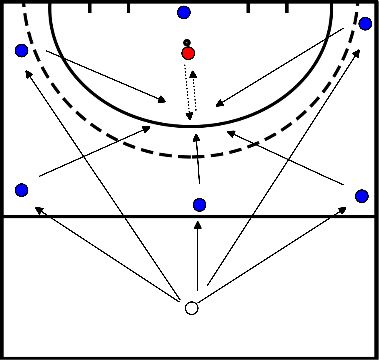
- Blue player receives the ball from the white player each time. (white player distributed)
- Red player runs from stroke point to head circle and receives ball from blue player.
- Red player shoots on goal.
- After each shot he walks back to stroke point and then receives the next ball from head circle.
- Players outside the box should replay as often as possible.
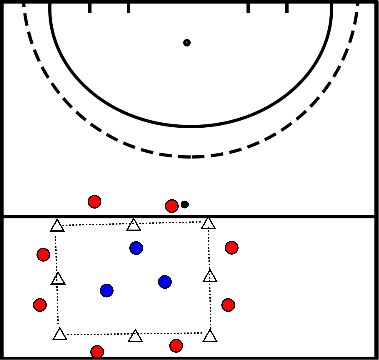
- The pass must always pass through the box.
- The players inside the box must try to intercept the ball.
- As soon as the players inside the box have intercepted the ball, they should replay as often as possible inside the box.
- Each time they have replayed 3 times, someone outside the box may enter the box to recapture the ball.
- As soon as they succeed, they will play to someone outside the box and it will start over again, so at least one player must always remain outside the box to be able to play.
- The field can be larger or smaller, there can be more or less players inside and outside the box.