



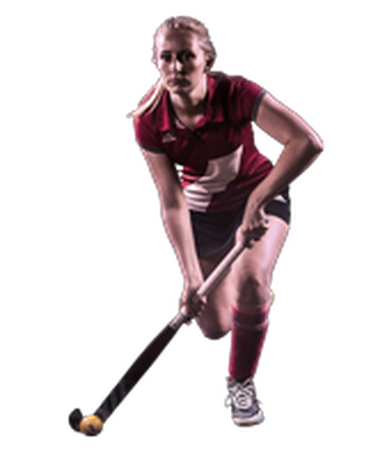
Hockeyexercises for u21
Place 15 to 20 pylons over a distance of about 40 metres from the rear line towards the middle line, in a straight line. The spacing between them at the basic form is 2 meters.
Make 2 rows that are positioned behind the back line. The players do their exercise on both sides of the pylons at the same time towards the end of the series of pylons. There they turn and dribble with a wide curve back to the beginning. When the first two are at the fourth pylon, the next two can start.
Put players with an equal physical capacity next to each other. You can do a positional approach (defender versus defender, attacker versus attacker).
Exercise
1. On the signal the front 2 players start.
2. Sprint each time 2 pylons forward and then 1 pylon backward.
3. Keep your face forward, so don't turn during the exercise.
4. The intensity is 90% of the maximum capacity. Especially the forward runs (starting away) must be explosive and with short steps.
5. At the end of the series of pylons you turn with a wide bend and dribble easily back to the starting point.
6. Repeat this exercise once.
Variations
1. Identical to the basic form, but now with the pylons in a different pattern: between the first 2 pylons is 1 meter, between the next 2 meters, then 3 meters, 4 meters and finally 5 meters. After this you go down again (respectively 4, 3, 2 and 1 meter space between the pylons). In total you will have 18 pylons.
2. Identical to the basic form, but now with a different pattern: between the first 3 pylons 1 meter, the next 2 pylons 5 meter, then again 3 pylons with 1 meter, 2 pylons with 5 meter. After this, place the same pattern again (4 times the same pattern in 1 line, with a total of 18 pylons).
3. Identical to variation 3, but now you don't place the pylons in a straight line, but in curves.
4. You make a straight line of pylons and arrange them as you see fit. Make sure there is a lot of variation.
5. Identical to variation 4, but now with faint curves.
Intensity of the exercise
The intensity is 90% of the maximum effort. Panting, should be motivated execution with highly explosive character in the runs with a maintained body control and athletic posture, EMI 7/8.
The player with the red pilon is ready for the long corner. This player plays the ball to the left and gives the ball to the player coming from the white pilon. The player of the white pilon plays the ball as hard as possible into the circle (towards the goal).
When the long corner is taken, the players try to run into the blue and orange pilon and intercept the ball. The player who intercepts the ball scores on the back line and the other player scores on the 23-m line. It becomes a 1 to 1.
Swap: Red - White - Blue - Orange - Red
Attention: The player who takes the long corner stands ready as if he himself is going towards the circle. Pass the ball hard and low towards the dot.
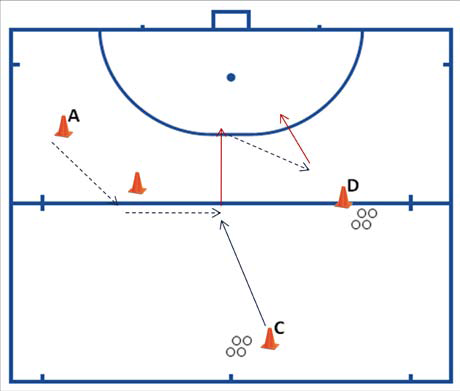
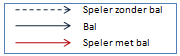
- Put out the columns as shown in the figure
- Spread the balls over pylon C and D.
- In this exercise you place a player at pylon C and D.
- The rest of the team will line up at pylon A.
- From A onwards, the player walks around the pylon
- From the post, the player makes a sideways movement facing the ball (facing C).
- Player C plays the ball in the forehand of A
- A takes the ball and turns right open
- A runs in the direction of the circle and finishes at goal.
- From here he runs to D and receives another ball.
- The player turns open to the left and finishes on goal again.
- The tagger should try to tap as many children as possible.
- If you are in danger of getting tapped you can call a television show and then the tagger is not allowed to tap you.
- You have to stand with your legs wide.
- The rest can be relieved by crawling between your legs.
- When you are tapped, you stand by the trainer.
- 1 or 2 taggers.
- On the spot where you are tapped, the tagger must hold his hand, for example, a hand on his shoulder.
- With the other hand another has to be tapped.
- defense intercepts the ball
- the ball is played to the right back
- the middle right pulls in so that the flank is open
- the back right plays the ball into the depths to the striker
- the striker pulls out to take the ball along the line
- Have 5 attackers practice with the penalty corners
- goalkeeper in goal
- vary with declarers
- different variants
- At the end of the session, discuss 3 variants that can be used in the competition
- The group is divided into 2 groups ( try boys who have to play together in the game across the board (far-mid or all defenders; all midfielders,...))
Playing field : 1/4 of the field over the entire width of the field.
- Exercise : The toss determines which team has ball possession.
- This group tries to visit all the houses on the playing field, after each visit the group has to get a key from the goalkeeper who is standing in a box in the middle of the field.
- You get the key by playing the goalkeeper and he has to kick the ball back to a member of the group.
- The house has to be approached by at least 3 people.
- Then a group member may stand in the house and receive the ball and play it back.
- The team may NOT have someone in the house in advance.
- Everything goes on time.
- After group 1, group 2 starts.
- Group 2 has to improve the time of group 1...
- The second version is with defense by the other group.
- Who scores the most houses in 10 minutes.
- Scoop is allowed in free space... houses may not be defended by a team... A house = a square with 4 pilons...
- Dribble:
- indian dribble: make touches from FH/BH if you have control increase the speed
- dummy: drag the ball to your left foot make a c pull without the ball, drag the ball with your backhand to your righthand-side and speed up
- 3d skill:
- https://www.youtube.com/watch?v=Ahig2BR72Do .
- it all starts with lifting the ball in the air while simultaneously making a move to change direction

- Push: In the circle and close to the goal
- slap: for a deflection or from 2 meters inside the circle
- deflection:
- https://www.youtube.com/watch?v=EZ7-bvFhojs
- hit: top of the circle FH/BH
- FH:
- https://www.youtube.com/watch?v=Sgx-pvioXrE
- BH:
- https://www.youtube.com/watch?v=j0PC3GbGRm0

- This is a good exercise for conditioning:
- The group has to stand in a row and you let them start dribbling.
- As soon as the trainer blows his whistle, the last one of the row should run forwards.
- You do this until everyone has been there and then you let them finish running the track.
- Let the team run for about five minutes and then continue with the following exercises:
- put out the pilons as shown in figure one.
- Have the team make two rows on the sideline at the height of the 23-metre line.
- Perform the following running exercises on the dotted line:
- - Knee lifting (constructive 50%, 80%, 100%).
- - Heel to buttocks (building 50%, 80%, 100%).
- - Sideways
- - Cross step.
- - And finally, release the arms.