

Hockeyexercises for u22
Execution
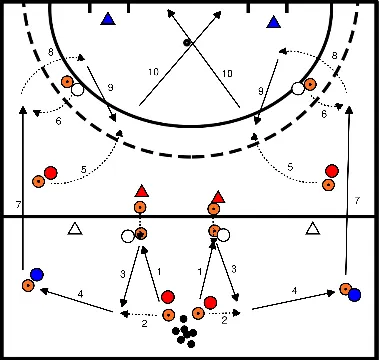
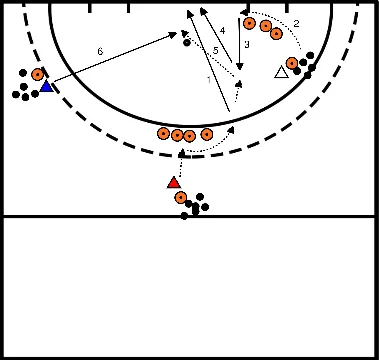
- The ball starts with red. White runs towards the ball. Red passes the ball to white and takes a few steps wide to the outside.
- White passes the ball back to red. Red passes the ball to blue.
- The second red (midfield player) moves inside while the second white (forward) moves outside.
- Blue passes deep along the line to the forward who has come to offer support there.
- The forward receives the ball and drives towards the goal.
- The midfield player comes in to guard the forward and receives the ball.
- The midfield player drives into the circle and shoots at the goal.
- Add two defenders (see red and white triangles).
- The red triangle applies pressure from behind on white and then takes the shortest route to the goal.
- The white triangle chooses whether to close off the line (pass 7) or to move inside with red.
- Blue must decide whether the pass can go along the line or needs to go inside.
- A 3 versus 2 situation arises with the two triangles against red (midfield player), white (pivot), and white (forward).
- If necessary, an additional defender can be placed at the edge of the circle.
- Optionally, an extra forward can be added from the other side (blue triangle).
- If the exercise can only be executed on one side at a time, an extra pass can be added before pass 1, for example, a cross-field pass from the other side of the playing field.
Description
- Distribute balls over three cones: red, white, and blue.
- Red starts with a ball, dribbles towards the circle, and performs a passing movement at the cones on the edge of the circle.
- Red then shoots at the goal.
- At that moment, white dribbles with a ball towards the baseline and makes a loop around the cones.
- White looks for a pass (preferably perpendicular) towards red who has come forward after the shot.
- Red receives this pass and shoots at the goal (this can also be done directly without receiving).
- Red then continues towards a post or the penalty spot.
- Blue gives a hard pass to the spot where red is positioned.
- Red preferably tips this ball.
- Rotate in the sequence: red > white > blue.
- At least 3 forwards, 4 is also possible, and preferably with a goalkeeper.
- With 3 forwards: play with rebound.
- With 4 forwards: maximum 1 quick rebound and then rotate to avoid long waiting.
Execution
- The exercise is performed on both the left and right sides, allowing players to practice their skills in both directions.
- Three players are active in the exercise simultaneously, while the remaining players double up their positions.
- The exercise begins with a fast and accurate pass from the first player to the second player.
- The second player receives the ball and quickly handles it to pass it on to the third player.
- The third player completes the exercise by either passing the ball back to the first player with precision or choosing a new direction.
Execution
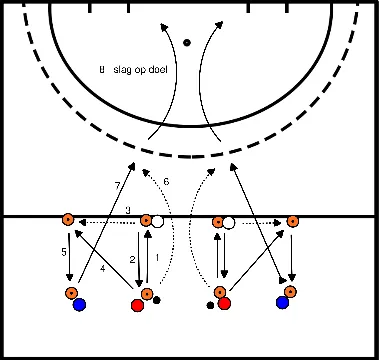
- Start on the right side of the pitch.
- Pass the ball to the forehand of the drag-flicker.
- Use a feeder and a pusher for the execution.
- Direct on goal: The drag-flicker shoots directly at the goal after receiving the ball.
- Push to feeder for tip-in: The pusher returns the ball to the feeder for a quick tip-in towards the goal.
- Slide to the left: After receiving the ball, the drag-flicker slides the ball to a player on the left side for a shot on goal.
Objective
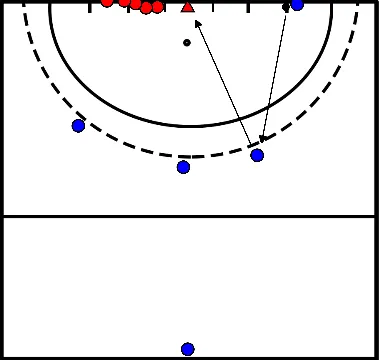
- To improve attacking technique and finishing on goal in an indoor hockey situation.
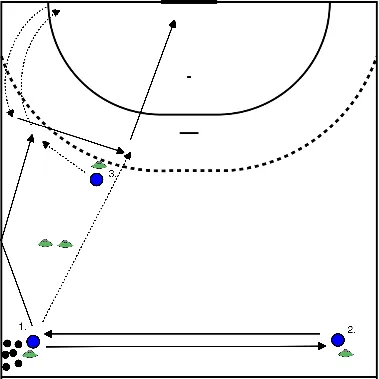
- Player 1 passes the ball to Player 2, who receives it and returns it to Player 1.
- Player 1 receives the ball and plays it off the boards to the oncoming Player 3.
- Player 3 carries the ball on the backhand into the corner, makes a strong turn onto the forehand, and dribbles a few metres inside with the ball.
- Player 3 passes back to the top of the circle.
- After passing to Player 3, Player 1 continues towards the top of the circle, receives the ball on the move, and finishes on goal.
- Players rotate according to the pattern: 1-3-2-1.
- The exercise can be set up twice if there are enough players.
Description
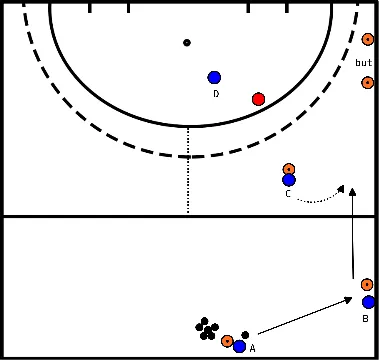
- A passes the ball to B.
- C moves towards the space on the sideline and accelerates in that direction.
- C receives a strong pass from B.
- C and D play a two against one against the red defender.
- Improve coordination and teamwork in situations of numerical superiority.
- If the defender recovers the ball, attempt to score in the small goal on the side.
Execution
- Sprint within 35 seconds (adjust time if necessary).
- Touch the line with your hand when turning.
- Follow the course: from the backline to the 23-metre line, back to the backline, to the centre line, back to the backline, to the 23-metre line, and back to the backline.
- Take 30 seconds rest and repeat the sprint.
Execution
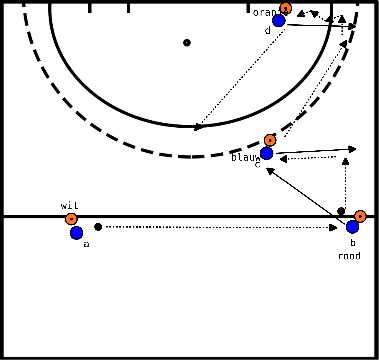
- Player A passes the ball wide across the entire width to the right.
- Player B receives the ball openly and plays it deep to Player C, who has run towards the line.
- Player C immediately plays the ball wide back to Player B, who positions themselves there.
- Player B passes the ball to Player D, who positions themselves from outside the circle.
- Player D runs with the ball along the baseline back into the circle and plays the ball to the top where Player A is now positioned.
- Player A shoots at the goal.
- B to A
- A to C - white to blue
- C to D - blue to orange
- D to B - orange to red
- B to A - red cone to white
Execution
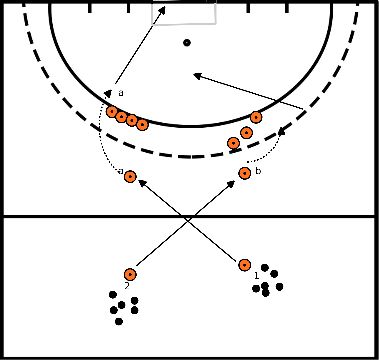
- Player 1 passes the ball to Player A.
- Player A receives the ball and dribbles around the cones.
- Player A finishes on goal.
- After the shot, Player A positions themselves immediately for the second ball.
- Almost simultaneously, Player 2 passes the ball to Player B.
- Player B dribbles the ball around the circle and passes to Player A.
- Timing: Pay attention to when Player 2 starts.
- After the shot, Player A must switch immediately and position themselves.
- Player A must be passed to in stride/motion.
Execution
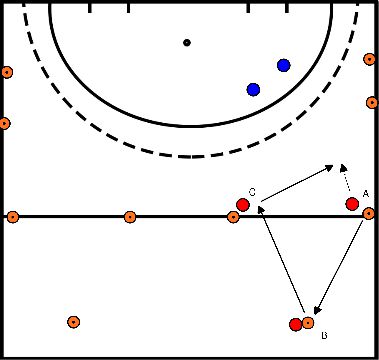
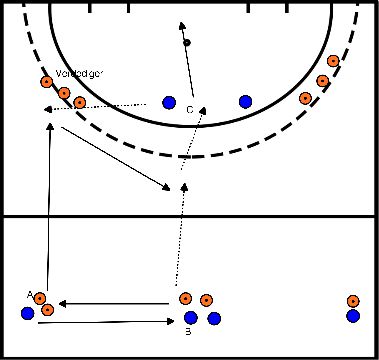
- Player A starts with the ball and passes to Player B.
- Player B receives the ball and passes directly back to Player A.
- Player C moves wide and receives a firm pass from Player A.
- Player B moves towards the circle and gets the ball back from Player C, who cannot play forward due to a defender.
- Player B receives the ball, accelerates towards the circle, and strikes at goal.
Objective
- Quickly transition between attack and defence.
Setup
- The field between the 23-metre line and the centre line is divided into two parts.
- There are three teams of 3 players each.
- Two teams play against each other, while the third team has a rest period.
- Team 1 and Team 2 play against each other: The objective of Team 1 is to score. The objective of Team 2 is to get the ball to Team 3.
- When a goal is scored, the other team must switch to defence for the next game.
- Example: Team 1 scores against Team 2, then Team 2 plays as the defensive team against Team 3.
- When Team 2 intercepts the ball, they pass it to Team 3.
- Team 3 starts the attack on Team 1 as soon as they receive the ball.
- Team 1 then transitions from attack to defence.
- Team 2 takes the place of Team 3 and waits for the game between 3 and 1 to conclude.
Variations
- The number of players per team can be adjusted.
- The field can be made narrower.
Key Points
- The game should continue as much as possible.
- As a coach, it is helpful to have enough balls on hand to support the game.
Execution
- Player A starts with the ball and passes to Player B.
- Player B receives the ball and passes to Player C.
- Player C receives the ball and plays it wide to the advancing Player A.
- Player A receives the ball, creating a 3 versus 2 situation against the defenders.
- Defenders start in the circle and may step out as soon as Player C has received the ball.
- Attackers attempt to score on the large goal.
- Defenders score in the small goal at the sideline.