



Tennisexercises
Introduction
- The trainer briefly discusses the previous lesson: what did we do and what have you learned?
Technical Focus
- Zoom in on forehands and backhands.
Tactical Focus
- Construction of a point.
- Positioning in doubles.
- Collaboration and communication.
Execution
- Try to rally in pairs.
- Create space and hit the ball into the open space.
- Experiment with hitting harder, taking the ball earlier, and deliberately slowing down the game.
Variation
- Use different court lengths to experience how hard, soft, high, low, deep, or shallow the ball should be hit.
Rotation
- After the ball is hit incorrectly twice, the pair swaps with the waiting pair.
- Waiting students can monitor the task and participate mentally.
Execution
- The players stand in the centre of the court.
- One player delivers the ball using their foot, ensuring the ball bounces in a service box.
- The other player is required to approach the net.
- For a lower level: do not approach the net.
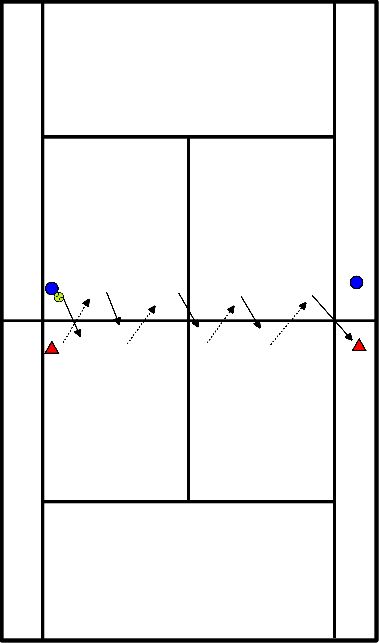
Execution
- The players start in one corner of the court on a mini-tennis court.
- They try to volley with each other to the opposite side of the court and back again.
- Count the number of times they can play back and forth.
Execution
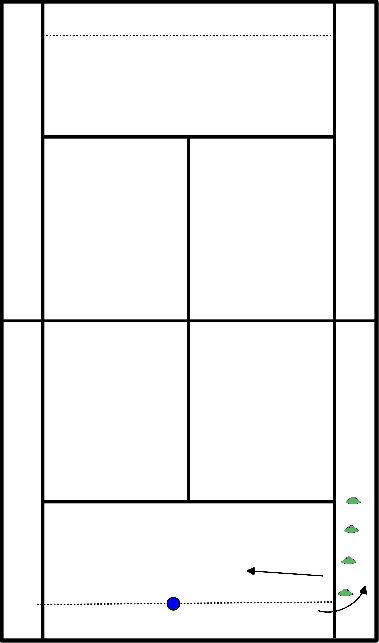
- Four balls are randomly fed.
- After each ball, the student must move around the cone using a sidestep.
- Move from back to front.
- The four cones are lined up one after another within the doubles lines.
Execution
- A backhand is indicated.
- The player alternates playing in one zone and then in the other.
Execution
- Play the ball straight over.
- After each stroke, you must touch a point.
- Move half a metre behind the baseline in the centre.
- Use only half of the court.
Game Rules
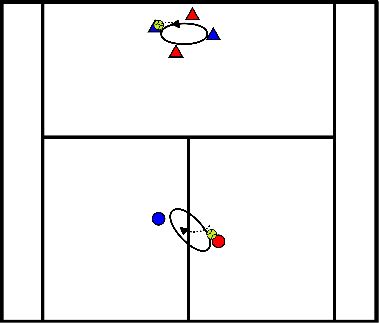
- Players compete in singles or doubles, each holding a racket.
- A hoop is placed in the centre between the teams.
- A baby ball (purple ball) is used, and players must hit the ball into the hoop each time.
- If the opponents cannot return the ball and it bounces twice, the other team scores a point.
- Players may pass to each other but must not obstruct.
- Players move continuously around their hoop to create different angles for the opponent.
- Start with singles, then progress to doubles.
- First, play the ball upwards to yourself and then attempt to score (singles).
- Receive the ball from the opponents, play it upwards (pass to a teammate), and the teammate must play the ball into the hoop (doubles).
Challenge
- Which pair can hit the ball over the net with the forehand the most times within a set period?
- You may count every successful forehand stroke.
- If the ball goes out, you do not need to start over; you may continue counting.
- Play using only the backhand.
- Use both techniques.
Execution
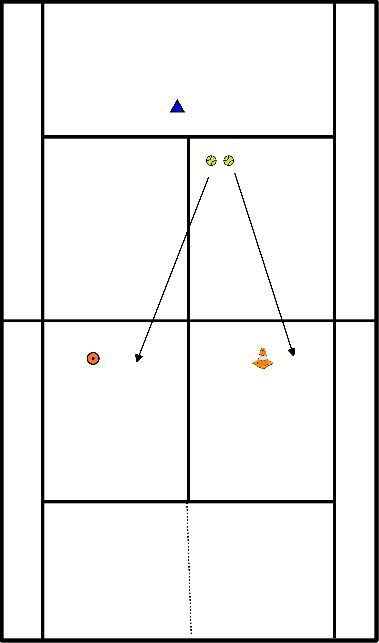
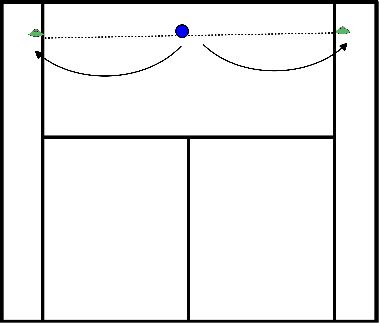
- Four balls are randomly indicated.
- There is a cone on each side of the court.
- For a forehand, the forehand cone must be tapped.
- For a backhand, the backhand cone must be tapped.
Execution
- The players stand in pairs facing each other outside the circle area.
- The circle area is marked with strips, cones, or small markers.
- At the trainer's start signal, they try to tag each other.
- They may only move sideways using side steps.
- Due to health guidelines: Hold a racket in hand and tag with it.
- The goal is to be the first to score 3 points.
Objective
- Which pair can play the ball over the net the most independently?
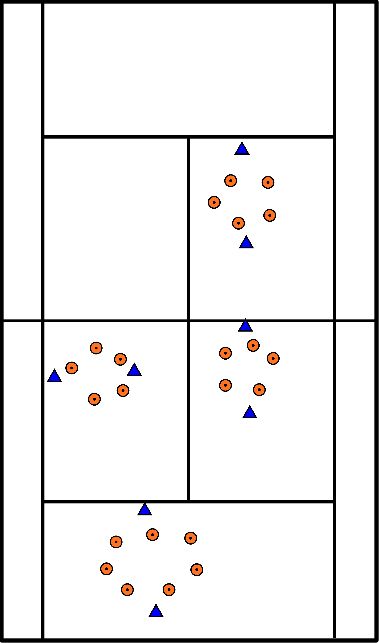
- The players stand close to the net. Two hoops are placed between both players, approximately one meter apart.
- Try to bounce the ball into each other's hoop. Who has the most hits?
- Increase the distance between the players. Each player on one side of the net, with two hoops on each side of the net. Play the ball over the net and try to bounce the ball into the other hoop.
Execution
- Start with 2 laps of jogging.
- Form lines for the following exercises.
- Warm up on the mini court with orange balls.
- Warm up on the mini court with yellow balls.
- Warm up on the full court straight.
- Warm up on the full court cross-court.
- Switch cross-court sides after each exercise.