



Handballexercises for technique ball control
Last update: january 2026
Team Composition
- Two teams of a maximum of 4 players each.
- One ball per game.
- On each side, 2 players are on the court, while the remaining players stand behind the back line.
- Score in the opposing field in one attempt (within the lines).
- Start with a simple underhand serve.
- We play underhand handball, so the ball must go over the net in one attempt.
- For a difficult ball, the ball may bounce once but must then be returned with one hand, a foot, or the head.
- If a mistake is made, the player leaves the court, goes to the back line, and a new player takes over.
Objective
- Improve passing and catching technique.
Execution
- Throwing back and forth, pay attention to the correct posture: elbow at shoulder height, left leg forward.
- Throwing with a running movement: left-right-left.
- Throwing with the left hand.
- Throwing behind the back.
- Aim at the right (catching) hand, but catch with both hands.
- Throwing via the ground.
- Catching: posture with a "W" or cup shape.
- From the E-youth: throwing with a jump shot.
- Underhand passing.
- Sideways passing.
- Passing with an attacking movement: a few steps towards the goal, pass and then move backwards.
Execution
- The Left Wing Player (LW) starts by applying pressure on the outside of the wing defender.
- The Left Backcourt Player (LB) applies pressure between the wing defender and the defending Right Backcourt Player.
- The Centre Backcourt Player (CB) applies pressure between the defending Right Backcourt Player and the Centre Back.
- The Right Backcourt Player (RB) applies pressure between the Centre Back and the defending Left Backcourt Player.
- The Right Wing Player (RW) applies pressure between the defending Left Backcourt Player and the wing defender.
- The RW moves around the outside of the wing defender and shoots at the goal.
- Shift positions.
Execution
- 2 to 3 players in the left backcourt (can also be another position) practice shots.
- The remaining players collect balls, and one player continuously passes the balls.
- Shooting from the left backcourt one after another.
- The player who scores 10 times first, wins.
- After a shot, the player must run backwards to their position.
- Different approaches (for example, slightly inward or outward).
- Different shots (underarm throw, wrist throw, on the move, and so on).
- Use more than one position.
Introduction
- Exercises with mats in pairs of 2, using 1 ball.
- The player with the ball tries to touch the mat with their foot. The other player tries to prevent this with their body. The defender keeps their hands on their back. Each pair plays for 2 times 1 minute, then switch roles.
- Both players sit on their knees on the mat. Try to push each other off the mat. If someone is pushed off the mat, start again.
- Both players on their knees on the mat. One player holds the ball, the other player tries to snatch the ball away.
- The ball lies on the mat. Both players place their hands on the edge of the mat and roll the ball to each other.
- Same as before, but after contact with the ball, stand further away, so that you have walked completely around the mat.
- The ball is placed between the heads of the players. Move around the entire mat on your hands.
Execution
- Roll the ball 5 metres forward and pick it up while running. Do this across the entire field and return around the outside.
- Throw the ball up and catch it while running. Repeat this across the entire field and return around the outside.
- Slide sideways across the field with the ball above your head. Do this across the entire field and return around the outside.
- Make a cross pass sideways with the ball above your head. Repeat this across the entire field and return around the outside.
- Perform high knees while swinging your arms and holding the ball in one hand. Halfway across the field, kick your heels to your buttocks. Repeat this 2 times.
Execution
- Blue players cross the field.
- Red players try to tap the balls away from the blue players.
- When a ball is tapped away, the player defends until everyone has lost their ball.
- Add extra defenders to increase the challenge.
- When capturing the ball: as soon as you hear the ball on the ground, place your hand between the ball and the opponent's hand.
- Attack on the side of the ball.
Moving with the Ball
- Dribbling with the ball: right, left, or alternating.
- Rolling the ball, picking it up, and rolling it again.
- Throwing the ball up, optionally letting it bounce once, and catching it.
- Throwing the ball up behind the back and catching it in front again.
- Circling the ball around the hip.
- Passing the ball under the knee with each step.
- Same, with knee lifts.
- Football dribble.
- Keeping the ball in front of you and moving with heel-to-butt or knee lifts.
- Making feint throws while moving.
- Performing passing movements while moving.
- Players sit on a chair with a ball.
- Stand up and make three-pass to jump throw and throw at goal (goal, mat, pawn....)
- Points of attention:
- Left - right - jump (left-handers vice versa)
- Arm goes backwards on the right
- Last pass is big
Variations
- Set down and throw over cabinet
- Instead of 3-pass a 2-pass i.e. stand up -right-right-jump
- Mark floor with hats for null pass, catch and drop, and jump shot with 1 or 3 passes.
- Have the players practice performing different feints, in the beginning without the ball, as soon as the movement is done well, perform the same movement with a ball.
- Have the players play together in pairs, feinting each time they receive the ball.
- Have them practice a 0 pass on 2 legs.
- Perform the 0 pass on 1 leg.
- Perform the 0 pass on the other leg.
- Have the players perform an 0-pass followed by a feint (shot arm side)
- Having the players make an 0 pass followed by a feint (not shot arm side)
- Working in threes
- One ball is needed per group
- 2 players stand together (with the ball) and the last player stands a few meters away
- The ball carrier always plays to the player on the opposite side
- Everyone runs after the ball after playing
Variation:
- With 4 players making a total of 4 players spread over 3 positions on the field.
- The ball starts where 2 players are standing.
- Still everyone runs after the ball after passing it over.
Duo opposite each other with 1 ball
- Distance 3 meters over throw (pay attention to elbow above shoulder, correct leg and pass on throwing arm)
- In motion (move forward on approach, backward, receive ball and move forward again)
- Increasing distance with bounce (note in hands, bounce just over center)
- Jump shot
- Passing sideways
- Pass too low and catch!
- Pass to high and catch!
- Flyer
- Increase distance
- 2 balls at the same time
- 1 rolls the ball, the other throws
The team runs in a run around the half court.
- Player 1 has the ball and holds the ball behind his head.
- Player 2 tries to grab the ball and then does the same to player 3.
- And so on.
As soon as the one behind has the ball she/he takes a sprint forward so that she/he becomes player 1 and then it starts again.
- Player 1 has the ball and runs backwards and throws the ball with a bounce to player 2.
- The latter turns around and throws the ball to player 3.
- And so on.
As soon as the back has the ball he takes a sprint forward so that he becomes player 1 and then it starts again.
- Jump shot explanation:
- Left - right - left - outlet with left for jump - shoot in the air. Left-handed players do it the other way around.
- Eventually you should be able to start it with both legs.
- Pay attention to height - so don't just jump forward. Use arms and 1 leg to get extra upward energy. First in slow motion!
- Trainer stands halfway up 9 meters
- Players line up at a distance
- Player throws ball to trainer, runs in, catches ball at the 9 meter and finishes with 3 passes- jump shot
- Trainer is on knees gets ball from player, player makes jump shot and throws over trainer.
- Mark floor with hats for null pass, catch and down, and jump shot with 1 or 3 passes.
Setup:
- Put a pawn on the left and right of the goal area line.
Goal:
- Players must round from outside the pawn on goal. Shot angle can be made easier or more difficult by moving pawn.
Exercise:
- Row of players on left attack. Focal point on center.
- Left attack puts pressure, plays ball to middle, gets ball back and rounds.
- When one has been one goes on right attack, where the same thing is done.
- Important is that players jump well inside towards goal.
Variations:
- Idem 1, but now with starting from the middle.
- The ball is now played to the trainer in front of them.
- This one also plays the ball back.
- Alternate left and right.
- Same as 2, but now also place a pawn where the players must pass inside.
- This causes the player to arrive at the 2nd pawn in a nasty way -in the previous exercise they will have run a nice little arc to avoid this-, so they end up having to turn more in their shot to still get towards goal.
- A distance shot from the middle can also be inserted throughout to train this as well.
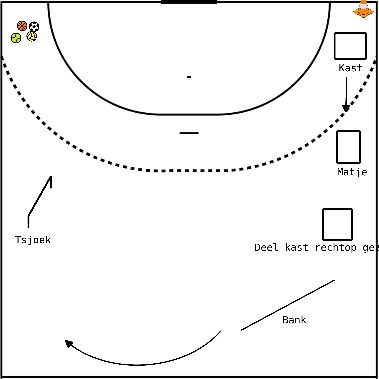
Everyone needs a ball, especially use different balls!
Set up a dribble course, according to your own idea/ judgment. Below is an example of a course.
You cover the entire course while dribbling:
Set up a dribble course, according to your own idea/ judgment. Below is an example of a course.
You cover the entire course while dribbling:
- Start in the corner by the pawn
- Climb over the cabinet and while sitting on the cabinet, dribble a lap around the cabinet
- Sit down on the mat and stand up again
- variation: lie down on stomach or back while dribbling
- Prop up a part of the cabinet and climb through it while dribbling
- Walk across the bench while continuing to dribble
- Walk towards the Chukchi, throw the ball into it. Catch it yourself and finish on goal
For younger youth, you could have them hold the ball on their own or dribble in the gaps.
Warming up:
- Lunge pass.
- Calf raises, possibly on bench, sagging slightly.
- Jumping in place, landing softly on 2 legs, torso straight, knees out.
- Jumping walk on 1 leg, landing softly.
- Lunge stride.
Jump shot exercise:
- Place a marker at the jump spot.
- Player starts from corner, ball is passed with bounce by other player.
- Run up sharply to avoid giving defenders space.
- Lean sideways to prepare the turn.
- Aim in the left-right corner/high low.
- Possibly with goalkeeper.
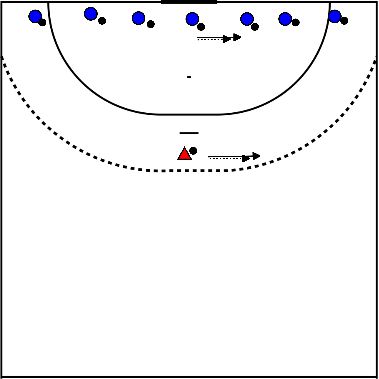
- All players grab a ball and line up next to each other.
- The trainer stands with ball in front of it.
- The players follow the trainer dribbling as a mirror image. If the trainer goes forward then they go backward, if the trainer goes left then they go right, and so on.
Variation:
- Trainer raises number of fingers and players call out how many; looking over the ball.
- Sit down while dribbling and stand up again.
- Lie down while dribbling and get up again.
- Turn ball around waist.
- Dribbling between the legs.
- Set down hurdles or double low hats in a left-right pattern.
- With 2 legs over the hurdle, wide step sideways and again with 2 legs over the hurdle.
- Mats at the 9 meter on build-up positions: stand next to the mat - with 1 leg a wide jump over the mat and then complete with 2 or 3 passes, depending on the side you choose
- Practice the above without mat, with opponent as dummy :-)
- 1 versus 1 in a narrow space: demarcate with markers - first walk forwards and backwards, so pass each other twice, then start the attack. Practice passing and feinting.
Use soft ball
Playing vision.
Playing vision.
- 5 players in the field without a fixed goalie.
- One aims for a maximum of 2 substitutions per team.
- All players attack together.
- When the opponent has possession of the ball, everyone returns to their own half.
- The one who reaches the circle first can stand on goal.
- The defense is mandatory offensively on own half.
- Scoring is only allowed from the other side's half.
- The goal of defending is to conquer the ball.
- Personal coverage of a player is not allowed.
- Coaches are game leaders, they explain rules, but do not punish.
- Attacker gets the ball back after mistake and may try again.
Use Magnet aiming discs or a hole cloth if necessary.
- Player throws to thrower, player catches ball again, lands in 0pass.
- Then 3-step. Pay attention:
- Left hand goes with ball, left arm stays slightly in front of body. Protection of ball and space in front.
- Keep body low, increases jumping power. Dribble also helps.
- High jump off, right leg gives a kicking motion slightly to the outside during throw.
- Keep arm high at beginning of throw for more throwing power.
- Explanation jump shot: Left - right - left - turn with left for jump - shoot in the air. Left-handed players do it the other way around
- (Eventually you have to be able to start it with both legs)
- Pay attention to height - do not jump forward. Use arms to get extra upward energy. First in slow motion!
- Trainer stands halfway the 9 meters
- Players in a row at distance
- Player throws ball to trainer, runs in, catches ball at the 9 meter and finishes with 3 passes - jump shot.
- Trainer sits on knees (or stands, depending on length) gets ball from player, player makes jump shot and throws over trainer.
- Mark floor with hats for null pass (catch and drop) and jump shot with 1 or 3 passes.
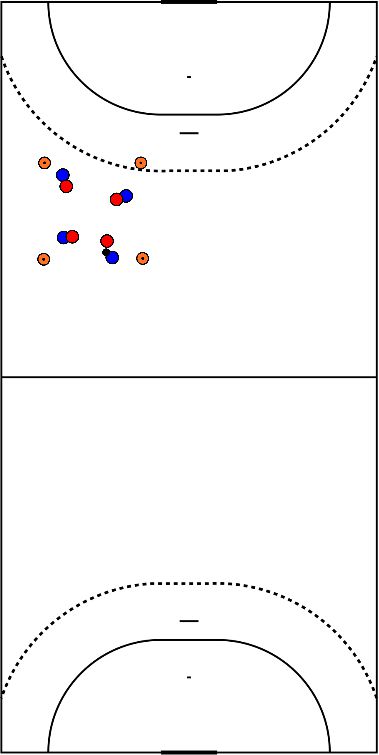
This game can be played as an end game but also during training and as a warm-up, which makes it attractive, especially since you can differentiate and change it well.
- Two teams are made in a square of about 10 by 10.
- One team starts with the ball, the goal of this team is to pass the ball to a teammate 10 times.
- The goal of the other team is to intercept and pass the ball 10 times.
This game comes in different situations.
Examples are:
- Larger/smaller field
- Different way of passing (MUST via bounce, MUST through the air).
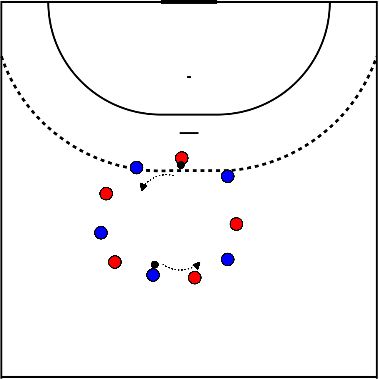
- You make 2 groups.
- 1 group has a vest.
- The groups must have an equal number.
- The children take turns standing in a circle. (So someone with a vest stands next to someone without vest).
- There are 2 balls and of each group 1 person has the ball (they face each other).
- You throw the ball as fast as possible to someone of your own group and try to catch the ball of the other group.
- If the ball falls, pick it up as quickly as possible and continue.
- Who will be first to catch the ball from the other team?
- If this goes well they all take 3 steps back and we increase the distance.
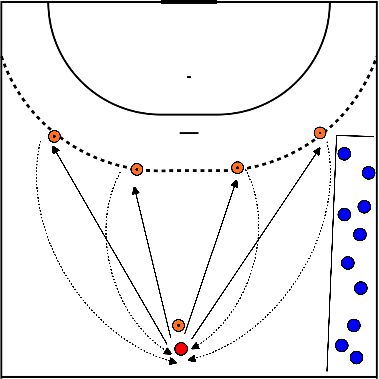
- Put a goal or put a mat in front of it and make compartments with tape or in some other way.
- Give the divided squares points.
- Each player may throw 3 times.
- Keeping track of the points and adding them up
- Player starts at the pylon in the middle.
- Sprints to the left pylon.
- Picks up the ball and works it towards the goal.
- Player sprints back to the pylon in the middle.
- Now sprints to the right pylon.
- Picks up the ball and finishes on the goal.
- Player sprints back to the centre pylon.
- Sprints to the second pylon on the left.
- Finishes with the goal.
- Player sprints back to the centre pylon.
- Sprints to the second pylon on the right.
- Finishes with the goal.
- The other players remain in their places, dribbling
- Or they can do strength training
- Jumping rope
- Dribble with the ball in a square.
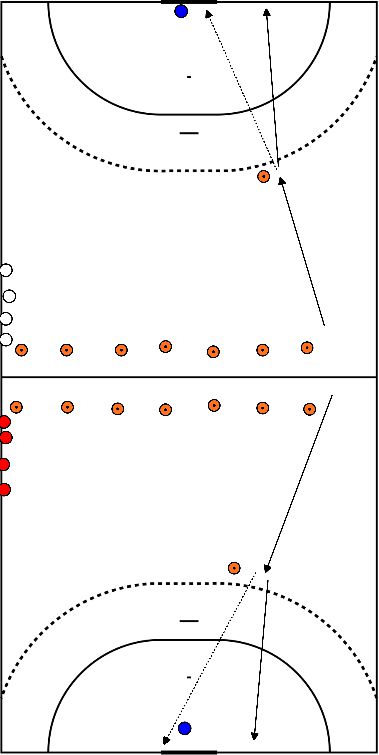
- 2 teams of 5 - 6 players.
- The exercise is performed as a relay race.
- The team runs a slalom around the pylons.
- The point from which the throw must be made is at the pylon at the free throw line.
- The moment the player finishes, the next player starts.
- Variations:
- The whole round is dribbled
- Each player makes 3 rounds:
- The first round the ball is carried between the pylons and dribbled along the long side
- The last round is the whole round dribbled.
- Carry the ball between the pylons and dribble the rest of the way
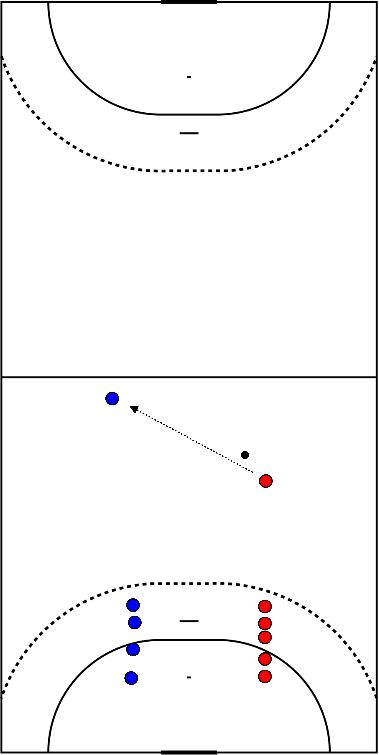
Doubles:
- Make 2 rows on the 6 meter at the height of LO and RO (1 row needs balls).
- The first two of the row run towards the other 6 meter line, while doing so they play the ball over (finishing on goal). Run back.
Focus on:
- Max 3 steps with the ball.
- Accelerate when picking up the ball.
- Good ball handling
- Depth in the game (do not run on the same line).
Variation:
- 3 teams (LO, MO, RO)
- 5 team (LH, LO, MO , RO, RH)
- Make sure the corner players are away first and can only get the ball when they are in scoring position.
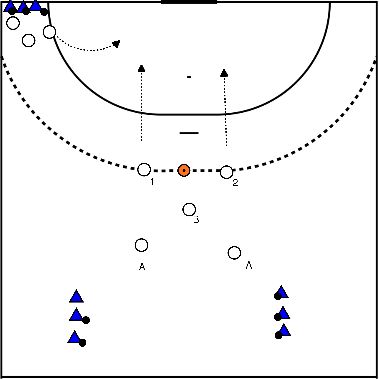
1. CORRECT ROUND
- LH plays to LO
- Takes position deep in the corner
- LH gets the ball back in the run (with bounce) and completes. 3 Pass rhythm.
- In each hoop/bicycle tyre 1 foot.
2. LO ROUNDS
- RO plays the ball in the run to LO
- LO opts:
- A-B-1 (or left past the pylon/defender)
- A-B-2 (or right past the pylon/defender)
3. RO ROUND AFTER
- LO passes the ball to RO
- RO elects:
- A-B-1 (or right past the pylon/defender)
- A-B-2 (or left past the pylon/defender)