


Soccerexercises for u21
Execution
- Start in a stable position on one leg and move around a cone.
- Go into a prone position and quickly stand upright.
- Place the slats between the legs.
- Move the ball to the left or right.
- First, move the leftmost or rightmost leg over the inside of the slats and catch the ball low.
- Repeat step 1.
- Go into a supine position and quickly stand upright.
- Repeat step 3.
- Move the ball to the left or right.
- First, move the right or left leg within the slats to push further and catch the ball.
Objective
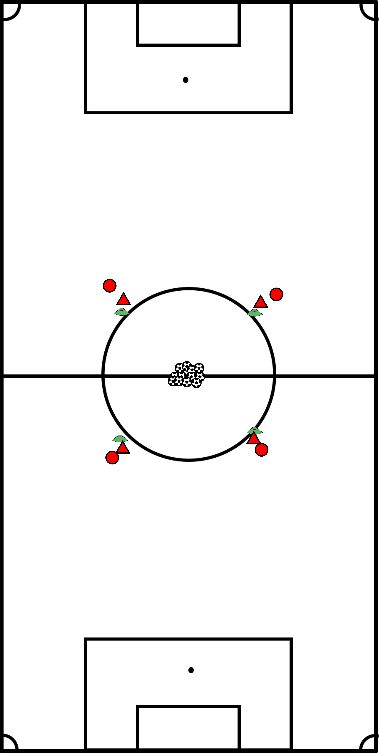
- Try to get 3 balls to your cone as quickly as possible.
- Form 4 pairs.
- Start with 12 balls.
- Each time, 1 player from a pair participates, the other player waits.
- The winner is the one who first has 3 balls at their cone.
- After each round, the second player of the pair goes.
- After each round, 1 ball is removed from the game.
- Do not carry more than 1 ball at a time.
- Only dribbling is allowed.
- The waiting players may not help or hinder.
- It is not allowed to take balls away during dribbling.
- Balls may be taken away from another player.
Execution
- Distance: approximately 10 metres.
- Start with a gentle running pace, repeat 3 times.
- Players stand next to each other on the spot.
- Lift the leg to hip height and bring the arm forward so that the finger reaches shoulder height.
- Then walk at pace, repeating the same leg and arm movement.
- When the right leg goes up, the left arm must also go up.
- The rest of the body remains still.
- Repeat 10 times at a gentle pace.
- Then 10 times at an accelerated pace, paying attention to the technical execution as described above.
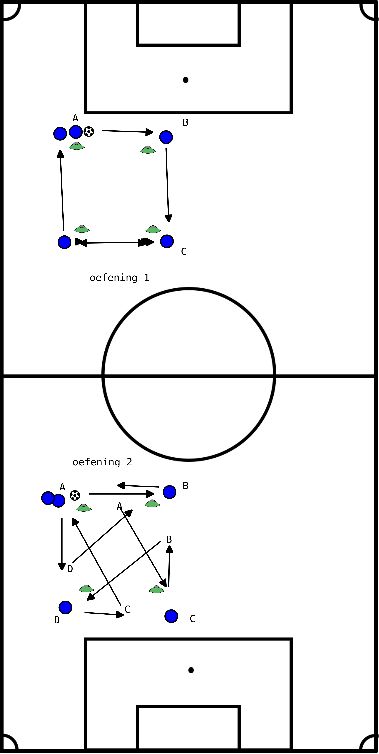
Passing Exercise 1
- Player A passes the ball to Player B and takes over Player B's position. Player B is turned open, receives the ball, and passes it to Player C.
- Passing: Hit the ball in the centre so it stays low. Lift your shooting leg slightly for the correct technique.
- Receiving: Be turned open with your body facing the player you are passing to and keep your eyes on the ball.
- Clockwise: Receive with the left foot, pass with the right foot.
- Counter-clockwise: Receive with the right foot, pass with the left foot.
- Increase the pace if it becomes too easy. Remove the receiving step for more challenge; pass the ball directly.
- Player B calls for the ball. Player A passes to Player B, who drops the ball back to Player A. Player A passes to Player C, who drops the ball back to Player B. Player B passes diagonally to Player D, and so on.
- After passing, the player must continue running to request the ball between the cones.
- The player who returns the ball runs around their cone and requests the ball in the middle.
- When returning the ball, the player must turn quickly towards the grid and not away from the play.
- Switch direction after 8 minutes. Pass clockwise with the right foot, counter-clockwise with the left foot.
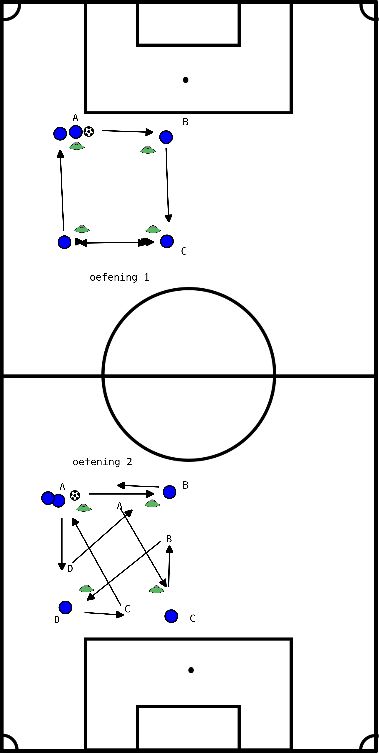
Passing Exercise 1
- Player A passes the ball to Player B and moves to Player B's position.
- Player B opens up, receives the ball, and passes it to Player C.
- Passing: Strike the ball in the centre so it stays low. Lift your shooting leg slightly for proper technique.
- Receiving: Stand open, with your body facing the player you are passing to and keep your eyes on the ball. When playing clockwise, receive with your left foot and pass with your right. Conversely, receive with your right foot and pass with your left.
- Increase the pace if it becomes too easy. If that is also simple, skip the reception and pass the ball directly.
- Player B calls for the ball.
- Player A passes to Player B, who lays it off to Player A.
- Player A passes to Player C, who lays it off to Player B.
- Player B passes diagonally to Player D, and so forth.
- The player passing must continue running and ask for the ball between the cones.
- The player laying off the ball runs around their own cone to request the ball again in the middle.
- When laying off, the player must make the correct turn and keep their eyes on the ball. The turn should be short towards the grid.
Objective
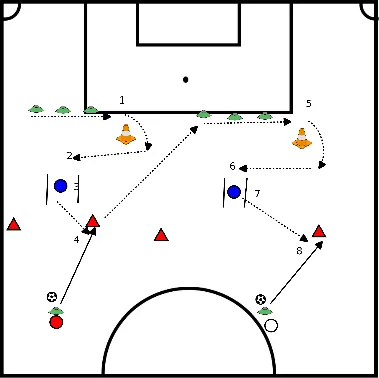
- Defenders attempt to intercept the ball quickly.
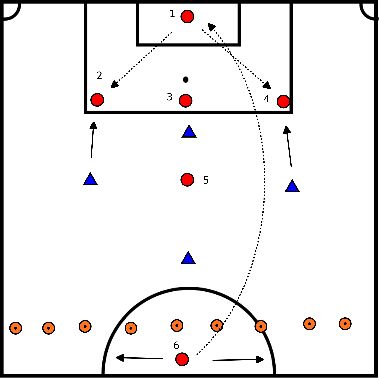
- The play starts with number 6 passing to the goalkeeper.
- The goalkeeper plays directly to number 2 or 4.
- When number 2 or 4 receives the ball, the blue team begins pressing and tries to prevent the penetration pass.
- The red team can "score" by making a penetration pass to number 6, who is allowed to move across the full width within his designated zone.
- The blue team can score in the large goal.
- Number 2 and 5 of the defending team apply immediate pressure on the ball.
- Number 9 of the defending team directly covers the line of the ball.
- Number 4 of the defending team steps directly onto number 5 of the attacking team.
- Number 6 of the attackers moves with the ball and participates in the play.
Setup
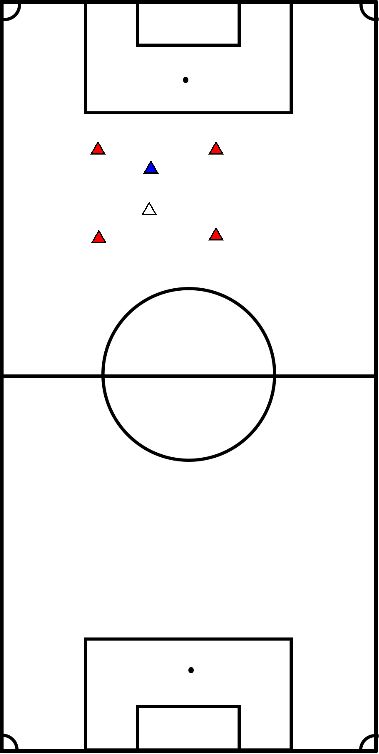
- Red square: 16 metres wide, 15 metres long.
- Blue cone: back line in the middle, 5 metres inside, and another 5 metres further.
- White cone: in the middle and 5 metres outside the area.
- Player B requests the ball by unbalancing the active defender and sprinting to the blue cone.
- Player A passes to B, B passes to C with the active defender at his back, C passes to D.
- D lays the ball wide and C finishes.
- If the active defender captures the ball, he may score.
- The player who loses possession must try to regain the ball.
- The exercise ends as soon as one of the parties scores.
- A becomes defender, defender becomes B, B becomes C, C becomes D, and D joins the back of the line.
- Start by first receiving and playing so B has to deal with a player at his back.
- Then place permanent defenders in the active defender positions and make it a match.
- Whoever scores the most goals in 5 minutes wins.
- Pass the ball at the right speed so your teammate can handle it immediately.
- The position of B is important to shield the ball immediately upon receiving.
Duration: Approximately 15 minutes
Setup:
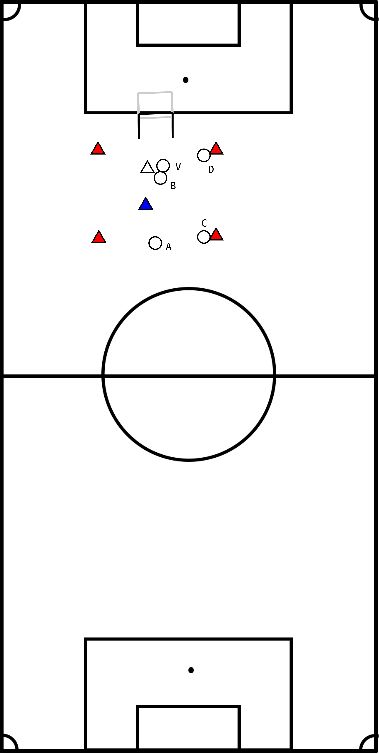
- Red square: 16 metres wide, 15 metres long
- Blue cone: back line, centre point, then 5 metres inward and 5 metres further the white cone
Explanation:
- Player B requests the ball by unbalancing the active defender and sprinting to the blue cone.
- Player A plays to B, B plays to C with the active defender at his back, C plays to D.
- D lays the ball wide and C finishes.
- If the active defender intercepts the ball, he may score.
- The player who loses the ball must try to regain possession.
- The exercise ends when one of the parties scores.
Rotation:
- A becomes the defender, the defender becomes B, B becomes C, C becomes D, and D joins the back.
Execution:
- Start with first receiving and playing so that B has to deal with a player at his back.
- Then place fixed defenders in the active defenders' positions and make it a match.
- The team that scores the most goals in 5 minutes wins.
Note: Defenders remain in positions A-B-C-D.
Coaching moments:
- Correct speed of passing the ball so that the teammate can handle it directly.
- The position of B is important to shield the ball immediately during reception.
Setup
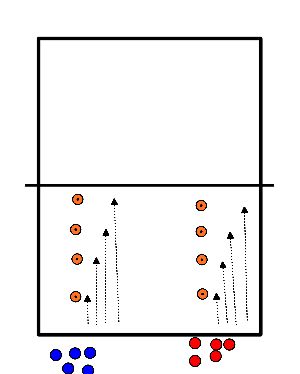
- Create two groups.
- Set up a course with four cones in a row.
- Maintain a distance of approximately 3 metres between the cones.
- At the signal, the first player sprints back and forth to the first cone and returns.
- At each subsequent cone, the player sprints further and then returns.
- At the last cone, the player returns and tags the next player.
- The group that returns first is the winner.
Objective
- Improve the execution of various set pieces.
Execution
- Corner Kick Left/Right: Practise taking corner kicks from both the left and right sides of the pitch.
- Free Kick in Field: Work on free kicks within the field of play, focusing on precision and power.
- Free Kick near the Penalty Area: Practise free kicks near the penalty area, paying attention to technique and effectiveness.
- Throw-in: Improve the technique and tactics when throwing the ball in.
Execution
- The central player runs with speed towards the goal with the ball at their feet and finishes.
- They return to the blue cone in a sprint and pass the ball back to the player at the nearest red cone.
- The player at the red cone dribbles along the flank to approximately the goal line.
- Meanwhile, the starting player returns towards the goal and requests the ball from the opposite flank in their stride.
- They take the ball and finish outside the penalty area.
- The right flank and centre forward dive into the penalty area and finish the cross from the left flank.
Execution
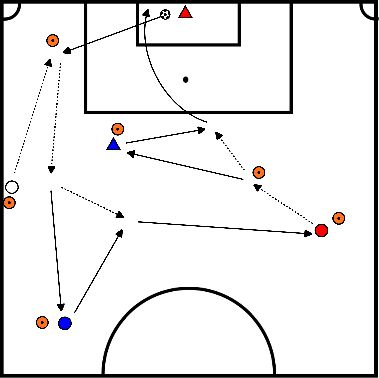
- Player "WHITE" drops back to collect the ball from the goalkeeper. The goalkeeper plays the ball to "WHITE".
- Player "WHITE" dribbles towards player "BLUE". At the level of his starting point, "WHITE" passes to "BLUE" and continues running.
- Player "BLUE" returns the ball to "WHITE". "WHITE" delivers a cross pass to player "RED".
- Player "RED" dribbles towards the penalty area. Around the middle of the field, "RED" passes to "BLUE2".
- Player "BLUE2" returns the ball to "RED". Player "RED" shoots the ball on goal.
- Rotation
- "WHITE" takes the position of "BLUE".
- "BLUE" takes the position of "RED".
- "RED" takes the position of "BLUE2".
- "BLUE2" takes the position of the goalkeeper (if there is no fixed goalkeeper).