



Hockeyexercises for technique attack / offense
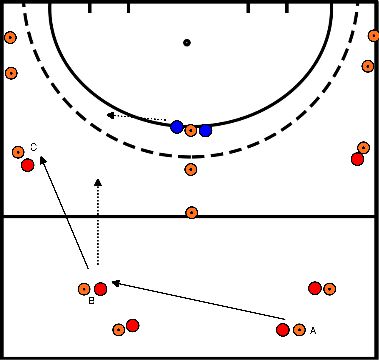
Execution
- Player A delivers a long, hard pass to Player B.
- Player B receives the ball and passes it on to Player C.
- Players B and C engage in a 2-on-1 situation against the defender who applies pressure from the centre.
- If the defender intercepts the ball, they score in the small goal at the side.
Execution
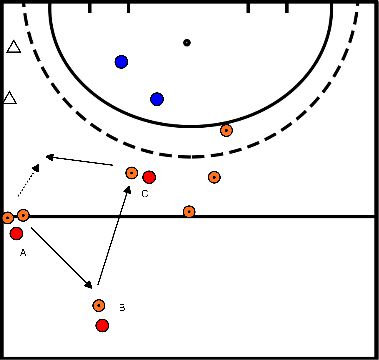
- Player A starts with the ball and passes it back to Player B.
- Player B receives the ball and passes to Player C.
- Player C controls the ball and plays it wide to the advancing Player A.
- From this point, a 3-against-2 situation begins.
- Defenders aim to push the ball outwards by collaborating.
- The objective is to intercept the ball only when the opponent reaches the baseline.
- Afterwards, they attempt to break out using a channel over the forehand side.
- They score in the small goal at the side.
Execution
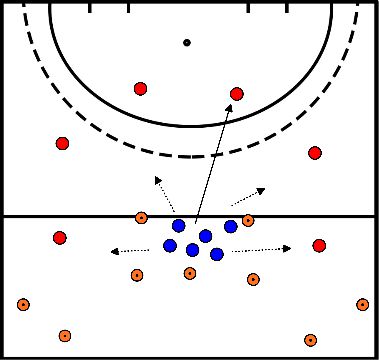
- Divide the group into two teams.
- One team starts in the zone and applies pressure on the players already on the field.
- The players on the field aim to move the ball using the zone and score in the goals on the sides.
- The players in the zone may only leave the zone when the ball has been passed to one of the defenders.
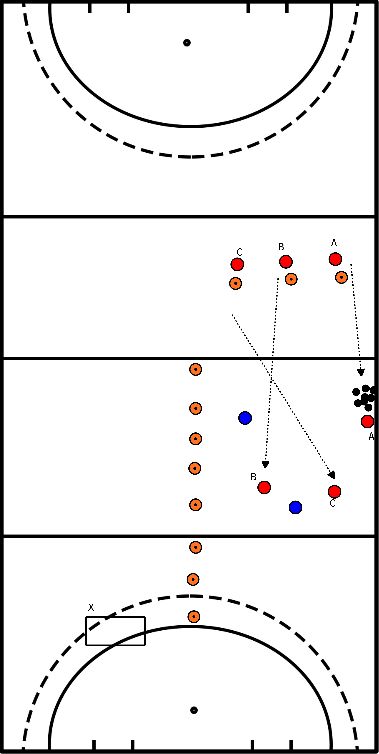
Execution
- Player A runs towards the balls.
- Players B and C move towards the playing field.
- Player A takes the ball and hits it in.
- Players B and C offer themselves as options while being covered by two defenders.
- Player A is allowed to perform a self-pass.
- Attackers try to score in the large goal.
- If defenders gain possession of the ball, they try to score in goal X.
- Quickly taking the ball.
- Offering options by players.
- Running and playing lines.
- Tackle back.
Objective
- Improving passing.
- Improving finishing on goal.
- Use half of the playing field.
- 2 distributors (Z) and 1 goalkeeper.
- Course with one-two passes, dribbling, and finishing on goal.
- After each pass, continue running to receive the ball back from the distributor.
- Pay attention to the position of the goalkeeper before shooting on goal.
- Train different passing movements.
- Practice both leftwards and rightwards.
Execution
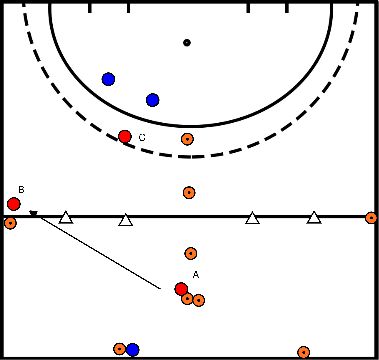
- A starts with the ball and passes to B.
- From here, a 3-on-2 situation begins with a tracking back defender who may start as soon as B has received the ball.
- The defenders try to apply pressure on the ball and ensure that the centre of the field remains closed.
- The attackers try to increase speed to prevent the tracking back defender from assisting in the defence.
- If the defenders regain possession of the ball, they may score in the goal at the 23-metre line.
Instructions
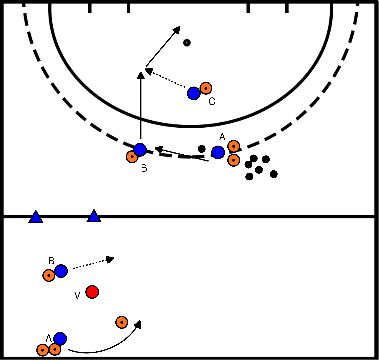
- A starts with the ball and gives a push pass to B.
- B receives the ball and sees that C is running into depth.
- B gives a push pass to C.
- C receives the ball and shoots at goal with a slap shot.
- A starts with the ball and dribbles around the cone.
- From that moment, the defender may try to take the ball away from A.
- A and B want to score together in the goal.
- Try to have them run and give a depth pass.
- Let them try a few times first, then explain what you as a trainer want to see.
Execution
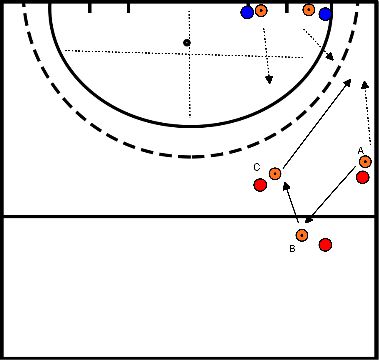
- Player A starts with the ball and passes to Player B.
- Player B receives the ball and passes to Player C.
- Player C receives the ball and plays it into the depth to the advancing Player A.
- Player A receives the ball and from here a 3 versus 2 situation begins.
- Consider the scoring positions in the circle and maintain eye contact with each other.
- For the defenders, communication is crucial; ensure they audibly communicate with each other about their positions.
Execution
- Conclude the training session with a match form on a half field.
- Adjust the width of the field depending on the size of your team during the training session.
Objective
- To seek the flanks instead of hitting the ball through the centre of the field. Teams look for solutions and are inclined to shift the game. This increases the percentage of ball possession.
- Two teams are formed, depending on the number of available players. In the middle of the field, there is a square or rectangle where neither the ball nor the player may pass through.
- Adjust the size of the square or rectangle to change the level of difficulty. The larger this area, the more challenging it becomes.
- You can agree that players may run through the area, but the ball may not pass through it.
- Ensure there are no items in the area and use flat cones to prevent tripping.
- With an odd number of players, you can play with a 'chameleon'. This player always joins the attacking team and thus constantly changes roles.
- Place balls at the side of the field so that when a ball is out, a new ball can be immediately picked up to continue play.
- As a trainer, stand in the middle of the field and coach both teams.
Objective
- Make players understand that getting ahead of your opponent and quickly passing the ball is essential in an attack.
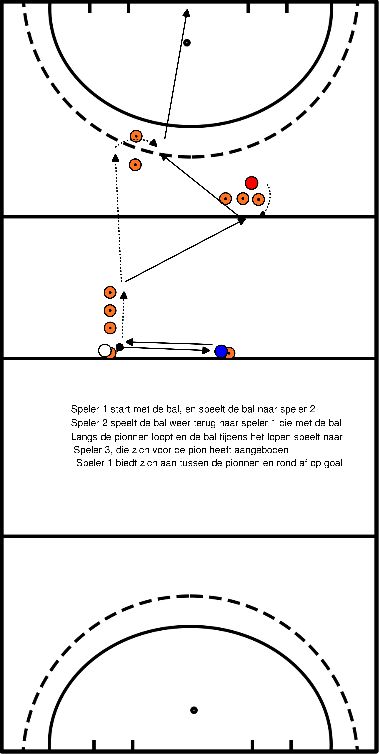
Objective
- As attack: achieve efficiency from your attack.
- As defense: execute clever defensive plays.
- The field is limited to the dotted line.
- The attackers take the ball somewhere on the dotted line and try to score.
- The defenders attempt to clear the ball via the outside.
- The attackers score 3 points for a goal, 2 points for a forced penalty corner, and 1 point for a good scoring opportunity.
- The defenders earn 3 points when they clear the ball by playing between the cones, 2 points for a free hit, and 1 point when the ball goes over the sideline.
- Adjust the size of the teams based on the number of available players.
- Play with one team on the side and switch every 2 to 3 minutes to facilitate rest and discussion.
- Make the cones for the defenders smaller.
- Use a 'chameleon' to give the attackers a numerical advantage if scoring is difficult.
- Ensure clarity on who is marking which opponent.
- Defenders must stay low and avoid fouls.
- Attackers should actively seek a foot.
- As an attacker, target the opponent's backhand; an attack on the right side is often easier.
- Defenders should assist in defending if their direct opponent is not active.