


Tennisexercises for u11
Correct Ball Toss
- Ensure a consistent and accurate ball toss.
- Place your feet in the correct position for stability and balance.
- Use the hammer grip for an effective service.
- Perform a full pronation during the stroke.
- Ensure a good follow-through for maximum power.
Execution
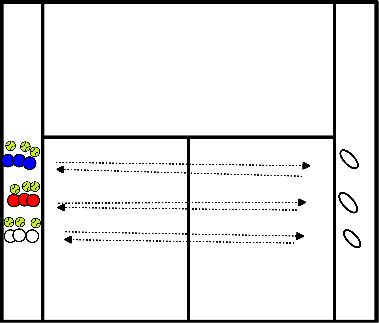
- Divide the players into groups of 2 or 3 and position them on the left side of the court.
- Give each player a tennis ball.
- At the start signal, the first player from each group runs with a ball to the right side of the court.
- Upon reaching the other side, the player places the ball outside the line and runs back as quickly as possible.
- The next player in the group repeats the action with his or her ball.
- When all balls are on the right side and the last player is back with the group, the relay is finished.
- The group whose last player returns first wins.
Preparation
- Use half a court.
- Place cones on the baseline with a tennis ball on top.
- Place an equal number of cones at the net.
- Have the players run with the tennis ball to the opposite cone.
- Let them place the ball on the cone for 2 seconds.
- Have them pick up the ball again and run back to the starting cone.

Execution
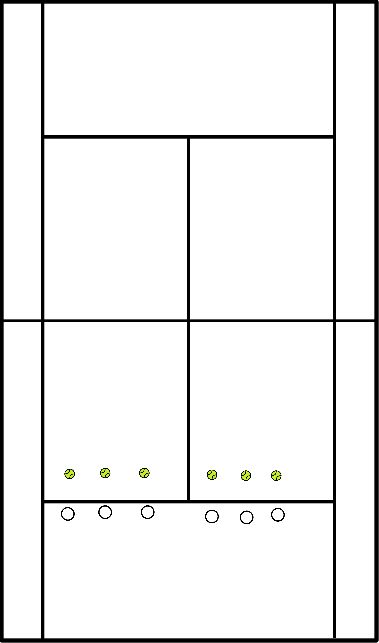
- Place the players in a line next to each other. Approximately 1 metre in front of them, place a tennis ball on the ground.
- Have them stand with their feet slightly apart.
- Quick steps - dribbling - on the spot.
- On the trainer's signal, while dribbling, they perform the following actions:
- Hands on the knees.
- Hands on the toes.
- Hands on the shoulders.
- Hands forward.
- Hands in the air.
- When the trainer shouts "Ball!", they must grab the ball as quickly as possible.
- Repeat and vary the commands for variety.
Execution
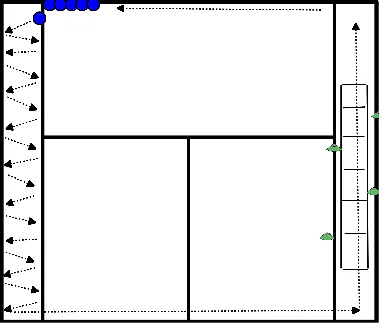
- Have the players stand in a line behind the baseline.
- Let them make lateral close steps one by one within the tramlines.
- Then they run along the net.
- Use an agility ladder for extra challenge.
- Repeat the sequence a few times.
Objective
- The student is able to execute forehand and backhand techniques in various ways in both doubles and singles play.
- Identify the principles that apply when constructing a point.
- Independently initiate and maintain game and practice forms.
- Participate in the lesson with attention and understanding, focus, diligence, and determination.
- Collaborate and communicate effectively.
- Apply knowledge of the rules.
Execution
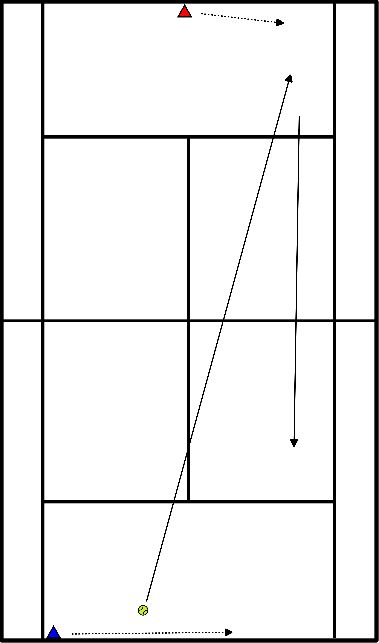
- The player on the opposite side starts in the middle of the court on the baseline and receives a low ball.
- The first ball must be played with a slice straight down the line.
- The player on the trainer's side begins at the singles line with a forehand or backhand, depending on the opposite line of the first ball.
- Play out the rally.
- Can you score with a volley? That earns 3 points.
Introduction
- The trainer briefly discusses the previous lesson: what did we do and what have you learned?
Technical Focus
- Zoom in on forehands and backhands.
Tactical Focus
- Construction of a point.
- Positioning in doubles.
- Collaboration and communication.
Execution
- Try to rally in pairs.
- Create space and hit the ball into the open space.
- Experiment with hitting harder, taking the ball earlier, and deliberately slowing down the game.
Variation
- Use different court lengths to experience how hard, soft, high, low, deep, or shallow the ball should be hit.
Rotation
- After the ball is hit incorrectly twice, the pair swaps with the waiting pair.
- Waiting students can monitor the task and participate mentally.
Execution
- The players stand in the centre of the court.
- One player delivers the ball using their foot, ensuring the ball bounces in a service box.
- The other player is required to approach the net.
- For a lower level: do not approach the net.
Execution
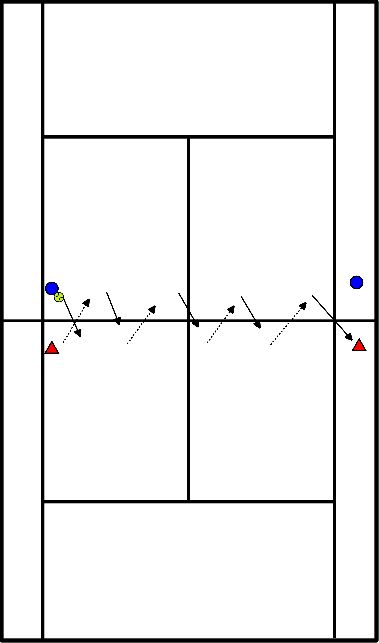
- The players start in one corner of the court on a mini-tennis court.
- They try to volley with each other to the opposite side of the court and back again.
- Count the number of times they can play back and forth.
Execution
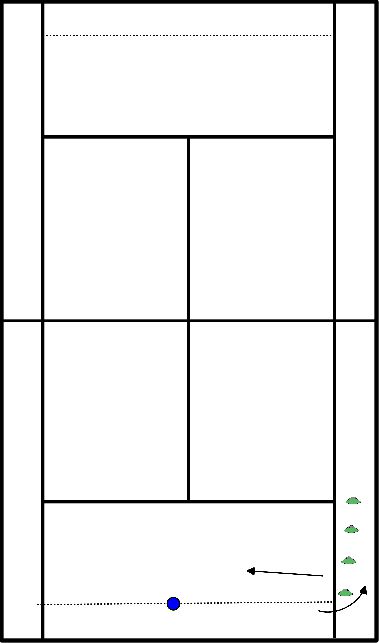
- Four balls are randomly fed.
- After each ball, the student must move around the cone using a sidestep.
- Move from back to front.
- The four cones are lined up one after another within the doubles lines.
Game Rules
- Players compete in singles or doubles, each holding a racket.
- A hoop is placed in the centre between the teams.
- A baby ball (purple ball) is used, and players must hit the ball into the hoop each time.
- If the opponents cannot return the ball and it bounces twice, the other team scores a point.
- Players may pass to each other but must not obstruct.
- Players move continuously around their hoop to create different angles for the opponent.
- Start with singles, then progress to doubles.
- First, play the ball upwards to yourself and then attempt to score (singles).
- Receive the ball from the opponents, play it upwards (pass to a teammate), and the teammate must play the ball into the hoop (doubles).