



Basketballexercises for technique defense
Last update: january 2026
Objective
- Apply pressure on the dribbler during a press.
- Have each player sprint fully along the drawn lines and always close off the sideline.
- Repeat with defensive slides.
- Repeat with alternating slides - sprint - slides.
- Practice with an attacker without the ball. The defender must make slides as long as possible; sprint when necessary.
- The defender must close off the sideline in any case.
- Practice with the ball. The defender forces the attacker to turn at the sideline.
- Keep the exercise short and intensive.
- The defender must stand as close as possible to the attacker, considering the dribbler's skill and speed.
- The defender must use their foot to close off the sideline, forcing the dribbler to turn.
- The defender must accelerate and get in front of the dribbler before closing off the sideline.
- If the dribbler manages to dribble between the sideline and the defender, they may score. The defender continues to defend.
- If the defender succeeds in making the attacker turn at the sideline, they may then dribble, and the attacker becomes the defender.
- Start with a weak dribbler and have them begin with their weak hand.
- Initially, impose restrictions on the attacker: they may only change speed, but not direction, except at the sideline.
- Reduce the restrictions as the defenders improve.
Objective
- Concentration and energy in defence.
Organisation
- 4 versus 4 on one basket.
- New defenders after 3 stops (defenders gain possession).
- After a score or a foul on the shot, the defensive team loses one stop.
- The session lasts 12 minutes.
- The trainer counts down for prolonged attacks: 5-4-3-2-1-0.
Execution
- After 2 stops, the defence intensifies.
- On the third stop, they may attack.
- With 12 players: rotate with 4 after each stop, score, or foul.
- New attackers after each stop, score, or foul (trainer determines fouls).
- The team causing the third stop goes on defence.
Variations
- Three defenders, four attackers.
- 2 or 3 consecutive stops for a switch (with shot clock).
- 35 seconds of defence without a score or foul.
- On a stop, the clock remains, attackers try again.
- On a score, offensive rebound, or foul, the clock resets to 35 seconds.
Advantages 2-1-2 zone:
- strong under the board and at the free throw line
- good fast break possibilities at the moment of the shot
- against good centers and inside teams
- great rebound positions, as the spots in front of the defensive triangle are already taken in advance
Disadvantages 2-1-2 zone:
- vulnerable on the weak side to the end line and center in front of the free throw line
- shooters from close or half distance
Advantages 3-2 zone:
- strength lies in the mobility of the front line, which the opponent must attack aggressively; possibly double-teaming
- shooting from outside the bucket is difficult against this zone
- opportunities for organized fast break
- very useful against inexperienced and technically weak teams
Disadvantages 3-2 zone:
- weak between the two lines and in the corners
- rebound positions can often be less well occupied
- overloading in the corner/side areas is dangerously weak against a good center
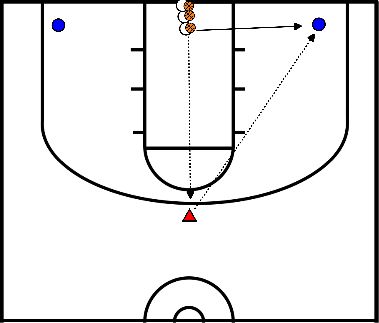
This is a high tempo drill:
- One shooter to the left and one shooter to the right of the Bucket
- The rest of the players stand under the board with a ball
- White passes to the trainer -triangle red
- The trainer passes left or right to one of the shooters
- White provides a good Close Out, going high towards the shooter with 2 arms and contesting the shooter
- The archer tries to hit under pressure
- After 1 minute switch shooters
- Variation: different shooting positions
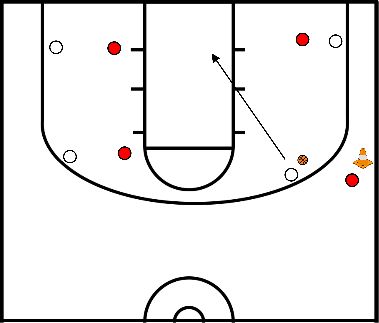
- Starting lineup:
- 4-on-4 on a half court
- The player with the ball has an advantage
- The player with the disadvantage is off the field
- Course:
- Playing 4 against 4
- The right forward has the ball and starts the game
- The player with the disadvantage may only defend when the forward dribbles
- Important is that the players rotate well; helpside defense
- Rotate clockwise on each new play
- Progression:
- The player at a disadvantage stands behind the right forward
- The player at a disadvantage stands next to the right forward
- The player at a disadvantage stands in front of the right forward; disadvantage falls away
- Maximum of 3 dribbles per player
- Regression:
- The player at a disadvantage stands off the field
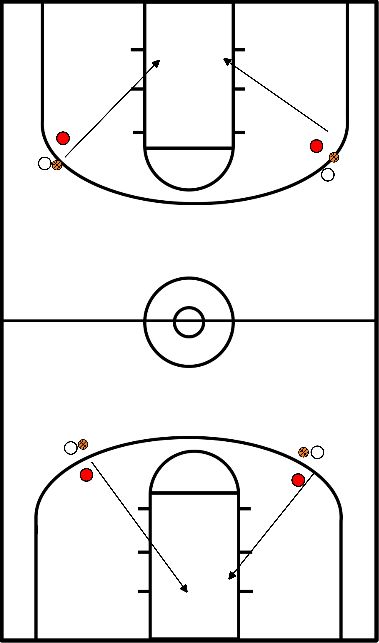
- Starting lineup:
- Each 2 form a team
- Each team has 1 ball
- Maximum of 2 teams per goal
- Conduct:
- Playing 1 against 1
- Defense passes the ball to offense; at the level of the three-point line
- Each team takes turns so we don't get in each other's way
- Each team stays on its own half
- Progression:
- Maximum of 3 dribbles
- Maximum of 3 dribbles
- Regression:
- Defense with 1 hand behind the back
- Defense with both hands behind the back
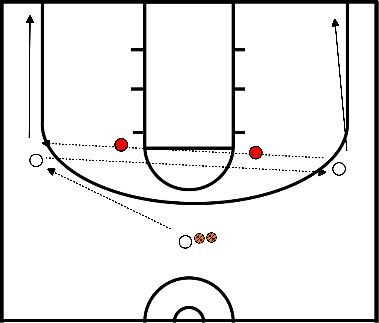
- Setup:
- 2 in defense, one foot each in the bucket
- 2 in offense at the three-point line
- 1 passer
- Passer passes to 1 of the forwards
- Footwork is important, foot defense over foot offense
- Forward passes to the other forward
- Defense adjusts position
- Forward passes to other forward
- Defense adjusts position
- Passer passes second ball to other forward
- And then they go 1 on 1 towards the baseline
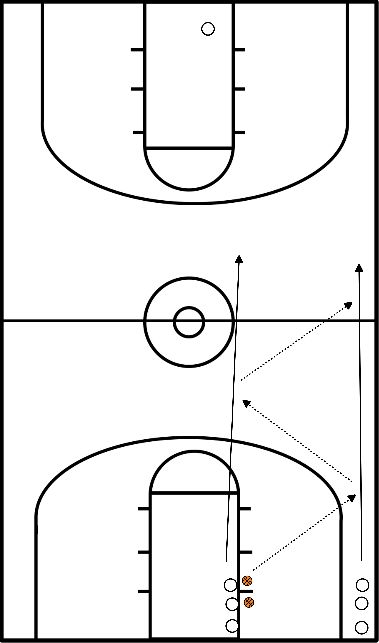
- Setup:
- Everyone baseline
- 1 group at the free throw line with ball
- 1 group near the sideline
- Players give 3 passes to each other
- Important that they walk in a straight line
- After last pass we play 1 against 1, around the middle line
- Defense closes the middle, pushes the attacker to the sideline
- Variation:
- 1 extra defender under the bucket
- Extra defender may only help if the attacker goes baseline
- If the attacker goes to the middle, there is no help
- Do this to oblige the player not to give middle
Setup:
Which team brings in most gold pieces/ pits?
Which team brings in most gold pieces/ pits?
- 1 bank & one-against-all
- 2-4 gangs of thieves
- 1-2 guards.
Game consists of 4 rounds of play:
Game Round 1:
Game Round 1:
- Thief - attacker: per post only 1 active & 1 gold piece at a time try to steal from bank.
- Collect in own vault -hoop-.
- Guard - defender- may only defend outside the bank.
- If the thief is caught so tapped, he must leave the gold piece in the police station -under a cone.
- Which team was able to steal most gold pieces?
Game Round 2:
- Divide gold pieces equally among the thieves.
- Thieves: safely move your gold pieces 1-for-1 to other safe -from one hoop to another.
- Thief -attacker: walk around your cone without the guard catching you.
- Agent -defender: in this case may only defend inside the bank.
- If the thief is caught -attacked, he must leave the gold piece in the police station -under a cone.
- Which team was able to transfer most gold pieces safely?
Game Round 3:
- Thieves: for x time, steal as many gold pieces as possible from other safe.
- Thief -attacker: mandatory back & forth through bank = watch for guard inside bank.
- Guard may only defend inside bank.
- If the thief is caught so tapped, he must leave the gold piece in the police station -under a cone.
Game round 4:
Same as game round 3, but with double guard 1 guard outside & 1 guard inside the bank.
Which team will have the most gold pieces in their possession after 4 rounds of play?
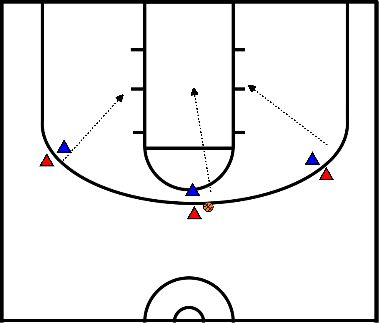
Players will stand offense and defense, facing each other on the three-point line.
- Then an alternating 1 vs 1 situation is started.
- Offense is going to provoke the defense through jab steps, pump fakes and other feints.
- Only when the defender steps on the wrong leg, steps up from his defense before the shot or when there is no reaction, a shot may be fired/passed to score.
The goal of the exercise is to read your defense better and not to lose your triple threat by dribbling immediately.
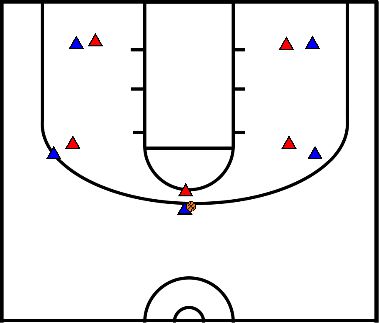
- Players distribute to the bucket.
- Opposite them will be defenders.
- Attackers are going to take care of 8 to 10 passes -straight- while defense tries to get in between.
- Attackers are allowed to make in outs but no screens. So they really stay on their own position.
- The attacker with the ball is allowed to make 1 dribble to get the ball to his teammate and make a good pass.
- After 8 to 10 well-crafted passes there is a scoring attempt after which offense and defense will switch.
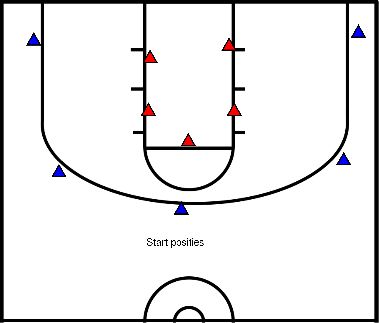
5 attackers and 5 defenders.
- Defenders stand as a zone and start communicating where the ball is and who has the ball.
- Player opposite the ball makes a closeout, the rest move so that they are in the direct pass line or are a good help side.
- Attackers may take 1 step to pass and overhead passes are allowed.
This drill is really about communication.
After 10/15 passes, a shot may be attempted and communication is also important here.
SHOT must be called so that a good boxing out occurs.
After 10/15 passes, a shot may be attempted and communication is also important here.
SHOT must be called so that a good boxing out occurs.
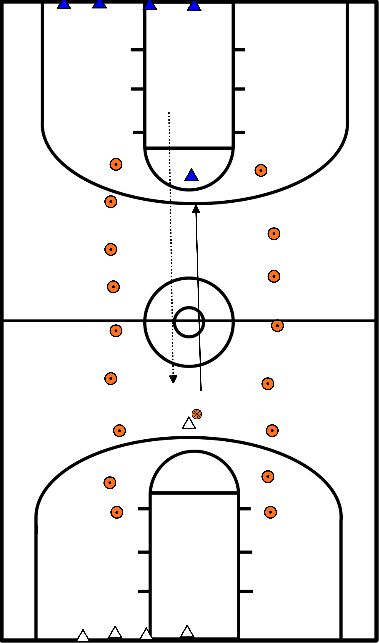
Preparation:
- Set up pawns to fence off the field in which to play.
- Make two teams.
- 1 v 1 situation.
Play:
- If player loses the ball, the ball is intercepted, then no score 1 goal attempt.
- If scored then attacker goes back on defense.
- The first player in line then starts playing 1v1 and after scoring goes back on defense.
- After defending, he or she returns to the back of the line.
At 10 points, one of the two teams has won and the other must run/push ups.
- Split players into groups of 5
- Normally have 2 or 3 baskets available
- For example, switch every 7 minutes
Basket 1
- Shooting game
- 2 teams or 3 teams from the free throw line
- Everyone a ball
- The loser(s) do pushups
Basket 2
- 1x1
Basket 3
- Shooting game with 5 positions
- 2 teams, shoot around (only if you hit the target, move to the next position)
- Start on position 1 and 5, loser does killer run
Basket 4
- Dribble skills (1-2 pawns)
- Over the pylon (do not take it with you, keep control, from left to right, 1 hand behind your back)
- Lift pylon with left hand, dribble with right hand (throw pylon, catch with other hand)
- Left/right and touch pylon (timer, counting) - hand that releases the ball must touch pylon (low position, defend the ball)
- 2 cones, dribble left, touch right
- 2 pawns (8 dribble with 1 hand)
Station 5 dribble skills (row of pawns)
- Zigzag around the pawns, low dribble, back and forth (tempo)
- Variant: low dribble, feet on both sides of the pawns, cross after every pylon
- Low dribble, always touching the according pawn - stay in control, stay on the same side (dribble left, touch pawn with right)
- Divide players into groups of 5.
- Normally we have 2 or 3 baskets available.
- For example, every 7 minutes turn over, first center explanation. (most guidance on the dribbling skills needed)
- Station 1. (Basket 1)
- 3x2 play from the center line without dribbling (only passing, free running, pivoting)
- Station 2. (basket 2)
- 1x1 play (substitution, attacker becomes defender, occasionally change the order to get different match-ups, 1-shot attempt or under time pressure to keep up the momentum)
- Station 3. (Basket 3 - if available)
- Shooting exercise: 5 positions on edge of bucket (low, elbow, free throw line, elbow low).
- 1 player shoots, others catch and pass the ball (1 shot per position, highest score of the group)
- Station 4 dribbling skills. (1-2 pawns)
- Over the pylon (do not take it with you, keep control, from left to right, 1 hand behind your back)
- Lift the pylon with the left, dribble with the right (throw the pylon, catch it with the other hand)
- Left/right and touch pylon (timer, counting) - hand that releases the ball must touch pylon (low position, defend the ball)
- 2 pawns, dribble left, touch right
- 2 cones (8 dribble with 1 hand)
- Station 5 dribbling skills. (row of pawns)
- Slalom around the pawns, low dribble, back and forth (tempo)
- Variant: low dribble, feet on both sides of the pawns, cross after every pylon.
- Low dribble, always touching the according pawns.
- Stay in control, stay on the same side. (dribble left, touch pylon with right)
- Dry practise
- All players on the baseline.
- First player starts in the corner, makes slides.
- Slanting towards line of basket. (Put a pawn down!)
- From there, sprint to the side of the center line.
- Then slides to line of basket.
- Then from there sprint again.
- Practise with attacker - without 1v1
- Pairs with 1 ball.
- Start on the baseline, in the corner.
- 1 attacker, 1 defender.
- Explain position:
- Sit deep.
- Hand in knee.
- Other hand prevents pass.
- Slides to the other side.
- Second round same as above, but from the middle line 1-on-1.
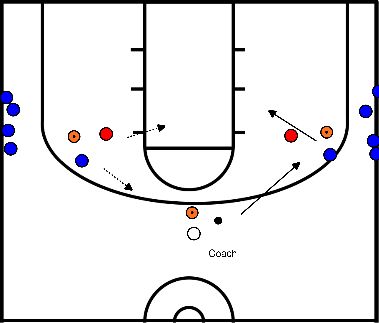
Prerequisites:
- Knowing defensive stance / attacking principle of in-out.
Organization:
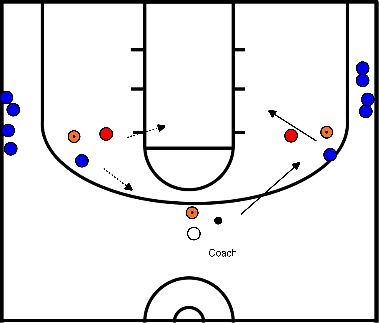
- Coach gives pass on spot one (only attack after four passes/four swings)
- Attacker at spot two and three
- In/out move
- First part of the exercise 1vs1; second part 2vs2
- Passing on: offense becomes defense, defense connects and steps in as offense afterwards (stay on same side)
Goal:
- Teach correct defensive position (denial + help defense)
Teaching points:
- Quickly change position when the ball changes sides, read defenses as attackers (backdoor)
- In/out to the bucket, when defending short, get out to 1m outside 3pt line and use backdoor option, jump to the ball as defender
Prerequisites:
- to know the defensive position
Organization:
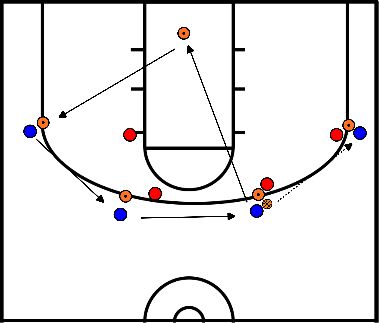
- coach gives pass to spot 1 (only attack after 4 passes/4 swings)
- attacker on spot 2 and 3
- in/out move
- first part of the exercise 1vs1; second part 2vs2
- shuffle through: offense becomes defense, defense connects and joins in as offense afterwards (stay on same side)
Goal:
- To teach the correct defensive position (denial + help defense)
Teaching points:
- Quickly change position when the ball changes sides, read defence as attacker (backdoor)
- In/out to the bucket, when defending short, get out to 1m outside 3pt line and use backdoor option, jump to the ball.
Prerequisites:
- Bit of game insight at fill the spot, be able to apply defensive stance (denail - helpside)
Goal:
- Offence: quickly see where there is an empty spot and cut through after a pass, defence: adjust stance depending on how the ball moves
Organisation
- Four players (U10) on a spot with defence, empty spot under the ring.
- Offence: Pass the ball around and make a quick cutting move towards the empty spot below the ring, other attackers move up and the empty spot is filled in by the cutting attacker.
- Defence: adjust position according to the ball. (hands on the ball, denail, weakside help on the line ring-ring)
- Five passes (calmly), then 4vs4
- Passing on: offence becomes defence, defence steps out and then becomes offence.
Teaching points
- Offence: good pass - in/out to deep bucket and high exit - jump-to-the-ball - placement of feet - attention to running faults
- Defence: anticipate the ball - check correct posture per spot before passing.
Triplets with a ball.
- Trainer throws ball against the board, team must rebound and choose outlet.
- Trainer blocks off one side so they have to pick and ask for the ball!
- Outlet dribbles to the middle and 3X0 completes with a layup (pace.)
- Depending on the level of the U12 explain: outlet, ask for the ball (hands), fill in lines and run attack.
- Trainer can be disruptive at the 2x1, pay attention to left and right handed dribbling.
- players stand at the baseline on 5 lines 1 group in the middle the other 2 groups at the ends of the field the other 2 in between.
- The ball goes from the central player to player 2 who stands to the right of player 1.
- Then player 1 goes behind player 2 and passes player 4.
- While this is happening player 2 passes to player 3, and player 2 runs behind player 3 and past player 5 towards goal.
- Then player 3 passes to player 4 and performs the same overtaking move.
- When this happens, player 3 passes to player 4 and performs the same overtaking move.
- if player 5 is still too far from the goal he passes to player 1 who has to finish
- As soon as this is done the last passer and finisher go back in sprint defence to the other half where they will play 3 against 2.
- From the end of this fastbreak the shotter goes back into defence and the defending players attack.
- option:
- After this they can play 1 vs 1 back.
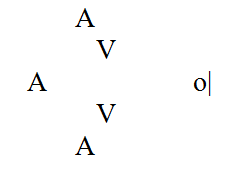
- The attackers are not allowed to move from their spot.
- They play the ball around and if they get the chance, they try to score
- The defenders have to run They try to prevent a goal from being scored
- When defenders are too static and stand by an attacker, you can do 3 things
- Or force the defenders to run by telling at least one of them to run towards the attacker with the ball
- Or tell the attackers they can take 2 steps.
- Or draw a square on the ground where the attackers can move.
- After 5 attempts, the defenders change with 2 new defenders.
- Centers + Guards + Forwards
- 3 Players
- 1 ball
- -a basket
- -2 Cones
Requirements :
Players must be able to dribble and run a layup
Goal :
- To finish off an overtime situation in 2-man break.
- train outlet pass
- to train running line flyer
Organization:
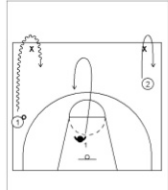
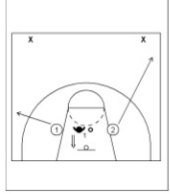
- the defender throws the ball against the board, left or right of the ring
- the attacker on the side of the board takes the outlet position and asks for the ball.
- The flyer sprints away towards the middle line.
- Flyer sprints around the pawn back to the basket.
- outlet dribbles as fast as possible around the other pawn
- the passer sprints to the centre circle, but has 1 foot in there and then goes to defend.
- attackers have 1 goal attempt and max 2 passes.
- the attacker who misses becomes the defender.
Teaching points
- the defender NOT to make any unsportsmanlike mistakes
- defender takes the charge or forces the dribbler to the side of the pitch