




Soccerexercises for u18
- Putting intense pressure on the ball
- We play 5 against 5, and 5 players along the side
- 4 minutes of game play without rest
- Ball out is asking players along the side
- Players along the side also fetch the balls
- 20 x 20
- 4 small goals
- Ball out or goal, direct ball ask along side
- Switching at ball loss
- Direct pressure on the ball
Put intense pressure on the ball.
Conduct:
- We play 4 against 4, rest of the players along the side
- 4 minutes of party play without rest
- ball out is asking players along the side
- players along the side also fetch the balls
- 20 x 20
- 4 small goals
- ball out or goal, ask ball directly along side
- switch at ball loss
- direct pressure on the ball
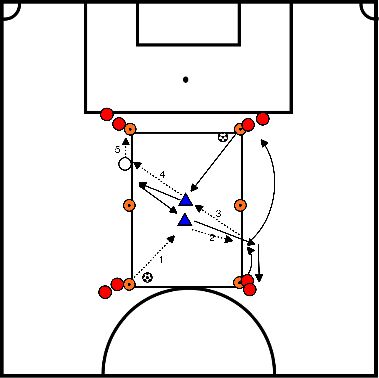
- Exercise to encourage pass running and movement in the field.
- The player on the bottom left plays in to the central player, the central player plays in to player 2 who left from the bottom right.
- The player on the lower left departs at the same time.
- Player 2 rebounds the ball to the 2nd central player and he dribbles to the top left.
- You do the same from the top right downwards!
- Make three lines with four to five players each.
- With pawns, make a start and end point at a distance of 10 to 15 metres from each other.
Execution:
- Have your captain lead this exercise.
- Players walk as a group, in lines of three, from the start to the end. At the end they turn around and form the same line again.
Quality:
- This exercise should be sharp and fast paced.
- Variety of activities can be done: knee up, heels buttocks, short sprints, running backwards, etc.
Progression:
- Increase speed/sharpness as players get warmed up
For this soccer practice, each 2 players are given one ball. They stand about five meters away from each other.
Execution:
- The players do each of the following exercises 10 times with each foot
- Hitting once
- Hit twice (accept and pass again)
- Volley in the feet or on the chest of the team-mate
- With the instep back to the hands or feet
- Thigh, then volley, 10 each leg.
- Chest, then volley, 10 total.
Quality:
- Players stand on their front feet each time during the drill
- All passes must be completed as accurately as possible
The players line up in a circle, ideally 6 to 8 players per circle. Per circle you have only one ball.
Execution:
One player passes the ball to another player, runs after the ball towards the player he plays in â€" the second player receives the ball and plays it again to another player from the circle, he too runs after the ball again towards the player he just played in. This keeps repeating itself.
Quality:
- Passes must be clear and accurate.
- The passes are played over the ground, keep the ball low!
- Just after the pass, the players accelerate (short sprint)
- The players call out the name of the player they want to play in
- All players are constantly on their toes, not flat footed, this is to improve handling speed.
Progression:
- You can make the game more difficult by applying one hit
- You can play with two balls
- Split your team into three teams of four
- 1 ball per team
Implementation:
- Players play the ball around within their team of four in the marked area
Quality:
- Players keep moving constantly, with many tempo changes to find space.
- Each team must try to maintain a diamond shape
- Players should all communicate with teammates, asking for the ball and calling out the name of the player by the person passing the ball
- Passes should arrive well, in space or at the feet.
- Players may not touch each other, nor may the balls touch each other.
- This drill requires great attentiveness from the players.
Progression:
- Limit the number of touches to one or two.
- Add a passive defender who can defend every ball.
- Add a defender who may conquer the ball.
For this fun and interactive football warming up you let the players make a circle around you, about 15 metres away from you. You stand in the middle of the circle.
Execution:
- The starting point of the players is their spot in the circle, they stay “jogging†on their spot.
- Call: “Inside†and all players sprint towards you up to a meter or two away from you. Then they turn around and quickly sprint back to their spot keeping moving.
- Call out “outside†and all players sprint away from you until you call out “backâ€, then everyone returns to their starting position in the circle.
Quality:
- Make sure players are not standing on their flat feet, but always on their toes.
- Players should sweat profusely after this drill.
Progression:
- You can add different variations: sit-ups, push-ups, jump up, knees up at base position, sprint to the right or left while maintaining the circle shape.
- Make groups of 2 for this passing warm-up, with 1 ball per group of 2.
- The players with the ball line up on the sideline. The other players stand opposite, about 6 meters from the player with ball.
Execution:
- Player A dribbles forward, while player B jogs backwards across the field.
- As the players jog across the field, player A passes the ball to B, who passes it back to A, until they reach the opposite sideline.
- The roles reverse when the players reach the other side of the field. Player A then runs backwards to the line where they started.
Quality:
- Have passes alternate from right foot to left foot.
- Players should try to hit the ball once, only if it is really necessary can they hit it twice.
- Focus on quality over speed, it's not a race.
- Don't forget to encourage successes!
Progress:
- Play the ball on the thigh, bring the ball under control and volley back to partner.
- Play the ball on the chest, bring the ball under control and volley back to partner.
- Play the ball on the head, head the ball back to partner.
- For this warm up, set out an area of 30 by 40 yards.
- Give each player a number.
Execution:
Players pass in numerical order: # 1 to # 2 to # 3 etc. as they move through the plotted area.
Quality:
- Use 2-3 balls to increase speed and awareness.
- Make sure players are moving through the entire area and not just staying close to the players they are supposed to pass to.
- Players should all ask for the ball when it is their turn and call out the name of the player they are going to play in themselves.
Advancement:
- Have players perform special actions when making a pass, for example:
- Play the ball in the run. The receiving player must accelerate.
- The odd numbers may only hit once, the even numbers 2 times. Alternate this.
- 6 players with the ball try to dribble to the opposite side without the defender(s) stealing the ball
- If the defender captures the ball and has the ball under control(ball under foot) or if the trio shoots the ballthey get 1 point
- when the defender scores 3 points, another defender comes on
size: depending on age and skill
- length: 20 metres
- width: 10-15 metresalways play this form in a rectangle
- player 1 starts with the ball and has to play the first ball to player 2 and then play 2 against 1
- pair can score on goal with goalkeeper
- defender + goalkeeper can score by dribbling the ball over the linedribble
- when the ball is out dribble in (defender) or pass in (pair)
- at a back ball / corner kick / goal restart
- set out the organisation 2 times and change after 3-4 minutes.
size: depending on age and skill
- length: 20 meter
- Width: 10 meter
Number of players
- 10 players (set out organisation 2x)
Equipment:
- 8 balls
- 4 cones
- 8 caps (4 by 4)
- 2 goals (5 by 2 meters)
- if the trio has passed the ball around 10 times it scores 1 point
- if the defender conquers the ball and has it under control(ball under foot) or if the trio shoots the ballthey get 1 point
- if the defender scores 3 points, another defender joins the game
size: depending on age and skill
- length: 10-12 metres
- width: 7-10 meter
always play this form in a rectangle
- Two players start simultaneously with dribbling to the other side.
- The defender tries to take the ball, and if he succeeds, he gets one point.one point.
- When the players reach the middle square, they can score (shoot) at the large
They can score (shoot) on the big pupil goal.
- After they have aimed at the pawns, they pick up the ball and dribble via the sideline.and dribble back via the ditch.
- After a certain time, they change defenders.
Size: depending on age and skill.
Length: 15-25 meter.
Width: 10-15 meter.
- Three players start simultaneously with dribbling to the other side.
- The defender tries to take the ball away, if he succeeds, he gets one point.
- When the players reach the middle square, they can score (pass-aim) on one of the two small goals.
- After they have aimed at the small goal, they collect the ball and dribble back via the ditch.
- After a certain amount of time, there is a change of defenders.
Size: depending on age and skill. - Length: 15-25 metres.
- Width: 10-15 meter.
- Two players start simultaneously with dribbling to the other side.
- The defender tries to take the ball, and if he succeeds, he gets one point.one point.
- When the players have reached the middle square, they can score (pass-aim) on one of the two small goals.They can score (pass-aim) on one of the two small goals.
- After they have aimed at the small target, they pick up the ball and dribble via the small target.and dribble back via the ditch.
- After a certain time they change their fighter.
Size: depending on age and ability.
Length: 15-25 meter.
Width: 10-15 metres.
- Players can score by stopping the ball at five metres from the goal and score by shooting the ball through one of the holes in the hole cloth, which is suspended in the goal.
- The ball must be shot at the goal, in the holes of the goal. When you have succeeded three times, you move to the next line (seven metres). When you have done this three times more, you move to the champion's line (ten metres).
- The first person to score three times from the champion's line is the Lion King.
- When you have missed twice from a certain line, then move again one line closer to the goal.
- Points only count when the player dribbles back to the starting position via the ditch.
Dimensions: adjust depending on age and skill (e.g. distances to hole 7, 10 and 15 metres).
- Four players start simultaneously with dribbling to the other side.
- The defender tries to take the ball, and if he succeeds, he gets one point.one point.
- When the players have reached the middle square, they can score (pass-aim) on one of the two small goals.They can score (pass-aim) on one of the two small goals.
- After they have aimed at the small target, they pick up the ball and dribble via the small target.and dribble back via the ditch.
- After a certain time, they change defenders.
Size: depending on age and ability.
Length: 15-25 metres.
Width: 10-15 metres.
- One player starts dribbling to the opposite side.
- The defender tries to take the ball away, and if he succeeds, he getshe gets one point.
- When the players have reached the middle square, they may score (shoot) at theThey may score (shoot) at the pupil's goal.
- After they have aimed at the pupil's goal, they pick up the ball and dribble via the playground.and dribble back via the ditch.
- After a certain time, they change defenders.
Size: depending on age and ability.
Length: 15-25 meter.
Width: 10-15 metres.
Number of players:
• 4-10 players (possibly divide into 2 groups and start separately).
Equipment:
Each player one ball.
1-2 vests (only defenders).
12 cones.
One pupil goal.
- Both players can score by pass-aimingthe ball against a pawn .
- When the ball is in touch, dribble in.
- At a back ball or corner kick, dribble in.
Size: depends on age and skill.
Length: 10-20 metres.
Width: 15-30 metres.
Equipment:
• Each player one ball.
4-6 vests (2 colours).
16 cones.
- The attacker with the ball starts dribblingfrom the back line near the small goal towards the pupil's goal.
- The defender without the ballmay try to overtake the player and take the ball.
- Both players can score, the attackers on the bigthe defenders on the small goal.
- When the ball is in touch, the attacker and the defender change places.
- When the attacker has shot at the pupil's goal, he dribbles back to the ditchhe dribbles via the ditch back to the start.
Size: depending on age and ability.
Length: 15-25 metres.
Width: 10-15 metres.
- Four to six players start simultaneously with dribbling to the other side, where theymust dribble through one of the three small goals.
- The defender tries to get rid of the ball, and if he succeeds, he gets one point.he gets one point.
- When the players have reached the other side, they have one point and they can use the sideline to go to the other side.If the players get to the other side, they get one point and can dribble back via the ditch.
Size: depending on age and skill.
Length: 15-25 metres.
Width: 10-15 metres.
- Both players can score by passing between the pawns.
- When you have scored three points from the three-metre line,you move to the next line (five metres). When you have scoredWhen you have scored three points here as well, you move to the championship line.The first player to score three points from the champion's line(seven metres) has won.
- When you miss the pawn two times in a row you move oneline closer.
Organization: Size: depending on ages skill.
Length: 15 metres.
Width: 10-12 meters.
- Players can score by stopping the ball at five metres from the goal and scoring.
- The ball has to be scored in the goal, when you have done this three times, you go to the next line (seven meters), when you have done this three times again, you go to the champions line (ten meters).
- The first person to score three times from the champion's line is the Lion King.
- If you miss twice from a certain line, you move another line closer to the goal.
- Points only count when the player scrambles back to the starting position via the ditch.
Dimensions:
Adjust depending on age and skill (e.g. distances to goal 7, 10 and 15 meters).
- Players can score by stopping the ball at five metres from the goal and score by shooting the ball through one of the holes in the net, which is suspended in the goal.
- The ball must be shot at the goal, in the holes of the goal, When you have succeeded three times, you move to the next line (seven meters). When you have done this again three times, you go to the champion's line (ten meters),
- Whoever is first to score three times from the champion's line is the Lion King.
- If you missed twice from a certain line, then you move another line closer to the goal.
- Points only count when the player dribbles back to the starting position via the ditch.
Dimensions: adjust according to age and skill (e.g. distances to hole screen 7, 10 and 15 metres).
Number of players:
- 4-6 players
Materials:
- Each player one ball,
- 14 pawns,
- 1 pupil goal,
- 1 hole cloth
- Players can score by stopping the ball at three metres from the lions and hitting one of the lions who are standing back to back.
- The ball has to be shot to the lion, when you hit the lion three times from three meters, you can move your pawn one giant step backwards. When you have taken two steps back and hit the lion three times, you are the winner, the Lion King.
Dimensions: depending on age and skill adjust (e.g. 7, 10 and 15 metres).
Requires: 4 lions
- Players can score by stopping the ball at five yards from the lions and hitting one of the lions.
- The ball must be shot against a lion. When you hit a lion, you will get the number of points shown on the lion.
- The first player to get 100 points from the champion's line is the Lion King.
- Points only count when the player dribbles back to the starting position via the ditch.
Dimensions: adjust depending on age and skill (e.g. 7, 10 and 15 metres).
Equipment: 4 lions
- Players can score by stopping the ball at five meters from the goal and score.
- If you score in the corners left or right of the pawn = three points / ball in the middle = one point.When you have five points or more you go to the next line(seven meters). When you have five points or more again you go to the championship line (ten meters).
- The first person to score three times from the champion's line is the Lion King.
- When you have missed twice from a certain line, you move another line closer to the goal.
- Points only count when the player dribbles back to the starting position via the ditch.
Dimensions: Adjust depending on age and skill (e.g. distances to cones 7, 10 and 15 metres).
Number of players: •
4-6 players.
Equipment:-
Each player one ball.
16 cones.
¢ 1 pupil goal.