



Basketballexercises for technique rebounding
Last update: january 2026
Objective
- Train the fast break in a game-like situation.
- Centres, Guards, and Forwards from Under 14, 6 or more players.
- 1 ball, two baskets.
- 2 teams with different coloured shirts.
- Players run around the circle.
- As soon as the coach shoots, they go for the rebound.
- The side that secures the ball runs a fast break to the other end.
- No shot within 5 seconds = push-ups + the other team takes the ball out from the baseline.
- After a score or defensive rebound, the other team runs a fast break back.
- Outlet position and pass.
- Flyer on the other side sprints away at full speed.
- Execute at top speed.
- After a score, immediately take the ball in with an overhead pass.
- Two teams alternately set up in 2 rows.
- Players tip the ball via the board to each other (jumping and tipping as with a tip-in) and join the back of the other row.
- On the coach's signal, the team that has the ball at that moment runs a fast break to the other basket.
- The other team defends.
- With an odd number of players, the larger team always attacks, creating an automatic numerical advantage situation.
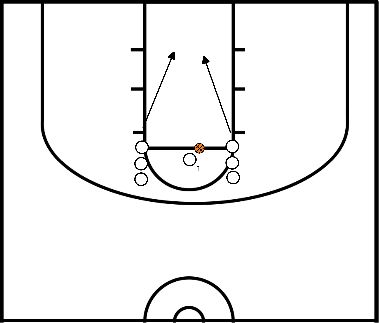
- Starting lineup:
- 1 player stands ready to take the free throw
- 1 player on the left is ready to take the rebound
- 1 player on the right stands ready to take the rebound
- Other players join left and right
- Course:
- Player 1 takes the free throw
- If player 1 scores, he stands and shoots again
- If player 1 misses, then players on the left and right fight for the rebound
- After taking the rebound, the game is played 1 against 1
- The player who scores takes a free throw next
- The player who missed the free throw connects left or right
- The player who did not take the rebound connects on the other side
- Whoever has 10 scores first wins
- Progression:
- Only 1 dribble may be set after the rebound
- Three-point shot
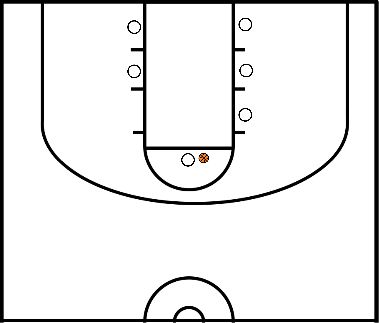
- Starting lineup:
- 1 player at the free throw line
- 5 players stand around the bucket
- Course:
- Player takes the free throw
- Other players fight for the rebound
- 1 point if you score the free throw
- 1 point if you take the rebound
- Play to 5 points
- Each in turn, shuffle through clockwise
- Progression:
- 2 points if it is an offensive rebound
- Play to 7 points
- Regression:
- Having fewer players rebound
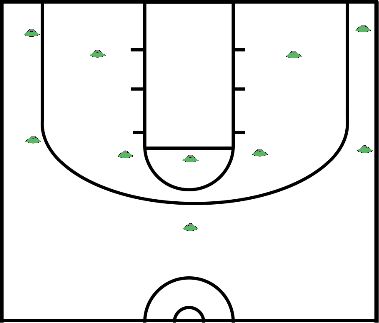
- Player A shoots from 10 different positions, with Player B rebounding and passing tight passes to Player A.
- 10x shots are made from each position.
- Both players take their turn.
- You have about 20 minutes to have both shot, if this is not the case there is a suicide.
- The goal of this exercise is to focus purely on your form.
At the end of the exercise you are asked which of the two has scored the most.
The losing player runs a suicide, should the score be forgotten, both players run a suicide.
The losing player runs a suicide, should the score be forgotten, both players run a suicide.
In this exercise, the basics of rebounding are explained and practiced (again).
Low center of gravity
- Pairs of equal strength, without the ball.
- Each pair backs against each other.
- Start on the baseline, player on the baseline (attacker) tries to push the player with his back towards him (defender) to the opposite side.
- Defender must have his back straight and his knees deep, so that the centre of gravity is low.
- Once on the other side, the players swap roles and go the other way.
Explanation of basic movements
- Watch where the attacker is going.
- Make contact with hand/arm.
- Pivot so your back is turned to your opponent.
- Box out!
Exercise
- Same pair on the baseline, about a metre apart.
- Trainer calls out left or right.
- Attackers then calmly take a few steps towards defender.
- Defender carries out steps.
- NOTE: attacker must step slowly for the exercise!
- After a few rolls, attacker/defender turn around.
Game shape
- Same pair, around the centre circle. (Defender on the circle line, 1 ball in the middle.)
- When the trainer says GO, the attackers try to get the ball, the defenders have to box out!
- After a few rolls attacker/defender turn around.
- One person shoots free throws.
- Two other players stand behind the one who throws the free throw.
- According to the rules of the game
- Once the ball is gone the three players go for the rebound.
- If the person who made the free throw has the ball, he can make another free throw.
- If he doesn't have the ball, the 2 other players go to the other side of the court to attack, 2 against 1.
- If attacker is pressured by defender then go to free man, otherwise keep going until lay-up.
- The next three players get ready to execute the exercise.
- Two teams
- 1 team will slide into the bucket, everyone has a number (front to back)
- Other team is going to stand at the 3 point line
- I pass the ball to someone and then everyone in the bucket will box out someone from outside the bucket.
- Pay attention:
- Agree who defends whom.
- If you box out, make contact first and then turn open
- If the defending team has caught the ball, it can start attacking
- Each score one point, team that has 3 points first.
- Centers + Guards + Forwards
- Starting from U14
- 6 or more players
- 1 ball
- two baskets
Requirements:
- Mastering the basics of a break
Aim:
- break training in a competitive situation
Organization:
- 2 teams with different shirt colors
- the players all run around the circle
- as soon as the coach shoots they're gonna rebound
- the team that captures the ball runs a break on the other side (no shot within 5 seconds = push up + take out other team on the back line)
- after score or defensive rebound the other team runs a break back
Teaching Points:
- outlet position and pass
- flyer on the other side at full speed away
- execute at top speed
- After score, take in position immediately with overhead pass
Variation:
- two teams arranged alternately in 2 rows
- the players tip the ball to each other via the board (jumping and tipping like a tip in)
- and connect to the back of the other row
- at the signal of the coach, the team that is currently picking up the ball runs a break
- on the other basket
- the other team defends
- (with an odd number, the largest team always attacks and there is automatically an excess situation)