



Basketballexercises for u16
Goal: teach defenders how to catch the attacking foul (= penetrate or charge) (and how to handle physical contact)
Principles:
- when the attacker gets closer, move your feet further apart and lower your butt
- Hard forearm across your navel for protection.
- Always land on both buttocks.
- Land in the direction of penetration.
- roll to your shoulders and bring your legs up for protection
- DO NOT catch with your hands to avoid broken wrists.
- scream while falling
Preparatory exercises:
- players line up in defensive stance
- Trainer walks forward
- players put their feet outward, bring the hard forearm in front of their navel and lower their buttocks
- Trainer shouts "charge".
- players fall and roll on
defend the dribbler
- the trainer makes a zigzag movement
- the players make slide steps and drop steps as if they were defending the dribbler
- as the dribbler approaches, players move their feet outward, bring the hard forearm in front of their belly button and lower their buttocks
- trainer calls 'charge
- players fall on both buttocks in the direction of the penetration and roll through
spin dribble
- the trainer simulates a spin dribble
- players take two quick slide steps around their imaginary attacker, land wide, bring the hard forearm in front of their navel and lower their buttocks
- Trainer calls 'charge'.
- players fall on both buttocks in the direction of penetration and roll through
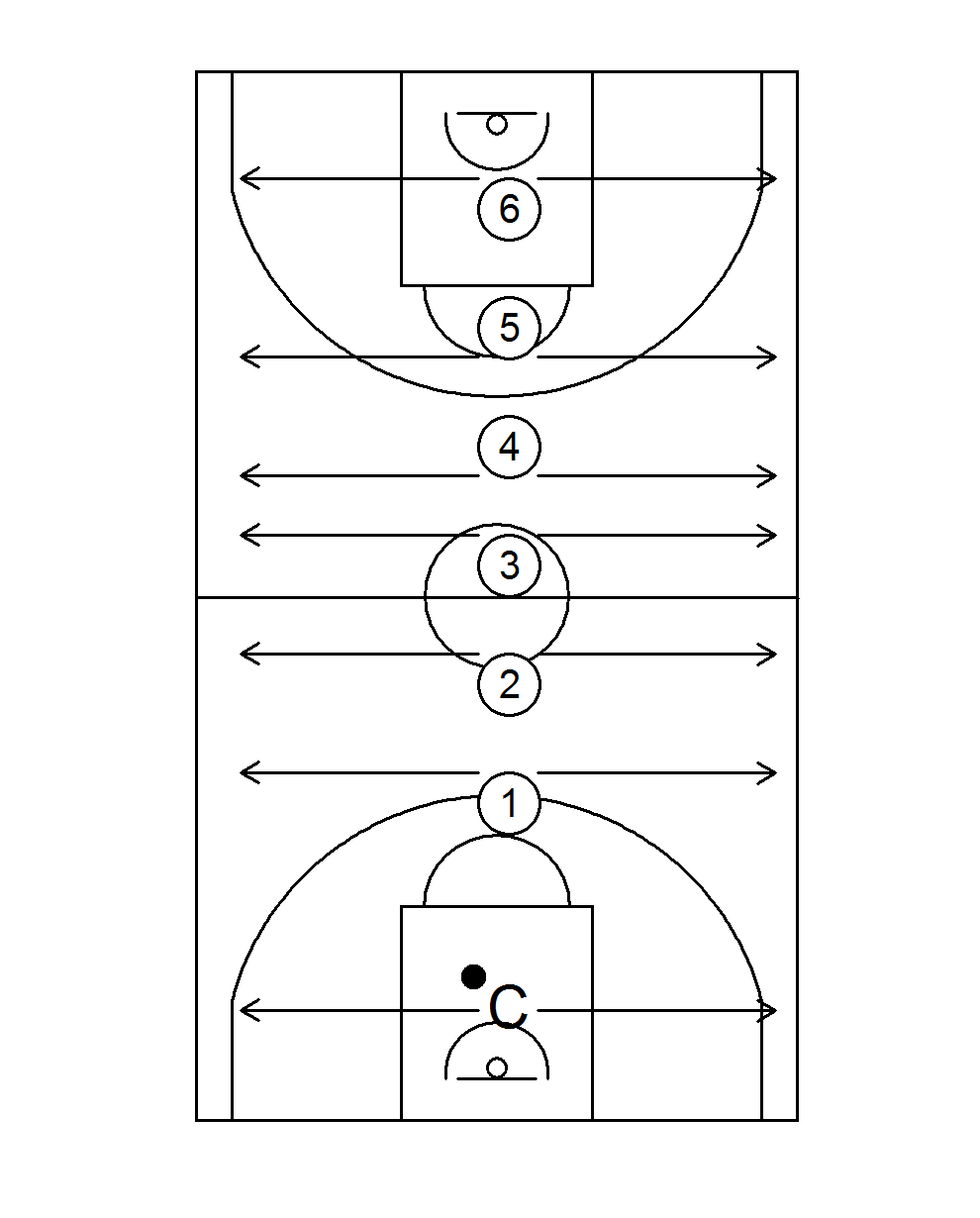
Goal: learn or improve side slides + condition
Organization:
- all players on the helpline, facing the coach
- when coach bounces the ball all players jump into defensive position
- coach moves to the left or to the right, parallel to the backline
- players must stay with their face right in front of the ball
- increase the level of difficulty by changing direction and/or speed at random
Teaching Points:
- feet at least shoulder width
- knees at about 100 degrees (= sitting down deeply)
- shoulders above the heels (= back straight)
- Head upright (overlook the field)
- Hand closest to the ball is low (to be able to tap the ball away on the dribble)
- Other hand is above the shoulder (to intercept a pass)
- push hard on the push-off leg to gain speed
- Feet stay low to the ground (= slide, shuffle)
- feet do not connect after a slide, but remain at shoulder width
Variations:
- let the defender keep his hands on his back if you want to accentuate the feet and stance.
- 1 slide and back to the sideline, 2 slides and back etc. until you reach the sideline; followed by a short fierce sprint back to the sideline
- first a drop step and then slides backwards to the sideline + sprint back
- idem, but first a little tap (quickly transfer weight from one foot to the other)
Prerequisites:
players must know what the correct defensive stance is
Goal:
- to reinforce good habits regarding defensive position
- To increase speed and flexibility of footwork
Organisation:
- always 3 minutes
- back over the backline with sprint to the basket and then slides to the sideline facing the centre circle.
- facing each other slowly - wax on wax off
- faster - hold both hands
- only the back hand
- follower holds the leader's shirt
- leader tries to get free by changing speed
- follower tries to keep his head in front of the chest of the leader
Teaching points:
- knees bent
- shoulders above the feet
- front foot pointing in the direction
- hands: wax on - wax off
Prerequisites:
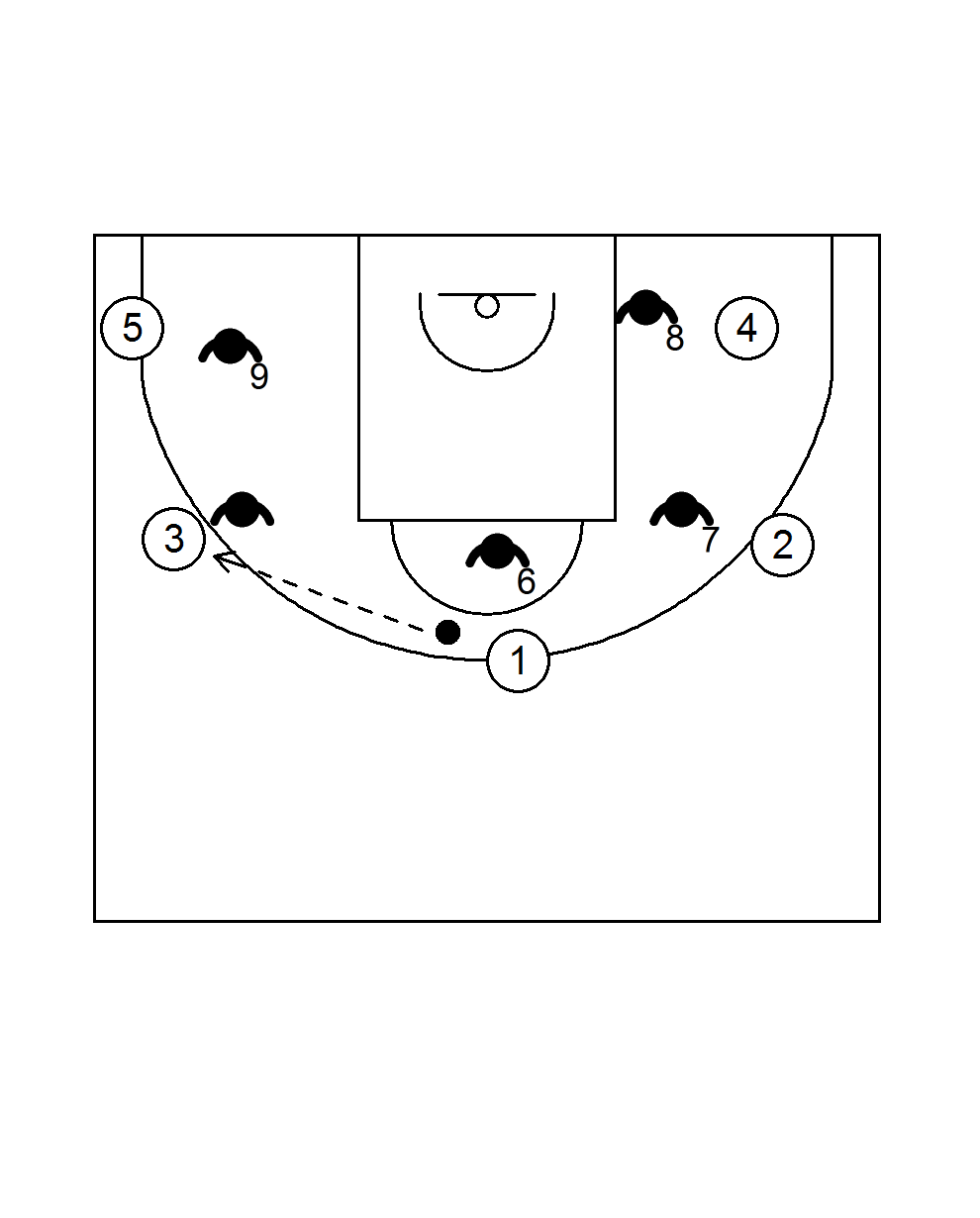
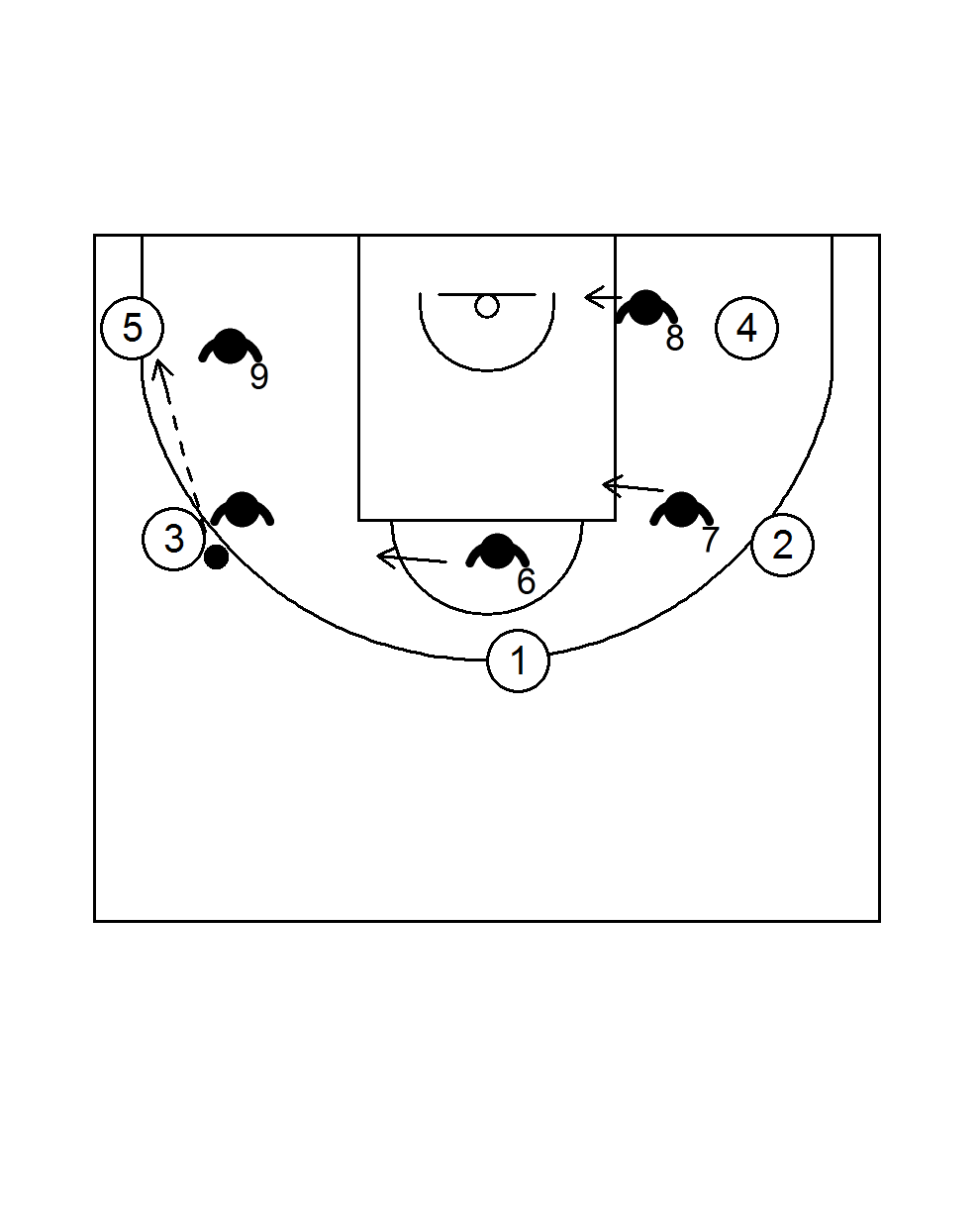
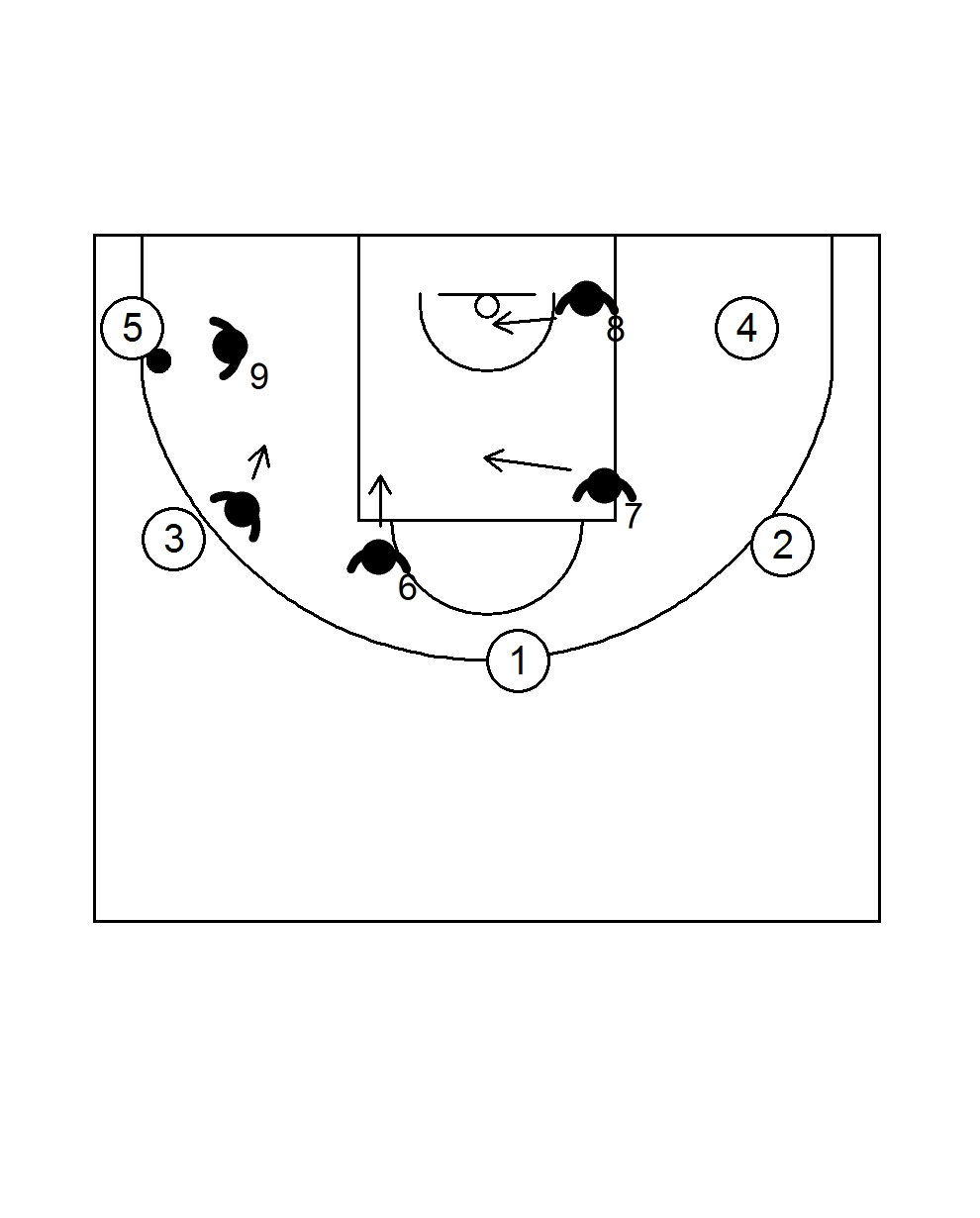
players must understand the principles of help side and ball side defense
Goal:
To create automatisms in defence
Organization:
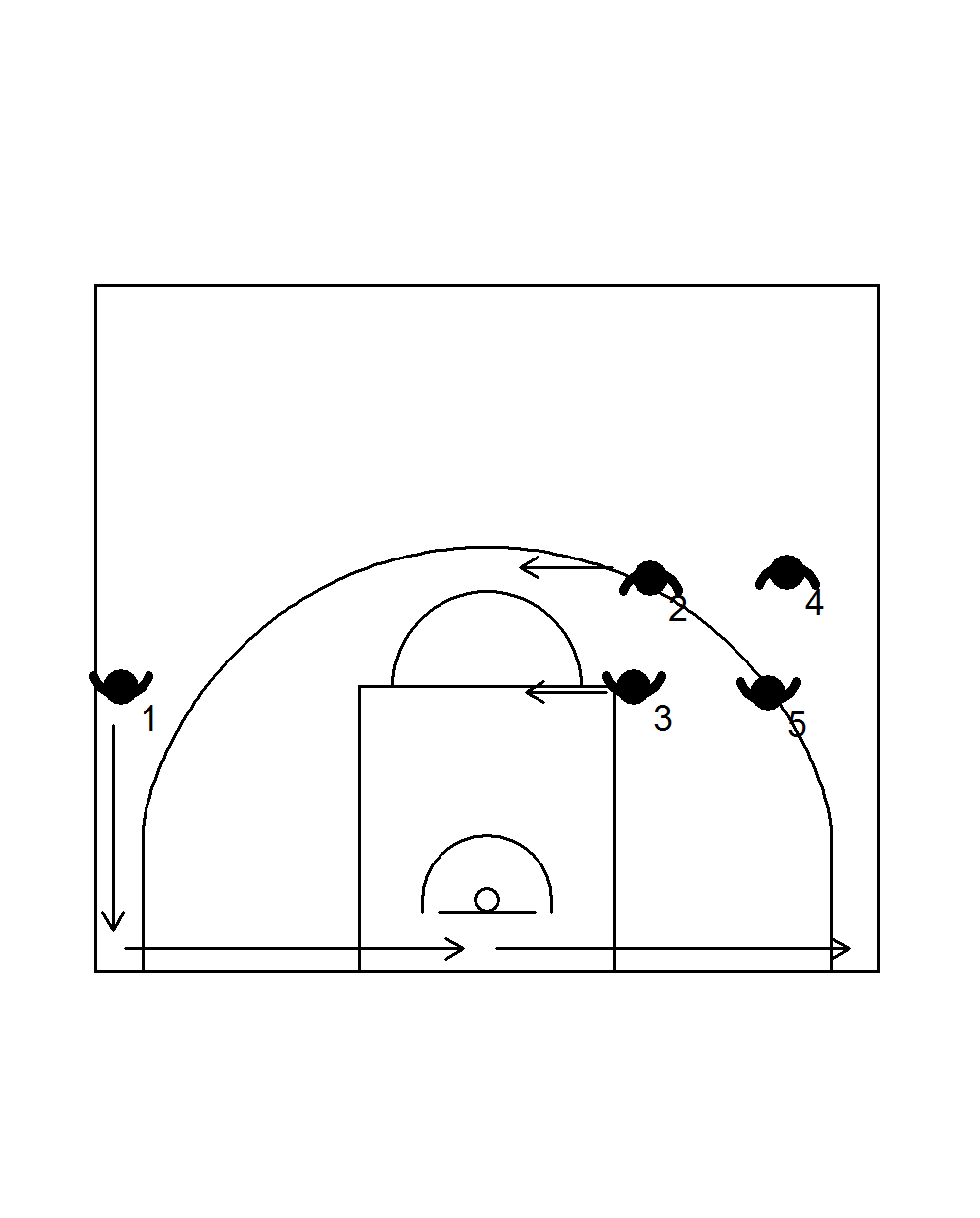
5 against 5 on one basket
Successively:
- pass only
- pass + cut + fill in
- drive left + turn the wheel and the same player does a back up dribble + drive right + turn the wheel
- then he passes and cuts to the weak side
- the same with a skip pass after the two drives
- centre comes in from the weak side = catching and forcing a cut to the back
- both forwards cut in from the weak side in quick succession
Variation:
- play with 4 out
- allow the first pass to the centre
- Defender of the center takes up his position between man and basket while the ball is in the air with a hop.
- passer cuts past the post
- centre passes out to the head
Teaching points:
- all defenders move to their new position while the ball is in the air
- cutting in after a pass = jump to the ball - catch with the chest and force the ball to be cut in behind you
- cutting in from the weak side catch the player with your forearm and force him to cut behind you
- recover immediately after you have helped and the ball is passed out
- aggressive sprint + mini slides + sitting deep at close out after skip pass
- centre passes to the head = his defender has to be 'up the line and on the line
Requirements:
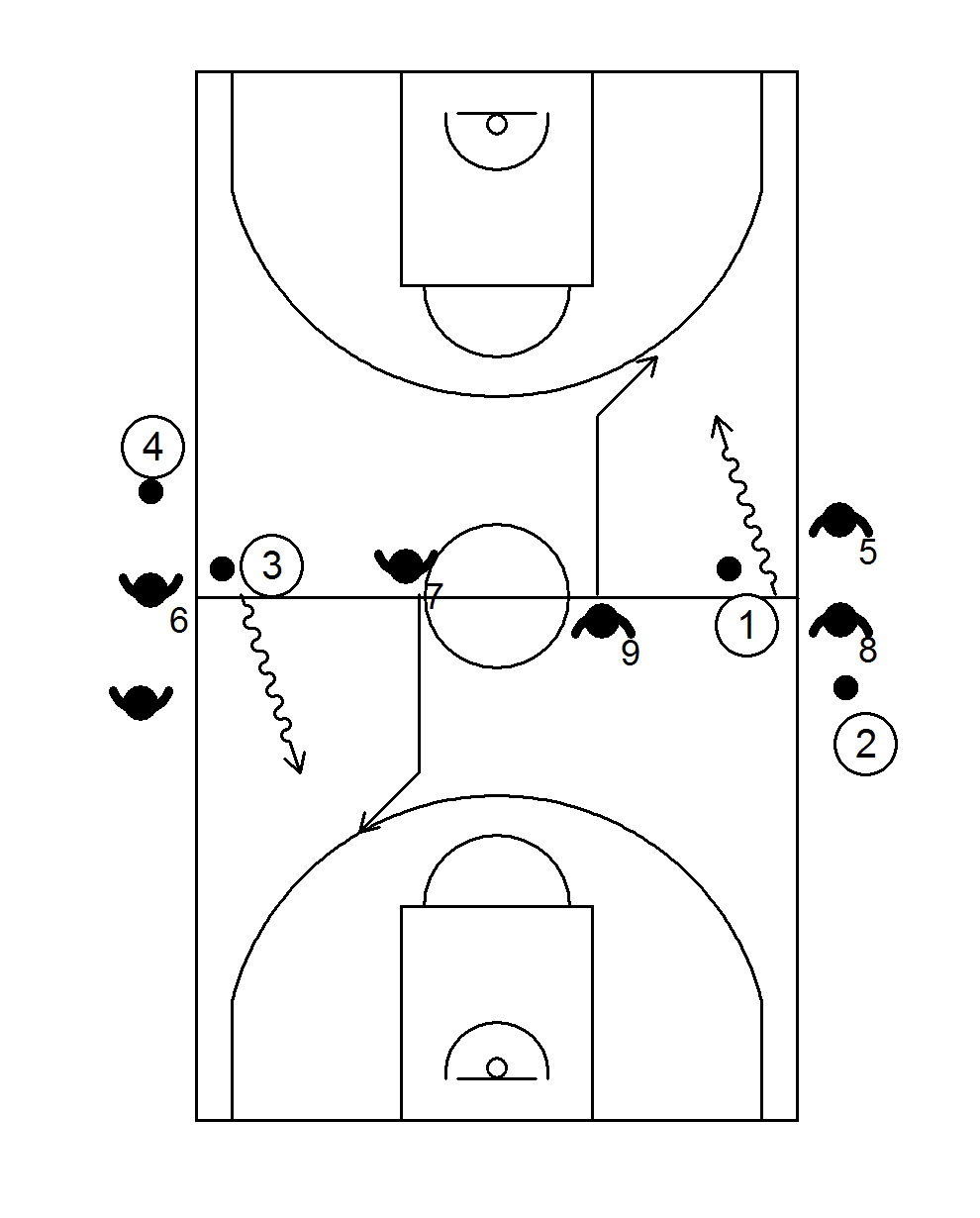
players must be able to defend the man with the ball individually (slides)
Goal: apply individual defensive technique in a simplified game situation
Organisation:
- attackers use one quarter of the playing field
- is not allowed to cross the baseline
- plays 1 against 1
- the defender may only step over the half-way line once the attacker has put one foot over the half-way line (the attacker may make feints, if the defender steps too early he must first put both his legs back behind the line)
- the defender first has to sprint to get his position between man and basket, then stay with slides between man and basket
- winner will attack on the other half of the court
- Loser keeps on defending in this quarter (turning in at the halfway line).
- the next pair starts when the predecessor takes the rebound.
Teaching Points:
- make sure you overtake the attacker by a large margin and only then take the defensive position.
- then immediately move backwards with slides
- In case of a defensive fault, the attacker is the winner.
Variations:
- let the defender keep his hands behind his back if you want to accentuate his footwork
- You can give good defenders a handicap by having them start 1 or 2 steps behind the attacker
- attackers can be slowed down by having them dribble behind their back in front of the 3-point line, etc.
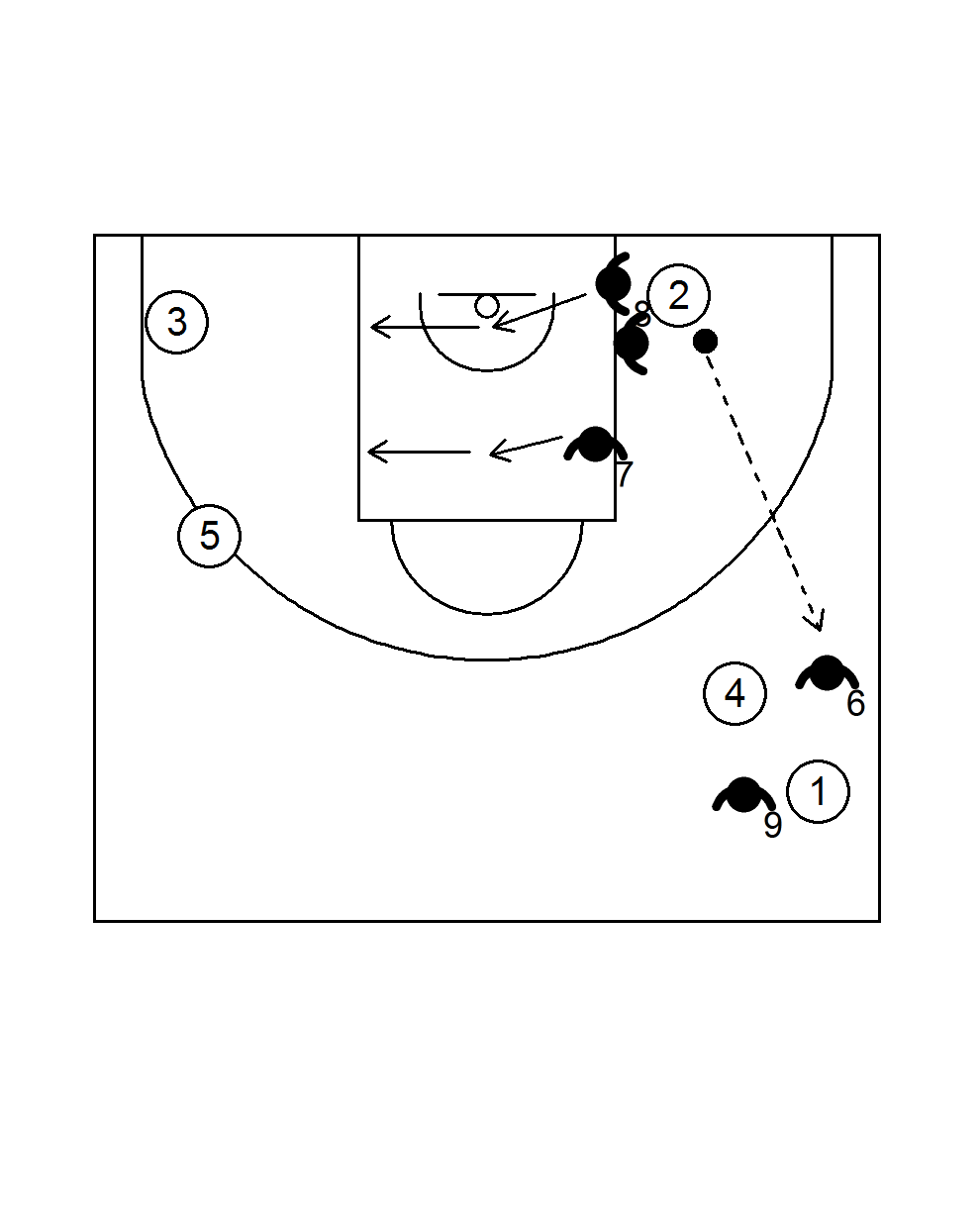
Prerequisites:
players must know how to use slides and sprints to keep their position between man and basket
Objective:
to teach positioning in the help side
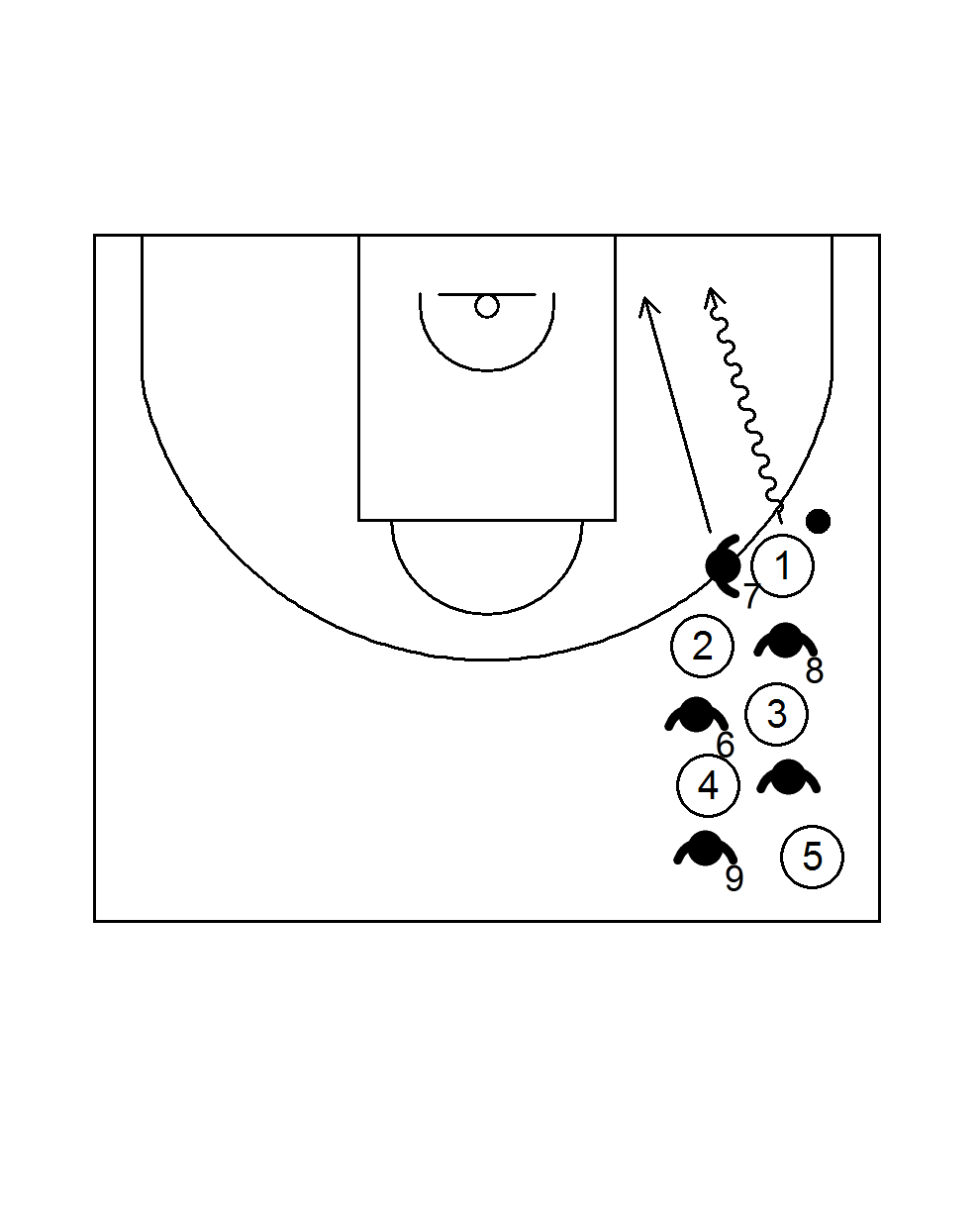
Organisation:
- in the waiting line white and black take turns; offensive and defensive
- stop at the side of the bucket, pass the ball backwards to the next player
- closing the back and changing roles (attacker and defender).
Teaching Points:
- forearm on the hip of the dribbler
- sit deep
- Keep your nose in front of the ball
- Make sure you stay between man and basket until you get below the block
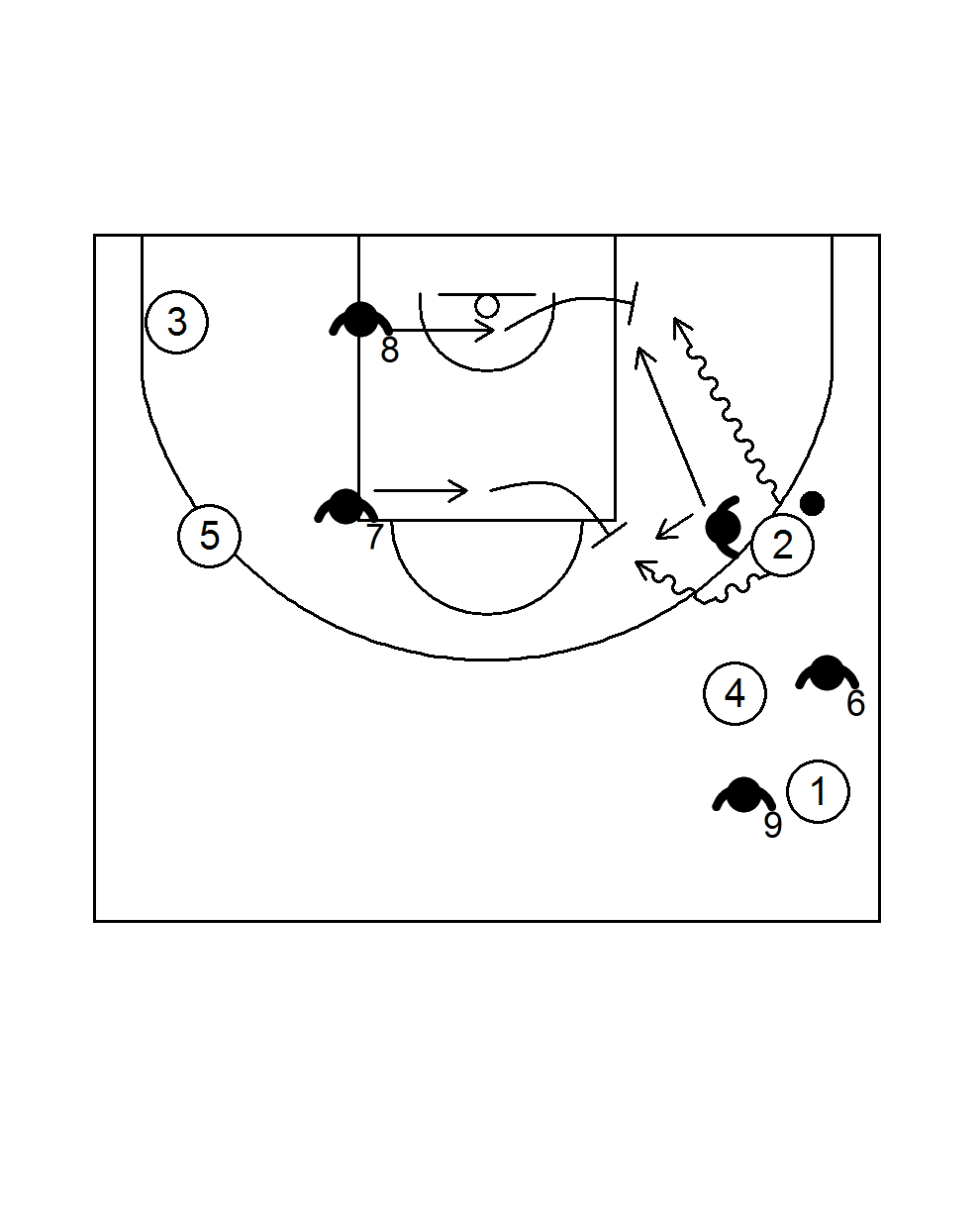
With two defenders on the help side:
- The help side defenders start with one foot in the bucket.
- As soon as the dribbler goes below the free throw line, both help side defenders step in until they reach the helpline.
- when the dribbler passes his man, they close the way to the basket (under the block or above the elbow)
RECOVERY:
- Â- as soon as the dribbler picks up the ball they sprint back to their position on the helpline
- Â- if he passes the ball back to the guard line, then the help position side bucket
Teaching points:
- defend close to the dribbler; don't leave room for feints
- only really help to stop the dribbler after he has passed his man
- but at all times prevent the dribbler from entering the bucket.
- recover immediately after you have helped and the ball is picked up or passed to the passer
- in the assisting position, your chest is parallel to the imaginary line between the ball and your man
- Split vision: see the ball AND your own man
- until you actually start to help Then you let go of your man and concentrate fully on stopping the dribbler
- when the ball is passed out, all defenders move to their new position while it is in the air
Rotation:
dribbler 2 and his defender take the bottom positions is3
and 8 go up5
and 7 join the back row the
defenders on the weak side are always the same colour as the defender on ball side
Variation:
- start with a skip pass
- 4 starts from the helpline
Teaching points for the recovery and close out:
- sprint two steps towards your man
- then use minislides to reduce the distance to an arm's length while lowering your hips.
- raise one hand to be able to block the shot
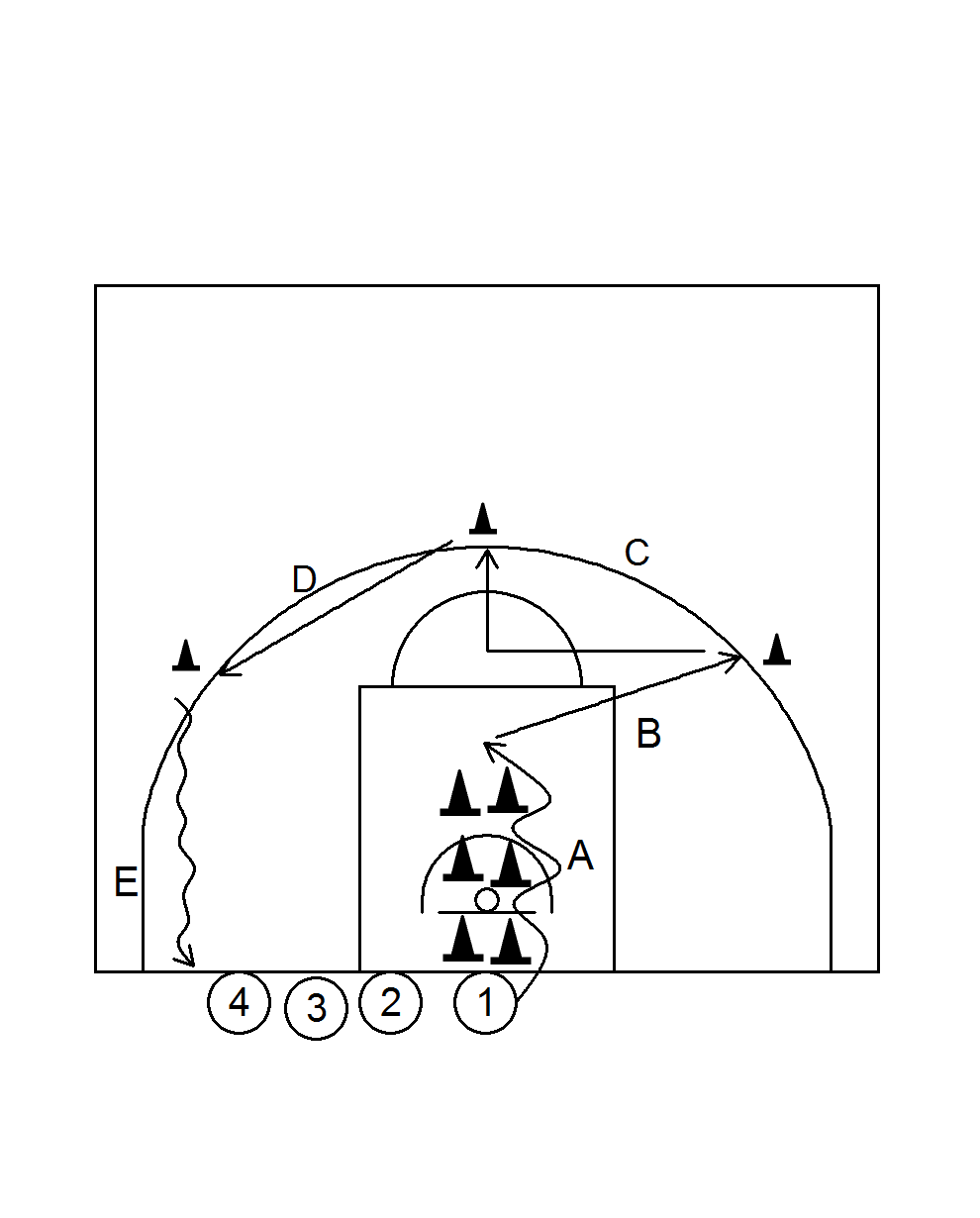
Prerequisites:
players must master slides and a close out of the shooter
Objective:
- to instill good defensive footwork
- increase speed and flexibility of footwork, plus fitness
Organization:
always 3 minutes
A jump strength
- start in defensive stance
- take off with two feet, jump high over the cones (try to touch your chest with your knees)
- land in balance, spring through the knees, feet at shoulder width
- and jump directly over the next cones.
B close out weak side shooter
- two explosive sprint steps, then lower your hips a bit + reduce step size
- inside foot in front
- outside hand in the face of the archer
- Touch the pawn with your inside hand (= check that you are sitting deep enough)
- take off with 2 feet and jump as high as possible with both arms stretched to block the imaginary shot
C help stopping penetration of the guard
- two explosive sprint steps, then lower your hips a bit + reduce step size + turn a quarter
- feet parallel
- arms wide
- quick step straight forward + pull in the back foot (in the game when the guard stops and shoots)
- tap the pawn with your hand
- push off with 2 feet and jump as high as possible with both arms extended to block the imaginary shot.
D defend the dribbler
- land in defensive stance
- powerful sllide steps to just in front of the pawn
- arms wide
- touch the pawn with your outside hand (= check that your seat is deep enough)
- take off with 2 feet and jump as high as possible with both arms stretched to block the imaginary shot
E turn the hips
- Face and chest parallel to the sideline.
- walk crosswise towards the backline
- alternately put the right foot in front of and behind the left leg
- while doing so the pelvis rotates which increases the flexibility of the hips.
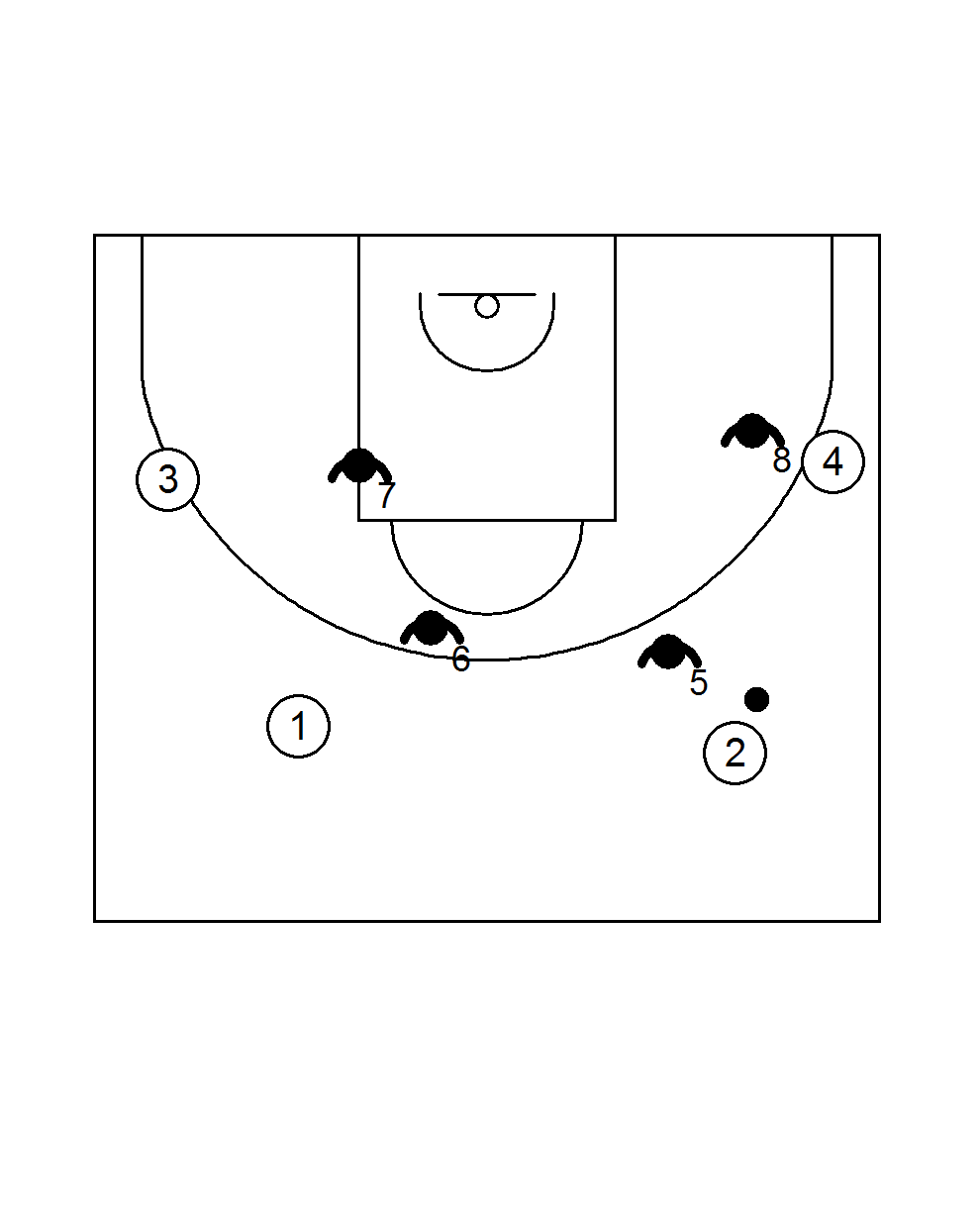
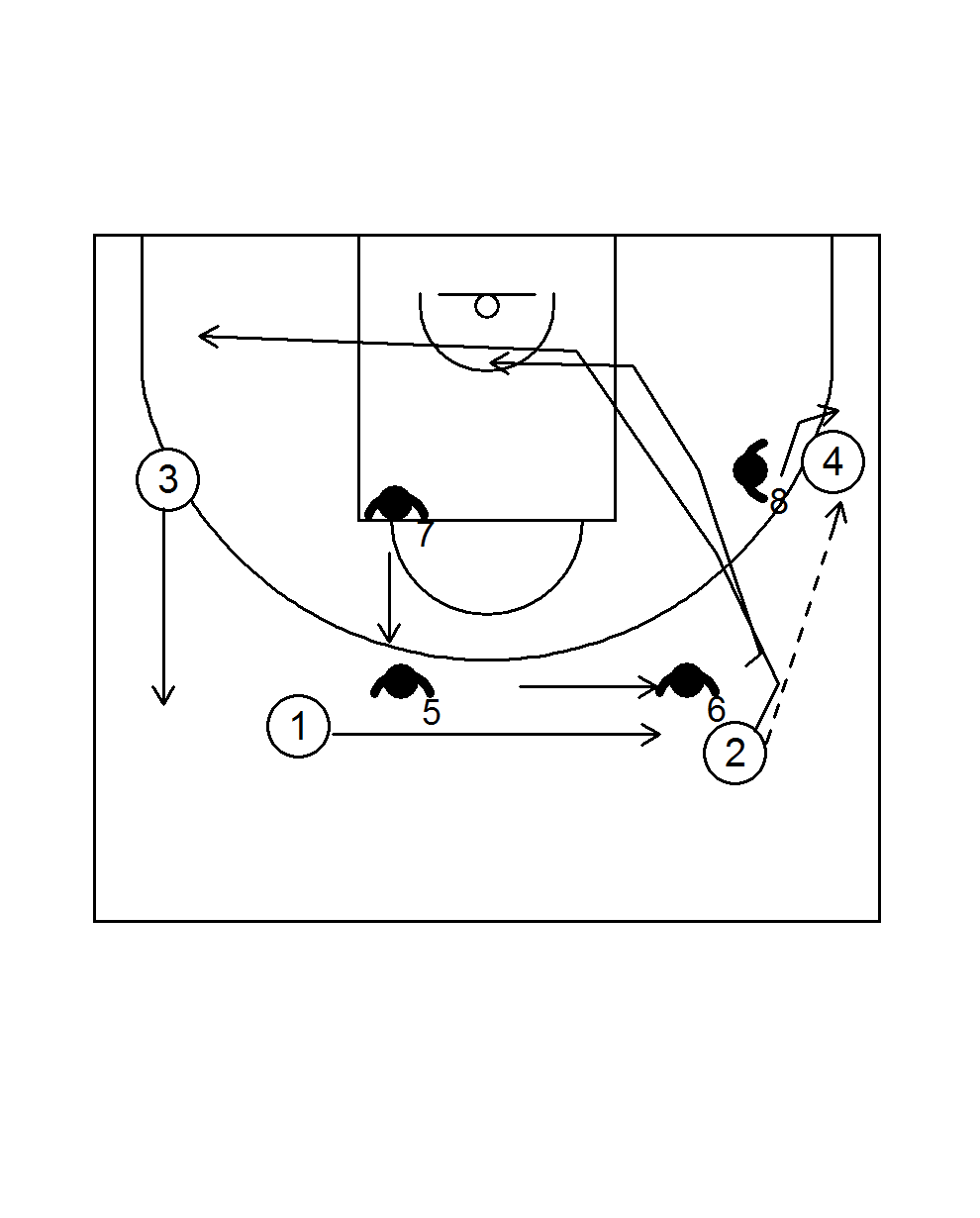
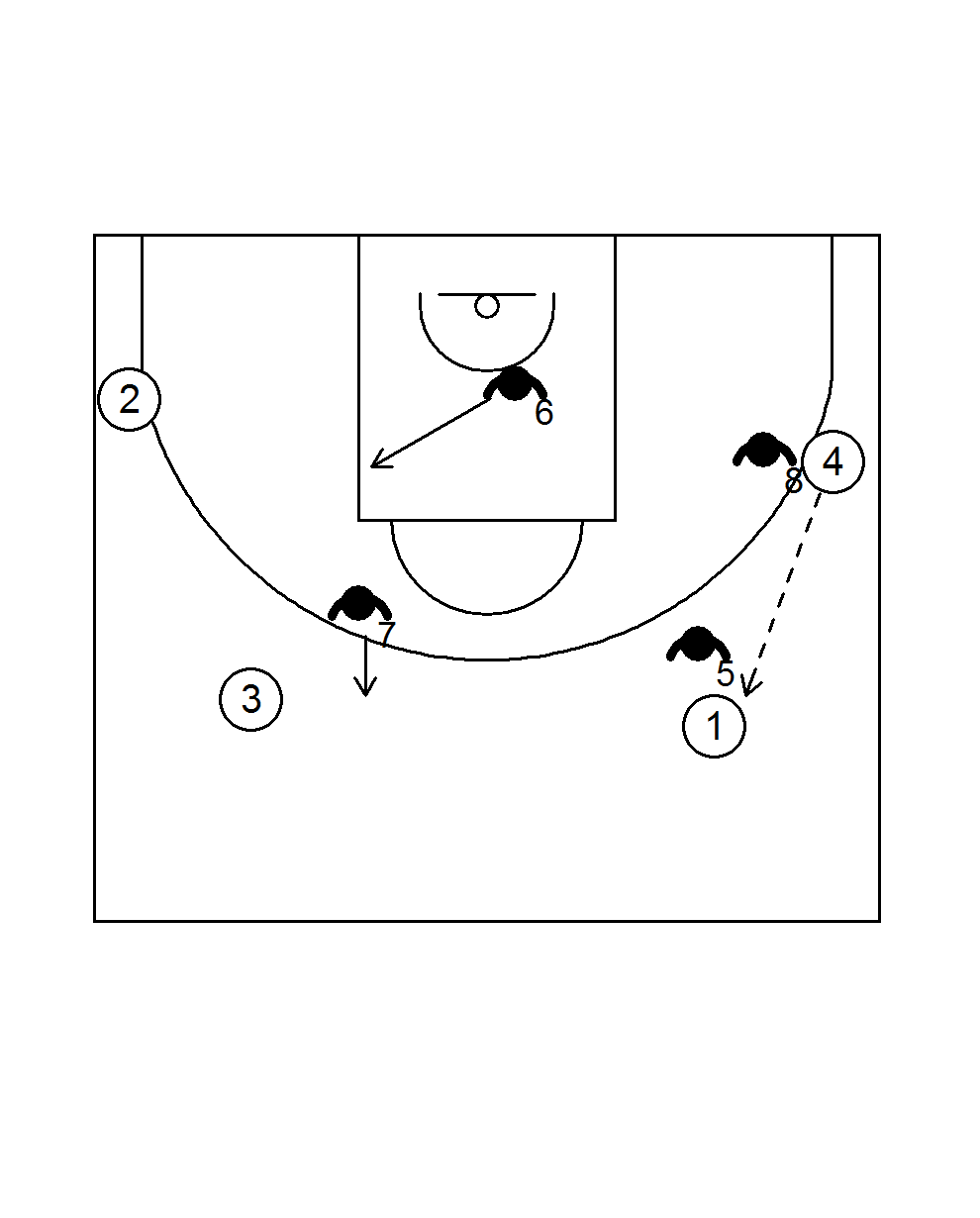
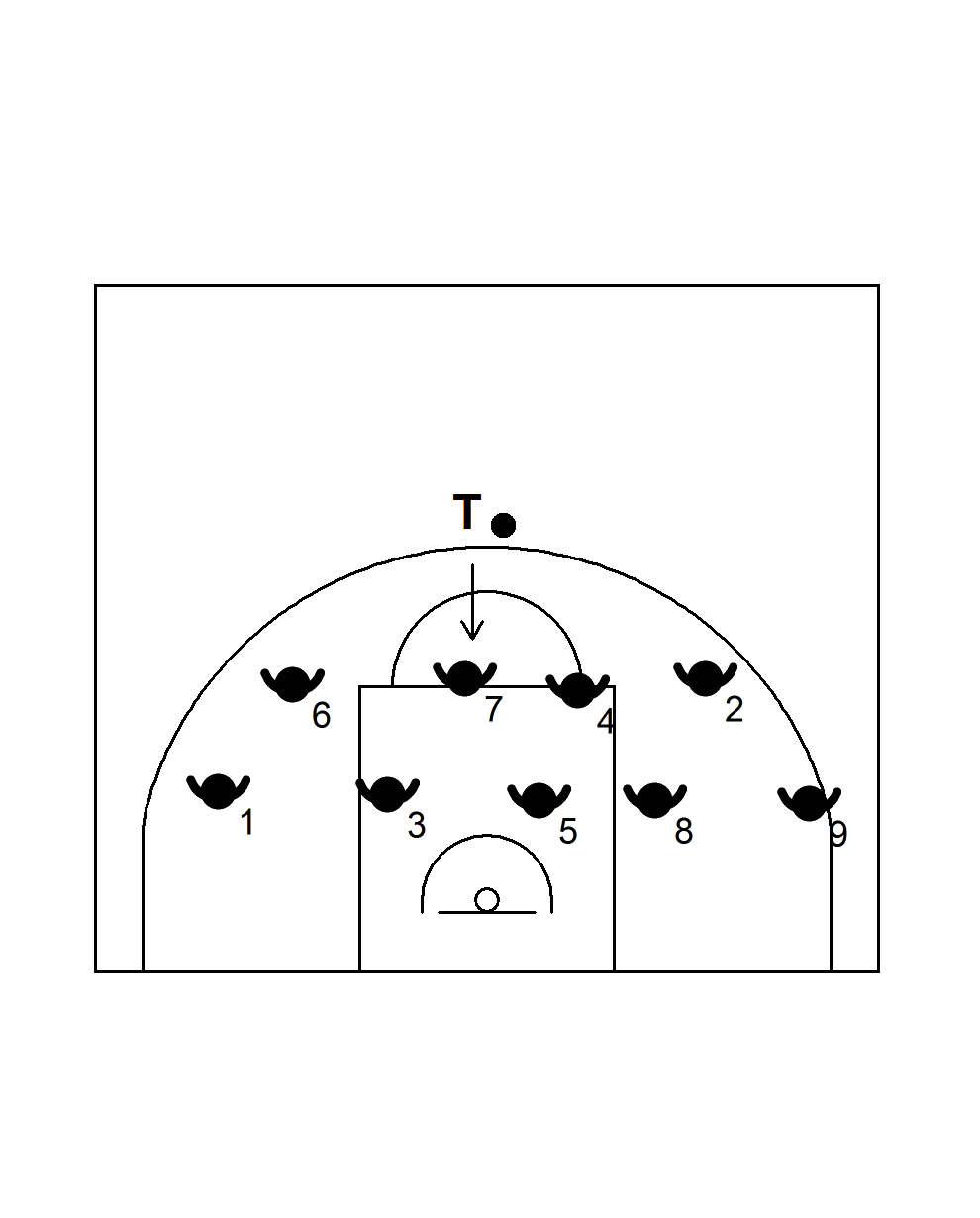
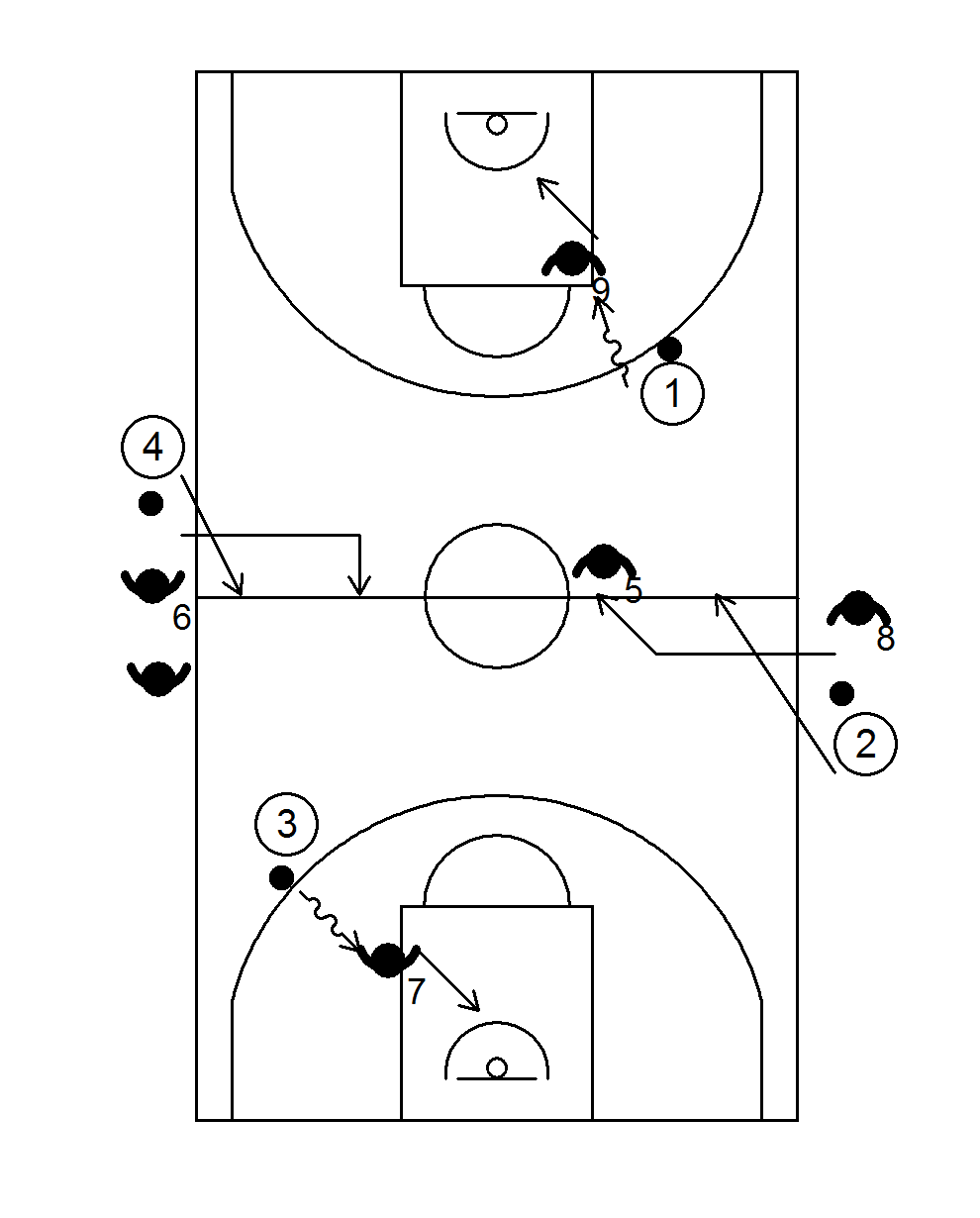
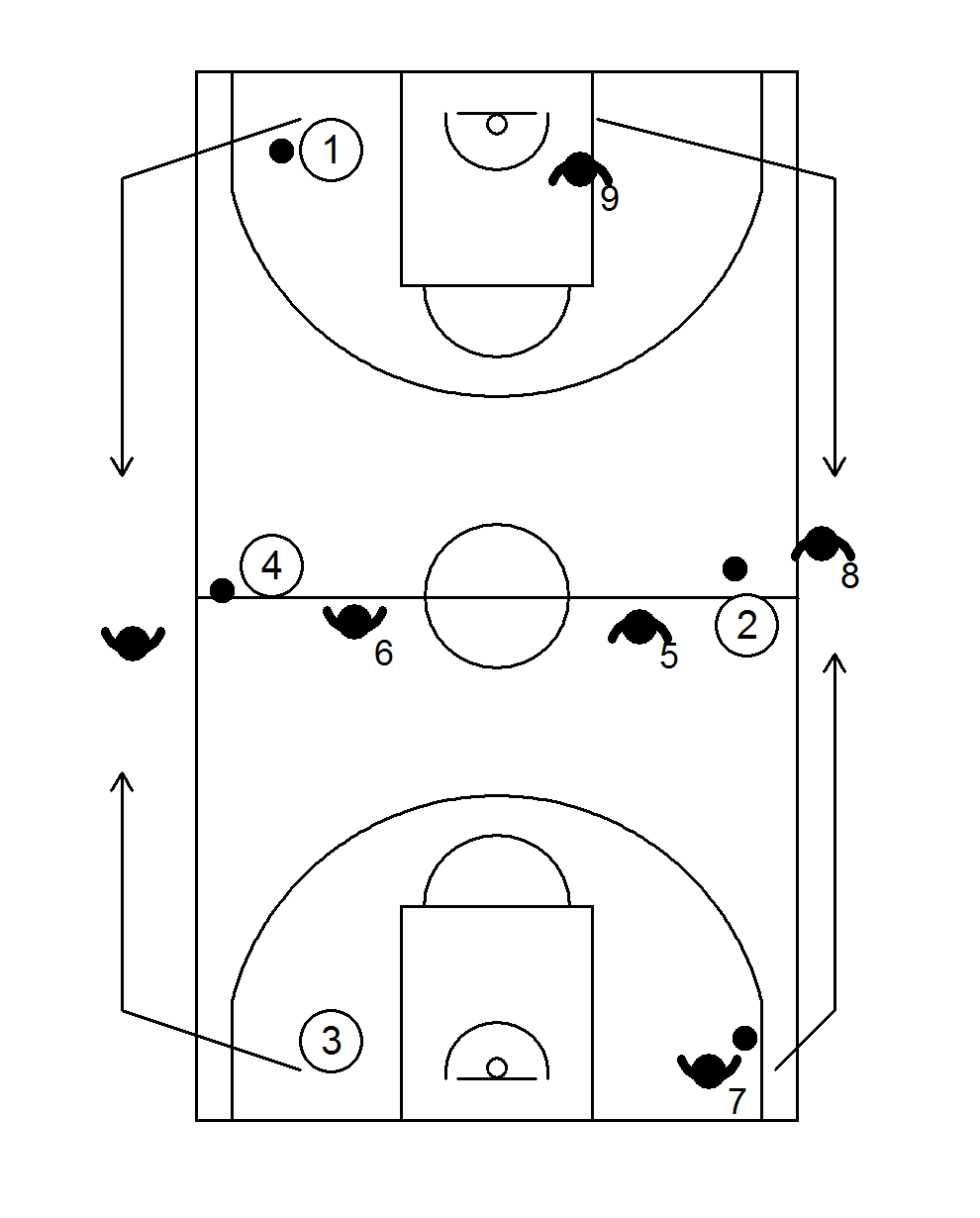
Goal: learn/improve defensive position (1 pass or 2 passes away)
Organization:
- 4 attackers and 4 defenders
- attackers may only pass
- immediately after the pass, the passer must change position
- 2 passes to 4
- 2 cuts to basket
- 6 defends the pass to 2 with a jump to the ball
- defender 8 does not allow the pass from 4 to 2
- Attackers 1 and 3 move up one position
- Defender 3 goes from help to denial
- ball is above the lifeline, so defender 8 moves from the lifeline to the side of the bucket
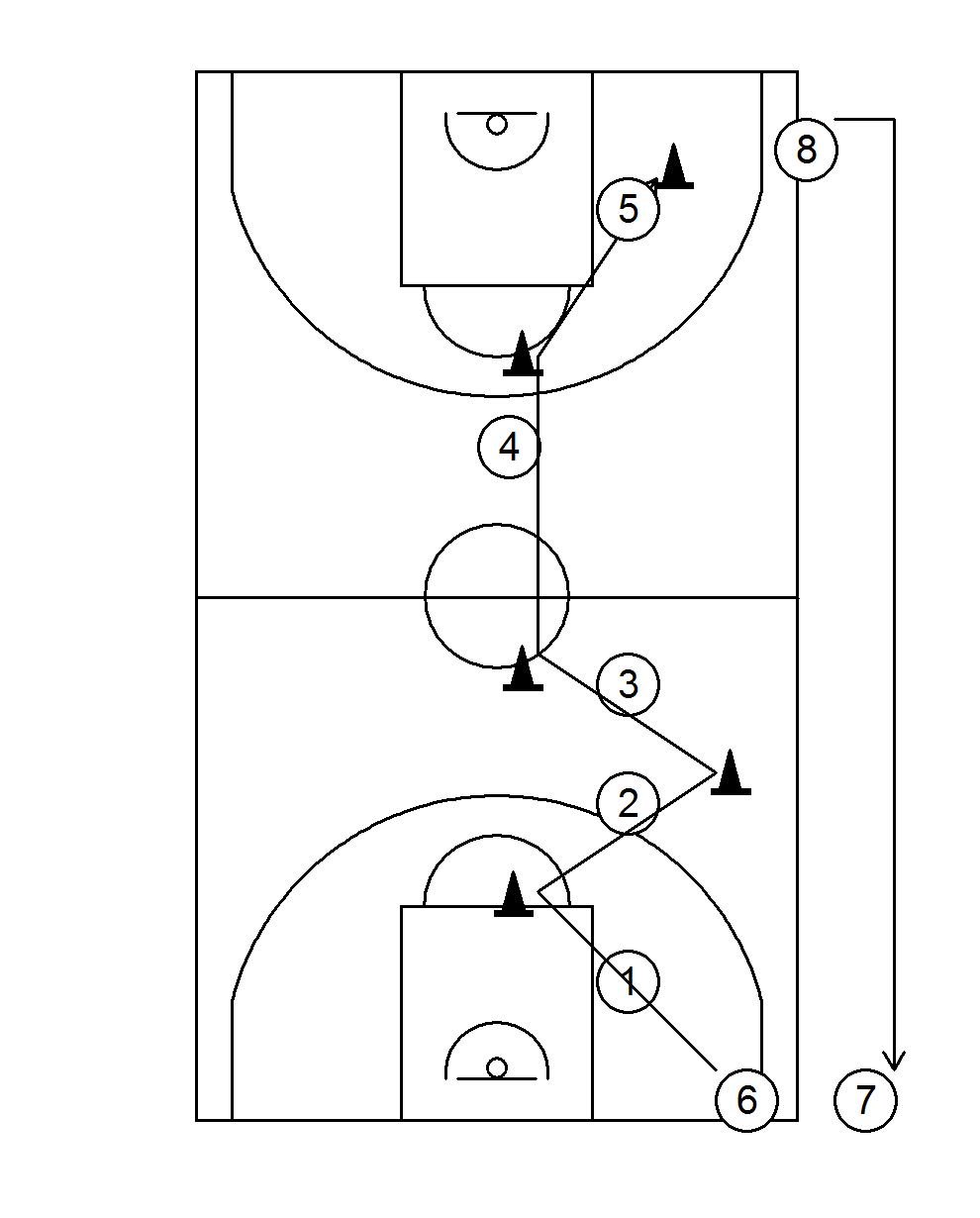
Goal: learn or improve drop step and side slides + condition
Organization:
- place 5 cones as shown
- vary distance and angle
- players move with slides from one pawn to the other
- at every cone they make a drop step and change hands from high to low and vice versa
- Always face the back line where the player started.
- between pawns 3 and 4, a short quick sprint (now with the face to the other back line)
- at pawn 4, turn 180 degrees, assume defensive position, drop step + slides to pawn 5
- in a quiet run back to the starting point
Teaching Points:
- Feet at least shoulder width.
- Knees at about 100 degrees (= sitting down deeply)
- shoulders above the heels (= back straight)
- Head straight up (overlook the field)
- Hand closest to the ball is low (to be able to tap the ball away on the dribble)
- Other hand is above the shoulder (to intercept a pass)
- push hard on the push-off leg to gain speed
- Feet stay low to the ground (= slide, shuffle)
- feet do not connect after a slide, but remain at shoulder width
- at the drop step, the foot closest to the ball moves backwards quite a bit; then the defender changes direction and the hands change from high to low and vice versa
- intermediate sprint must be quick (= simulate recovery of defensive position after the dribbler has passed the defender)
- take up position between pawn 4 and the basket and immediately with slides to pawn 5
Variations:
- let the defender keep his hands behind his back if you want to accentuate his feet and stance
- make bigger differences in the distance between the pawns and the angle they are placed to each other.
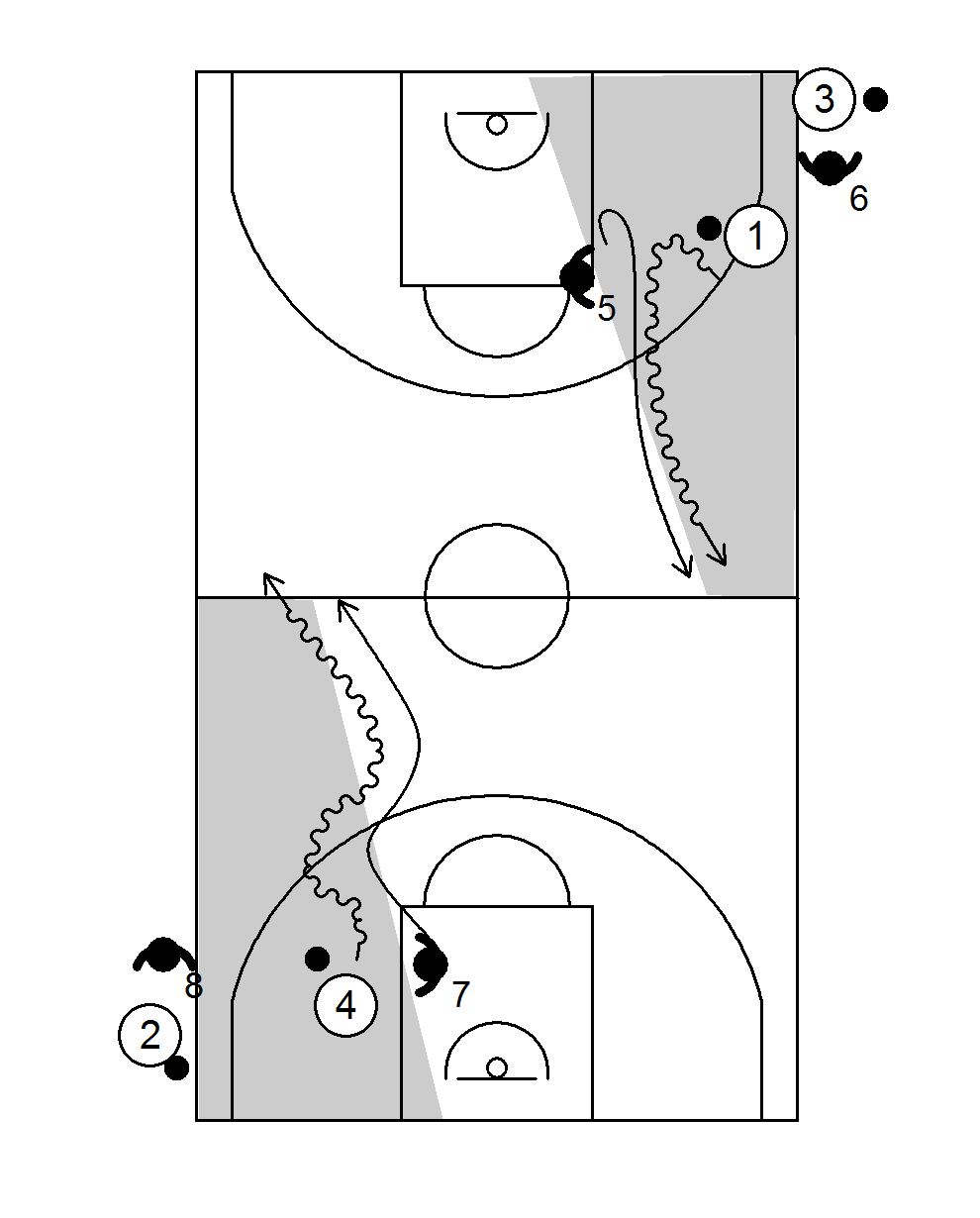
Requirements:
- players must be able to individually defend the man with the ball
- players must be able to dribble
Goal: defender must keep the dribbler in the marked area, so that it crosses the center line in the lane
Organization:
- waiting player takes the ball
- and counts down 8 seconds
- The dribbler has to touch the helpline at least once with his foot before he can cross the
- the half way line.
- the dribbler wins if he crosses the half way line outside the marked area (choose a line on the field)
- defender wins if he allows the dribbler to cross the centre line inside the marked area OR at 8 seconds
- loser has to defend in the next round
Teaching Points:
- defender must keep an appropriate distance, taking into account the dexterity and speed of the dribbler
- Defender must anticipate the changes of direction of the dribbler.
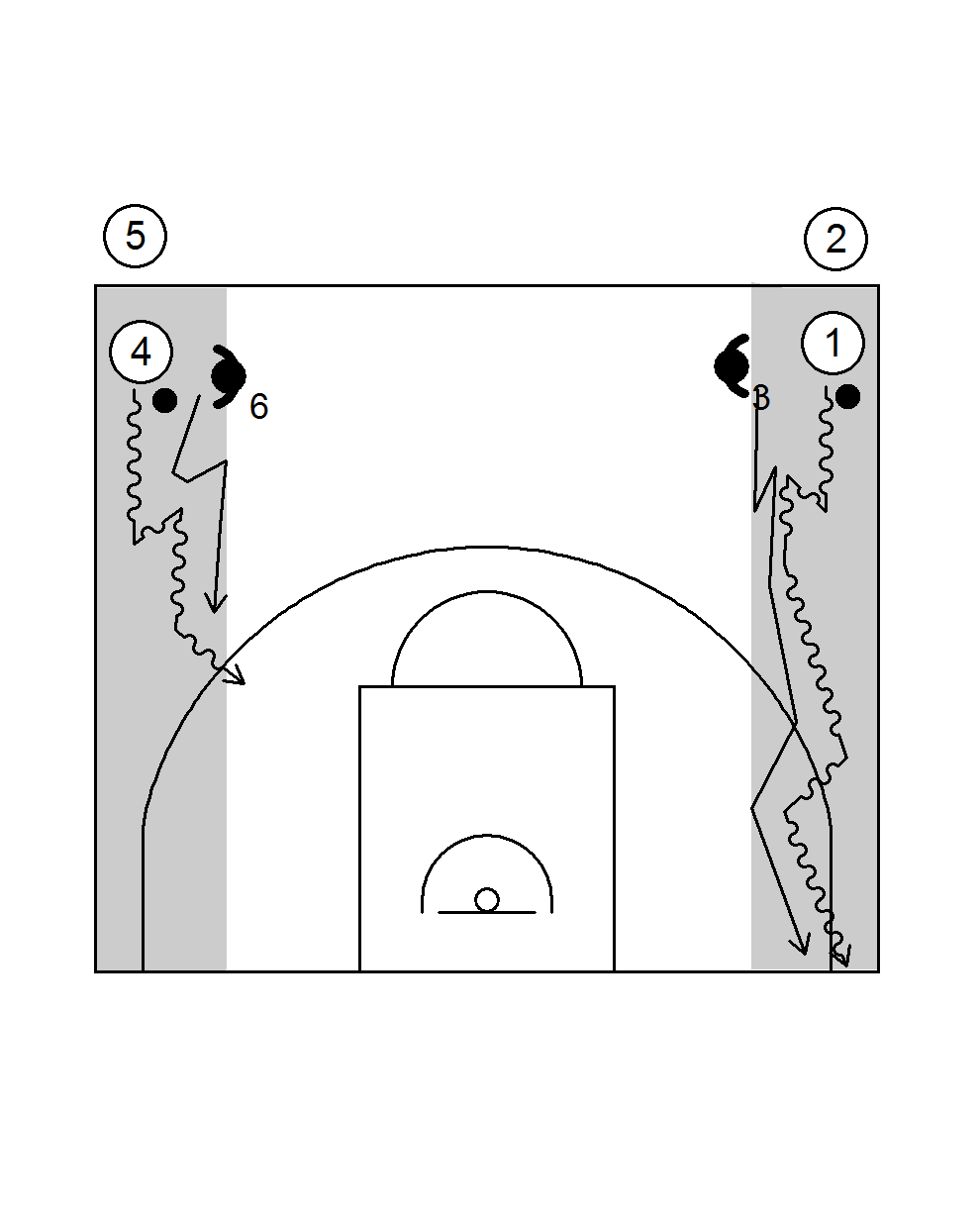
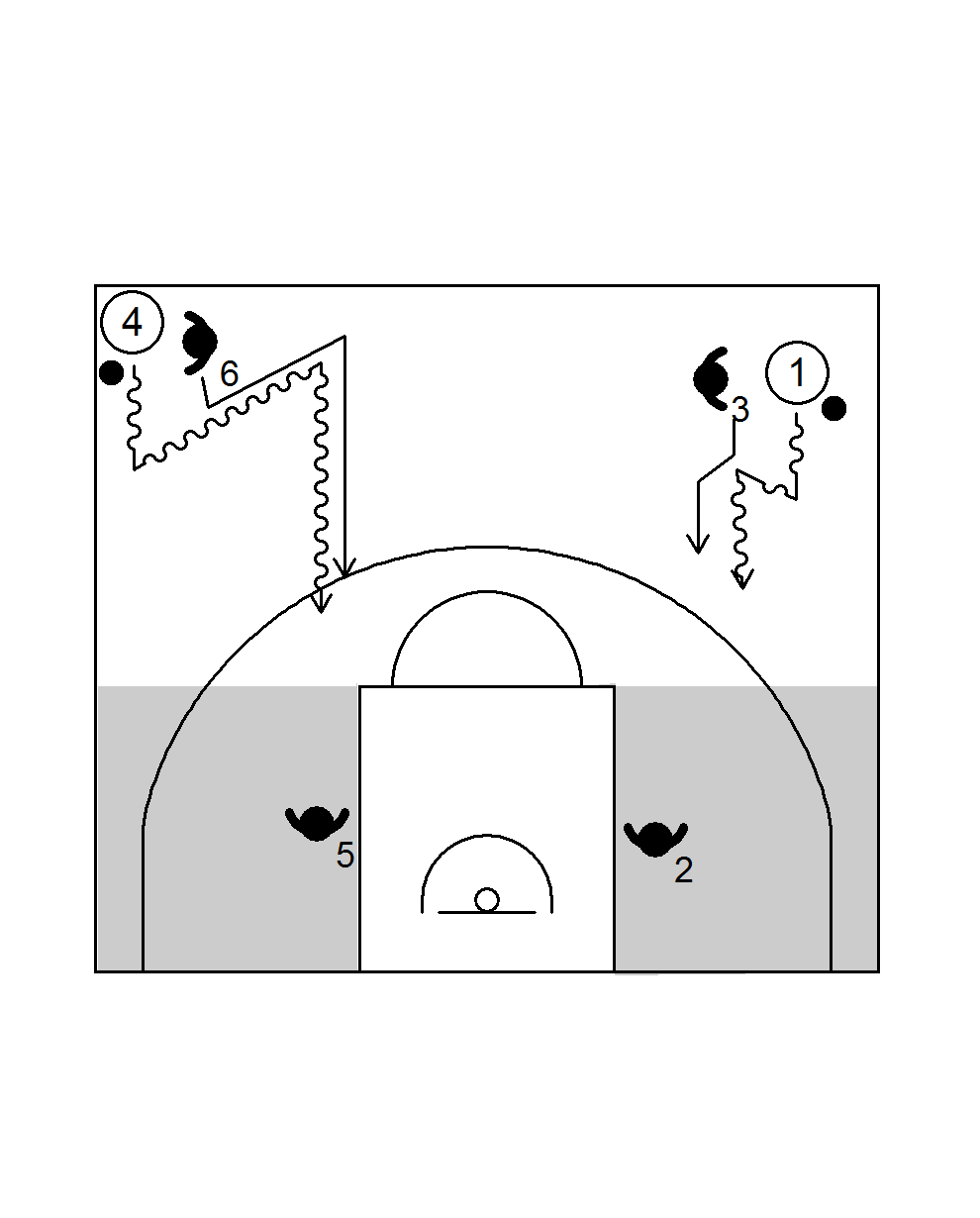
Requirements:
- players must be able to individually defend the man with the ball
- players must be able to dribble
Goal: defender must force the dribbler to the side of the field. Dribbler must never penetrate over the defender's front foot and through the middle
Organization:
- choose a line on the field and demarcate the lane with it
- the dribbler must reach the baseline within 5 seconds
- the waiting player counts down aloud
- every time the attacker dribbles over the chosen line, he has a point (waiting player will judge doubtful cases)
- the attacker then dribbles back to the touchline at the same height and lets the defender take his position. The players continue the game, the time runs on
- defender pushes up 5 times for each point
- Attacker becomes defender, waiting player starts dribbling
Teaching Points:
- front hand points to the ball
- at the start of the dribble, the front foot of the defender should be next to the attacker to prevent him from coming directly over the front foot.
- Encourage the attacker to try this every time
- defender should keep an appropriate distance, taking into account the dexterity and speed of the dribbler
- defender should take a slide-step towards the half way line and towards the by-line to prevent the attacker from penetrating over the front foot.
Variations
- start with restrictions for the dribbler: compulsory dribbling with the weak hand; other hand on the back etc.
- as the defenders improve, remove these restrictions step by step
Game shape:
- helper starts on the block
- and may only defend in the marked block
- attacker has 8 seconds to score (the helper counts down)
- if attacker 1 manages to pass defender 3 over his front foot, he can score through the bucket, without the helper being able to do anything
- if defenders 2 and 3 are only allowed to help in the marked area
- at a score the attacker keeps the ball
- at a stop, the players move up one position
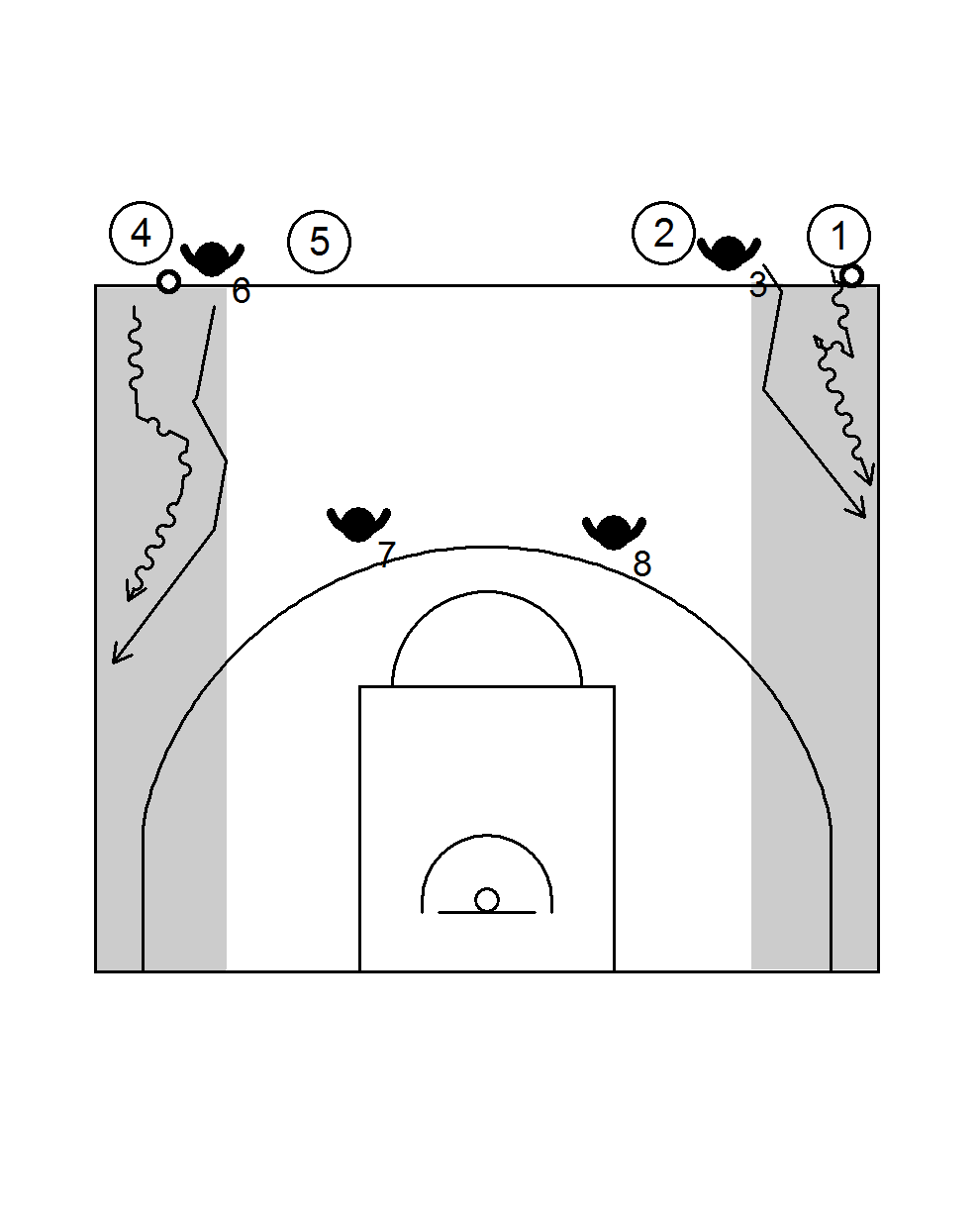
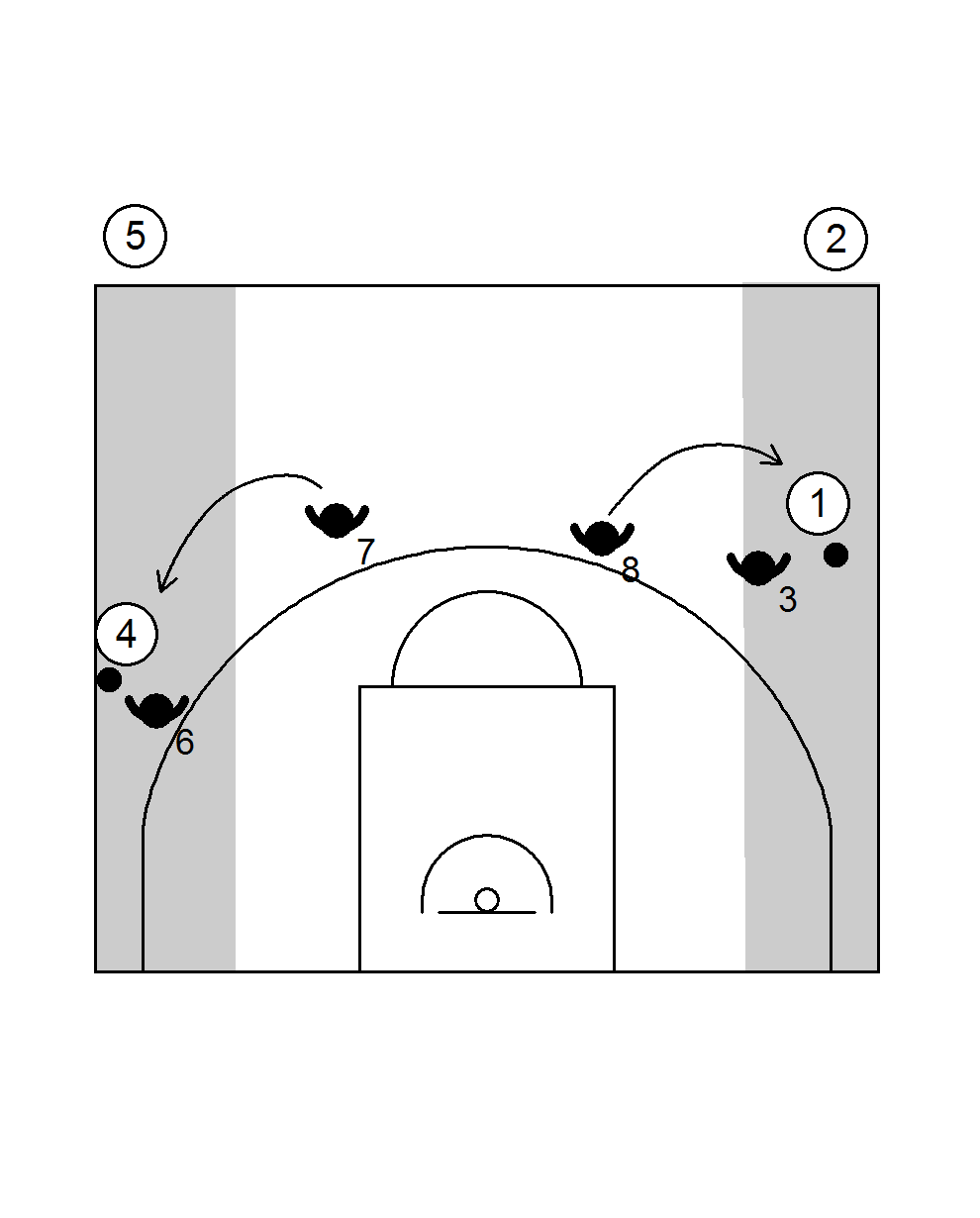
Requirements:
- players must be able to individually defend the man with the ball
- Players must be able to dribble
Goal: defender forces the dribbler to the side of the field and reduces the distance so that the dribbler grabs the ball.
Organization:
- choose a line on the field and demarcate the lane with it
- the defender has to keep the attacker inside the lane
- the dribbler has to be at the back line within 5 seconds
- the waiting player counts down aloud
- immediately after the start of the dribble, the second defender locks the dribbler in the back of the court
- as soon as the dribbler takes the ball, the defenders together cut off the passing lines towards the half way line
- and only passes they allow are parallel to the touchline
Teaching Points:
- first defender must aggressively close the gap
- AND close off the touchline
- second man starts as soon as the dribbler crosses the half way line
- trace the ball
- defenders always one hand low and one hand high (umbrella)
- attacker is never allowed to step or pass between the defenders
- avoid mistakes; conquer the ball by 1) 5 seconds, 2) bad pass, 3) attacker's foot on the line
Variations
- start with restrictions for the dribbler: mandatory dribbling with the weak hand; other hand on the back etc.
- as the defenders improve, remove these restrictions step by step
- 2 extra attackers and 2 extra defenders. After the dribbler has picked up the ball, the 2 extra attackers try to open up a passing line The defenders must intercept the pass