



Hockeyexercises for u21
- Each player takes a pilon.
- Fields of about 10x5 are made.
- The pilon is placed in the middle of the back lines.
The aim is to play past your opponent and dribble the ball over the pilon. IT IS NOT ALLOWED TO SHOOT FROM 10 METERS!
The winner goes one square to the right and the loser goes one square to the left. Rounds of -/+ 2 minutes
- It works just like a normal game only now there's a square in the middle.
- If a shot or other foul is made, or if the ball has been out of bounds, the trainer throws/plays in a new ball from inside the square.
- The ball does not necessarily go to the same team or at the place where the foul was made.
- The size of the field depends on the number of players.
Aim:
To become physically as well as technically warm as preparation for the training.
Set up:
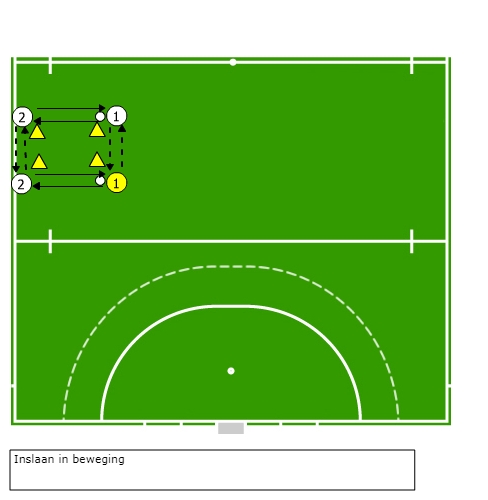
The exercise will be done with a maximum of 4 people. Of course you can put a multiple of these so that the exercise still works.
1. The players 1 start with the ball and play it to their players 2. Then they change positions.
2. Players 2 play the ball back to players 1 and also change positions.
Variations:
- You can vary the way of passing (hitting, push, flats)
- Increase the distance between the pilons that players only has to run further.
- Increase the distance between the pilons that players have to pass over longer distances
- Increase both distances.
- Increase speed.
- Make as many successful passes as possible in time.
Points of attention:
- Sit low for a good control.
- Stick to the ground at ball control.
- Play the ball on the forehand side.
- Stand still while performing a ball control.
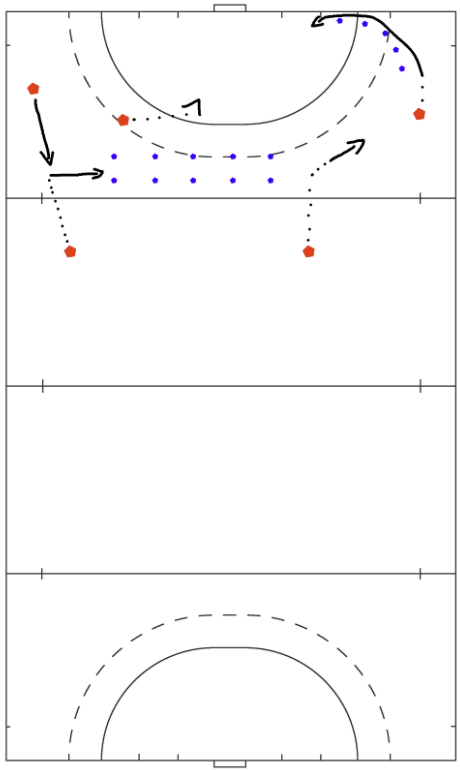
- Balls are at the first pilon.
- The player at the first pilon passes the ball to the second pilon,
- who pushes the ball through the pilons to the third person.
- The third person runs in on the ball and runs even further,
- then he pushes the ball to person 4 while he's running.
- Person 4 runs around the pilons and passes the ball at the top of the circle,
- where person 5 has just run up to finish the ball in the goal.
Aim:
Getting warm through a combination of passing, running and controlling the ball while running or standing still.
Set up:
This exercise also known in volleyball. The pilons are not quite in a triangle. It is possible, depending on the number of players, to set up multiples of the exercise.
1. The player at A plays the ball straight on to the player at B.
2. The player at B plays the ball to the player at C and runs towards point A.
3. The player at C receives the ball at point D and passes it to point A.
4. For the substitution A goes to B, B via D to C and C to A.

Variations:
- The stroke can be varied. (hitting, push, flats)
- The distances can be increased or decreased to adjust the level of difficulty.
- Pilons can be placed to play in between. This to increase the accuracy. When you make the pilons smaller, the difficulty increases.
- To play the ball from C to D, it can be bounced.
- To play the ball from D to A, it can be bounced.
- You can also place point C on the other side so that you turn backhand and forehand.
- When you place point C in 90 degrees from point B, you can rotate the same exercise only then from a different angle at point D.
- When you put down different situations, you can let the exercise rotate. Situation A is the standard, with situation B the exercise is mirrored, with situation C the exercise is set up in such a way that point B and C are at 90 degrees from each other and situation D is a mirror of situation C.
Points of attention:
- As a trainer you can take a good look at the different techniques of your players.
- Sit low when controlling the ball
- When playing the ball from C to D, the ball must not pass too far in the direction of A. The aim is for the player coming from B to take the ball at right angles.
- Play where possible on the forehand.
- Stand ready to control the ball. (low to the ground, stick on the ground)
Aim:
- To become physically as well as technically warm as preparation for the training.
Design:
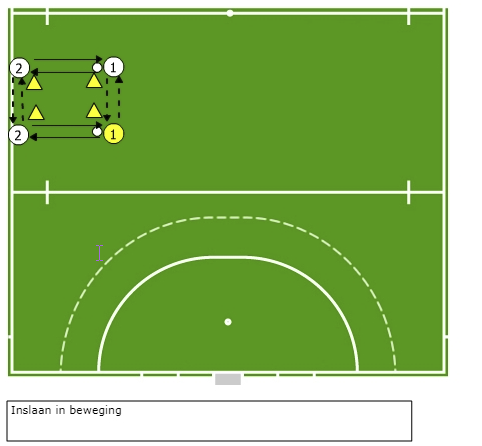
- The exercise will be done with a maximum of 4 people.
- Of course you can put a multiple of these so that the exercise still works.
- The players 1 start with the ball and play it to their players 2. Then they change positions.
- Players 2 play the ball back to players 1 and also change positions.
Variations:
- You can vary the way of passing (hitting, push, flats)
- Increase the distance between the pilons so that one only has to walk further.
- Increase the distance between the pilons so that one only has to move on.
- Increase both distances.
- Increase speed
- Make as many successful passes as possible in time.
Points of attention:
- Sit low for good control.
- Stick to the ground at ball control.
- Play ball on the forehand side.
- Stand still at ball acceptance.
- Place pilon to form a little slalom.
- Increase speed
- customize slalom
- finish at goal at the end of the slalom
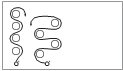
- Use in a relay race; dribble around the hoops and dribble back in one go.
- through the hoop
hoop on a pilon and play through it (hold the hoop and play or crawl through it
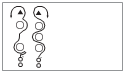
- Place all the hoops in the room (islands).
- On the outer side of the square, dribble with the ball to the left, dribble to a hoop and stand in it with the ball.
- Dribble around the corner to the right
- On the trainer's sign, dribble inside the square around 5 different hoops, counterclockwise.
- change the number of hoops
- always go to a different color hoop
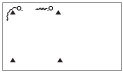
- Dribble the ball and pass it when you pass the hoop to a fellow player who does the same.
- Expand the number of hoops (length and width)
- score on a target at the end of the exercise

- All children dribble with the ball in a designated area.
- The trainer is 'mother/ father'.
- Regularly the children ask: "Mother what time is it?"
- If the mother mentions a random time, the kids just keep driving the ball.
- But when mother answers, "It's bedtime", all the children try to get out of the area as quickly as possible before they are tagged by the mother.
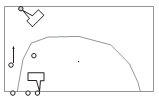
Place 15 to 20 pilons over a distance of about 40 metres from the back line towards the middle line, in a straight line. The spacing between them at the basic form should be 2 meters.
Make 2 rows of players that are positioned behind the back line. The players do their exercise on both sides of the pilons at the same time towards the end of the series of pilons. There they turn and dribble with a wide curve back to the beginning. When the first two are at the fourth pilon, the next two can start.
Put players with an equal physical capacity next to each other. You can put players next to each other based on their positions (defender versus defender, attacker versus attacker).
Exercise
1. On the signal the front 2 players start.
2. Sprint 2 pilons forward and then 1 pylon backward.
3. Keep your face forward, so don't turn during the exercise.
4. The intensity is 90% of the player's maximum speed. Especially the forward runs (starting) have to be explosive and with short steps.
5. At the end of the series of pilons you turn with a wide bend and dribble back slowly to the starting point.
6. Repeat this exercise once.
Variations
1. Identical to the basic form, but now with the pilons in a different pattern: between the first 2 pilons is 1 meter, between the next pilons 2 meters, then 3 meters, 4 meters and finally 5 meters. After this you reduce distances again (respectively 4, 3, 2 and 1 meter space between the pilons). In total you will have 18 pilons.
2. Identical to the basic form, but now with a different pattern: between the first 3 pilons 1 meter, the next 2 pilons 5 meter, then again 3 pilons with 1 meter, 2 pilons with 5 meter. After this, place the same pattern again (4 times the same pattern in 1 line, with a total of 18 pilons).
3. Identical to variation 3, but now you don't place the pilons in a straight line, but in curves.
4. You make a straight line of pilons and arrange them as you see fit. Make sure there is a lot of variation.
5. Identical to variation 4, but now with curves.
Intensity of the exercise
The intensity is 90% of the maximum effort. Panting, should be present in the forward runs, because they are highly explosive. Good body control and athletic posture should be maintained, EMI 7/8.