



Basketballexercises
Last update: january 2026
Execution
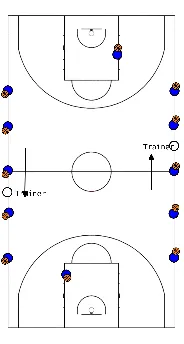
- The players dribble along the outer line of the court.
- At various points along the line, a trainer, coach, or assistant coach positions themselves to attempt to intercept the ball.
- The players pass the coach by using a feint or by quickly switching hands. They are free to choose how to do this.
- Encourage the players to dribble with both their strong hand and their weaker hand.
- When the players reach the basket, they may attempt to score with a lay-up.
Initial Setup
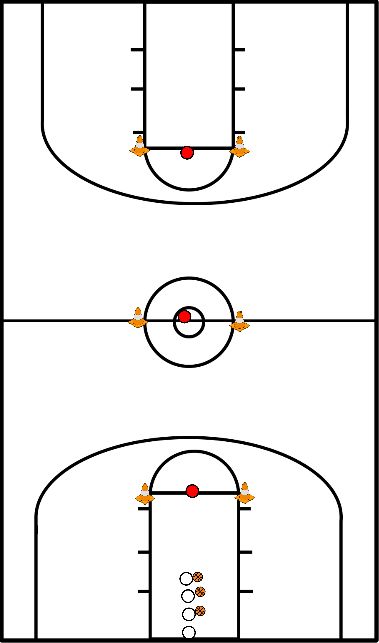
- 1 defender positioned at the free-throw line
- 1 defender positioned at the centre circle
- 1 defender positioned at the free-throw line
- Place cones at both ends
- Attackers dribble past the 3 defenders
- Defenders earn 1 point for each player they can stop
- Attackers earn 1 point if they can pass all 3 defenders
- Cones closer together
- Cones further apart
- Defenders with one hand behind their back
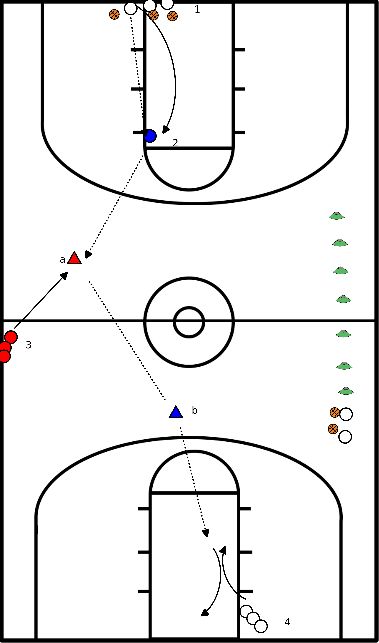
Execution
- Player 1 with the ball passes to Player 2 and takes the place of Player 2.
- Player 2 dribbles towards cone A.
- Player 3 runs towards cone A.
- As soon as the pass is possible, Player 2 passes the ball to Player 3.
- Player 2 takes the place of Player 3.
- Player 3 dribbles to cone B and passes to Player 4 when possible.
- Player 4 calls for the ball under the basket and finishes.
- Player 3 takes the place of Player 4.
- Player 4 goes along the sideline to the queue of Player 1, weaving through the cones with a slalom dribble.
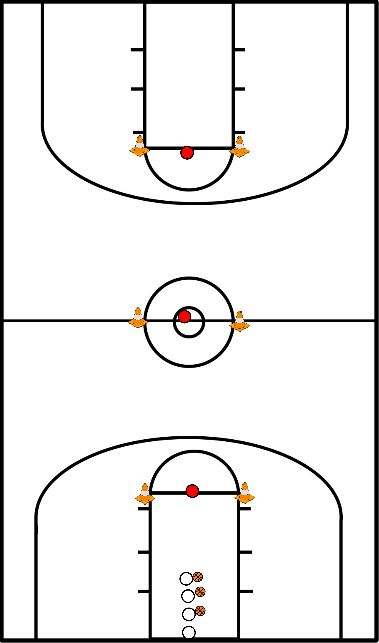
Initial Setup
- 1 defender positioned at the free throw line
- 1 defender positioned at the centre circle
- 1 defender positioned at the free throw line
- Cones placed at both ends of the court
- Attacking player dribbles past the 3 defenders
- Attacking player performs a lay-up at the end
- Attacking player sprints back with the ball over the full length of the court
- Defence earns 3 points for each player they can stop
- Attacking player earns 1 point if they can pass a defender
- Place cones closer together
- Place cones further apart
- Defence plays with one hand behind their back
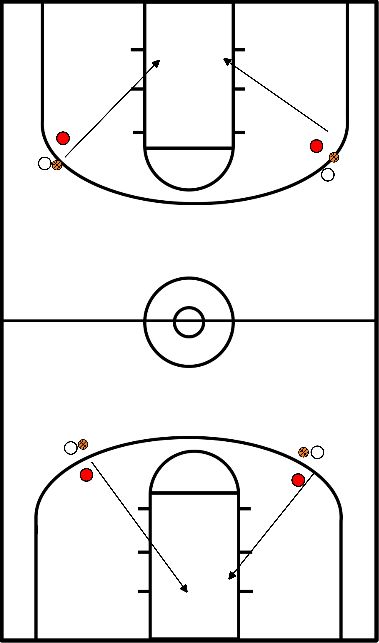
Initial Setup
- Form a team with two players each. Each team has one ball. Maximum of two teams per goal.
- Play one-on-one. The defender passes the ball to the attacker at the three-point line. Each team takes turns to avoid interference. Each team stays on its own half.
- A maximum of three dribbles is allowed.
- The defender plays with one hand behind their back.
- The defender plays with both hands behind their back.
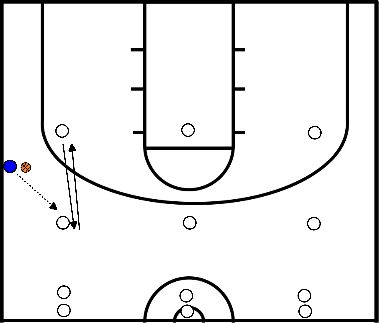
Basic Setup:
- 3 players in defence
- 3 players in offence
- Players not participating wait at the midline in 3 groups
- Coach has the ball
- Coach passes to 1 player
- Player opposite runs first to the midline and then returns to defence
- Play 3 versus 3
- Upon ball loss, score, or rebound, the ball goes to the coach
- Offence becomes defence
- Quickly set up again and the next group plays
- Allow defender to run a shorter distance
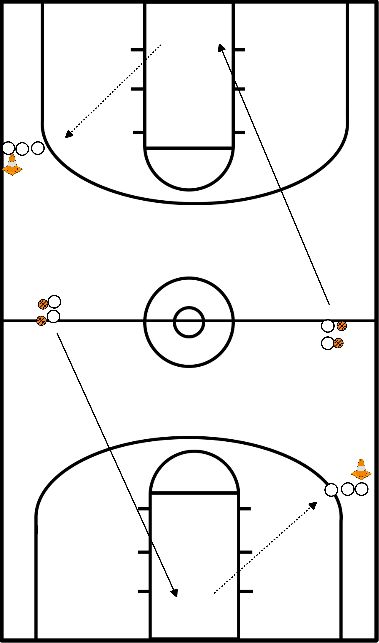
Starting Position
- Use the entire court.
- Two players are positioned on the right side at the centre line ready for a lay-up.
- Two players are positioned on the left side at the centre line ready for a lay-up.
- Three players are positioned on the right sideline, level with the free-throw line.
- Three players are positioned on the left sideline, level with the free-throw line.
- Players at the centre line start with their lay-up.
- After the lay-up, they take their own rebound and make an outlet pass to the waiting player on the sideline.
- Then they join the sideline group, level with the free-throw line.
- Lay-up, power lay-up, lay-back, jump stop.
- Change of direction at the three-point line.
- Cross-over, behind the back, reverse dribble at the centre line.
- After the lay-up, remain in a defensive position.
- Take a shot instead of a lay-up.
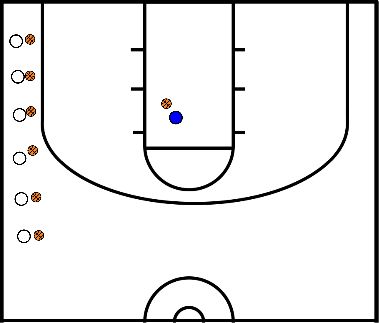
Starting Position
- Each player has one ball on one side of the court.
- The coach is clearly positioned to demonstrate the exercises.
- Each exercise lasts 30 seconds and is performed with both the right and left hand.
- Move the ball around the body without dribbling.
- With legs spread, hold the ball between the legs, one hand in front and one behind, release the ball and quickly switch hands.
- Make a figure-eight movement around and through the legs without dribbling.
- Toss the ball upwards and catch it behind the back, starting low and gradually higher.
- Dribble around one leg; 10 times and then around the other leg, changing direction.
- Dribble at knee height beside the body, left and right.
- Dribble very low in front of the body, left and right.
- Perform a crossover in front of the body with 2 dribbles.
- Perform a crossover in front of the body with 1 dribble, keeping the ball low.
- Stand still and dribble through the legs from front to back with 1 dribble.
- Stand still and dribble through the legs from front to back in a figure-eight pattern, in both directions, left and right.
- Perform a V-dribble with 1 hand in front of the body, left and right.
- Perform an in-and-out dribble in front of the body, left and right.
- Dribble beside the body from front to back at knee height, left and right.
- Who can dribble through their legs the most?
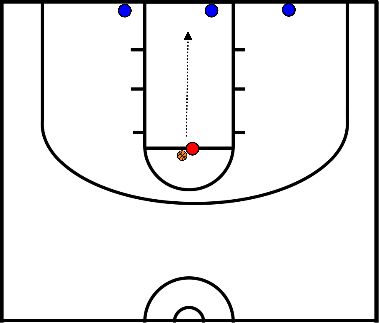
Setup
- Three players start on the baseline.
- A fourth player stands around the free throw line and throws the ball towards the hoop.
- The three players rebound for themselves and try to score the ball in the basket.
- A score earns one point, but rebounding the ball again after scoring also earns a point.
- The first player to reach five points swaps with the player throwing the ball towards the hoop.
- Physical contact is allowed.
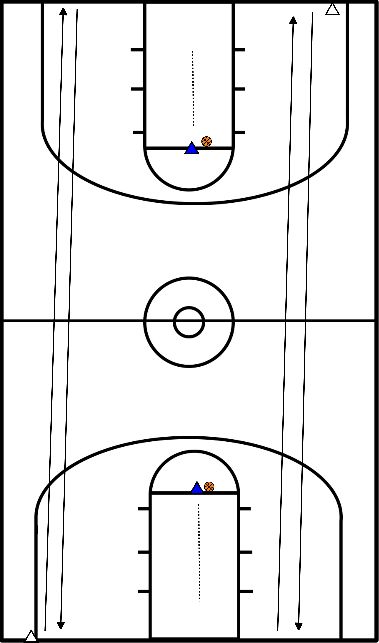
Execution
- Players divide themselves over two baskets.
- Each player takes two free throws consecutively.
- After the free throws, regardless of whether they score or miss, the player sprints up and down the entire court.
- It is important that they accelerate well and give 100% effort.
- After the sprint, they return to the free throw line and take two more free throws.
- Players build their conditioning and simulate a game situation where they must also rest during their free throws.
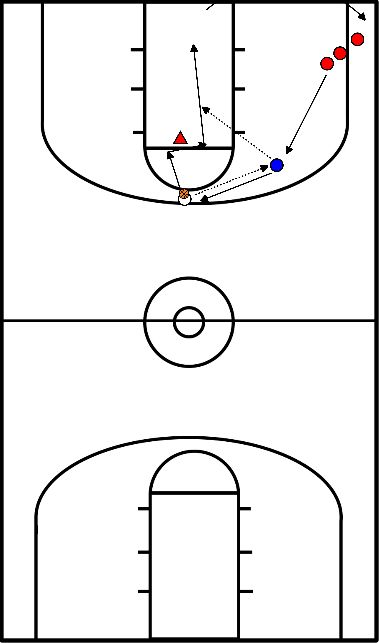
Setup
- Player 1 with the ball at the top of the three-point line (position 1, white).
- Player at position 2 or 3 (blue).
- The other players at position 4 or 5, on the same side as the forward (red).
- A defender or cone around the free-throw line, closer to player 1 (defender of 1).
- White passes the ball to blue and immediately makes a cutting movement towards the basket.
- White makes a fake move to the left and cuts over the defender.
- Blue passes the ball back to white during their movement and takes position 1.
- The first player of red fills the position of blue.
- White scores the ball and the ball goes to the new player in position 1.
- White joins red and becomes the last player in the red line.
- The exercise starts again.
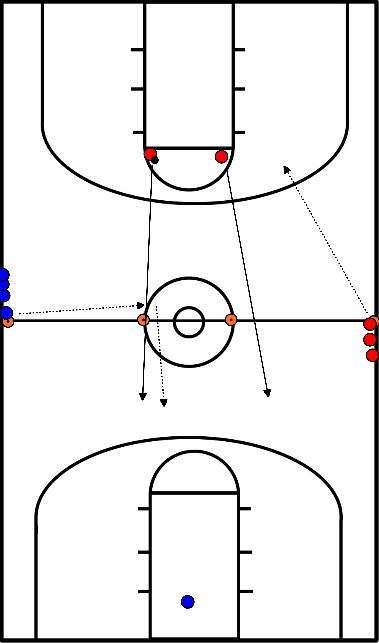
Setup
- The group is divided into two teams and positioned at the sideline level with the midcourt line.
- A blue player is ready to defend.
- Two red players are ready to attack.
- When the first red player crosses the midcourt line, the second blue player, who is still at the sideline, may start.
- He must first run around the cone before he is allowed to help defend.
- Meanwhile, the next red player is already preparing to defend.
- After a score or ball recovery, the two blue players attack.
- The two red attacking players go to the sideline to line up.
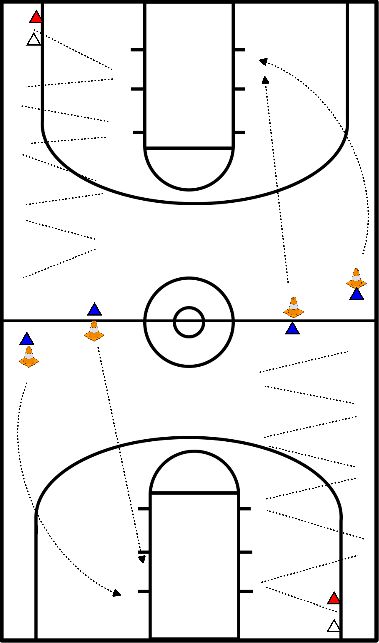
Setup
- Players are positioned in pairs at the cones.
- The outer player holds the ball, while the inner player must accelerate.
- The inner player accelerates and tries to stop at the finish line.
- After a scoring attempt, roles are switched.
- The attacker performs defensive slides while the defender dribbles the ball.
- Players challenge each other and maintain a deep dribble.
- The exercise is conducted at both baskets so they run in circles.
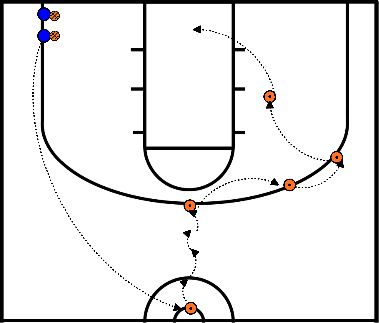
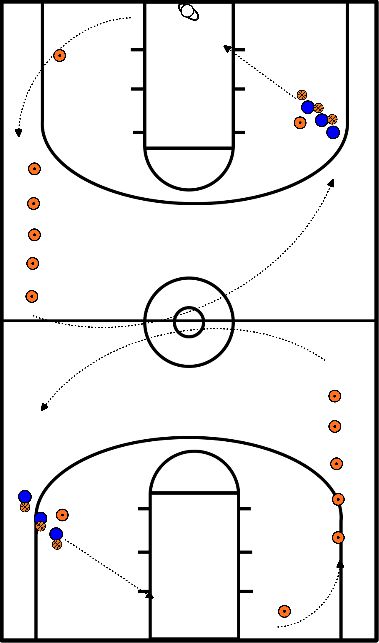
Execution
- Each player has a ball.
- Place the five cones as shown in the diagram.
- At each cone, players make a change of direction.
- Between the first two cones, they continuously execute their change of direction.
- After the cones, there is an opportunity to take a shot or a lay-up.
- Ensure clear changes in direction.
- Accelerate after each change.
- Show aggressiveness in the execution.
Execution
- Ensure that all players have a ball.
- The player starts at the cone next to the key.
- The player dribbles towards the basket.
- The player stops on two feet for a jump shot.
- The player begins the two-count rhythm for a lay-up:
- From the right side: first right foot, push off with left foot.
- From the left side: first left foot, push off with right foot.
- The player retrieves their own rebound and dribbles around the cone.
- The player zigzags through the cones.
- The player then rejoins the line at the basket.
- The first group to score 20 points wins.
- In a large group, this activity can be performed on both sides of the court.
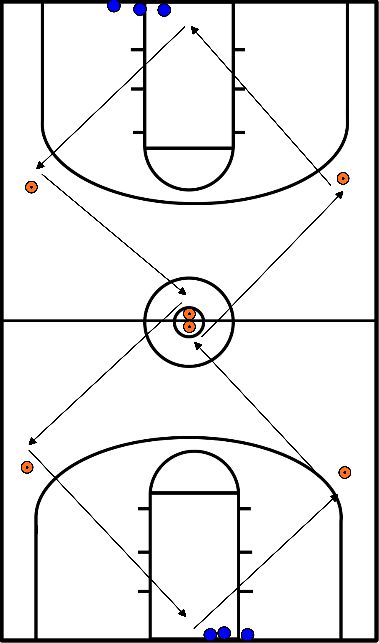
Execution
- Each player has a ball.
- The group is divided into two groups, each at a basketball hoop.
- The first player of the group attacks the first cone and performs a change of direction.
- At each cone, the player repeats the change of direction until reaching the hoop on the opposite side.
- The player finishes according to the indicated variation.
Change of Direction Variations
- Crossover
- Between the legs
- Behind the back
- Hesitation
- Fake move
Finishing Variations
- Lay-up
- Reverse lay-up
- Euro step
- Jump stop shot
- Floater
- Jump stop cross step
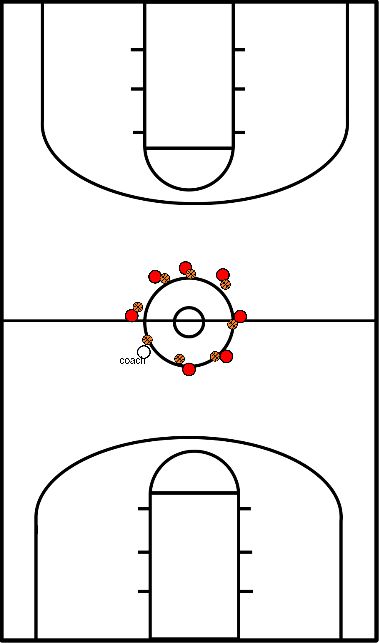
Setup
- Stand with the whole group in a circle in the middle of the court.
- Ensure each player has one ball.
- Dribble normally (waist height).
- Dribble low (below knee height).
- Dribble extremely low (bounce no higher than ankle height).
- Dribble low (below knee height).
- Dribble normally (waist height).
- Dribble extremely high (above shoulder height).
- Dribble normally (waist height).
- Have the players sit while dribbling.
- Have the players stand up while dribbling.
- Have the players sit down again while dribbling.
- Players now dribble between their legs.
- Have them stand and make figure eights between their legs.
- Then rotate the ball around the waist as quickly as possible, then in the other direction.
- Note: Each part can be performed with both hands.
- The coach acts as an example.
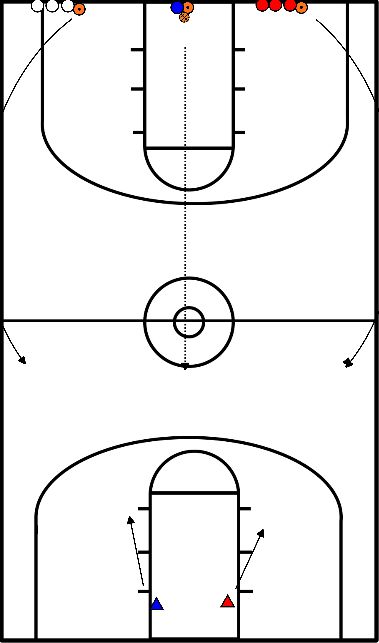
Setup
- Players gather at the baseline in two groups.
- One player stands under the basket with the ball.
- Two players are ready to defend on the opposite side.
- The player with the ball dribbles to the other side.
- Players on the left and right run along the sideline to join the offense.
- The defense freely chooses whom to defend but remains active without taking a position in or around the key area.
- The player who finishes or loses the ball returns together with the two defenders.
- On the opposite side, two new defenders are already prepared.
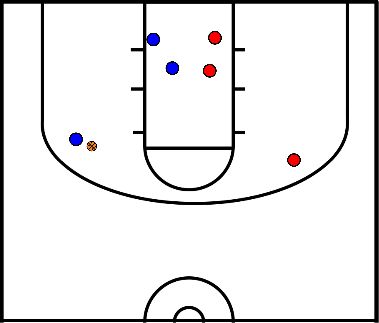
- Starting lineup:
- 2 teams
- 1 shooter per team
- 1 or 2 rebounders per team (depending on number of players at practice and available goals)
- Progression:
- The shooter takes a shot
- If the shooter scores, he stays put
- If the shooter misses, rebounding is required
- The player who takes the rebound goes outside and takes a shot
- 1 point per score
- 1 point per rebound
- Whoever has 10 points first wins
- Progression:
- Three-pointers shot
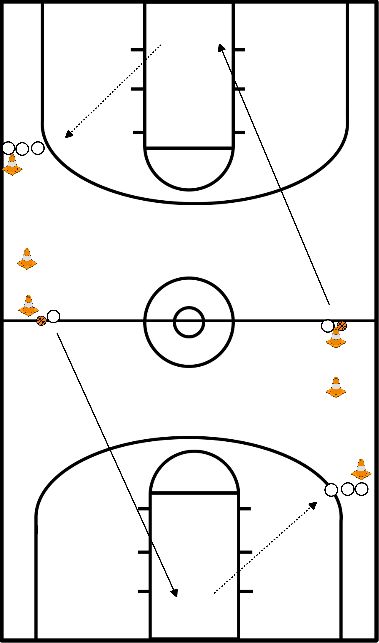
- Starting lineup:
- Use an entire field
- 1 player near the center line (left)
- 1 player at the center line (right)
- Group of players in line with the free throw line (one side of the court)
- Group of players at the extension of the free throw line (other side terrain)
- Progression:
- Players at the center line start their lay-up
- After the lay-up, they take their own rebound and give an outlet pass to the waiting player on the sideline
- Then they join the sideline, at the level of the free throw line
- Lay-up, bob cousy, power lay-up, lay-back, jump stop
- Progression:
- Change of direction at the level of the three-point line
- Crossover, behind the back, reverse dribble at the center line
- Coach defends, attacker adjusts
- Stepping towards the ball instead of running forward
- Retrieve ball in the middle and from there dribble and lay-up through the middle
- Add 2 players defending passively at the three-point line
- Add 2 players actively defending at the three-point line
- 2 players defending actively
- Regression:
- Taking shot instead of lay-up
- Player 1 with ball Passes ball to Player 2 and
- Takes place of Player 2
- Player 2 dribbles towards cone a
- Player 3 runs towards cone a
- As soon as pass is possible Player 2 hands ball off to player 3
- Player 2 takes the place of player 3
- Player 3 dribbles toward cone b and passes to player 4 when possible
- Player 4 asks for the ball under the goal and finishes
- Player 3 takes the place of player 4
- Player 4 goes down the sideline to player 1's line past the hats with slalom dribble
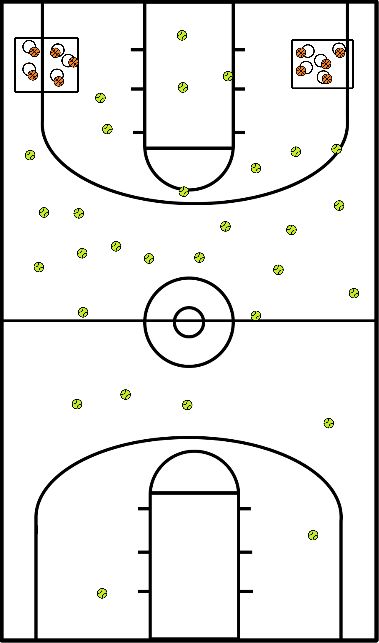
Divide the group into 2 teams.
- Tell the story that it is autumn and the nuts are falling from the trees.
- We are a group of squirrels and we need to gather as many nuts as we can to survive the winter. The team with the most nuts wins.
- The coach scatters the nuts (can be ping pong balls, tennis balls or other small balls).
- On the coach's signal, all players may start collecting nuts all dribbling.
- They may bring one nut at a time to their nest.
- When all the nuts are collected, we count the nuts per team and the team with the most nuts wins.
- The chaos forces the little players to look around and not at the ball when they are dribbling.
Variation:
- dribbling with weak hand
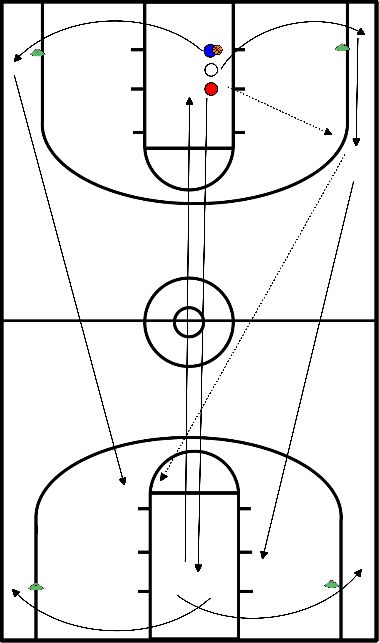
- Blue makes a board pass to the right of the hoop and sprints left around the pillon to the opposite side.
- White catches the ball in the air and makes a board pass, sprints right around the pillon and sprints toward the center line.
- Red catches the board pass, turns up the right side already in the air, makes an outlet pass to White and sprints across.
- White makes a long pass to blue and sprints across.
- Blue makes a layup and sprints across the right side to the other side.
- White sprints past the left pillon and sprints across again.
- Red grabs the rebound and makes another outlet pass to white.
- White passes to blue again.
- Blue makes a layup... etc, etc
- High tempo.
- Try to execute this drill without a dribble.
- Clearly call Outlet.
- How many times can you score without letting the ball touch the ground?
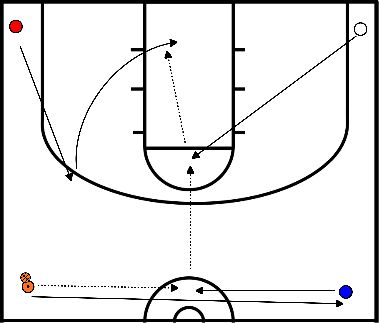
Option 1
- Blue runs to the middle and receives the pass from orange
- Orange then fills in blue
- White and Red come up at the same time that orange passes to blue
- White receives the pass from blue at the free throw line and faces the basket
- Red accelerates somewhere near the free throw line and heads for the basket
- White passes to red and red makes a layup
Option 2
- After orange passes to blue, orange also cuts across the right side and there is a second playoff opportunity for white.
Option 3
- Orange and blue continue to cut in and white takes a shot
- Orange and blue fight for the rebound and a score
* After building this exercise up to Option 3, players must be sharp, there can always be a pass or fight for the rebound.
* There is no dribbling
* Rotation is counterclockwise
* There is no dribbling
* Rotation is counterclockwise
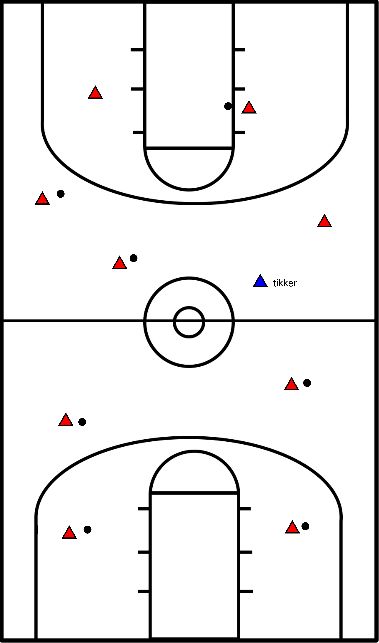
Requirements
- paste technique
Organization
- There is one ticker without the ball and two players without the ball.
- Whoever has the ball cannot be tapped without it.
- The ball may be held for a maximum of ten counts.
- If the scapegoat intercepts a ball, the ball is out of the game.
- Change the scapegoat regularly
- Depending on the amount of players adjust the size of the field.
- Running outside is not allowed.
Goal
- Free running, searching for space
- Movement
- The joy of playing
Teaching points
- Passing technique, running free and filling space
- Ball must reach other player, otherwise also out
- Dribble!
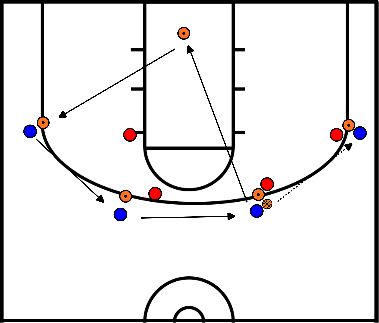
Prerequisites:
- Some game insight at fill the spot, be able to apply defensive stance (denail - helpside)
Goal:
- offence: quickly see where there is an empty spot and cut through after a pass, defence: adjust stance according to how the ball is moving
Organization
- 4 players (U10) on a spot with defence, empty spot under the ring.
- Offence: pass the ball around and make a quick cutting move towards the empty spot below the ring, other attackers move up and the empty spot is filled in by the cutting attacker.
- Defence: adjust position according to the ball. (hands on the ball, denail, weakside help on the line ring-ring)
- 5 passes (calmly), then 4vs4
- Passing on: offence becomes defence, defence steps out and then becomes offence
- Possibly start with passive defence (hands on back) depending on players' level.
teaching points
- Offence: good pass - in/out to deep bucket and high stepping out - placement of feet - attention to mistakes.
- Defence: anticipate the ball - check correct posture per spot before passing - jump-to-the-ball
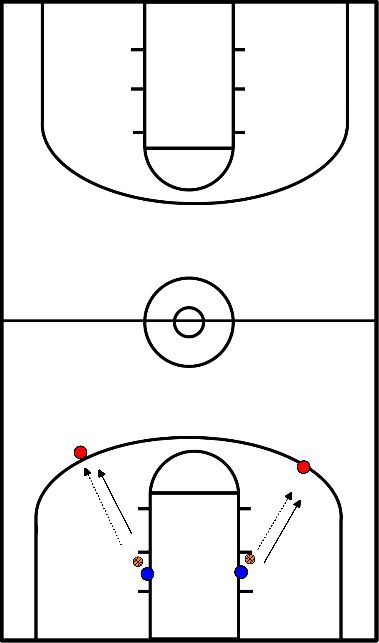
- Player blue passes to red and sprints to red for a close-out.
- Player red tries to get into the "paint" to score.
- Player blue is going to try to prevent this.
- Either blue can steal the ball
- point for blue
- Either red can score
- point for red
- After a possible goal is score, red takes rebound, passes to the next in line.
- Blue goes to the position of red.
The exercise now starts again with the next players.
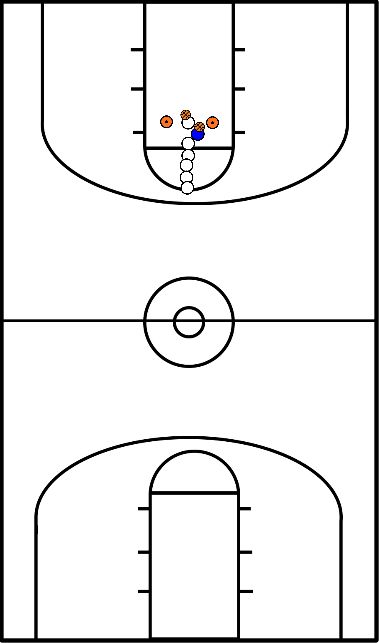
- Players in a row on the free throw line or for U10 and U12 a bit closer to the basket (put down pilons).
- First two players have a ball.
- Player 1 tries to shoot.
- When the ball is thrown, player 2 may also shoot.
- If the player misses, go for the rebound as fast as possible, try to score from the area where the rebound is picked up (if it is behind the baseline, dribble in a bit).
- If player 2 scores before player 1, player 1 is finished and is not allowed to play again.
- After a goal is scored, pass as soon as possible to player 3 plays so that he can 'kill' his predecessor.
- Connect yourself at the back of the row.
- Play on until there is 1 player left.
- Note that the player who has to be played has to get out at the right side to be able to play. And that the scorer rebounds the ball as fast as possible and plays it back with a good tight pass.