



Korfballexercises for technique running in shot
Last update: january 2026
Organisation
- Pairs stand on either side of a line in the middle of the hall.
- The number 1s, slightly to the left of the line, are the rats.
- The number 2s, half a metre to the right of the line, are the ravens.
- There is a metre of space between the rats and the ravens.
- The trainer calls out 'rats' or 'ravens' in random order.
- When 'rats' is called, the rats run as fast as possible to their side of the hall.
- The ravens try to tag the rats.
- Who tags their personal opponent the most?
- To keep it exciting, let the 'r' roll for a long time or make a short story out of it.
Objective
- Practicing the running-in shot from challenging situations.
Organisation
- Groups of three or four per korf.
- One or two players under the korf, two in front.
Execution
- After passing, run forward and take a running-in shot, then rotate positions.
Variants
- Bounce running-in shot: Running-in shots are passed with a bounce.
- Delayed overhand running-in shot: The pass is delayed, take overhand running-in shots.
- Delayed sideways running-in shot: The pass is delayed, run left or right past the korf and bring the ball sideways or diagonally backwards upwards. When pushing off with the right leg, the movement is smoother and the shot more accurate if you run past the post on the left.
- Durk Bergsma shot: The pass is delayed, run past the post and sling the ball with one hand over the head into the korf.
- Delayed jump running-in shot: The pass is delayed, take the running-in shot in a jump.
- Early long pull shot: The ball is passed too early, take a 'long pull shot' with a long floating moment.
- Rolled ball: The ball is not thrown but rolled.
- Show movement: The ball is passed slightly too early, bring the ball once around the body before shooting.
Variations
- Space passing: The pass is no longer made from under the korf, but from the space approximately 5 meters diagonally in front of the korf.
- Long distance: The passer stands more than 20 meters from the korf.
- With defender: All exercises with a defender at the taker of the running-in shot.
3 tallies at a post. Each 3-team adds up the amount of goals scored. Goal of this exercise is to score as many goals as possible.
- distance shot from movement in front of basket, after shot repeat shot. (Whoever scores 20 goals first).
- Walk-through balls front side combined with back side. 1 player makes a through ball on the front side then walks through to the back side and makes another through ball. After this switch. Whoever has 25 goals first.
- Shots on the 4 meter line. No repeat shot. Whoever scores 20 goals first
- 40 short chances.
- distance shot from movement behind basket, after shot repeat shot. (Whoever scored 20 goals first).
- 2 teams mixed
- Each round lasts 5 min, then quickly convert everything to the next round (max 3 min)
- Keep score, highest number at the end wins
- Perform pawn exercise well first then make certain score
- Round 1:
- score walk-through balls. (Pawn exercises = feinting between 2 pawns)
- Round 2:
- score shots 3-4m. (pawn exercise = 2 pawns forward, 1 pawn backward)
- Round 3:
- scoring short chances behind the post. The sprinter is indicated and who plays back to the out-stepping rebounder under the post (pawn exercise = hopping over the pawns)
- Round 4:
- scoring shots 4-5m. (pawn drill = skating jumping over the pawns, landing briefly holding)
- Round 5:
- scoring swerve balls. (pawn exercise = jumping up at pawns 1, 3 and 5 and squat at 2 and 4)
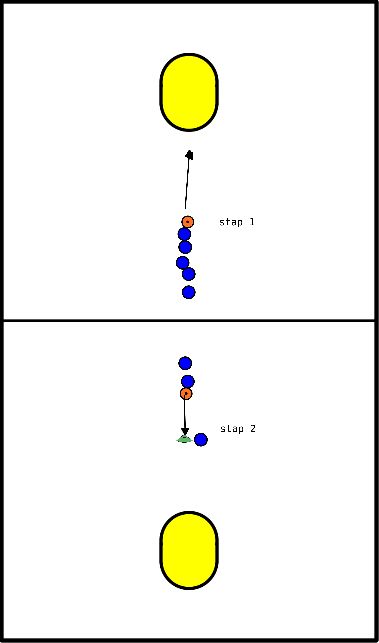
Step 1:
Each player has their own ball and lines up in a line with other players in a row 6 meters in front of the basket.
The first player in line runs toward the basket and takes a penalty throw with a quick motion. Runs back and joins the back of the line. The next player starts.
Each player has their own ball and lines up in a line with other players in a row 6 meters in front of the basket.
The first player in line runs toward the basket and takes a penalty throw with a quick motion. Runs back and joins the back of the line. The next player starts.
Step 2:
Same setup as step 1. Only now a player also stands in support, slightly in front of the penalty throw spot. This one puts the ball on 1 hand. The runner approaches, grabs the ball from the hand and takes a penalty throw.
Step 3:
Same as step 2. Only the declarer throws the ball up a little.
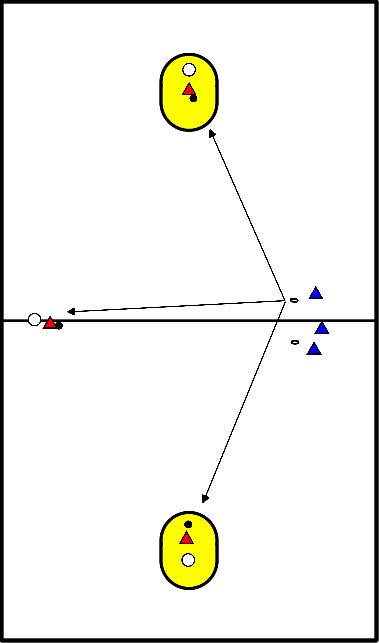
- Poles in triangle:
- At each basket someone with a ball with fixed pointer.
- The other players in the middle at the 2 hoops.
- From the middle you take a through ball to one of the baskets.
- You may never go to the same post twice in a row.
- You always move on to the next post by putting your foot in one of the hoops.
- The goal is to score 5 times as fast as possible.
- If you manage to do this, you move into one of the hoops. This hoop may then no longer be used by the others to move on to the next basket.
- Then switch attackers and start again.
- Halfway through the exercise switch to away balls.
- Each pair must try to crack the code. This is a four-digit code where the sequence matters.
- Each exercise is a number; they can use this number in the code.
- When they have done 4 exercises, they pass this as the code, in the order in which they did the exercises.
- The trainer then indicates how many the players got right and how many are in, but not in the right place.
Exercises:
- 8 walk-through balls
- 5 rounds of running ladders pp
- 2 laps around the whole field
- 5 fallback balls right
- 5 safety balls left
- touch post small chance, 8 score
- 20 penalty throws
- 6 distance shots 6 m in front of the basket
- 6 distance shots 5 m behind the basket
To make the run-throughs a little more fun, we'll make it a contest!
- You put a number of baskets in a circle with one passer on each occasion.
- There are also more players than baskets in the middle
- Every run through counts for 1 point
- If you score a run-through, you take your turn
- If you miss the follow-through, you and the server swap positions
- The first player to score 6 points wins. Number of points to be determined on what the players can do.
variation:
- you can do different sizes of baskets and give them a different score
- for example an archer basket counts for 2 points
- Step 1: Each player has their own ball and line up one after the other at 6 meters in front of the basket. Then the first in line walks toward the basket and takes a penalty throw. This is done in a smooth motion.
- Step 2: Same setup as step 1. Only now a player also stands in support, slightly in front of the penalty throw spot. This one puts the ball on one hand. The runner approaches, grabs the ball from the hand and takes a penalty throw.
- Step 3: Same as step 2. Only the declarer throws the ball up a little.
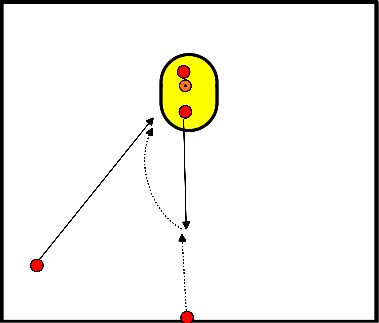
- Ball is played from the other box to the very high running support player.
- Just before the ball is received, it is run in from the side to the post.
- This player is played on and makes a through ball.
- The fourth player catches and plays the ball to the now run-through declarer.
- High support player runs to the other box, the passer becomes the new high support, the shooter catches and the player from the other box becomes the shooter.
Score 20 through balls from the right and 20 from the left.
Indicate with the outer hand, the other hand is bothered by the defender.
Indicate with the outer hand, the other hand is bothered by the defender.
Requirements: 2 speedladers with a basket behind them.
After each exercise, run through for a pass or a shot, catch your own ball and pass to the next player.
After signalling, the handler runs to the beginning of the speed ladder.
Exercise:
After each exercise, run through for a pass or a shot, catch your own ball and pass to the next player.
After signalling, the handler runs to the beginning of the speed ladder.
Exercise:
- Lateral high knees, speed ladder:
- Jog sideways through the ladder, raising your knees and keeping your torso upright.
- Move your arms along with the movement. left and right.
- Straight fast through speed ladder
- Whoever scores the most goals from the through ball has won.
The poles are side by side on an imaginary center line in the box max 4 per box.
The side/or center/back line are the end marks.
Per pole a declarer and a runner. The runner walks from line to line and shoots from the back one time and from the front the next.
The runner runs 3 minutes each time.
The side/or center/back line are the end marks.
Per pole a declarer and a runner. The runner walks from line to line and shoots from the back one time and from the front the next.
The runner runs 3 minutes each time.
- Easy pace as a warm up.
- Tempo goes up to 50%.
- Take through ball with short sprint and run out slowly to the other line.
- Halfway through the run-up two steps to the left or right and then run through again 50%
Although the emphasis is on fitness, make it a contest with your fellow runner to see who scores the most.
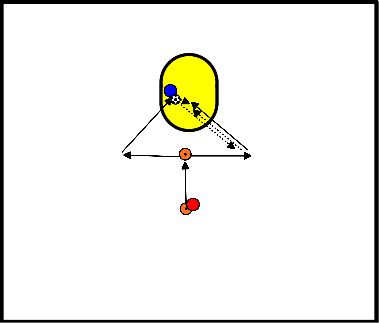
- Player walks to pilon and makes sideways movement to left or right
- Clearly makes 3 steps sideways facing the basket
- Follows by a through ball
- Score 10 times after moving to the left and 10 times after moving to the right.
- Same, but now a feint follows at the pilon and then a sideward movement and a through ball at a clearly higher speed
- Now with opponent and get the ball after the dodge, you play the ball back to the basket and make a through ball.
- Depending on the defender, you pass outside or inside
- At inside pass you pass the ball to the other hand, because the defender protects the outer hand
- At the moment of play, you step past your opponent and cut inside in front of her
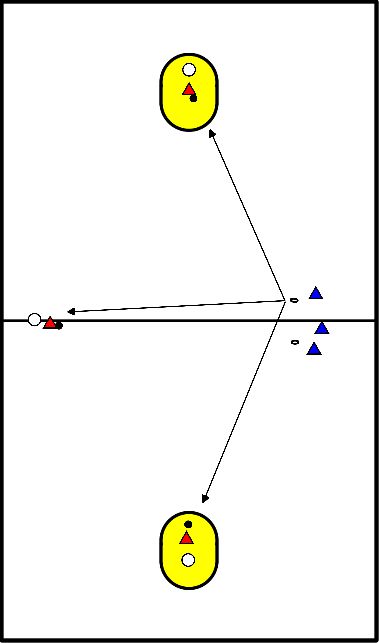
- Poles in triangle:
- At each basket, one player with a ball (fixed pointer).
- The other players in the middle at the 2 hoops.
- From the center, take a walk-through ball on one of the baskets.
- You may never go to the same post twice in a row.
- You always go to the next pole by putting your foot in one of the hoops.
- Goal is to score 3 times as fast as possible.
- If you succeed, you stand in one of the hoops. (This hoop may not be used anymore by the others to walk to the next basket).
- The first 2 players who stand in the hoops will play the final.
- They have to score a runthrough with one hand.
- The winner is the one who is first back in the hoop after a goal.
- He/she earns one point.
- Then switch players and start again.
- Halfway through the exercise, switch to dodge balls.
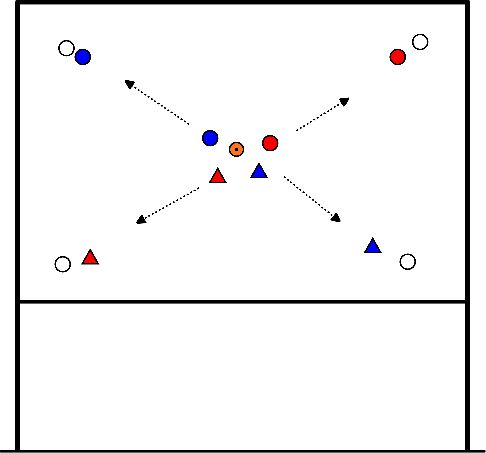
> 2-pairs (take turns)>
Pawns in the middle of the playing field> Pawns won
are 1 meter from your basket> 20 pawns
with 8-10 players | 24 pawns 11-14 players | 28 pawns 15-18 players> Each round
lasts as long as all pawns are gone (+ 1 minute of stealing pawns)
- Round 1:
- 5 dlb in a row = 1 pawn.
- 8 dlb in a row = 2 pawns.
- 10 dlb in a row = 3 pawns.
- Round 2:
- 2 shot = 1 pawn.
- 3 shot = 2 pawns.
- 4 shot = 3 pawns.
- Round 3:
- 4 short shot = 1 pawn.
- 7 kk = 2 pawns.
- 9 kk = 3 pawns.
- Round 4:
- 5 dots = 1 pawn.
- 8 dots = 2 pawns.
- 10 pips = 3 pawns.
- Round 5:
- 1 shot = 1 pawn.
- 2 shot = 2 pawns.
- 3 shot = 3 pawns.
- 4 shot = 4 pawns.
- 5 shot = 5 cones.
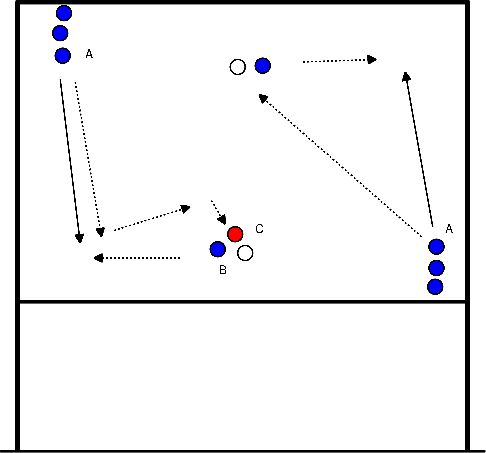
- Warming up on a large field with a lot of passing.
- Round 1:
- A passes to B who runs out and goes in for a walkthrough. (10 balls)
- Round 2:
- A passes to B who runs out, picks up for double and pulls away.
- B passes to A who then flips inside with ball to player C for through ball. (10 balls)
- Round 3:
- Same as round 2:
- But A doesn't take a through ball but passes to C for short chance. (10 short chances)
- Round 4:
- Ditto round 2:
- But A doesn't fold in but shoots immediately (4 a 5m). (6 shots)
- Round 5:
- Ditto round 4:
- A does clap inside for neighborhood movement (4 a 5m). (6 shots)
- Players learn not to throw a ball to the passer and then wait for the ball to be caught, but to run after it immediately.
- The ball is thrown to the basket.
- Immediately after throwing the ball, run after it to the basket.
- Goal is to be past the line before the ball is caught.
- Then get the ball back and shoot.
- The line makes the assignment concrete.
- Depending on the team, this may or may not be necessary.
- Variation 1:
- The ball starts under the basket, is outplayed and immediately thrown back.
- Variation 2:
- Working with an opponent.
- This opponent does not run with the ball to the basket (because that would not work in an exercise where the breakthrough is the only option), but does ensure that the attacker has to run around something.
First pass without a defender.
- Caution:
- Straight line to the basket
- Excellent
- Flowing movement
- Signaller on time
If that goes well, then:
- Defender joins in, he allows everything.
- Caution:
- Attacker must walk in the path of the defender.
- Walk in a straight line, not with a curve to the basket.
- Stretching.
If that goes well, then:
- The defender stays with the attacker, and now defends well.
- Stand by:
- The defender, what is his position? (Does he bend his knees a little, is he moving backwards, etc.)
- The attacker must walk in the same lane as the defender.
- Walk in a straight line, not with a curve to the basket.
- Stretching.
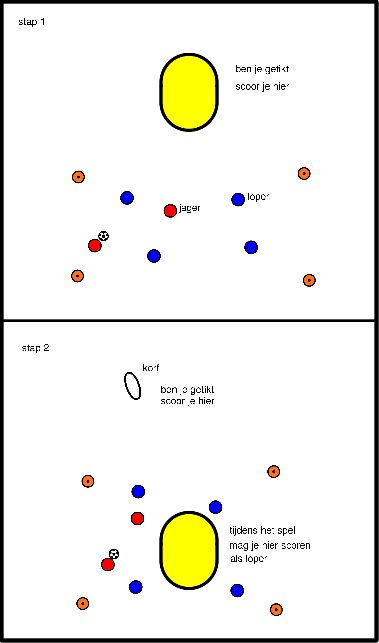
Step 1:
- As a hunter duo, try to move yourself around the field, playing over and throwing off as many runners as possible within 1 minute.
Step 2:
- Try to take the ball away from the hunters as quickly as possible, play over and score in the basket, but be careful not to get tapped by the hunters.
- This is allowed when you have the ball in your hands.
Rules:
- Lay the hats down in a square with approx 5m between the hats.
- Two players are the tappers, the rest move inside the square.
- The two scapegoats are allowed to scapegoat the other players with the ball. The catchers are not allowed to walk with the ball.
- By throwing over the ball the taggers can tap the other players.
- If you are tagged or left outside the box, you are out and you can join again if you have scored a goal.
- At step 1 the runners are not allowed to touch the ball of the hunters.
Variation:
- When players are out, they belong to the tag team instead of being out of the box.
- This is only allowed after they have scored.
- More or less players and therefore more or less balls.
3 or 4 at a pole.
- Play around with each other. Someone takes the catch after a pass, this is player 1.
- Player 2 is the one who just received the ball and is going to pass the deep line.
- Player 3 moves towards player 2, is "front defended" and runs a deep line.
- Player 2 passes a tight ball with a small arc to Player 3.
- Player 3 takes a shot.
- Player 1 catches, passes out to any team-mate and rejoins.
Expansion
- Instead of shooting, player 3 makes a shooting move.
- Player 1 steps out from the rebound.
- Player 3 passes to Player 1 and takes a walkthrough.
- 4 players play around the post.
- One player takes the rebound.
- The other three keep a triangle around the post and keep playing around with the three of them.
- The rebound player moves to the side where the ball is, gets the ball and shoots.
- Variant
- The rebound player steps out to the near post, receives the ball and passes to the far post.
- Both can also be combined, with the rebound player opting to pull away and pass on the ball.
- Other players must recognise their choice and make the right decision
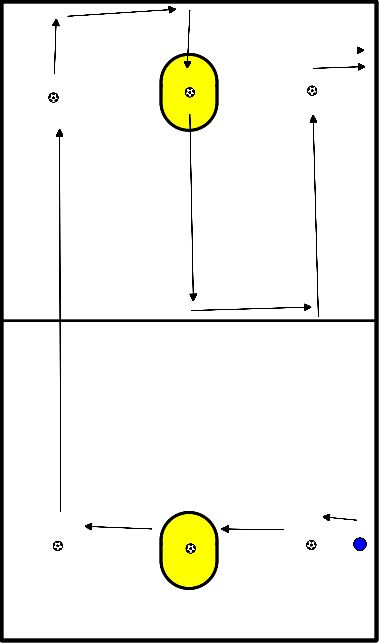
- Set up six baskets in two lines of three.
- Under each basket, a fixed declarer.
- The other players stand on the sideline across the first line of baskets.
- The other players take a walk-through ball on the side of the first three baskets.
- Followed by a ball in front of, behind and in front of the basket on the next baskets. (See diagram).
- Then all players do the same round, reversed and back again, after which they exchange players and do another round back and forth.
- Practicing throwing and releasing on the short and long line.
- The declarer stands far from the basket. The archer stands in front of the box at the side of the declarer.
- The archer walks up to the declarer (the short line), receives the ball and shoots.
- The declarer becomes a shooter, the shooter walks to behind the basket, the catcher arrives at the position of the declarer, after the ball is thrown to the next declarer.
Variant:
- The shooter chooses the long line after feinting towards the short line or basket.
- Both variations can be trained with the opponent near the shooter, so that the declarer learns to judge when someone is free.
- Dose the defender. When using a defender, the 2nd declarer (who in fact does nothing) can act as a defender.
- The rotation after the exercise is: declarer becomes defender, defender becomes gunner, gunner becomes catcher and catcher becomes declarer (after a combination with a player).
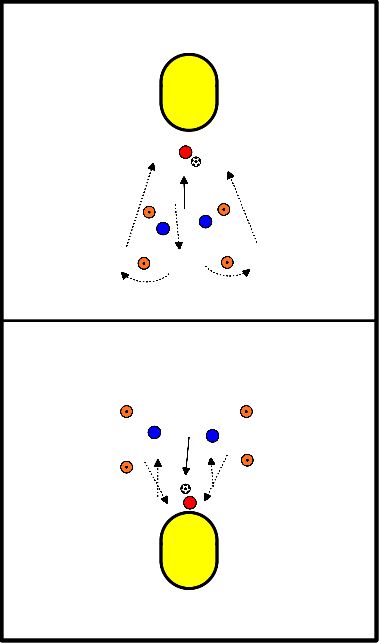
- There are 4 pilons in front of the post.
- 2 pilons of the same colour
- These pilons are in a square.
- 1 player is under the post and 2 players are between the pilons.
- The 2 players between the pilons start with a light dribble towards the post.
- The player under the post names the colour of 1 of the 2 colours of pilons.
- The following actions are possible:
- The players run to the back 2 pilons turn around and sprint to the post and the first one takes a through ball.
- The players run to the first two pilons and tap them and run back to the post and the first one takes a through ball.