




Soccerexercises
Last update: january 2026
Objective
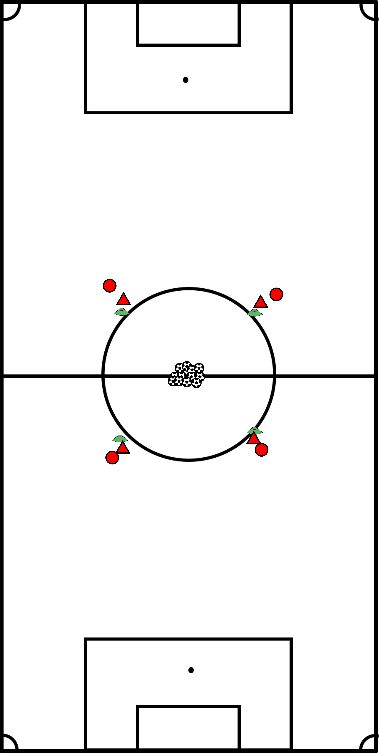
- Try to get 3 balls to your cone as quickly as possible.
- Form 4 pairs.
- Start with 12 balls.
- Each time, 1 player from a pair participates, the other player waits.
- The winner is the one who first has 3 balls at their cone.
- After each round, the second player of the pair goes.
- After each round, 1 ball is removed from the game.
- Do not carry more than 1 ball at a time.
- Only dribbling is allowed.
- The waiting players may not help or hinder.
- It is not allowed to take balls away during dribbling.
- Balls may be taken away from another player.
Execution
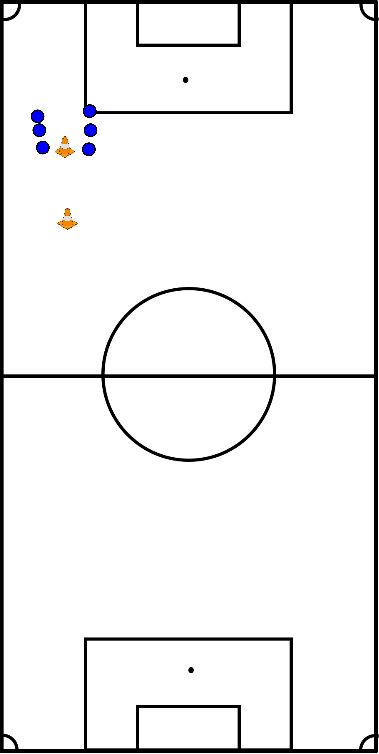
- Distance: approximately 10 metres.
- Start with a gentle running pace, repeat 3 times.
- Players stand next to each other on the spot.
- Lift the leg to hip height and bring the arm forward so that the finger reaches shoulder height.
- Then walk at pace, repeating the same leg and arm movement.
- When the right leg goes up, the left arm must also go up.
- The rest of the body remains still.
- Repeat 10 times at a gentle pace.
- Then 10 times at an accelerated pace, paying attention to the technical execution as described above.
Passing Exercise 1
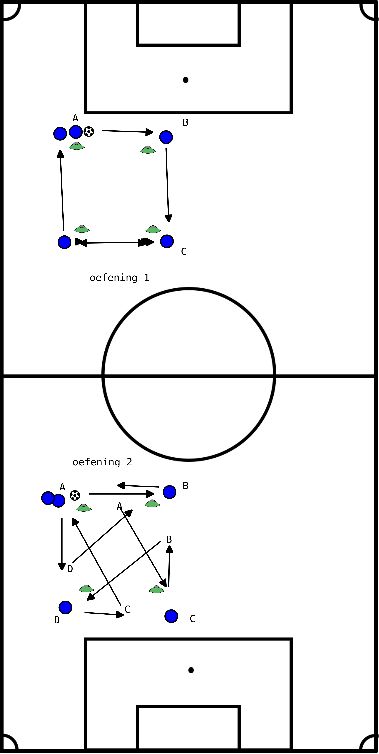
- Player A passes the ball to Player B and takes over Player B's position. Player B is turned open, receives the ball, and passes it to Player C.
- Passing: Hit the ball in the centre so it stays low. Lift your shooting leg slightly for the correct technique.
- Receiving: Be turned open with your body facing the player you are passing to and keep your eyes on the ball.
- Clockwise: Receive with the left foot, pass with the right foot.
- Counter-clockwise: Receive with the right foot, pass with the left foot.
- Increase the pace if it becomes too easy. Remove the receiving step for more challenge; pass the ball directly.
- Player B calls for the ball. Player A passes to Player B, who drops the ball back to Player A. Player A passes to Player C, who drops the ball back to Player B. Player B passes diagonally to Player D, and so on.
- After passing, the player must continue running to request the ball between the cones.
- The player who returns the ball runs around their cone and requests the ball in the middle.
- When returning the ball, the player must turn quickly towards the grid and not away from the play.
- Switch direction after 8 minutes. Pass clockwise with the right foot, counter-clockwise with the left foot.
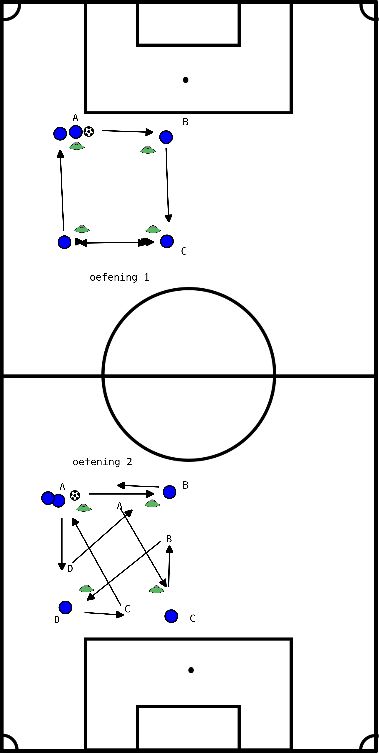
Passing Exercise 1
- Player A passes the ball to Player B and moves to Player B's position.
- Player B opens up, receives the ball, and passes it to Player C.
- Passing: Strike the ball in the centre so it stays low. Lift your shooting leg slightly for proper technique.
- Receiving: Stand open, with your body facing the player you are passing to and keep your eyes on the ball. When playing clockwise, receive with your left foot and pass with your right. Conversely, receive with your right foot and pass with your left.
- Increase the pace if it becomes too easy. If that is also simple, skip the reception and pass the ball directly.
- Player B calls for the ball.
- Player A passes to Player B, who lays it off to Player A.
- Player A passes to Player C, who lays it off to Player B.
- Player B passes diagonally to Player D, and so forth.
- The player passing must continue running and ask for the ball between the cones.
- The player laying off the ball runs around their own cone to request the ball again in the middle.
- When laying off, the player must make the correct turn and keep their eyes on the ball. The turn should be short towards the grid.
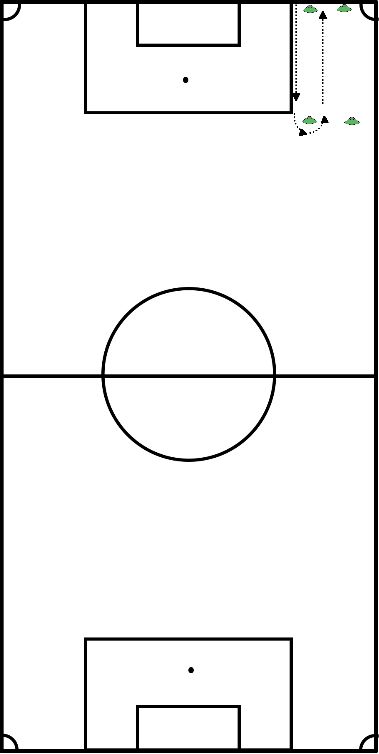
Team Division
- Split the team into two groups.
- Two rows with two cones facing each other at approximately 15 metres apart.
- Each team runs in a line between the cones, turns around the other cone and returns.
- Jog 2 laps around half the field or 4 times back and forth across the width of the field.
- 3 sets of 8 high knee lifts on the way there, jog back.
- 3 sets of 8 heel kicks to the buttocks on the way there, jog back.
- Jog with single arm swings: 3 to 4 times left, then right, repeat.
- Return skipping with both arms forward, 3 to 4 times, then both arms backward, repeat.
- Lateral jumping jack movement back and forth, change direction every 3 steps.
- Crossover steps back and forth, change direction every 3 steps.
- Walk backwards on the way there, sideways backwards movement: 3 steps left, 3 steps right on return.
- Low skipping on the way there, high skipping with knee lift on return.
- Lunges forward on the way there, jog back.
- Light acceleration on the way there up to max 60%, and back up to max 60%.
- Stand in a circle with sufficient distance.
- Swing arms backward left and right, feet in a light spread stance.
- Rotate arms in large circles up and down, counterclockwise and clockwise.
- Windmill with a light spread stance, slightly bent knees.
- With left hand to right foot, right hand up and look up, then switch.
- 10 times left and 10 times right.
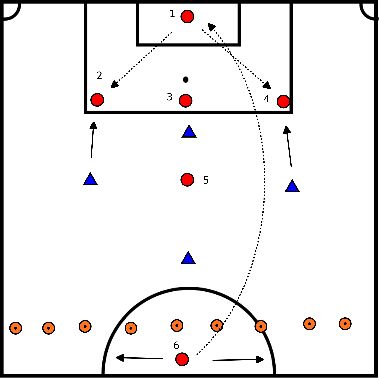
Objective
- Defenders attempt to intercept the ball quickly.
- The play starts with number 6 passing to the goalkeeper.
- The goalkeeper plays directly to number 2 or 4.
- When number 2 or 4 receives the ball, the blue team begins pressing and tries to prevent the penetration pass.
- The red team can "score" by making a penetration pass to number 6, who is allowed to move across the full width within his designated zone.
- The blue team can score in the large goal.
- Number 2 and 5 of the defending team apply immediate pressure on the ball.
- Number 9 of the defending team directly covers the line of the ball.
- Number 4 of the defending team steps directly onto number 5 of the attacking team.
- Number 6 of the attackers moves with the ball and participates in the play.
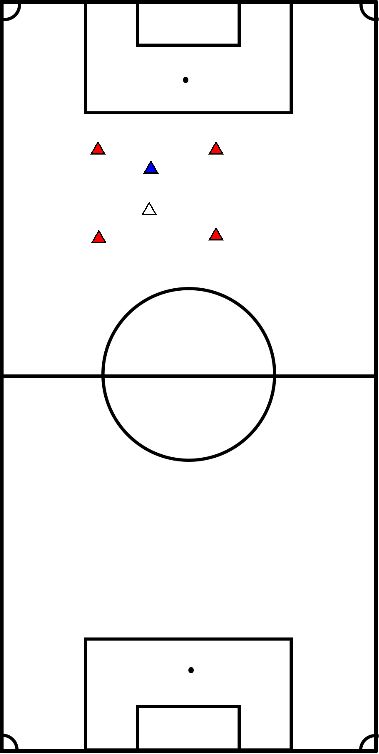
Setup
- Red square: 16 metres wide, 15 metres long.
- Blue cone: back line in the middle, 5 metres inside, and another 5 metres further.
- White cone: in the middle and 5 metres outside the area.
- Player B requests the ball by unbalancing the active defender and sprinting to the blue cone.
- Player A passes to B, B passes to C with the active defender at his back, C passes to D.
- D lays the ball wide and C finishes.
- If the active defender captures the ball, he may score.
- The player who loses possession must try to regain the ball.
- The exercise ends as soon as one of the parties scores.
- A becomes defender, defender becomes B, B becomes C, C becomes D, and D joins the back of the line.
- Start by first receiving and playing so B has to deal with a player at his back.
- Then place permanent defenders in the active defender positions and make it a match.
- Whoever scores the most goals in 5 minutes wins.
- Pass the ball at the right speed so your teammate can handle it immediately.
- The position of B is important to shield the ball immediately upon receiving.
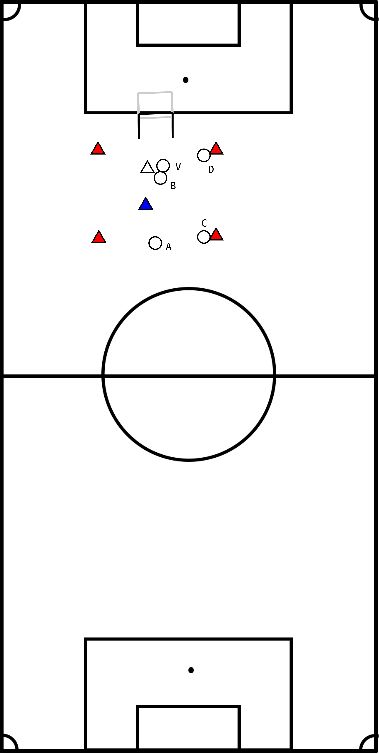
Duration: Approximately 15 minutes
Setup:
- Red square: 16 metres wide, 15 metres long
- Blue cone: back line, centre point, then 5 metres inward and 5 metres further the white cone
Explanation:
- Player B requests the ball by unbalancing the active defender and sprinting to the blue cone.
- Player A plays to B, B plays to C with the active defender at his back, C plays to D.
- D lays the ball wide and C finishes.
- If the active defender intercepts the ball, he may score.
- The player who loses the ball must try to regain possession.
- The exercise ends when one of the parties scores.
Rotation:
- A becomes the defender, the defender becomes B, B becomes C, C becomes D, and D joins the back.
Execution:
- Start with first receiving and playing so that B has to deal with a player at his back.
- Then place fixed defenders in the active defenders' positions and make it a match.
- The team that scores the most goals in 5 minutes wins.
Note: Defenders remain in positions A-B-C-D.
Coaching moments:
- Correct speed of passing the ball so that the teammate can handle it directly.
- The position of B is important to shield the ball immediately during reception.
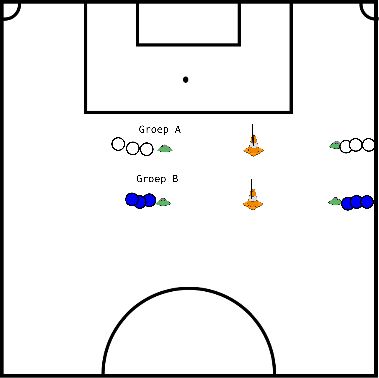
Setup
- Form two equal groups next to or opposite each other.
- Place a pole at a distance of 8 metres.
- Start with group A against group B.
- The left side begins simultaneously.
- Run at high speed to the centre pole, keeping the face forward.
- Circle around the pole and continue to the opposite side.
- Pass the bib to the next player, who does the same in the other direction.
- Replace the bib with a ball. The rest of the activity remains the same.
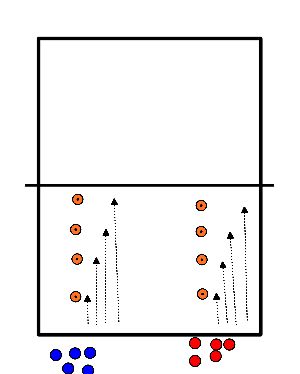
Setup
- Create two groups.
- Set up a course with four cones in a row.
- Maintain a distance of approximately 3 metres between the cones.
- At the signal, the first player sprints back and forth to the first cone and returns.
- At each subsequent cone, the player sprints further and then returns.
- At the last cone, the player returns and tags the next player.
- The group that returns first is the winner.
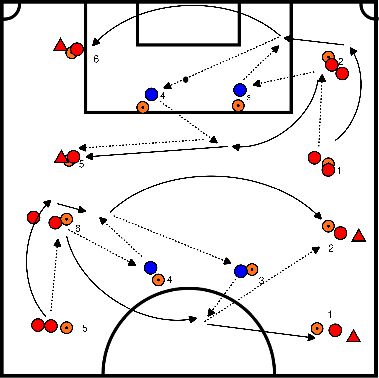
Execution
- Player 1 passes the ball to Player 2.
- Player 2 passes the ball to Player 3.
- Player 1 runs behind Player 2.
- Player 3 returns the ball to Player 1.
- Player 1 passes the ball to Player 4 and continues to the marker near Player 6.
- Player 2 runs diagonally left past Player 3.
- Player 4 returns the ball to Player 2.
- Player 2 passes the ball to Player 5 and then continues to the marker near Player 5.
- When it goes well, the speed must increase.
- If it does not go well, slow down and always control the ball first.
- If it still goes well, make the field smaller.
- Player 5 passes the ball to Player 6.
- Player 6 passes the ball to Player 4.
- Player 5 runs behind Player 6.
- Player 4 returns the ball to Player 5.
- Player 6 passes the ball to Player 3 and continues to the marker near Player 2.
- Player 6 runs diagonally left past Player 4.
- Player 3 returns the ball to Player 6.
- Player 6 passes the ball to Player 1 and then continues to the marker near Player 1.
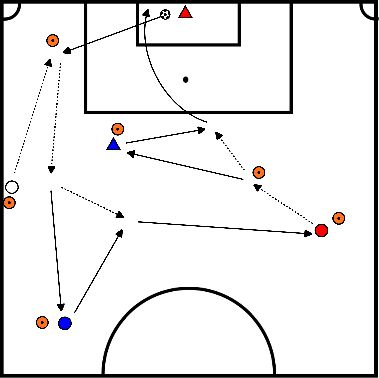
Execution
- Player "WHITE" drops back to collect the ball from the goalkeeper. The goalkeeper plays the ball to "WHITE".
- Player "WHITE" dribbles towards player "BLUE". At the level of his starting point, "WHITE" passes to "BLUE" and continues running.
- Player "BLUE" returns the ball to "WHITE". "WHITE" delivers a cross pass to player "RED".
- Player "RED" dribbles towards the penalty area. Around the middle of the field, "RED" passes to "BLUE2".
- Player "BLUE2" returns the ball to "RED". Player "RED" shoots the ball on goal.
- Rotation
- "WHITE" takes the position of "BLUE".
- "BLUE" takes the position of "RED".
- "RED" takes the position of "BLUE2".
- "BLUE2" takes the position of the goalkeeper (if there is no fixed goalkeeper).
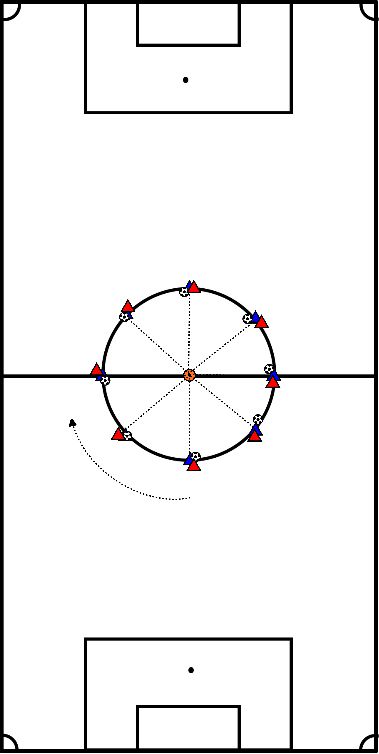
Execution
- Divide the group into pairs and place each pair at a cone on the centre circle.
- Leave the balls at the cones and have the group first run a few laps around the centre circle.
- Ensure that each pair stands at a cone with a ball.
- Player 1 dribbles the ball to the centre spot and places it there.
- On the way back without the ball, Player 1 performs exercises such as high knees.
- As soon as Player 1 returns, Player 2 begins the same exercises and then retrieves the ball.
- Repeat this and be creative with the exercises.
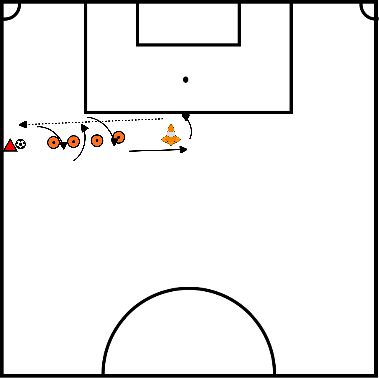
Setup
- Players are divided into equal groups.
- Each group tries to dribble the ball through the poles as quickly as possible.
- The last player of each group must pick up the ball and place it on the cone.
- Start with the first player of each group dribbling the ball through the poles.
- The next player begins as soon as the previous player has handed over the ball.
- The last player places the ball on the cone to complete the race.
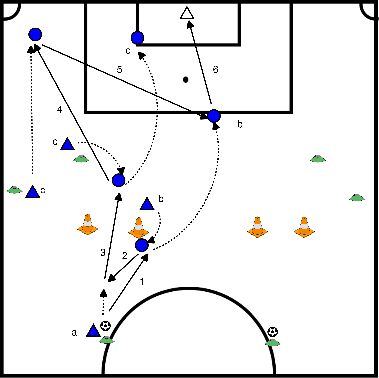
Positional Play and Passing
- Dotted lines indicate the movement paths, solid lines are the passing lines.
- Cones act as defenders.
- Player B finishes.
- If the cross is too low or too soft, player C can finish.
- Timing, accurate passing, and positioning are essential.
- Move forward: A to B, B to C, C to D.
- D takes the ball from B and joins on the other side.
- The right side begins when a cross is given on the left, and vice versa.
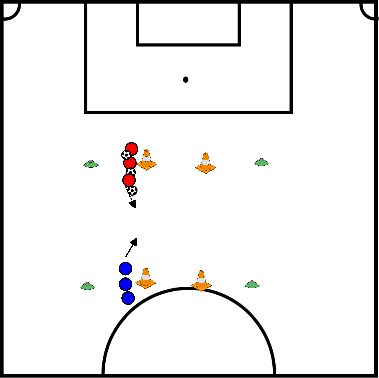
Setup
- Distances between cones: 10 metres long by 6 metres wide.
- Goals: Distance depends on age group.
- No bibs needed, as it is one-on-one.
- Red dribbles into the area and plays the ball to Blue.
- Blue tries to score on Red's goal.
- If Red intercepts the ball, they score on Blue's goal.
- After a goal or if the ball goes out of the area, join the queue at the opposite side where you started.
- Defence: Ensure you stay between the opponent and the goal. Be patient, bend your knees slightly, and stay on your toes.
- Attack: Maintain speed in your play. Once you stop, you are easy to defend. Unbalance your opponent with body movements. Tap the ball past your opponent and accelerate. Try to keep your body between the opponent and the ball.
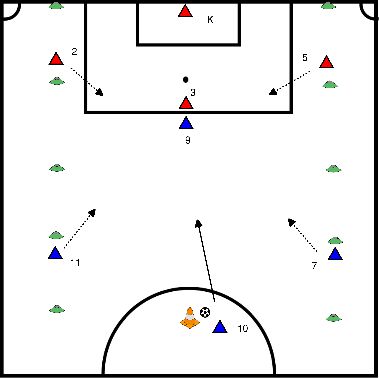
Formation and Objective
- Game form with attack against defence in a double diamond, 8 vs 8.
- Attackers attempt to score in the large goal.
- Defenders try to take the ball and play it back to the starting point.
- Field dimensions: 30 x 30 metres.
- The ball starts with player 10, who dribbles in.
- The goalkeeper, player 3, and player 9 are already in their positions.
- As player 10 departs, players 7 and 11 join in.
- Player 10 then plays to player 7, 9, or 11.
- From the first pass, players 2 and 5 join the defence.
- The attack ends with a goal, a ball over the end line, or when the defence gets the ball back to the starting point.
- After the attack, rotate or substitute, depending on the number of available players.
- Maximum 2 touches per attacker per attack.
- Maximum 5 passes until a mandatory goal attempt.
- Maximum 3 passes until a mandatory goal attempt.
- At least 2 triangles per attack.
- At least 2 double passes per attack.
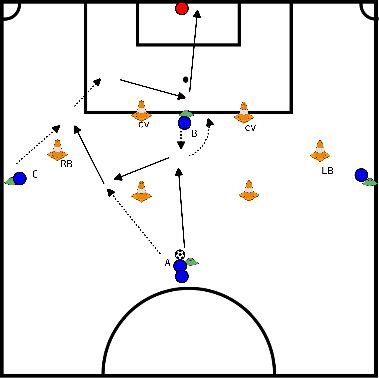
Setup
- Cones on the 16-metre line, 5 metres apart.
- Cones below at a distance of 10 metres.
- Cones on the side, 3 metres from the 16-metre line and 5 metres down.
- Player A stands 10 metres from the cones.
- A plays the ball to the incoming Player B and immediately runs to the side past the defender.
- B lays the ball off to A and returns to his starting position.
- As soon as B lays the ball off, C starts running to pass the full-back.
- A plays the ball into the path of C.
- C passes the last man and lays the ball back to B.
- B finishes.
- A becomes B, B becomes C, and C retrieves the ball and joins the back of the line, then switches to the other side.
- A must continue running immediately after the pass.
- B must create space to request the ball and then choose position directly.
- C must start at the right moment and not stand too deep to avoid being too close to the central defender.
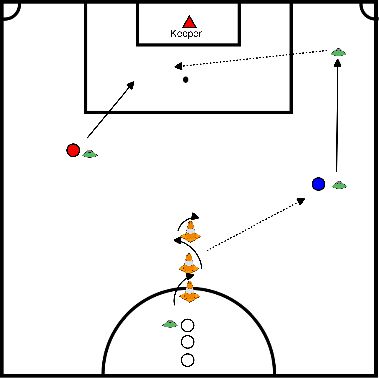
Game Description
- The player with the ball starts at the back and dribbles through the cones.
- Then, he passes the ball to the player waiting on the right.
- The player on the right plays the ball to the incoming player on the left.
- The incoming player tries to shoot the ball past the goalkeeper into the goal.
- The players rotate positions after their action.
- The player who dribbled through the cones joins the player who made the through pass.
- The player who made the through pass moves to the finishing position.
- The player who finished retrieves the ball and joins the players at the back who need to dribble through the cones.
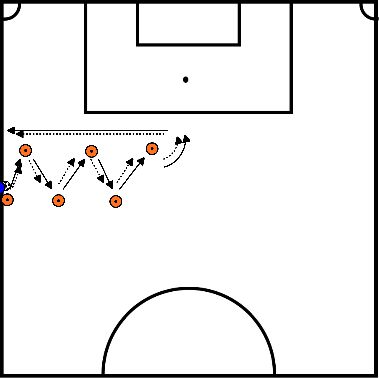
Setup
- Left: 3 white cones with 10 foot lengths between, first cone 10 foot lengths from the line.
- Right: 3 blue cones with 10 foot lengths between, starting on the line.
- There are 3 lanes, exercises are performed in the lane.
- Rejoin via the zebra crossing (space between the lanes).
- White cones: with left foot.
- Blue cones: with right foot.
- Tap tap stop (same foot).
- Tap stop (straight through the lane), alternating feet.
- Tap tap drag.
- Tap tap make a V.
- Tap tap cut.
- Tap tap behind support leg.
- Tap tap step over.
- Tap tap scissors.
- Tap tap Cruyff move.
- These technique lanes can be used as a warm-up in every training session.
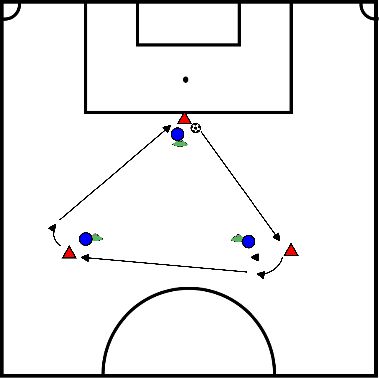
Setup
- Place three cones as reference points in a triangle.
- Players stand in pairs at each cone.
- The rear player performs the exercise.
- The player gets open from the player in front.
- A firm, hard pass is given along the ground.
- The receiver controls the ball with the furthest foot and passes to the next player.
- After the pass, the player sprints to the cone where they passed the ball.
- The player takes position in front of the player still standing there.
- Accurate and firm passing.
- Good one-touch ball control.
- Getting free from the defender.
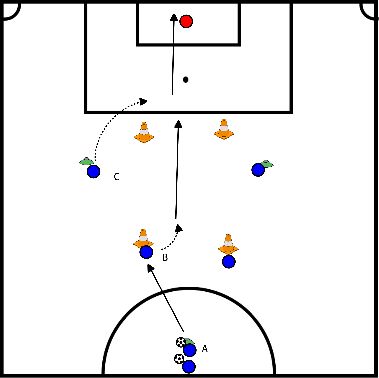
Setup
- Large cones are placed 3 meters outside the penalty area.
- Player C stands 10 meters outside the penalty area.
- The distance between C and B is 10 meters.
- The distance between B and A is 5 meters.
- Large cones act as opponents.
- Player A passes the ball to player B.
- B turns away from the opponent towards the inside and plays a through pass between the defenders into the running path of C.
- Player C finishes on goal.
- After the action, A becomes player B, B becomes C, and C retrieves the ball and joins the back of the line.
- The exercise then starts on the other side.
- Ensure that player C does not leave too early to avoid being offside.
- Do not leave too late, otherwise the goalkeeper can easily collect the ball.
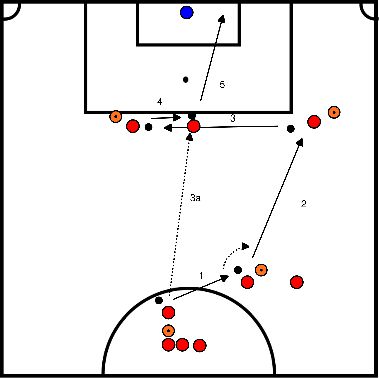
Setup
- Four players in position as shown in the diagram.
- Two players are in line at Player 2's position.
- Player 1 plays the ball to Player 2.
- Player 2 turns and passes to the winger, Player 3, on the right side.
- Player 3 delivers a cross-field pass at the 16-meter mark to the left, to Player 4.
- Player 4 lays the ball off wide, and Player 1 finishes.
- Player 1 moves to Player 2's position, Player 2 moves to Player 3's position.
- Player 3 moves to Player 4's position, and Player 4 retrieves the ball and joins the back of the line.
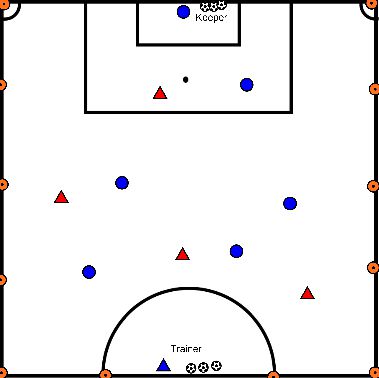
Objective
- Teams attempt to score on the goal with the goalkeeper.
- Teams must first earn the right to attack by making a pass with the trainer on the other side of the field.
- There is continuous transition between attacking and defending.
- Players must be alert and coach each other on actions and positions.
- In the event of a goal kick or when the goalkeeper has the ball, the goalkeeper plays to the team that was last defending.
- After a goal, the trainer immediately plays to the team that conceded the goal.
- Minimum width: 25 metres.
- Minimum length: 40 metres.
- Preferably play in a numerical disadvantage or advantage situation.
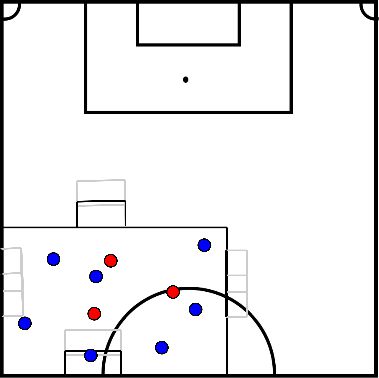
Game Principle
- Upon losing possession, the team must immediately apply pressure on the ball.
- The objective is to regain the ball as quickly as possible.
- The red team plays in possession of the ball.
- The yellow team attempts to take the ball away.
- If the yellow team gains possession, they try to score immediately in one of the four goals.
- The red team must prevent this by applying immediate pressure.
- The field is small to encourage quick attempts on goal.
- Observe whether pressure is applied upon losing the ball.
- Analyse who applies pressure and who does not.
- Assess the intensity of the pressure applied.
- Use small goals if there are no goalkeepers.
- Allow the team with fewer players to score by dribbling out of the field.
- Award points to the team with more players for a number of successful passes.
- Award points to the team with more players if they regain possession without a goal attempt from the team with fewer players.
- Adjust the number of goals.
- Count goals from the team with fewer players as more valuable.
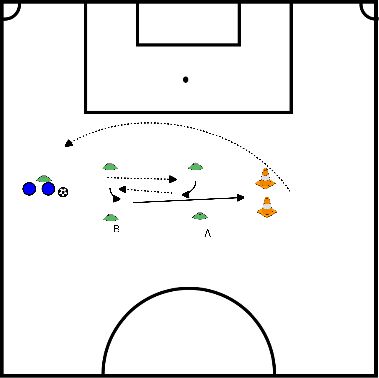
Execution
- Distance from point A to point B is 5 metres.
- Distance from point A to the goal is 5 metres.
- Distance from the cone to line B is 1 metre.
- The size of the goal varies depending on the age; younger players have a larger goal.
- The player dribbles to line A, cuts the ball, dribbles to line B, cuts again, and shoots the ball at the goal.
- The player retrieves the ball and runs around the outside back to the start.
- Cutting with the inside or outside of the foot.
- Cutting behind the standing leg.
- Dribbling with both the left and right foot.
- Dribbling: Touch the ball with each step.
- Make a short turn when cutting.
- At line B, cut so the ball is well positioned to step directly and shoot, without needing to go backwards for a run-up.
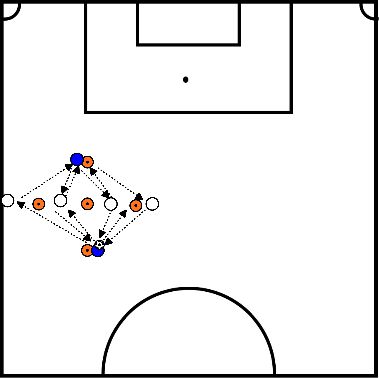
Explanation:
- 3 players in total: 2 blue ones who stay with their pawns and 1 white one who runs between the middle pawns
- 1 meter between the middle pawns, 2 outer pawns at +- 2 meter distance
- small exercise that can often be played side by side
Purpose of the game:
- 1 of the blue ones starts with a ball
- White steps 'knee lift' over the first pawn and bounces the ball back to blue.
- White steps over the next pawn and rebounds the ball back to blue
- Then white steps over the last pawn, receives the ball and turns open to the other side where he and the other player do the same
Focus points:
- Each ball is played in on the furthest leg so that it can be easily bounced and turned open. Good ball in the feet at a short distance.
- Practise passing the ball between the opponents using short passes. Create skill in passing and turning.
- Let the outer players coach what the middle player has to do: 'pass' 'turn open'.