



Tennisexercises
Last update: january 2026
Plank 30 seconds
- On forearms and toes
- Back straight, abdominal muscles engaged
- Do not sag!
- Lie on your back, hands behind your head
- Alternately bring your elbow to the opposite knee
- Steady pace, focus on control
- Lie on your back, knees bent
- Hips up, engage abdomen and glutes
- Hold, return slowly
- Sitting position, feet off the ground
- Rotate your upper body from left to right
- Optionally with a ball or small bottle
- On your side, support on forearm
- Hips off the ground, body in a straight line
- Switch sides after 30 seconds
- Lie on your stomach
- Arms and legs off the ground, hold
- Strengthens lower back and gluteal muscles
Execution
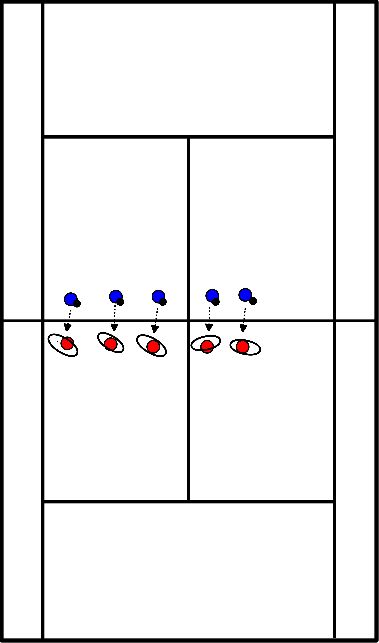
- Jump on your left foot and maintain balance for 10 seconds. Then sprint to the red line.
- Repeat on your right foot and sprint to the red line.
- Perform high knees in place for 10 seconds.
- Stay on your toes for speed and sprint to the red line.
- Do 5 lunges on the right and 5 on the left. Sprint to the red line.
- Jump sideways over the line back and forth 3 times. Sprint to the red line.
- Repeat the sideways jumps, but now with your back to the court.
Movement and Reaction T-Catch Tennis Ball
- Initial Setup: 2 players, 3 cones, 2 tennis balls
- Execution: Player A moves between the cones
- Player B holds 2 tennis balls high
- Player A returns to the centre
- Player B drops a tennis ball
- Player A catches the ball
- Initial Setup: 2 players, 5 tennis balls
- Execution: Player B tosses 5 tennis balls randomly into the court
- Player A tries to hit the ball after 1 bounce
- Initial Setup: 2 players, 1 tennis ball
- Execution: Player A stands with their back to Player B
- Player B throws a challenging tennis ball over Player A
- Player A catches the ball after 1 bounce
- Movement and reaction
- Footwork
- Always return to home base!
Execution
- Set up the situation twice.
- The first obstacle is a speed ladder through which you move sideways.
- Place two feet inside the speed ladder and one foot outside.
- Then you encounter three hurdles that increase in height from low to high.
- Jump over these hurdles.
- On the way, take a bag from the bucket with you.
- Which team will be the first to have all the bags on the other side and then sprint first to the other side?
- The final sprint may only be initiated when the last bag is placed!
Execution
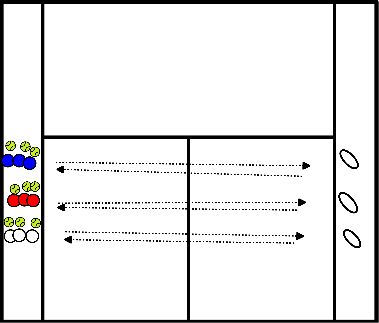
- Divide the players into groups of 2 or 3 and position them on the left side of the court.
- Give each player a tennis ball.
- At the start signal, the first player from each group runs with a ball to the right side of the court.
- Upon reaching the other side, the player places the ball outside the line and runs back as quickly as possible.
- The next player in the group repeats the action with his or her ball.
- When all balls are on the right side and the last player is back with the group, the relay is finished.
- The group whose last player returns first wins.
Execution
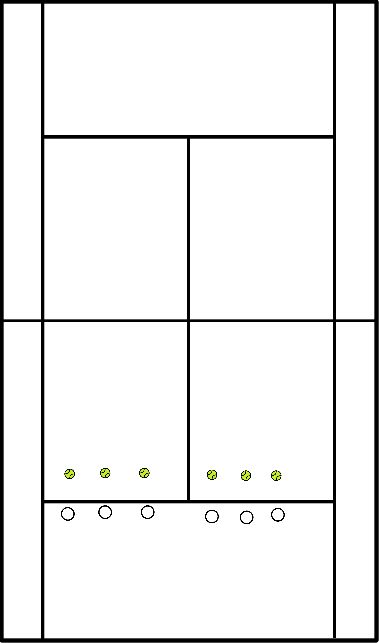
- Place the players in a line next to each other. Approximately 1 metre in front of them, place a tennis ball on the ground.
- Have them stand with their feet slightly apart.
- Quick steps - dribbling - on the spot.
- On the trainer's signal, while dribbling, they perform the following actions:
- Hands on the knees.
- Hands on the toes.
- Hands on the shoulders.
- Hands forward.
- Hands in the air.
- When the trainer shouts "Ball!", they must grab the ball as quickly as possible.
- Repeat and vary the commands for variety.
Introduction
- The trainer briefly discusses the previous lesson: what did we do and what have you learned?
Technical Focus
- Zoom in on forehands and backhands.
Tactical Focus
- Construction of a point.
- Positioning in doubles.
- Collaboration and communication.
Execution
- Try to rally in pairs.
- Create space and hit the ball into the open space.
- Experiment with hitting harder, taking the ball earlier, and deliberately slowing down the game.
Variation
- Use different court lengths to experience how hard, soft, high, low, deep, or shallow the ball should be hit.
Rotation
- After the ball is hit incorrectly twice, the pair swaps with the waiting pair.
- Waiting students can monitor the task and participate mentally.
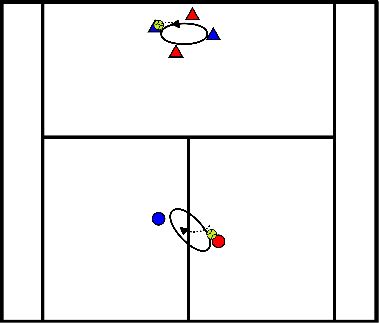
Game Rules
- Players compete in singles or doubles, each holding a racket.
- A hoop is placed in the centre between the teams.
- A baby ball (purple ball) is used, and players must hit the ball into the hoop each time.
- If the opponents cannot return the ball and it bounces twice, the other team scores a point.
- Players may pass to each other but must not obstruct.
- Players move continuously around their hoop to create different angles for the opponent.
- Start with singles, then progress to doubles.
- First, play the ball upwards to yourself and then attempt to score (singles).
- Receive the ball from the opponents, play it upwards (pass to a teammate), and the teammate must play the ball into the hoop (doubles).
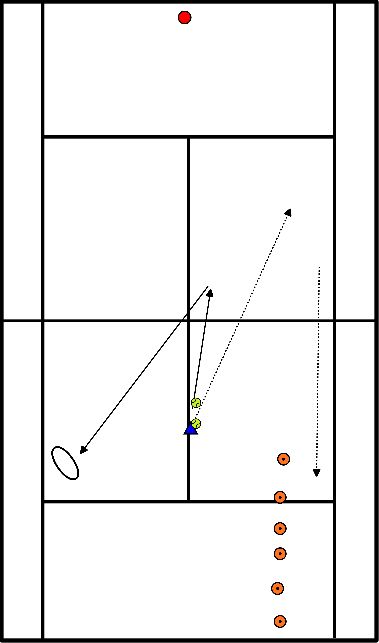
Execution
- The players start in the middle of the court at the baseline.
- They receive a lower ball on their backhand or forehand.
- Perform a deep slice along the line.
- Follow the ball to the net and finish the volley by aiming at the tower of balls (cone).
- Practice the same on the other side or both sides simultaneously.
- 1 sequence backhand slice
- 1 sequence forehand slice
- 1 sequence backhand slice
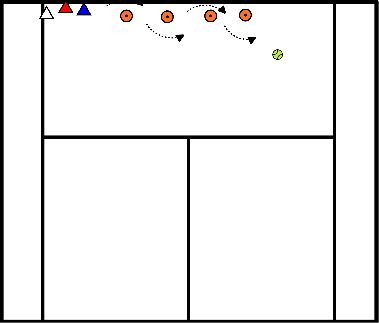
Execution
- The player zigzags as quickly as possible with their face towards the net between the cones.
- The next player may start when the player in front of them is halfway through.
- The trainer throws a ball forward.
- The player must hit the ball back with a forehand after one bounce at the end of their sequence, then with a backhand.
- Hop on the left or right foot.
- Circle around each cone.
- Jump over the cones with both feet.
- Same with backhand on the other side, throwing and starting.
Execution
- Place the ball on the racket and let it roll over the strings without letting it fall off.
- Keep the ball on the racket while touching the floor, sitting down, standing up, hopping, and running.
- Try to keep the racket at chest height.
- Throw the ball up with the racket and catch it again with the racket.
- Throw the ball a little in front of you, run after it, and catch it again with your racket.
- Throw the ball up, let it bounce once, and then catch it with the racket.
- Keep hitting the ball upwards without catching it and try to walk around while hitting the ball upwards.
- Who can do this without mistakes and without touching anyone?
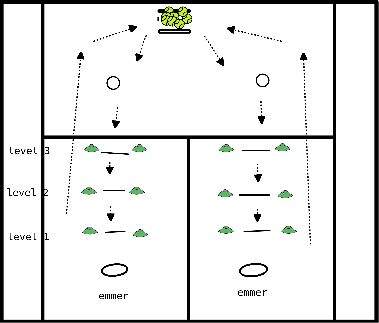
At the back line, place a bin of balls.
- The players start with a ball in their hand and run to the two hats closest to the net.
- They stand still between the hats and try to throw the ball into the bucket from there.
- Successful. Then they run back to the ball pit. Grab a new ball and run to the two hats in the middle to throw the ball into the bucket again from there.
- Failed. Then they run back to the ball pit. New ball and try again on that level.
- The one who completes the three levels first wins.
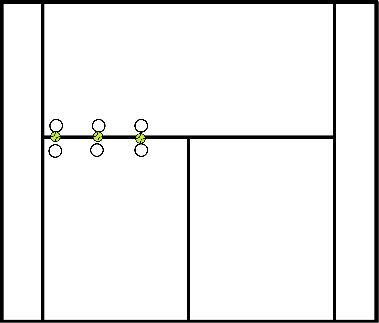
Put the players in a row next to each other.
About 1 meter in front of them on the ground is a tennis ball.
About 1 meter in front of them on the ground is a tennis ball.
- Have them put their feet slightly apart.
- Quickly run -dribble- in place.
At the trainer's instruction they do while dribbling:
- Hands on knees.
- Hands on toes.
- Hands on shoulders.
- Hands forward.
- Hands in the air.
- When the trainer calls Ball!, they grab the ball as fast as they can.
- Repeat and throw the commands interchangeably for variety.
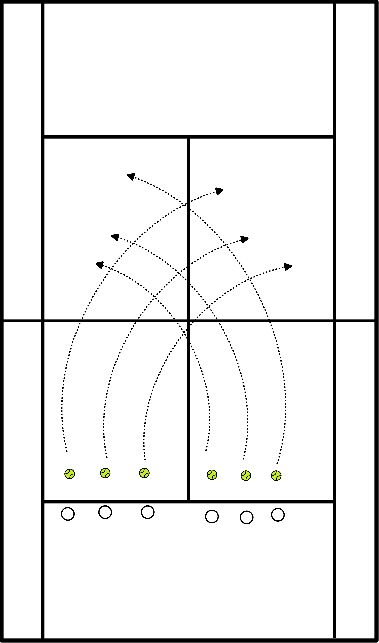
Put the players in a row next to each other.
About 1 meter in front of them on the ground is a tennis ball.
About 1 meter in front of them on the ground is a tennis ball.
- Have them put their feet slightly apart.
- Quickly run -dribble- in place.
At the trainer's instruction they do while dribbling:
- Hands on knees.
- Hands on toes.
- Hands on shoulders.
- Hands forward.
- Hands in the air.
- When the trainer calls Ball!, they grab the ball as fast as they can.
- Repeat and throw the commands interchangeably for variety.
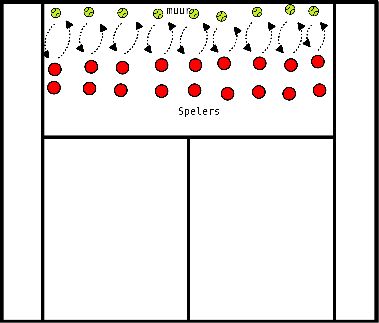
Setup:
- In pairs, place the players in a row facing the wall.
- Per pair 1 tennis ball.
Exercise:
- Player 1 stands closest to the wall and begins the exercise by throwing the ball against the wall.
- Player 2 catches the ball.
- Player 1 meanwhile runs back through the right side and then catches the ball that player 2 just threw against the wall.
- Repeat at least 20 times.
- Make the exercise more difficult by having the ball caught in a hat.
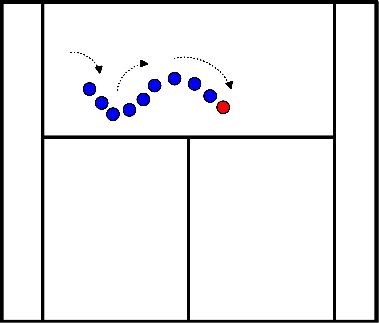
Warming up game
- Trainer leads the way and players follow in a string.
- Trainer makes turns like a snake and players follow.
- After a minute a movement is added. Then the walking becomes, for example, hopscotching or they wave their arms around while walking.
- Then the trainer calls a player's name and that player then leads the way and determines the running direction.
- As a trainer, you can then give commands about the "movement.
Warm up exercise in relay form
- Divide the players into groups of 2 or 3 players and place them on the left side of the field.
- Give each player a tennis ball.
- At the start sign, the 1st player of each group starts running to the other, right, side with a ball.
- Once there, they put the ball outside the line and run back as fast as they can so that player 2 of their group can start running with his/her ball.
- When all the balls are on the right side and the last player has returned to his/her group, it is over.
- The first one back to his/her group wins.
Put the players in a row next to each other.
About 1 meter in front of them on the ground is a tennis ball.
About 1 meter in front of them on the ground is a tennis ball.
- Have them put their feet slightly apart.
- Quickly run -dribble- in place.
At the trainer's instruction they do while dribbling:
- Hands on knees.
- Hands on toes.
- Hands on shoulders.
- Hands forward.
- Hands in the air.
- When the trainer calls Ball!, they grab the ball as fast as they can.
- Repeat and throw the commands interchangeably for variety.
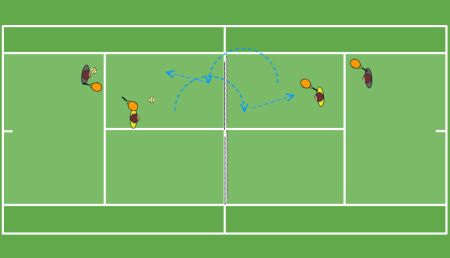
- On the left side, about 1.5 meters, of the net, line up half the players with a racket and small soft ball facing the opponent on the other side of the net.
- The opponents is the other half of the group each standing in a starting position; a hoop.
- With a tray, which they hold with two hands, they try to catch the ball that the group plays from the other side with the racket over the net.
- The catchers may step out of the hoop to catch/intercept the ball.
- After a few times, the groups switch.
- If you are right-handed stand sideways to the net with your right shoulder facing your opponent. This way you are at the right angle to give power.
- Drop your racket behind your body at the moment you turn your body. This way you use your hips and shoulders to give power to your stroke.
- During the swing, keep the arm extended and wrist stable. The elbow is slightly bent at the moment of impact because then you can give the ball direction and, if you want, a spin.
- Hit the ball when it reaches the height of your front hip. Be sure to move your feet toward the ball and put your weight on your front leg as you strike.
Left-handers stand with left shoulder facing the opponent.
You can also practice this exercise well against a wall.
You can also practice this exercise well against a wall.
- Put the ball on the racket: let the ball roll over the strings, the ball must not roll off the racket
- keep the ball on the racket, while you touch the floor, sit down, get up, limp, run etc.
- Try to keep the racket at chest height at all times.
- Throw the ball up with the racket and catch it again with the racket
- Throw the ball a little bit in front of you
- Run after it and catch it again with your racket.
- throw ball up let it bounce once and then catch it with the racket
- keep playing up the ball, don't catch it anymore
- try to walk around when you play the ball up, who succeeds without mistakes and without touching anyone
- The teacher will recap briefly the previous lesson.
- What did we do and what did you learn?
- It was about serving and returning and the experience that tennis is not that difficult at all and can be quite intense.
- The instructor explains that today we will technically zoom in on forehands and backhands, tactically on point building and doubles and in general on cooperation and communication.
- Each pair tries to play over, with each student trying to rush the other by creating space and hitting the ball in space.
- The emphasis is really on trying.
- Besides using the space, they can experiment with hitting harder, taking the ball earlier and deliberately slowing down the game.
- The teacher gives different lengths of lane (using the lines present in the room) to experience how hard / soft / high / low / deep the ball should be hit to be able to play together within this assignment.
- After the ball has been hit wrong twice, the two of them will switch to the waiting two on their lane.
- The students who are waiting can check the assignment and 'play along' in their minds.
- Stay in the rally The student is able to:
- To strike forehand- and backhand techniques in doubles and singles in different ways.
- To indicate which principles apply when building up a point.
- To start up and maintain independent play and practice forms.
- Participate in the lesson with attention and understanding, focus, hungry for work and combativeness.
- To work and consult together.
- Apply knowledge of the rules.
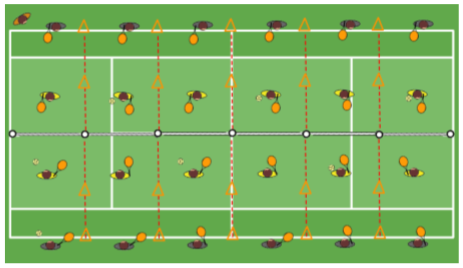
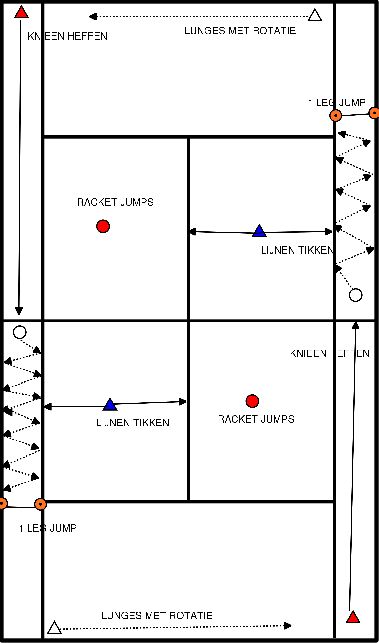
- POSITION 1: KNEES LIFT LENGTH BASELINE _ NET
- POSITION 2: LUNGES WITH ROTATION FH/ BH
- POSITION 3: TAPPING LINES WITH HAND / RACKET // SERVICE BOX
- POSITION 4: SKATE ON THE DOUBLE LINES WITH BALANCE
- POSITION 5: RCKET JUMPING L-R
= Sliding through system: Lunges- knees lift- racketspin-lines taps- 1 leg jumps with balance
exercise takes 1 min - 30 sec rest (move to next exercise) = 7.5 min/ lap = 2 rounds = 15 min
- Players play 1 vs 1 or 2 vs 2 with both a racket in their hands.
- There is a hoop in the middle between the teams.
- They get a baby ball (purple ball) and they have to hit the ball into the hoop each time.
- If the opponents can't take the ball anymore =2x bounces = point.
- Pass to each other
- Do not disturb
- So the players are constantly walking around their hoop, in order to make different angles for the opponent
- 1 - 1 start = afterwards 2 vs 2
- First play the ball up to yourself - then try to score ( 1 player -1 player)
- Receiving the ball from opponents - play up (pass to team-mate) team-mate must play in the hoop ( 2-2 players)
- The player zigzags face to face to the net as fast as possible; between the cones.
- The next player may leave if the player in front of him is in half.
- The trainer throws a ball forward
- The player must at the end of his series after one collision replay this ball with FH --> then BH.
Variants:
- Hopping LF / RF
- Circle around each cone
- 2 feet jumping over the cones
- Same in BH - throw the other side and start.
- Jump where you stand:
- Stand with your feet shoulder-width apart.
- Concentrate on a point on the floor and hop up and down where you are standing.
- Side jump:
- Stand up straight, keep your hands in front of you and jump from side to side.
- Butt Kicks:
- Stand up straight, and keep running in your place while your heel touches your buttocks with every step.
- High stepping:
- Raise the leg with the knee at a 90 degree angle.
- Quickly alternate with the other leg.
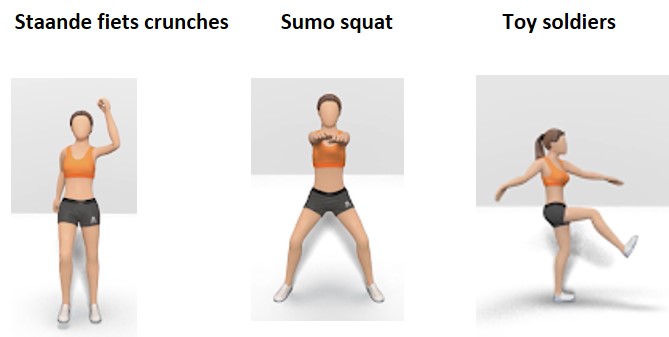
- Standing bike crunches:
- Stand with your feet shoulder-width apart.
- Bring your knee to your opposite elbow.
- Go back to the starting position and repeat with the other side (belly / legs).
- Sumo squat:
- Stand with your feet 6-12 inches apart.
- Stretch out your arms in front of you.
- Lower your body until your thighs are parallel to the floor.
- Return to the starting position and repeat the exercise (legs / buttocks).
- Jumping without a rope:
- Hold your arms along your side and pretend you're holding the end of a jump rope in each hand.
- Jump up and come down alternately on the ball of each foot, while at the same time turning your wrists as if you were letting a rope go around.
- Jumping without a rope
- Hold your arms along your side and pretend to be holding the end of a skipping rope in each hand.
- Jump up with 2 feet while simultaneously twisting your wrists as if you were making a rope go around.
- Arm Swings clockwise:
- Stand on the ground with your arms straight outstretched to the side at shoulder height.
- Move your arms quickly in large circles clockwise (arms).
- Arm Swings counterclockwise:
- Stand on the ground with your arms straight outstretched to the side at shoulder height.
- Move your arms quickly in large circles counterclockwise (arms)
- Toy soldiers:
- Start with your feet shoulder-width apart. Keep your legs and arms stretched.
- Kick up your left leg until your right hand touches your toes.
- Repeat with the other side (belly / legs / arm / shoulder).
Exercise with 3 players
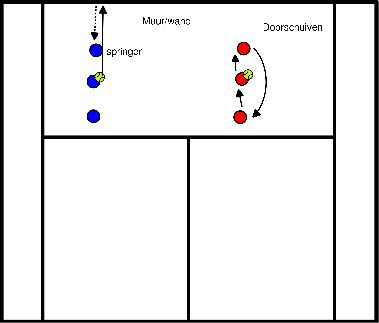
- With 3 players in a row across a wall
- 2nd player in line throws the tennis ball against the wall
- Player 1 jumps and spreads legs over the ball
- player 2 catches the ball after 1 bounce (descent: 2 bounces) and throws the ball backwards to player 3 who in turn throws it.
- If you jump over the ball
- at the back of the row
- Ball thrown
- goes player 1 as a jumper
- Player 3 has rest and then moves on to player 2 as thrower.