




Soccerexercises for technique passing
Last update: january 2026
Objective
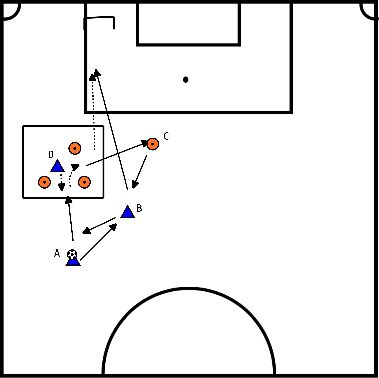
- Focus on the open-turn reception of player D.
- Start with player A.
- Player A passes the ball to player B.
- Player B bounces the ball back into the run of player A.
- Player D makes a preliminary move and comes to the ball between the two cones.
- Player A plays the ball to the left foot of player D.
- Player D receives the ball with one touch and turns between the two cones.
- Player D passes the ball to player C.
- Player C lays the ball off to player B.
- Player B threads the ball into the path of the advancing player D.
- Player D finishes in a small goal and joins the back of the line.
- Rotate positions alphabetically.
For 7 to 12 players
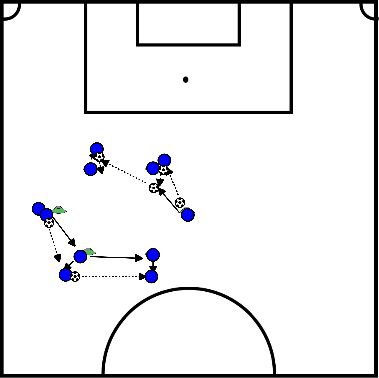
Make a hexagon with the pawns about 12-15 meters away.
At each pawn 1 player but at the 1st - and 4th if 8 players- 2 players.
Make a hexagon with the pawns about 12-15 meters away.
At each pawn 1 player but at the 1st - and 4th if 8 players- 2 players.
- 1 of the players at the pair starts with the ball.
- The player at the next pawn drops out and asks for the ball.
- The player with the ball plays it in.
- The player asking for the ball turns in and takes the ball.
- The player at the next pawn sinks out and asks for the ball and the player plays the ball in, etc.
- The player who plays the ball in runs on to the next pawn, and so on.
Variations:
- Counterclockwise and clockwise
- Instead of turning in and playing in, the player who plays in now asks for a rebound and the player rebounds the ball, then the player who asked for the rebound plays the ball in to the player at the next pawn. The player who rebounded runs on and now asks for a rebound, and so on.
For more than 8 players more people at some pawns or expand the hexagon to an octagon.
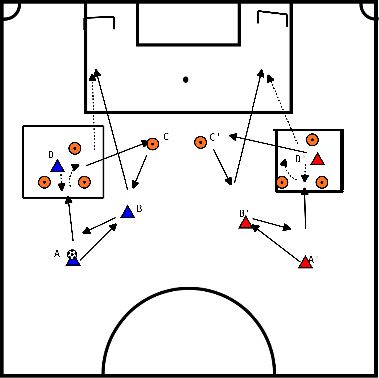
- Exercise revolves primarily around player D.
- Open-ended approach essential.
- Open-ended approach essential.
- Starts at A.
- A plays to B.
- B rebounds in the run back to A.
- D makes forward action and gets into the ball between the 2 hats.
- A plays in on D's left foot.
- D accepts with one ball contact and turns up between the two hats.
- D plays in on C.
- C drops on B.
- B pokes into the run of the passed D.
- D finishes in small goal and closes in behind again.
Alphabetical turn through.
Exercise revolves primarily around player D.
Open-ended approach essential.
Open-ended approach essential.
- Starts at A.
- A plays to B.
- B rebounds in the run back to A.
- D makes forward action and gets into the ball between the 2 hats.
- A plays in on D's left foot.
- D accepts with one ball contact and turns up between the two hats.
- D plays in on C.
- C drops on B.
- B pokes into the run of the passed D.
- D finishes in small goal and closes in behind again.
Alphabetical turn through.
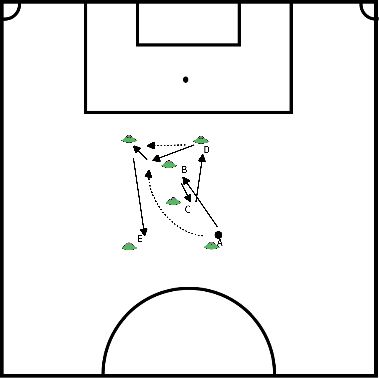
- Distances:
- Rectangle of 15 by 5 meters.
- Pawns B and C 5 meters apart.
- Both 2.5 meters from side and 5 meters from A and D.
- Duration: 10 min.
- After 5 min change direction
Explanation:
- A plays into B
- B drops the ball to C
- C passes to D
- The moment the ball reaches D, A has to be there to make the handball.
- D bounces to A and runs straight through to be played in again.
- A rebounds to D and D rebounds to E.
- E takes ball to starting point.
- Running lines: A becomes B, B becomes C etc.
Points of attention:
- Tight balls by hitting ball in heart, body slightly over ball.
- B must drop the ball on C slightly to outside so that there is a free pass line to D.
- A must time that she/he is present at the right time for the handball with D.
- If she/he is too early and has to wait too long it means in the match that there is opponent in her/his back.
- Is she/he too late D has to wait it means in the match that the opponent can put pressure on D.
- To maintain concentration make sure that at point A the ball is not played until everyone is in place.
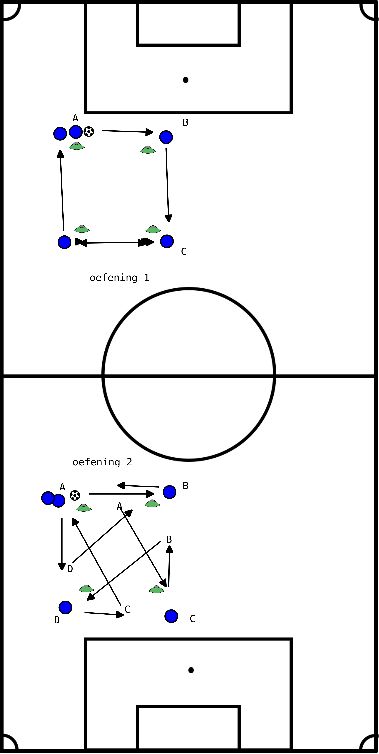
1st exercise:
- Player A plays the ball in to B and runs to B's position.
- Player B stands open turned, takes it and passes it to Player C and so on.
- Point of attention playing in:
- the ball must be hit in the middle so that it stays low.
- The correct technique for this is to lift your shooting leg slightly.
- Passing point:
- The player who accepts the ball should not be facing the ball with his or her body, but turned "open". You create this by positioning your body towards the player you are passing to and with your eyes on the ball.
- Playing around clockwise, the ball is taken on with the left and I play on with the right.
- In the other direction take on with the right and play on with the left.
- If you notice it's too easy, first increase the pace. Then to make it more difficult you can take out the assumption and they have to pass the ball directly.
2nd exercise:
- Player B asks for the ball.
- Player A plays into player B.
- Then B then drops the ball to player A after which he passes it back to player C.
- Player C then drops it to player B and then player B plays it diagonally to player D and so on.
Points of attention:
- The player who plays the ball in must move on after the play-in so that he can ask for the ball, in the middle, between the pawns
- Not further because then the effect is gone with the cross pass.
- The player who rebounds runs around his own pawn to ask for the ball again in the middle.
- This player must make the correct turn when rebounding so that he keeps his eyes on the ball.
- His turn should be short toward the box and not off the play.
In both drills after 8 minutes, change directions of play.
Clockwise passes with right leg, counterclockwise passes with left leg.
Clockwise passes with right leg, counterclockwise passes with left leg.
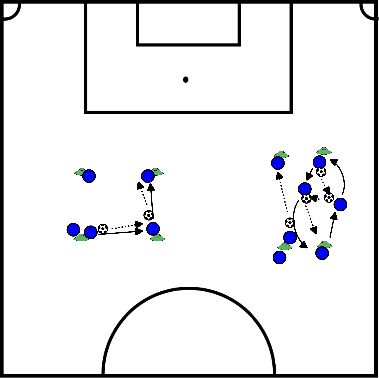
Square with 5 players or triangle with 4 players, at a distance of about 15 meters:
- Player at hat with 2 players starts.
- Plays the ball in on the right side and runs after his ball to the other hat.
- The player receiving the ball turns open and takes the ball well so that he can pass it in to the next player.
- Practice both counterclockwise and clockwise.
3 or 4 players per set:
- Two hats spaced about 15 yards apart.
- 2 players on one side and 1 or 2 players on the other side.
- 1 of the 2 players plays the ball to the other side and continues halfway to the other hat.
- The player on the other side takes the ball and plays it in to the player who ran halfway.
- This player rebounds the ball and continues to the other hat.
- The player who receives the ball back takes the ball and plays it to the player on the side where it was started.
- Running through like this.
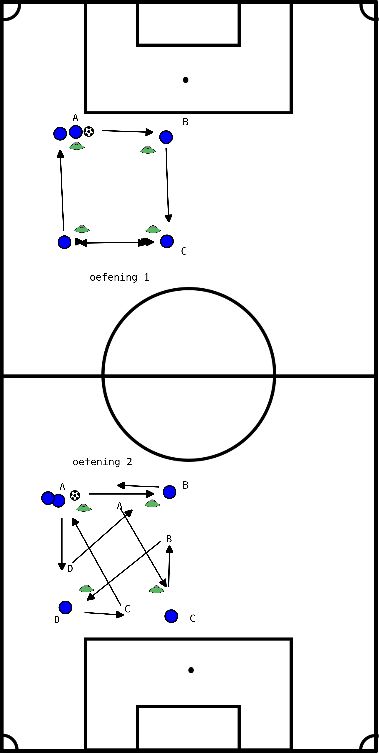
1st exercise:
- Player A plays the ball in to B and runs to B's position.
- Player B is open turned takes it and passes it to Player C and so on.
- Focal point 1 playing in: the ball must be hit in the middle so that it stays low.
- The correct technique for this is to lift your shooting leg slightly.
- Focal point 2 receiving: The player who has to receive the ball should not be facing the ball but rather, as they say, turned open. You create this by positioning your body towards the player you have to pass to and your face is facing the ball. Playing the ball around clockwise, the ball is taken on with the left and I play on with the right. other way round take on with the right and play on with the left.
- If you notice that it is too easy, first increase the tempo. If that also proves too easy then you take out the takeover and they have to pass the ball directly.
2nd exercise:
- Player B asks for the ball, player A plays into player B. Then B drops the ball to player A who then passes it on to player C.
- Player C then drops it to player B and then player B plays it diagonally to player D and so on.
Points of attention:
- The player who plays the ball in must move on after playing in so that he asks for the ball in the middle between the pawns
- Not further because then the cross pass effect is gone.
- The player who bounces the ball back runs around his own pawn to ask for the ball again in the middle.
- It is imperative that this player makes the correct turn when rebounding so that he keeps his eyes on the ball.
- His turn should be short toward the box and not off the play.
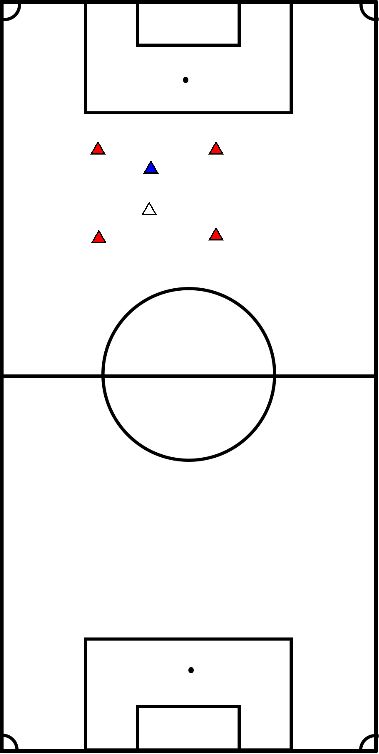
Duration: 15 min
Distance:
- Red square 16 meters wide 15 meters long.
- Blue pawn back line in middle then 5 meters inside other 5 meters again.
- White pawn in middle and 5 meters outside the square.
Explanation:
- B asks for ball by Active defender off balance and sprint to blue hat.
- A plays B in, B plays C in with active defender in back, C plays D in. D lays wide and C rounds.
- Has the active defender taken the ball away he may score.
- The player who lost the ball must try to win it back from the defender.
- The exercise is over when either player has scored.
- Passing A becomes defender- defender becomes B- B becomes C- C becomes D and D closes in behind.
- Start by assuming and playing first so B has to deal with player in back.
- Then put on the active defenders places the regular defenders and but your game of.
- Whoever scores most goals in 5 minutes wins. Note then the defenders remain standing A-B-C-D.
Coach moments: correct speed play the ball so your fellow player can deal with it immediately. Position B is important to shield the ball immediately during takeovers.
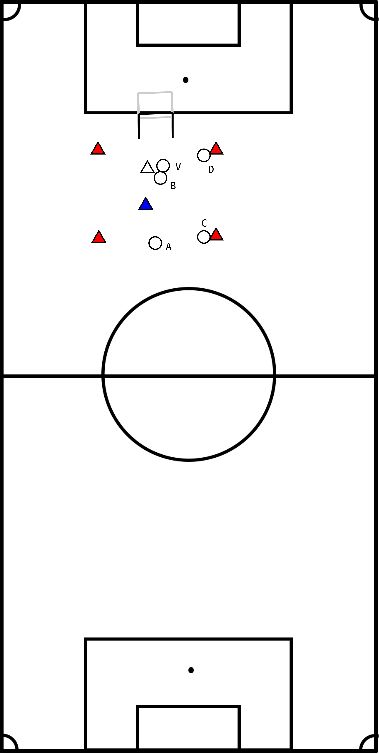
Duration: +-15 min
Distance: Red square 16 meters wide 15 meters long.
Blue pawn back line, center then 5 meters inward and 5 meters further the white pawn.
Distance: Red square 16 meters wide 15 meters long.
Blue pawn back line, center then 5 meters inward and 5 meters further the white pawn.
Explanation:
- B asks for ball by Active defender off balance and sprint to blue hat.
- A plays B in, B plays C in with active defender in back, C plays D in. D lays wide and C rounds.
- Has the active defender taken the ball away he may score.
- The player who lost the ball must try to win it back from the defender.
- So the exercise is over when either player has scored.
- Passing A becomes defender- defender becomes B- B becomes C- C becomes D and D closes in behind.
- Start by assuming and playing first so B has to deal with player in back.
- Then put on the active defenders places the regular defenders and make it a game.
- Whoever scores the most goals in 5 minutes wins.
- Note then the defenders remain standing A-B-C-D.
Coach moments:
Correct speed play the ball so your teammate can act on it immediately.
Position B is important to shield the ball immediately during takeovers.
Correct speed play the ball so your teammate can act on it immediately.
Position B is important to shield the ball immediately during takeovers.
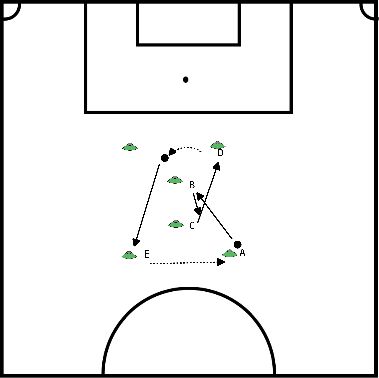
- Distances:
- Rectangle of 15 by 5 meters.
- Pawns B and C 5 meters apart.
- Both 2.5 meters from side and 5 meters from A and D.
- Duration: 10 minutes. After 5 minutes change direction
- Explanation:
- A plays into B
- B drops ball on C
- C plays into D
- D takes the ball in the movement
- D plays it in to E
- E takes ball to start point
- Running lines: A becomes B, B becomes C etc.
- Points of attention:
- Tight balls by hitting the ball in heart body slightly over the ball
- B should drop the ball on C slightly to the outside so that there is a free pass line to D
- D's assumption in the movement and pass to E must become a fluid movement so that you can perform the action in 2 touches
- NOTE THAT THE BALL AT POINT A IS PLAYED ONLY AT THE MOMENT WHEN EVERYONE IS IN PLACE. So that point A has to wait for a while that every round is in front of them and concentration remains.
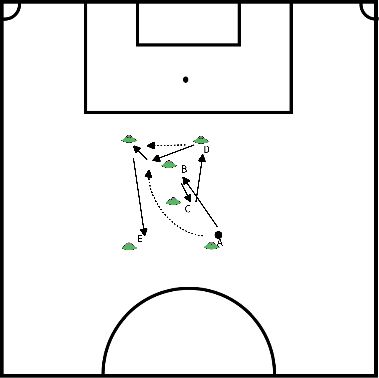
- Distances:
- Rectangle of 15 by 5 meters.
- Pawns B and C 5 meters apart.
- Both 2.5 meters from side and 5 meters from A and D.
- Duration: 10 min.
- After 5 min change direction
Explanation:
- A plays into B
- B drops the ball to C
- C passes to D
- The moment the ball reaches D, A has to be there to make the handball.
- D bounces to A and runs straight through to be played in again.
- A rebounds to D and D rebounds to E.
- E takes ball to starting point.
- Running lines: A becomes B, B becomes C etc.
Points of attention:
- Tight balls by hitting ball in heart, body slightly over ball.
- B must drop ball on C slightly to outside so there is a free pass line to D.
- A must time that he is present at the right time for the handball with D.
- If he is too early and has to wait too long it means in the match there is again opponent in his back.
- Is he too late D has to wait it means in the match that the opponent can put pressure on D.
- To maintain concentration make sure that at point A the ball is not played until everyone is in place.
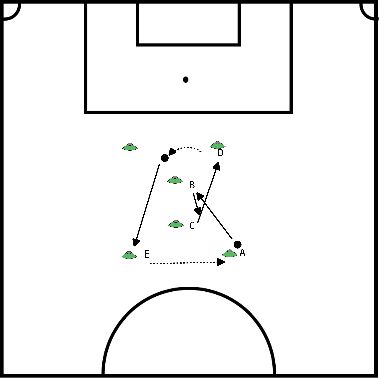
- Distances:
- Rectangle of 15 by 5 meters.
- Pawn B and C 5 meters from each other.
- Both 2.5 meters from side and 5 meters from A and D.
- Duration:
- 10 minutes. After 5 minutes change direction
Explanation:
- A plays into B.
- B drops ball on C.
- C plays D in.
- D takes the ball in the movement.
- D plays it in to E.
- Points of attention:
- Tight balls by hitting the ball in heart, body slightly over ball.
- B should drop the ball on C slightly to outside so that there is a free pass line to D.
- D's assumptions in the movement and pass to E should become a fluid movement so you can perform the action in 2 touches.
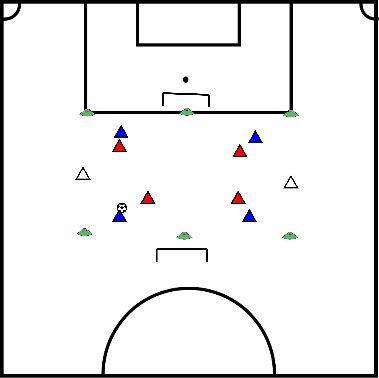
- This is a 4 against 4 position game with 2 handball players on both sides -white.
- The ball may be touched infinitely and if the ball goes out, the coach plays it in to the side for whom the ball is.
- If a team manages to pass 8 times without intercepting the ball, they may score in the goals and have a point.
Points of interest:
- Lots of movement.
- Good and tight passing.
- Trainer explains game situations.
- Moving the ball to the other side.
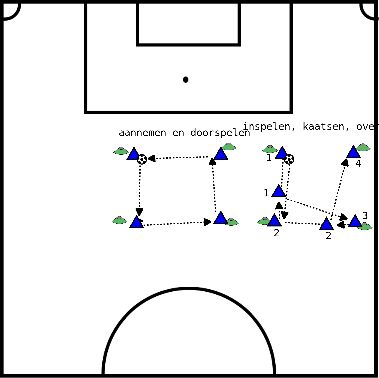
1st exercise:
- You start the first exercise by playing the ball in.
- The player accepts and passes it to the next player.
- The player also runs after the ball so that each time someone is in the right place.
- When you notice that it is too easy, you switch to the second exercise and it goes like this.
2nd exercise:
- Player 1 plays into player 2. He then drops the ball to player 1 who then passes it to player 3.
- Player 3 then drops it to player 2 and then player 2 plays diagonally to player 4 and so on.
Points of attention:
- Have the players coach each other.
- See if they are keeping track.
- If it is too easy, increase the pace.
- In exercise 2, then have the player really get under the ball when they get the ball back.
- The players must offer themselves.
- The players should ask for the ball.
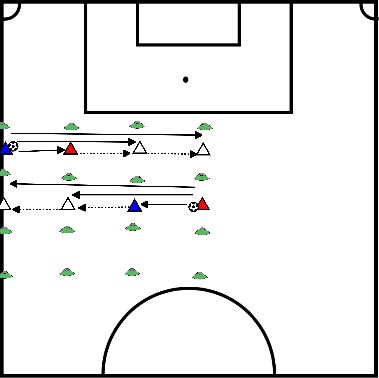
- There will be 4 rows of hats, each spaced 10 meters apart. As many lanes as you have pairs.
- Each lane has a 2-pair with 1 ball.
- Players line up at the first 2 rows of hats.
- The ball is at blue's sideline. This passes across the ground to red. This passes back across the ground and runs backwards to the next hats.
- Now blue passes with a firmer pass to red. This one passes back firmly and runs backwards to the last row of hats.
- Then blue passes to red with a high ball and runs himself to the row of hats closest to red.
- Now red stays on the back line and blue runs backwards to the next row of hats after each pass.
Pay attention to good kicking technique and good ball-taking.
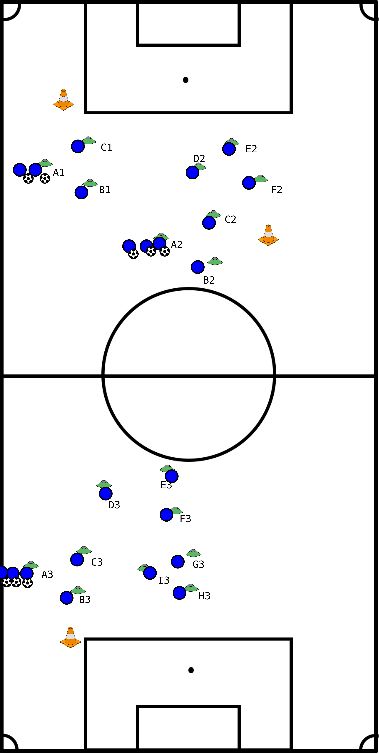
Distances 3 corners 10 meters to make it more difficult reduce the distances.
Distance next triangle 20 meters.
1st triangle:
Distance next triangle 20 meters.
1st triangle:
- A plays B in.
- B plays C in.
- C drops ball on A.
- A gives ball in runs with C towards Pawn.
- Running line A to B , B to C , C becomes A.
2nd triangle:
- A2 plays B2 in.
- B2 passes to C2.
- C2 drops ball on A2.
- A2 plays the ball to D2.
- D2 turns open, plays E2 in.
- E2 plays F2 in.
- F2 drops ball on D2.
- D2 hands ball in, runs with F2 towards Pawn.
- Running line A to B, B to C, C to D, D to E, E to F, F becomes A.
3rd triangle:
- A3 plays B3 in.
- B3 plays C3 in.
- C3 drops ball to A3.
- A3 plays the ball to D3.
- D3 turns open plays E3 in.
- E3 plays F3 in.
- F3 drops the ball on D3.
- D3 plays the ball to G3.
- G3 spins open plays H3 in.
- H3 plays I3 in.
- I3 drops the ball to G3.
- G3 gives ball in runs with I3 towards Pawn.
- Running line A to B . B to C. C to D. D to E. E to F. F to G. G to H. H to I. I becomes A.
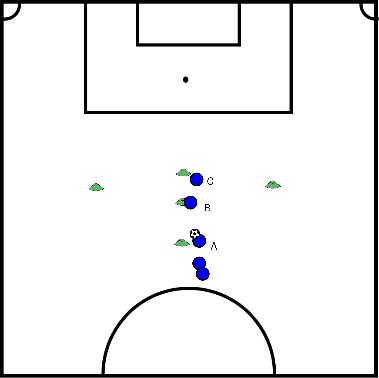
Organization:
Distance pawns A to B is 10 meters.
Distance pawns B to C is 5 meters.
Outward both 8 meters.
Goal of the exercise is A is going to coach B which way to turn open.
Distance pawns A to B is 10 meters.
Distance pawns B to C is 5 meters.
Outward both 8 meters.
Goal of the exercise is A is going to coach B which way to turn open.
- B gets loose from the pawn and asks A for the ball.
- A plays in at that point C points with his hand to the left or right.
- A coaches B to the side which C points to.
- B turns open and passes the ball to C who runs to the outer pawn he points to.
- A to B, B to C and C to A.
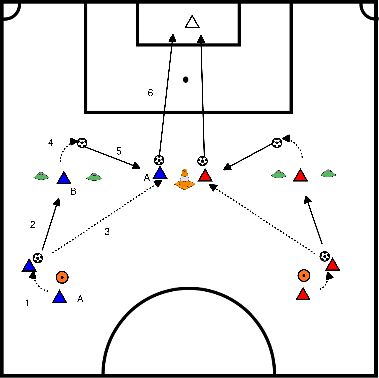
First left, then right, or both sides at once if enough players.
Encourage left to use left foot, right to use right foot.
Encourage left to use left foot, right to use right foot.
1. Player A turns open to outside behind opponent out.
2. Player A passes forward to player B between cones.
3. Player A runs diagonally to cone in front of goal.
4. At the same time, player B caps/turns out of the cones toward the goal line.
5. Player B passes diagonally behind to player A who meanwhile is standing at the cone.
6. Player A shoots at goal.
7. Player A becomes Player B, Player B joins the starting position.
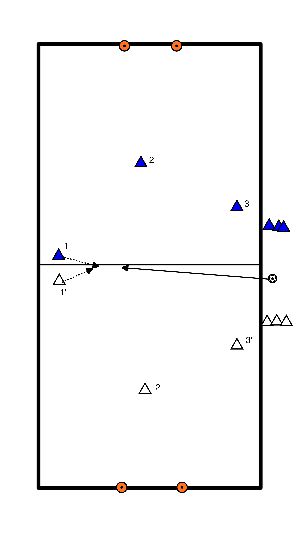
- Passing the ball "badly" to players 1, 1'
- Players 1, 1' must come to the ball and duel
- Winner of the duel plays the ball to a teammate
- Continue playing until ball outside, goal or 1 min
- Players shift through ( 1 --> row, 2 --> 1, 3 --> 2, row --> 3)
Points of attention:
- Call when ball leaves
- Place the body between the ball and the opponent
- Switching between offense <-> defense
- Players 1,3 stay in the right zone
- Player 2 stays between ball and goal
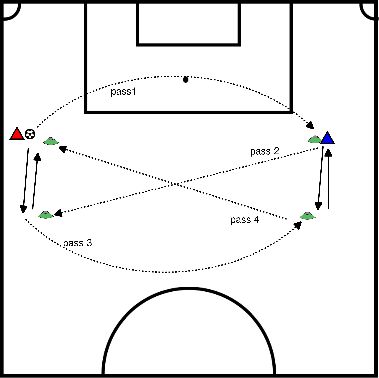
- Long pass straight through ground or air from player A Red to player B Blue.
- Player A runs to hat on the short side.
- Player B takes the ball cleanly and gives cross pass to player A.
- Player B runs to hat on the short side.
- Player A takes the ball cleanly & passes straight through ground or air to player B.
Repeat 4 x pass straight through from player A & 4 x cross from player B.
Then repeat but change player A cross and player B straight through.
Then repeat but change player A cross and player B straight through.
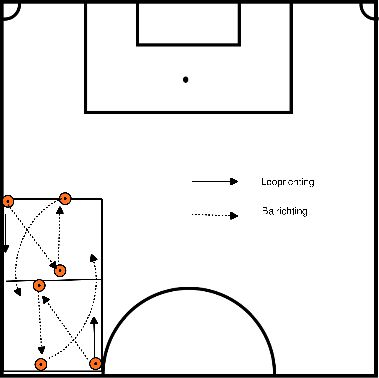
- The upcoming player (O) starts with the ball and plays it to the striker (S).
- The striker gives the ball back to the midfielder (M), who then gives the ball to the up-and-coming player.
- The intention is for the up-and-coming player to sprint the running action.
- It is all about the right timing.
- The up-and-coming player must keep a close eye on the bounce between striker and midfielder and judge when to give the ball deep.
- Starting too early would mean running offside.
- Starting too late would mean that the ball is intercepted by a defender.
- Running too slowly would mean being overtaken by a defender.
- The emerging player eventually plays with the ball to the emerging player on the other side and becomes the midfielder there.
- The midfielder becomes the striker, the striker becomes the emerging player
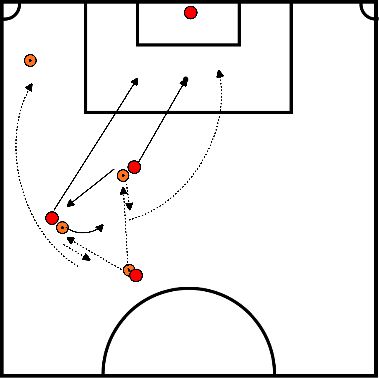
- In this practice form, two variants are completed.
- The team standing on the left plays against the team standing on the right.
- Always swap sides so players practice on both sides and with both legs.
- The deepest player is played in and drops the ball to the third man who finishes.
- The deepest player then gets directly into the ball and rebounds, after which the ball is played to the flank.
- The flank player can take the ball inside once to enter half space and must hit the low cross.
- Addition in the form is a defender of the opposing team may defend along with the low cross (2vs1).
SCORING SCORING (1) - YouTube
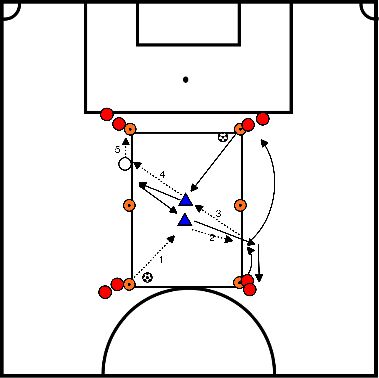
- Exercise to encourage pass running and movement in the field.
- The player on the bottom left plays in to the central player, the central player plays in to player 2 who left from the bottom right.
- The player on the lower left departs at the same time.
- Player 2 rebounds the ball to the 2nd central player and he dribbles to the top left.
- You do the same from the top right downwards!
Tiqui Taca One Touch Soccer | 6-Cone Drill with 2 Balls - YouTube
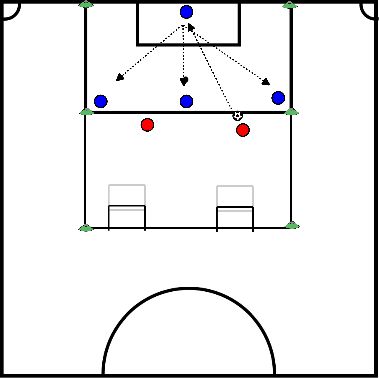
- In this form you play 2 attacker vs 3 defender with goalkeeper.
- The goal of the task is to have the goalkeeper play the ball into one of the 3 defenders.
- The ball starts with the 2 attackers.
- They play the ball equally deep to the goalkeeper to have a realistic start.
- From then on it starts.
- The goalkeeper can catch the ball, take it etc.
- The three defenders must constantly be on the ball.
- The goalkeeper tries to get the ball to one of the three defenders.
- From then on you get a 3 vs 2 situation.
- The attackers' task is to block as early as possible to make the build-up by the defenders difficult.
- With more than 6 players, you could also have an attacker and a defender come in when the defenders are played in.
- Then it becomes 4 vs 3.